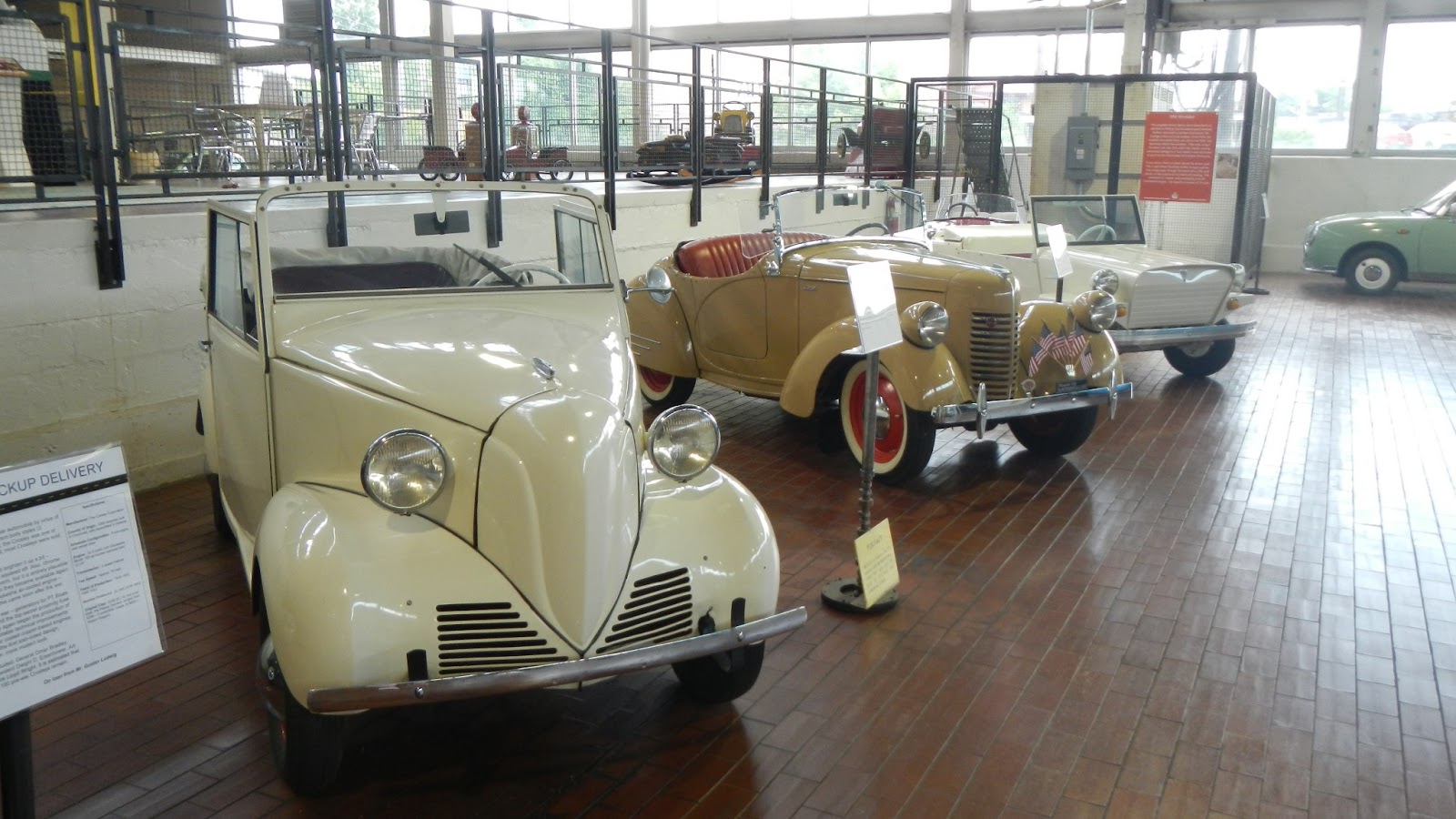
Monday, July 22, 2013

Automobiles, Motorcycles and More! (Part 2)

OK… It’s time for part 2 of our review of some of the ugly, beautiful, weird, rare and exotic motor vehicles that we photographed during our recent visit to Nashville Tennessee.


We’re continuing our photographic exploration of the many vehicles on display at the Lane Motor Museum.  FYI… The Lane Motor Museum is open 7 days a week.  Admission is very reasonable.  It’s $9.00 for adults, $6.00 for seniors and only $3.00 for youth who are age 17 or younger.

Laurie took this photo of Dawn Marie and I standing beside my new ‘dream car’!  This microcar is a 1959 Mikrus MR-300.  ‘Mikrus’ is Polish and it means “Little Tyke” or “Midget”.  I can’t even imagine trying to leverage myself into or out of this tiny little car!  The Mikrus was built in Poland from 1958 until 1960. 
The cars were produced in an old MiG-15 fighter jet plant.  Management was faced with the prospect of laying-off their skilled workforce…and they built many different products in an effort to avoid the layoffs in what was then a state run socialist economy. 
The Mikrus has a 4-speed transmission and a 2-cylinder engine which produces a whopping 14 HP!  Top speed is 56 MPH…but, on the bright side, it gets 47 MPG… Only 1,728 were ever built.  Note: In 1959 the Mikrus cost 50 times the average annual Polish workers salary!

This beautiful automobile is a 1935 Adler Trumpf Jr.  This sporty German car was in production from 1934 until 1941.  A total of 102,840 were built.  It had a 4-cylinder engine that produced 30 HP and its top speed was 60 MPH. The Trumpf Jr. has front wheel drive, all-round independent suspension and an all-steel body.
In 1880, Heinrich Kleyer founded a bicycle business and by 1900 he moved to automobiles. FYI…Adler means “Eagle”.  By 1928 Adler employed 6,000 and was making 60 cars a day, in addition to commercial vehicles and bicycles. The company was Germany’s third largest car maker after Opel and BMW. The Trumpf was introduced in 1932, and it became the best known Adler automobile. The Trumpf Jr. is a smaller version of the Trumpf. Passenger car production for Adler ended with the onset of WWII.  During the war the factory produced staff cars and ambulances. When the facilities were rebuilt after the war, they manufactured typewriters and motorcycles.
For more information re: some interesting and truly beautiful Adler automobiles…including photos of one that looks much like an early VW Beetle… just go to  http://en.wikipedia.org/wiki/Adler_(automobile).

I warned you that some of the motor vehicles at Lane Motor Museum were weird and exotic!  This is a 1948 Davis Divan.  This 3-wheeled car was built by the Davis Motorcar Co. in Van Nuys California.  Three prototypes were developed as well as a military version.  These autos were powered by a 4-cylinder engine and they could reach speeds of 116 MPH.  The Davis Divan had been projected to sell for $1,400 each…
Glenn Gordan “Gary” Davis was an industrial designer and salesman. At the end of World War II, he bought a small racecar that had been converted to a 3-wheeler–thinking it would make a practical economy car.  That vehicle was likely the first Davis prototype. The Davis Divan was presented as an advanced, aircraft-inspired, high-technology car.  Only 16 operating versions were built. (2 prototypes, 11 Divans, and 3 military jeeps) The Divan is 15½ feet long, a massive vehicle by 3-wheeled standards. It’s wide enough for four people to be seated side-by-side on the single bench seat.  Davis sold franchises around the country but he never began production.  He was eventually prosecuted for fraud and went to prison.   The prototype cars were not sold but rather given to creditors.
To see a photo of another Davis Divan as well as one of the prototype jeeps, just go to this photo from National Automotive and Truck museum in Auburn Indiana: http://en.wikipedia.org/wiki/File:Davis_Model_494,_NATMUS,_May_2011.jpg.

Here is another weird and wonderful automobile in the Lane Museum’s collection!  This is the 1946 Hewson Rocket.  It was built in Hollywood California by a company…and former body shop…named Coachcraft, Ltd.  The Rocket used a flathead Ford V-8 that was capable of producing 85 HP and speeds of 90 MPH.  This one-of-a-kind prototype cost $16,000 to build.
Coachcraft, Ltd. was founded in 1940 and the owners began building custom auto bodies for movie stars and wealthy Californians. (To view some of those custom cars, you can go to http://www.coachbuilt.com/bui/c/coachcraft/coachcraft.htm)
In 1945, William Hewson raised capital to form the Hewson Pacific Corp. He planned to produce the “Hewson Rocket” and sell it for $1,000.  The team at Coachcraft fabricated the body shape and welded the aluminum panels together. Hewson’s idea was to give the car a very aerodynamic shape with no projections anywhere–headlights covered with glass, tail-light lenses flush, and no outside door handles.  Unhappily, Hewson’s capital was depleted by the time the car’s body was finished.  Coachcraft kept the car in their front showroom until it was auctioned off in 1959 to a used car dealer in Minneapolis for $650.

Yes, as advertised in the blog’s title, the Lane Motor Museum also has a fair number of motorcycles in their collection.  Most of them are on display in this long corridor. 
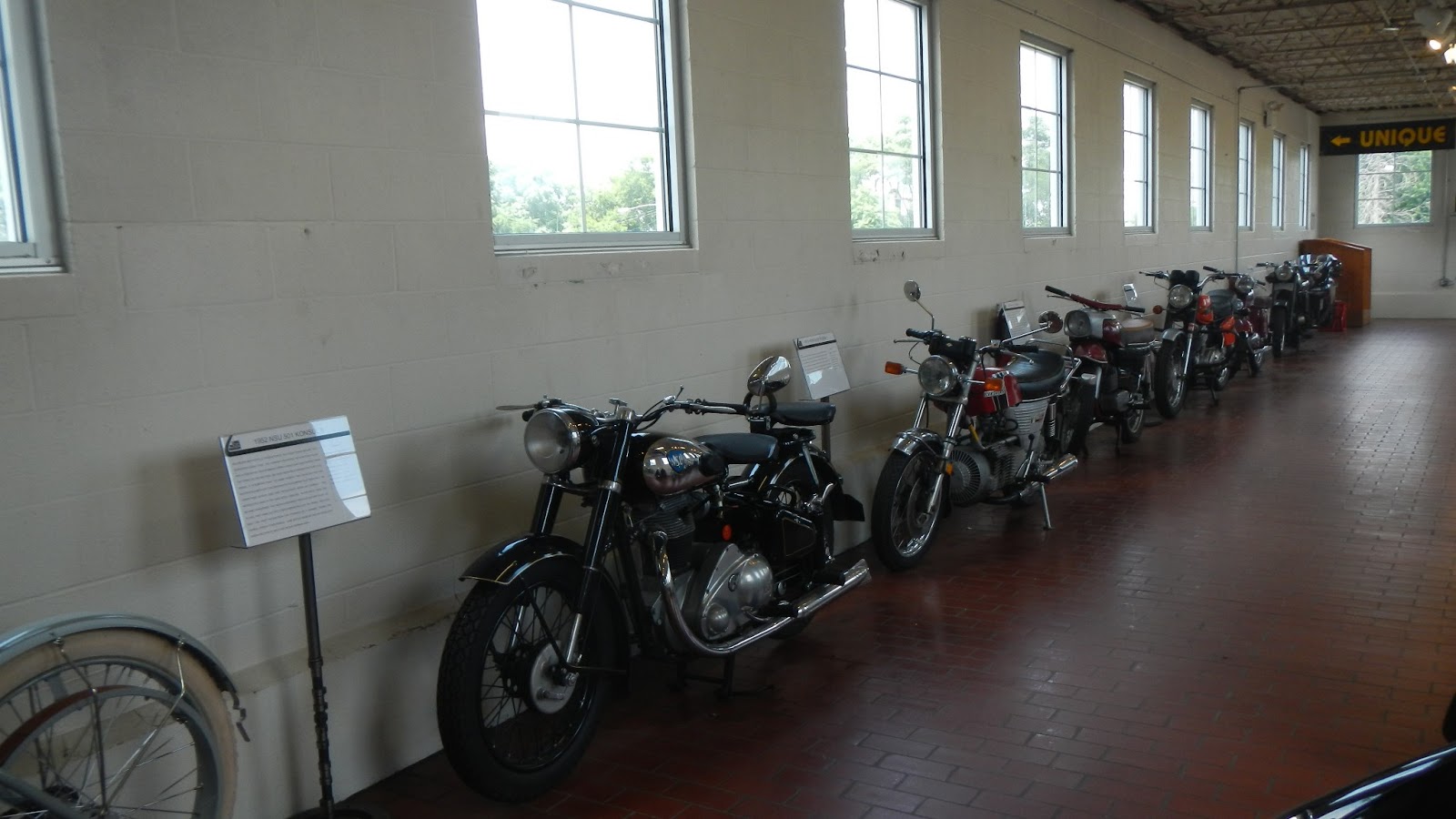
In total, the Lane Motor Museum’s website lists 31 motorcycles and motor scooters in their collection.  I suspect that the actual total is a bit higher…as I noted at least one car from the few photos that Laurie took that wasn’t listed in their website’s ‘auto inventory’.
Models represented in this collection include: Aprilia; BFG; BMW; Carabela; Fuji; Gas Gas; Hercules; Honda; IZH; Jawa; Kamasura; Kawasaki; MBK; McLean; NSU; Salsbury; Schwinn Whizzer; Sears Allstate; Sinclair; Suzuki; Velosolex; Vespa; Wind Wagon; Yamaha, and; Zundapp.

As the box in the photo above indicates, this is a folding and portable “Yike Bike”.  This is a 2011 version.  It’s an electric bicycle with a carbon version that weighs about 25 lbs., has a range of 6 miles and a top speed of 15 MPH.  It comes with headlights, a tail light and turn signals.  As you might note, the seating and steering arrangement is a bit unusual.
The “Yike Bike” was invented in and is manufactured in Christchurch New Zealand.  The carbon version sells for about $5,000 NZ…or just a little under $4,000 US.  Of course there are shipping costs and other add-ons that can drive up the price.  There are several dealerships for the “Yike Bike” in the USA.  These include: Seattle, Portland, San Diego, Miami, Houston, Mt. Dora FL, Walnut Creek CA and, strangely enough at least to me, McAllen TX.  To see a demo of the “Yike Bike” and to learn more about this new ‘ride’, just go to http://www.yikebike.com/.

This crazy looking ride is also found in the Lane Motor Museum’s ‘hall of motorcycles’.  This is a 2007 Snow Hawk Jr. X120.  This fusion of a motorcycle and snowmobile only weighs 120 lbs.  It has a single cylinder, 2-stroke 16 HP engine that can propel this machine at speeds up to 40 MPH.  Can you believe that its intended market was for kids…aged 5 – 10 years old!  The good news is that the Snow Hawk Jr. 'only' cost $2,500.00…
It appears that the Snow Hawk Jr. is currently off the market although the manufacturer still holds the rights to the design.  The original Snow Hawk for adults can still be purchased through another company…for only $16,000+!  If you’d like more information, you can go to AD Boivin’s website (Quebec Canada) http://www.adboivin.com/en/home-adboivin.aspx.
That’s about it for Part 2 of our tour of Lane Motor Museum’s collection of European, American, exotic, weird and beautiful methods of transportation.
Just click on any of the photos to enlarge them…
Thanks for stopping by and continuing the tour with us!
Take Care, Big Daddy Dave


Friday, July 19, 2013

A Taste of Italian Cuisine – Nashville TN

It had been a busy day… First there was the tour at Fontanel, then the Lane Motor Museum and finally, the Backstage Tour at the Grand Ole Opry.  Dawn Marie made reservations for us via 'Open Table' and, after driving around the area for a bit, we headed off for dinner. 


'Amerigo An Italian Restaurant' was one of the several dinner dining possibilities that I’d researched and vetted via Trip Advisor.  It had been reviewed many times and it scored a ratio of 120 excellent/very good to only 7 poor/terrible.  That’s a very nice food satisfaction risk ratio…
Amerigo in Nashville is one of 4 locations with that name that together comprise a small restaurant chain… Other locations are in Brentwood Tennessee, Memphis Tennessee and Jackson Mississippi.

The interior of the restaurant was warm and inviting and there was enough space between tables that we didn’t feel crowded. 

Our waiter started us out with some nice focaccia bread with some dipping oil. 

For an appetizer, we chose the Cheese Fritters. ($9.50) This dish has been featured in ‘Bon Appétit’ magazine and it consists of blended cheeses, fried and served with both marinara and honey mustard sauces.  This was an excellent appetizer!
Other appetizers of interest included the Bruschetta Amerigo, (grilled focaccia bread and melted mozzarella cheese topped with balsamic roasted grape tomatoes, Kalamata olives, garlic and basil - $9.00); Tuscan Crab Cakes, (jumbo lump crab, with baby greens, white bean salsa and lemon basil butter sauce - $13.00), and; Prince Edward Island Mussels, (mussels in garlic wine broth, with diced tomatoes, capers and grilled focaccia - $12.50)

Laurie and Dawn had dinner salads as a side, both with balsamic dressing.  They were good if not special, but one doesn’t expect a side salad to be anything other than a nice salad. 

I went one step further and ordered a side Caesar Salad with my dinner. ($4.00) It was OK…but it lacked any real definitive flavor other than the generous helping of cheese…

Our table at Amerigo’s was by the window.  Timing is everything!  It hadn’t rained on us all day…although it threatened at times.  It didn’t rain as we entered the restaurant and by the time we were done with dinner, it had stopped raining.  In the meantime, it really poured down!

For her entrée, Dawn ordered the evening’s pasta special.  This is the Noble Farms Goat Cheese Pasta with Bacon. ($16.00) While the presentation left a little to be desired, she seemed to enjoy her dinner. 

I ordered the Fettuccine Imperial with grilled chicken and pancetta (without the mushrooms) in Parmesan cheese cream sauce. ($12.50) While it wasn’t great it was just fine.  I should have ordered Amerigo’s Cannelloni Al Forno…fresh egg pasta stuffed with roasted chicken, ricotta cheese, spinach, fresh herbs and Parmesan cheese, then topped with fresh mozzarella and served with tomato and cream sauces. ($14.00)

Laurie just didn’t feel like pasta… So she ordered the Cedar Wood Roasted Fish of the Day.  In this instant the fresh fish of the day was sea bass. ($26.00) Her fish was roasted on cedar wood with blended Asiago cheese, leek potatoes and roasted vegetables.  Laurie gave this entrée Two Thumbs Up!  The presentation was very classy, she really liked the fish and potatoes, plus she loved the roasted vegetables…but she couldn't finish it all.
All in all, ‘Amerigo’s – An Italian Restaurant’ was a positive dining experience.  Service was satisfactory and pleasant.  The food ranged from good to excellent.  Parking is free and there is a guard in the parking lot.  This Amerigo’s restaurant is located at 1920 West End Avenue in Nashville Tennessee.  Phone: 615-320-1740.  Website: http://www.amerigo.net/.
Just click on any of the photographs if you’d like to enlarge them…
Thanks for stopping by to check out another restaurant review!
Take Care, Big Daddy Dave

Wednesday, July 17, 2013

The Grand Ole Opry – Nashville Tennessee

For our third tourist experience of the day, we decided to immerse ourselves in a true Nashville ‘country’ experience!  I’d booked a reservation for us for a late afternoon backstage tour of The Grand Ole Opry…


The Grand Ole Opry isn’t actually a building, but rather it’s a weekly country music stage concert and radio show based in Nashville, Tennessee.  The show is among the longest-running radio broadcasts in history and, ever since 1925, it has featured the biggest stars in country music.  The Opry showcases a mix of legends and contemporary performers who play country, bluegrass, folk, gospel, and who give comedic performances.  The Grand Ole Opry is "the show that made country music famous". 

Not to say that there isn’t a building involved… This is the current Grand Ole Opry ‘House’.  In 1974, this building became the 7th home for the Grand Ole Opry since it was founded.   From 1943 until 1974, the Ryman Auditorium was the home of the Opry.  The current home of the Opry is nine miles east of downtown Nashville on a new site that was originally part of the ‘Opryland USA theme park’.  On opening night in 1974, President Nixon played a few songs on the piano.
While the theme park was closed in 1997 and replaced by the huge and very busy Opry Mills outlet mall, the Opry House itself was left intact and incorporated into the new development.  Currently the Opry plays several times a week at the Grand Ole Opry House…except for an annual winter run at the Ryman.

This is the stage at The Grand Ole Opry House.  The auditorium seats 4,400 people.  In the spring of 2010, the Opry House was closed for repairs after record amounts of rain sent water from the Cumberland River 2 feet above this stage, damaging instruments, memorabilia and archival tapes.  Because of the flooding, the Ryman Auditorium once again became the primary venue for the Grand Ole Opry.  The restored Opry House reopened on September 28, 2010.
As we began our backstage tour of the Grand Ole Opry House, this was our first stop.  Our guide provided an introduction and a video orientation by country music superstar Blake Shelton, told us what we might expect.  We were about to walk in the footsteps of country music's superstars and get an close-up look at what happens behind the scenes of the show that made country music famous!

Yes, there is a ‘post office’ at the Grand Ole Opry House… Each living member of the Grand Old Opry has a mail box here… Mail is delivered and when members pay a visit, they pick up their mail.  In general, the mail slots at the top belong to those who have been members of the Opry the longest. An exception is 92 year old Little Jimmy Dickens, a member of the Opry since 1948…who at 4’ 11’’ couldn’t reach one of the higher mail boxes.
Information about Little Jimmy Dickens can be found at: http://en.wikipedia.org/wiki/Little_Jimmy_Dickens.   
The mail boxes are located adjacent to the desk where the stars check in for their appearances.  Once again Blake Shelton addressed our tour group via video.  He spoke about the importance of and the emotional impact on those country stars who are invited to join the Opry.  Yes, one has to be invited to become a member of the Opry.  Many performers actually participate in the live radio shows, (with an audience in the auditorium), but only a limited number are actually ‘made’ members of the Opry.  Some recent inductees have included Blake Shelton, Keith Urban and Carrie Underwood. 

A wall across from the performer’s reception desk is festooned with plaques like the ones shown above.  There is a name plaque for every past and present member of the Grand Ole Opry.  To check out the membership roster, you can go to: http://en.wikipedia.org/wiki/Category:Grand_Ole_Opry_members.
There is no such thing as a ‘passive member’ of the Grand Ole Opry.  In April 1963 Opry management established a rule that members had to perform on at least 26 shows a year to maintain an ‘active’ status.  In 2000, the minimum number of Opry performances was at 12.  While the minimum number of required performances has decreased, artists who are offered membership are expected to show a dedication to the Opry with frequent attendance.

Part of the backstage tour included a look into several of the stars dressing rooms.  Most of them are dedicated to a specific star or theme…and they range from feminine to almost hard rock in their appearance.  There are a total of 18 dressing rooms.

This is another one of the dressing rooms…but this one has a little ‘edge’ as regards its décor. 
I checked to see just which performers would be occupying the dressing rooms in the upcoming weeks.  With at least 150 shows a year, there is no shortage of star power…from old timers to current stars.  Some of the names I recognized include Jennie Seely, Riders in the Sky, Mel Tillis, Larry Gatlin, Charlie Daniels, Vince Gill and Lorrie Morgan.

Backstage daytime tours all end on the stage…with guests looking out over the traditional ‘church pew’ seating.  By way of explanation, the Ryman Auditorium also had church pew seating as it was the Union Gospel Tabernacle before it became The Grand Ole Opry.  The Ryman is still referred to as the “Mother Church of Country Music”.

When tours come out on the stage, each couple or group is posed on this "special circle of wood".  Photos are taken and when the tour ends, everyone has a chance to purchase the photos.  We posed but I don’t know what happened to our photos… In any case, we didn’t buy ours.    
When the new Opry opened in 1974, this six-foot circle of oak was cut from the original stage at the Ryman and then it was inlaid into the stage in this new venue.  This is the spot where the stars stand when they come out on stage to give their performance.  Apparently, standing on this spot is a very emotional experience for those involved! 


Dawn Marie couldn’t resist the opportunity to ham it up with one of the microphones on stage!  Fortunately, the mike wasn’t open…

There was one last stop on the tour…before being routed through the gift shop on our way out.  The spangled dress, flashy guitar and gold records are all part of a vignette that’s set up on Studio A.  It displays items for the current TV show, ‘Nashville’.  The dress was worn by actress Hayden Panettiere, who plays singer Juliette Barnes in the series.  This was also the Studio where the famous long running 'HEE HAW' television show was staged.

These are our guides for this backstage tour.  They were casual, knowledgeable and personable.  Stacy was our primary guide throughout… As I noted in my blog about our tour of Fontanel, the tour guide is the key to an enjoyable experience.
We are not particularly star struck…and while we enjoy country music, we are not dedicated fans who know all of the songs and performers.  Even so, this tour was an interesting and enjoyable experience.  The price for adults is $19.00…and people were lined up for the tours.  A new tour starts every 15 minutes and there are 25 – 35 people in each tour group. 
The Grand Ole Opry is located at 2806 Opryland Drive in Nashville.  There are regular shows as well as 3 different types of tours.  It is recommended that tickets be purchased in advance.  The very best seats for the shows themselves are $57.00.   For more about the Opry and upcoming shows, go to http://www.opry.com/.
Just click on any of the photos to enlarge them…
Thanks for stopping by and joining our tour group!
Take Care, Big Daddy Dave

Monday, July 15, 2013

Automobiles, Motorcycles and More! (Part I)

OK…Laurie, Dawn Marie and I were in Nashville Tennessee for the weekend and we’d finished the tour of Barbara Mandrell’s former home, (Fontanel), and we had time to fill before our next big tourist gig in the home of country music.  Fortunately we had our GPS and my list of tourist attractions that might fit our needs…

This is the exterior of the Lane Motor Museum in Nashville Tennessee.  In 2002, Jeff Lane and his wife Susan established Lane Motor Museum.  Jeff has been an automotive enthusiast since an early age. He began restoring his first car—a 1955 MG TF—when he was a teen.  His personal 80 car collection was the donation that began the foundation. Lane Motor Museum unveiled its collection to the public in October of 2003.  As Director, Jeff continues to search out cars for the collection that are technically significant or uniquely different. The goal of Lane Motor Museum is to share in the mission of collection and preserving automotive history for future generations.
Lane Motor Museum is one of the few museums in the U.S. to specialize in European cars, although as you’ll see, about 10% of the cars are American in origin.  Most of those are truly unknown to most auto enthusiasts. This is a working museum which has the goal of maintaining all vehicles in running order. Some cars are in showroom condition, while others represent typical aging. Efforts are made to restore each vehicle to near-original specifications.

This is an overview of part of the main display area of the museum.  The building was the former Sunbeam Bakery.  It was home to the bread company beginning in 1951 and this 132,000 square-foot facility was the largest and most modern bakery in the area when it opened.  The bakery building has been refitted for the museum’s needs but many of its original characteristics remain…the high ceiling, lots of natural light, as well as the hand-crafted brick and maple wood flooring. The architectural style complements the age of the cars represented.
To learn more about Jeff and Susan Lane as well and their passion for auto or motor vehicle collecting, just go to: http://www.hemmings.com/hcc/stories/2006/11/01/hmn_feature21.html.
There will be four (4) blogs in the next 2 or 3 weeks related to this collection of motor vehicles.  We’ll start with a few relatively ‘mundane’ autos and then we’ll step on the accelerator and check out some very unusual and rare vehicles…

The first car in this line is a 1939 Crosley Transferable.  Powell Crosley, Jr. was well known for producing radios and Shelvador Refrigerators.  But he had a passion for cars and he believed that the American public was ready for a small economy car.  The Crosley Motor Company, (Indiana), built cars off and on from 1939 until 1952.  This model cost $365.00 and was initially sold in appliance and hardware stores. Only 267 autos of this model were ever built.  It had a 12 HP, 2-cylinder motor that would produce a top speed of 50 MPH.
The list of well-known Crosley owners is extensive and wildly varied.  It ranges from Boy George to Frank Lloyd Wright.  There is a Crosley club for owners… To learn more about Crosley automobiles you can go to: http://en.wikipedia.org/wiki/Crosley.   

The vast majority of the vehicles in Lane Motors Museum’s collection are from Europe, but there is a sprinkling of unusual American autos in the collection.  This is a 1940 American Bantam Roadster.  With roots based on the English Austin 7, the American Bantam Car Company was preceded by the American Austin Car Company which went out of business in the mid-1930’s.
This handsome looking Bantam Roadster was produced in Butler Pennsylvania from 1938 until 1940.  It had a 20 HP, 4-cylinder motor which produced a top speed of 50 MPH.  A total of 6,000 of these cars were built.  The cost of this car was $479.00.  The 50th Annual American Austin-Bantam Club’s National Meeting will be held in Butler from 7/29/13 – 8/1/13.
Note: The American Bantam Car Company pioneered the first versions of the jeep and they build 2,500 + before the government awarded the wartime contract to larger manufacturers who could build the vehicles in massive quantities.  For more information of this company, go to: http://en.wikipedia.org/wiki/American_Austin_Car_Company.

This is a 1958 Vespa 400…a Vespa mind you…and although it’s small, it's not a motor scooter!  Of course Vespa is known around the world for its scooters, but the company also produced one economy car.  The company’s president felt that FIAT’s prominence in Italy should not be challenged, so the Vespa 400 was produced in France.
This four passenger coupe had a roll top roof, all-independent coil spring suspension, and hydraulic brakes. This car is in a totally different class from most other microcars.  The Vespa handles like a sports car and it did well in rallies, often winning the 500cc class. A few thousand of these cars were sold in the United States in the late 1950s and early 1960s–selling for about $500 less than a Volkswagen Beetle.  The Vespa 400 sold relatively well throughout the world, with 34,000 sold, (original cost $1,080), but production was cancelled in 1961 to concentrate on building motor scooters.
For more information on the Vespa 400, especially here in the USA, go to: http://www.hemmings.com/hmn/stories/2008/08/01/hmn_feature33.html.

This is a 1971 Citroen 2CV AK250.  The 2CV “Fourgonnette”, (or Truckette), played an important a part of the basic Citroen 2CV auto history.  Ultimately, over a million examples of this vehicle were built, which accounted for nearly a third of the total 2CV production. It was first shown to the public at the 1950 Paris Motor Show.
Shopkeepers, tradesmen, and farmers made an easy transition to the Truckette from the pure auto version.  The mechanical elements of the 2CV were used as the basis for this small truck. It was ideal for the streets of urban cities where parking is tight and commercial vehicles are taxed by size. This particular 28 HP Truckette was originally used by the Belgian Postal Service to deliver mail.
For me at least, it’s very interesting to note the big design differences between European and American automobiles and trucks…

This is a 1991 Nissan Figaro… This car was designed for a limited production run just for the Japanese market.  The retro-styled Figaro was intended to provide “delicate elegance” and “trendy sophistication”…”satisfying a zestful desire for a good time”.  Yes, it was named after Mozart’s comic opera, “The Marriage of Figaro”.
As it turned out, the Figaro was wildly popular.  Originally a run of only 8,000 cars was planned…but it was quickly increased to 20,000 units.  Buyers had to enter a lottery and have their names drawn in order to buy a Figaro.  Some of the design features of this 78 HP, $13,651 car mimic 1950’s Italian designs…

This is a 1967 Morris Mini-Traveler… Morris Motor Company was started in Britain in the 1920’s and the company established a reputation for reliable family cars.  In the 1950’s, Morris merged with its old rival Austin to form British Motor Corporation.  
Mid-1950’s economics in the United Kingdom made the creation of a quality miniature car a priority.  A Greek immigrant with an extensive racing and engineering background led the design team.  The original Mini was introduced in 1959, to great acclaim.  Its popularity spawned many models that targeted different markets. The Mini Traveller, a two door station wagon with double “barn-door” style rear doors, was designed for carrying. The luxury model shown above has wood inserts in the rear.  The Traveller model was built from 1961 to 1969.  This left-hand drive 45 HP Mini was designed for export and was originally delivered to a dealer in Portugal. It remained in Europe until 2002.
Laurie and I have special memories of Morris Minor Autos…as both of our families owned one as we were growing up.  We weren’t the only ones…there is an active Morris Minor Club for North American owners.  Check it out at: http://morrisminor.intuitwebsites.com/services.html.
Three more blogs covering The Lane Motors Museum’s collection are coming soon…and the vehicles will become increasingly rare and exotic!
Just click on any of the photos to enlarge them…
Thanks for stopping by for this museum tour!
Take Care, Big Daddy Dave

Friday, July 12, 2013

Burgers and ‘Wurst’ Too!

It was Saturday and we’d just finished our tour of ‘Fontanel’ in Nashville. (See previous blog) It was time for lunch and, as usual for our road trips, I’d done a bit of research seeking likely places for us to eat… We like casual and places that are a bit quirky are a plus!


The Pharmacy Burger Parlor and Beer Garden was voted to be the best new restaurant in Nashville in 2012…a True Original.  This photo doesn’t show it but the Pharmacy was really busy!  As per Trip Advisor, this burger joint is ranked #46 out of 1,474 restaurants in Nashville. Not too bad for a ‘joint’, which I place one level above a ‘dive’.  Neither term detracts from the food in these types of restaurant!  Trip Advisor totals to date are 112 votes excellent/very good vs. 10 votes poor/terrible.  I liked the odds!

Sorry about this fuzzy photo of the interior.  We’re still learning the foibles of our new camera…and it may be a while before we get it down pat!
However, the photo supports my opinion that this is a ‘joint’, albeit a very popular and successful joint!  We had to wait some 20 minutes before we could procure an inside table.  I don’t really like outside dining…re: heat and flies.

Here’s a photo of the biergarten/beer garden aka the outdoor dining area.  It is an expansive area.  For those of you that really enjoy different beers, this would be a great place to sit back and quaff a few.  The selection includes 30 American Craft Beers plus 14 from Germany, 5 from England, 2 from Canada, 2 from Belgium and one each from France, Czech Republic, Spain, Japan, Scotland and Italy. (59 choices!)

Laurie and I opted for some non-alcoholic Sprecher Root Beer.  It was very refreshing and a lot different from the usual grocery store variety.
Other Pharmacy Soda Shop options include phosphates, a selection of special sodas such as Creamsicle and Egg Cream, plus a nice selection of floats, milk shakes and malts.

If you remember the title of this particular blog, it included the word ‘wurst’.  That’s because, in addition to the burgers, The Pharmacy does bratwurst, jagerwurst, currywurst, bauernwurst, kielbasa, bockwurst and a combo Biergarten Platter. ($13.00)
For Laurie’s lunch, she ordered the bauernwurst. (pork and beef garlic wurst with marjoram and onion) It came with sauerkraut and spicy stoneground mustard.  For her side, Laurie had the German Potato Salad.  Unfortunately, she didn’t care for her lunch… The sausage was dry, (perhaps overcooked), there was way too much bun for the meat, the German Potato Salad was runny…and she didn’t like it's texture.

Both Dawn Marie and I ordered the Cheese Burger. ($8.50) This very large hand formed burger was topped with cheddar, Swiss and Muenster cheese, melted with tomato and roasted garlic aioli.  The French Fries were OK if not great…but the hamburger made it into my Top 10 all-time hamburgers! Now that I think about it, I’m not sure that I can even remember my top 10 burgers but this was a good one for sure… The buns are specially made for The Pharmacy and they held up very nicely with the juicy burger (medium rare) and all that cheese.  The garlic aioli was an extra plus!
We would recommend the Pharmacy for its burgers, soda fountain and beer selection.  I only wish that we had a burger of this quality in the Knoxville area.  The pharmacy is located at 731 Mcferrin Avenue in Nashville Tennessee.  Phone: 615-712-9517.  Website: http://thepharmacynashville.com/. To check out the customer reviews on Trip Advisor, just go to: http://www.tripadvisor.com/Restaurant_Review-g55229-d3135509-Reviews-The_Pharmacy_Burger_Parlor_Beer_Garden-Nashville_Tennessee.html.
Just click on any of the photos to enlarge them…
Thanks for stopping by and sharing lunch with us!
Take Care, Big Daddy Dave