Friday, September 27, 2013

Heritage Park – Calgary Alberta, Canada (#4)

This is the ‘final’ chapter illustrating and commenting on our all day adventure at Calgary Alberta’s Heritage Park Historical Village.  Note: There will be additional blogs related to this visit… They will include 3 or more blogs about our visit to the adjacent Gasoline Alley Museum and there will be one that focuses on railroad/rail travel as portrayed in the Park.

Now onto our last visit to the historic village itself!

This Case Steam Farm Tractor is parked right next to the 1909 Shonts Grain Elevator on the edge of the 1910 Village.  Note the distinctive eagle emblem on the front of this tractor.  J. I. Case introduced the eagle logo for the first time in 1865.  It was based on ‘Old Abe’, a Wisconsin Civil War Regiment's mascot.
The Case Corporation of Racine Wisconsin was founded in 1843 by Jerome I. Case.  It was originally named the J.I. Case Threshing Machine Company.  By 1891 the Case Company produced portable steam engines to power the threshing machines, and later went into the steam traction engine business.  By the start of the 20th century, Case was the most prolific North American builder of engines.  They ranged from a diminutive 9 HP up to a few massive 150 HP units. 
170 years later, Case is still in business…a part of CNH, (Case/New Holland), a world-wide company based in the Netherlands that is majority owned by Fiat Industrial.  The Racine Wisconsin plant is still operating.  To learn more about J.I. Case and his company, you can just go to http://en.wikipedia.org/wiki/Case_Corporation.

Draft horses are in use throughout the village.  Wherever they stop, people flock to them…just to pet and talk to them.  These horses are very patient with their human admirers and they apparently love the attention…

This is one of the streets that intersect with the 1910 Historic Village’s Main Street.  From left to right, we have Gledhill’s 1908 Drugstore, the Botsford 1906 Harness Shop, Black’s ca. 1904 Jewelry Shop, Claresholm’s ca. 1905 General Store and the 1910 Vulcan Ice Cream Parlor and Rotary Historical Hall.
The Jewelry Store is a recreation of the original but the Harness Shop, General Store, Drug Store and the Ice Cream Parlor are all original buildings that have been moved to the Park.
As an example, establishments such as the Botsford Harness Shop were always one of the first businesses to open in the newly settled villages on the Canadian Prairies.  Everybody needed tack for their horses or oxen, and saddles, yokes, horse collars and harnesses were always in high demand.  Botsford also repaired shoes, sold hardware and mended canvas, often before an audience of the town's children. The Municipal District of Rockyview No. 44 sold the building to Heritage Park for the nominal sum of one dollar in 1965.

Here’s another great example of an ‘old’ truck helping to visually set the scenario for the Park’s visitors while actually serving as a working vehicle for the Park’s staff…

As you can see, this is the Conklin Lakeview Amusements Park within the Heritage Park.  This attraction is adjacent to the 1910 Village Center…
Attractions in the 'Amusements Park' include the Baby Eli Wheel, a 12-passenger Ferris wheel specifically built for young children.  It was built by the Eli Bridge Company of Jacksonville, Illinois which began manufacturing Baby Eli wheels in 1923.  Other amusement park attractions include a 1904 Bowness Carousel, a ca. 1920’s Children’s Boat Swing, a 1920 German Dangler Swing and a 1923 Big Eli Ferris wheel.  For more on the Eli Bridge Company and its various products, go to http://www.elibridge.com/.

This is the Eugene Coste Park, which sits adjacent to the 1910 Village and the Conklin Lakeview Amusements Park.  Eugene Coste is known as the man who brought natural gas to Calgary back in 1912.  At the time, it was the longest natural gas pipeline in the world. 
Through the arch you can see the Celebration Tent, (used for weddings and other functions); the Chautauqua Tent, and; a replica of the 1914 Dingman No.1 Discovery Well.  The gasoline from the oil that was pumped from this first Alberta well was so pure that it didn’t require refining.
FYI…The name Chautauqua comes from Lake Chautauqua, New York, where a summer school was originally held for Sunday-school teachers beginning in 1873. After the classes expanded from religious studies to include arts, sciences and the humanities, the Chautauqua name soon came to be known as a travelling road show intended to educate as well as entertain.  ‘Chautauqua’ was extremely popular with the culture-starved prairie dwellers of Western Canada, with shows touring between 1917 and 1933.

This is the Sandstone House.  After the great fire of 1886, which destroyed 14 timber buildings, Calgarians started building in sandstone, which was fireproof, easily workable and readily available in the area.  Many buildings, such as banks, houses, schools and courthouses were made from sandstone, earning Calgary the nickname "Sandstone City" prior to the First World War.

Laurie couldn’t resist taking a picture of this beautiful flowerbed in front of the Sandstone House…

The original Sandstone House, upon which the 2/3-scale Heritage Park replica is based, was probably built in 1887.  The family of Colonel James Macleod, the former commissioner of the North West Mounted Police, who named Fort Calgary, later rented out this bungalow in May 1894.  Macleod died that September of a degenerative kidney disorder, and his body was laid in state in the original sandstone house. After Heritage Park completed its replica building in 1972, the house was decorated with items that would reflect the Macleods' Scottish ancestry.

This magnificent structure is the Prince House.  Peter Anthony Prince was a lumber and hydroelectricity magnate who, as the story goes, obtained an exclusive contract to provide Calgary with electricity after taking a fall on an unlit sidewalk.
Mr. Prince formed the Calgary Water Power Company in 1890, built a dam on the Bow River to harness hydroelectricity, and later became involved in other business ventures in Calgary, including a flour mill, a meat-packing plant, grain elevators and a brewery.  In 1894 he built this house for his family on the west end of town. The Prince House was preserved and relocated to Heritage Park in 1967. (That had to be a major undertaking!)

This is the Montefiore Institute… In the 1880s, a renewed wave of anti-Semitism spread across Eastern and Central Europe, with pogroms, (violent anti-Jewish attacks), in Russia and Romania causing many Jews to flee to North America.  The Montefiore Colony was established in 1910 near Sibbald, Alberta, and its synagogue, known as the Montefiore Institute, served as a place of worship, meeting hall and school for the religious education of the colony’s children.
The synagogue also housed a library with more than a thousand books in Yiddish, Hebrew and English. Drought conditions caused most members of the colony to abandon their farms by 1927 and resettle elsewhere. The building itself was later used for grain storage and a private residence. In 2008, it was purchased by the Little Synagogue on the Prairie Project Society, restored and moved to Heritage Park.

Nice barn isn’t it!  Actually this is the Hull Carriage House...ca. 1905.  It’s still being used as a horse barn and carriage house by the Park.  The building was designed by William Hull, one of Calgary's early tycoons, to be part of his Langmore estate.  Hull first arrived in Calgary with 1,200 head of horses, which he and a partner sold to the North West Mounted Police and the Northwest Cattle Company.
Hull established a thriving meat business and butcher shop during Calgary's early days.  He then built Calgary's first opera house and 6 office buildings, including the Grain Exchange.  Then he and his partners started Calgary Brewing and Malting.  The carriage house was designed to house two buggies, four horses, two ponies and the grooms in the rooms upstairs, with space left over for a tack room and hayloft.  It was donated to Heritage Park in 1964.

These are two of the horses that reside at the Hull Carriage House… They are Canadian Breeds, and they’re lighter and faster than the other heavy horse breeds.  This horse breed was selected from the stables of King Louis XIV and it was brought to the new world by French settlers sometime between 1647 and 1670.  They adapted well to the harsh climate and were widely used throughout Western Canada and the Northwestern United States.  In danger of disappearing by 1900, breeding programs have been established to ensure their line continues…
Ending this series of 4 blogs on Calgary’s Heritage Park with a couple of beautiful horses is appropriate…given my photographer’s love for these handsome 4-legged critters!  To find out more about this special horse breed, go to http://www.ansi.okstate.edu/breeds/horses/canadian/.
Just click on any of the photographs in order to enlarge them…
Thanks for stopping by for another chapter of our visit to this great park.  For much more information about the Heritage Park Historical Village as well as pictures of the various historical buildings and other attractions, you can go to http://www.heritagepark.ca/.     
Take Care, Big Daddy Dave

Wednesday, September 25, 2013

Home Happenings...Real Life!

I decided to take a short break from writing about our summer trip to Alberta Canada… We haven’t been sitting on our hands since coming home from the big Canadian adventure!  Here's what's been happening in our 'real life'...


As soon as we returned to East Tennessee, I went in for my second surgery this year.  It’s pretty bad, since this year was the first year that I’ve ever had any significant surgery!  This time, it was carpal tunnel surgery on my left hand.  It’s been a slow healing process so far.  I hope to be released by the doctor to start swinging a golf club by this coming weekend!

Of course, not to be outdone, Laurie went in for cataract surgery on her left eye!  This photo was taken right after we got home following her surgery.  It is amazing what they can do these days.  After a couple of weeks, she’ll go in for the same surgery on her right eye and a couple of weeks later, she should be able to see better than she has in years!
Health Care Financial Fact Learned: We learned that we’d actually save money on these surgeries if we didn’t use Laurie’s insurance with its $5K deductible. It would cost us at least $1,200.00 more out of pocket if we used her insurance than if we didn’t!  Don’t you just love our health care system?!!

On top of our surgeries, J.D., our pet rescue cat, is having some kind of health problems.  We haven’t figured it out yet, but we’ll be seeing the veterinarian again soon for a follow-up!  The vet thought it may be do to allergies...but it's been almost two weeks since we've seen him & now JD is staring to show more signs of some underlying problem.

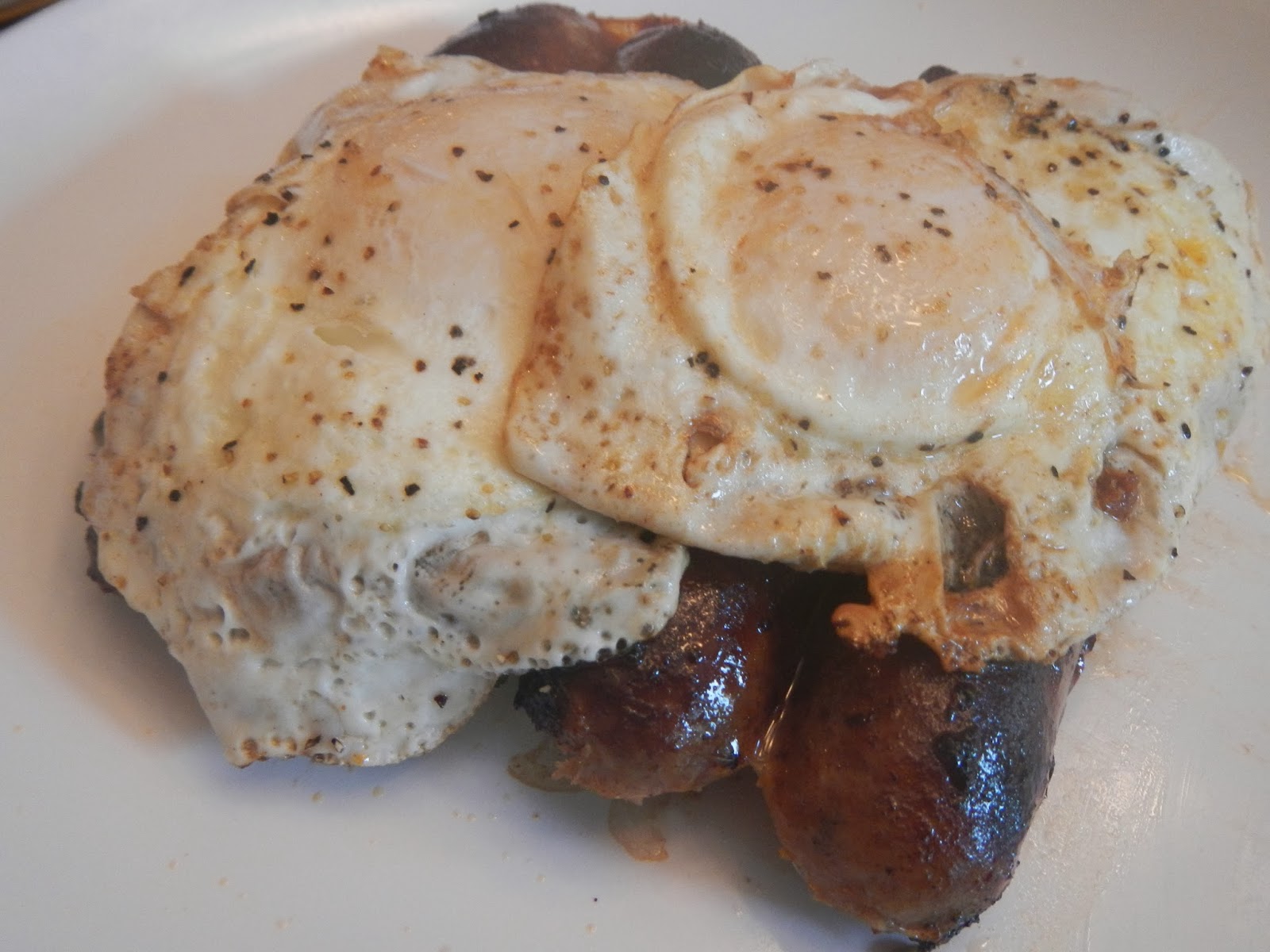
So…all of this hasn’t stopped me from playing with my breakfast creations!  In this case, I had a couple of leftover pizza slices to work with.  I zapped them in the microwave and then I topped them with a couple of leftover grilled hotdogs that I’d heated in butter in the frying pan…
 

Then of course, I had to top the pizza slices and hotdogs with a couple of over-easy fried eggs!  For the sake of the photo, I waited until after Laurie took the photo before topping this creation with my usual Tabasco…
FYI…These all beef hot dogs are the absolute BEST!  We buy them from Benton’s in Madisonville Tennessee.  Benton’s is famous for their country hams, prosciutto and bacon…and they don’t make the hot dogs.  But, whoever they buy them from, really knows how to make a hot dog!  If you’re from East Tennessee, Benton’s also sells great steaks at prices below any supermarket chain.  Benton’s is located at 2603 US Hwy. 411 North near Madisonville Tennessee.  Phone: 423-442-5003.  Website: http://bentonscountryhams2.com/.

My latest breakfast ‘creation’ doesn’t show up very well in this photo…and I also missed a key ingredient in this breakfast’s assembly.  These over-easy eggs are resting on slices of leftover Kentucky Fried Chicken that I’d heated in butter in the frying pan.  The bread is from the Delano Farmer’s Market…a high order Mennonite enterprise…near Delano Tennessee.  Great toast!!
In any case, I meant to place a slice or two of pepper jack cheese on the re-fried chicken before I added the eggs.  While it was still an OK breakfast, I think that it would have ‘popped’ if I’d remembered the cheese.

With my hand partially healed, I decided to head on over to Big Dude’s party dock to do a little fishing… (http://bigdudesramblings.blogspot.com) I didn’t catch much, just a couple of small catfish and a brim…plus this 13+ inch fish.  I think that it’s a Shad, but I’m not positive.  He was still flopping around when I took the photo.  I quickly returned him to the lake…
 
This is a warm fleece vest that Laurie used to wear to keep off the winter chill when we lived up North... It's getting a little too heavy to wear it now, except for show.  Almost wherever we go, we look for souvenir pins to add to her collection.  She now has over 90 pins on her vest.  They come from places such as Jasper Canada, the Farmer's Museum in Cooperstown NY, Shiloh in TN, the Atlanta GA Olympics, Fort Scott KS, and the Florida Panther sanctuary at the Cyprus National Preserve.  There are also a number of other pins that mean something to us or her...such as a Coke pin (Family), a cat pin (Pets), friendship pin (Nancy Hanck), a Nashville guitar pin and a teddy bear pin (one of Laurie's collections).
Well that’s about it for now.  If you’d like to enlarge any of the photos, just click on them…
Thanks for stopping by for a visit!
Take Care, Big Daddy Dave 

Monday, September 23, 2013

Heritage Park – Calgary Alberta, Canada (#3)

Continuing with our trip to Alberta Canada and with our experiences at Calgary’s Heritage Park Historical Village and its portrayal of living history…


As I mentioned previously, even the service vehicles in the park have been built to fit the overall image of one or the other time periods on display.  The park employees that were riding in this truck stopped and let us look it over and get inside.  Laurie snapped this photo of me in the passenger seat.
The park employees told us that the engine is a current production model and you can see that the tires are not from the era that this truck would have come from…

This is a view down the main street of the 1910 village.  There are no less than 28 different buildings in this ‘downtown’ area.  Examples include the City Hall, Post Office, Hotel, Railroad Depot, Newspaper Office, Dentist’s Office, General Store and a Chinese Laundry.

This is the Cochrane Fire Hall.  It was built in 1909 to house 2 new fire engines.  The builder was a carpenter who would later become fire chief himself.  In the early days, the fire chief also acted as the constable and sanitary inspector.  For these duties, he was paid $5.00 per month.  He was assisted by the 12 men of the Cochrane Volunteer Fire Brigade.
The fire engine that's inside the main portion of the fire hall is a 1915 American LaFrance chain-driven auxiliary pumper.  Originally, the Cochrane Fire Hall housed two hand-drawn, 60-gallon chemical engines.  It also contained a bedroom for the night watchman, and a meeting room for the town council. The Town of Cochrane donated the fire hall to Heritage Park in 1964.

This is the Cottage Hospital.  Several towns in Alberta established their first hospitals in cottages.  These cottage hospitals were small, temporary and poor.  By our standards, they did not have proper antiseptics or sanitary measures, with surgery often conducted on the dining room table.
This gingerbread trim house was built in 1907, and it was briefly owned by Martin Pallesen, owner of Calgary Central Creamery. After a long use as a home, the house was donated to Heritage Park in 1979.  Heritage Park restored the house as a Cottage Hospital in 1991.   

This log structure has been called ‘the only log opera house in the world’.  The Canmore Opera House was built by members of the H.W. McNeill Company Brass Band in 1898 in Canmore, about 62 miles west of Calgary at the foot of the Rocky Mountains.  The building, known to most residents of Canmore as the Band Hall, was used to host a variety of community events such as whist drives, plays, mine-sponsored Christmas parties and lavish dances.

FYI...Whist is a card game ancestral to bridge.  A whist drive is a social gathering where whist is played.  The winners of each hand move to different tables to play the losers of the previous hand.  
The Canmore Opera House occasionally featured well known acts such as the British Opera Company and the International Welsh Choir.  Early silent movies were shown here beginning in 1913.  Stars such as Jack Benny and Ginger Rogers drove from Banff to Canmore to see the world's only log opera house. The building held its last show in 1960.  Canmore Mines Ltd. donated the building to Heritage Park in 1964.  The opera house was fully refurbished in 2010 and its now home to a variety of entertainment and social gatherings.

This is Banff Alberta’s Royal North West Mounted Police Barracks.  In 1873, alarmed by the lawlessness engendered by the whiskey trade in the Western provinces, the Canadian government created the North West Mounted Police. This building was originally the second floor of one of the structures that formed the first NWMP detachment in Banff, which had been established in 1887.
That same year, the detachment also grew from two constables to a total of 14 men because of Banff's potential as a popular tourist destination.  The building was purchased for use as a private residence in 1910.  The owner donated it to Heritage Park in 1964.

Yes indeed!  Laurie filed a complaint against me and she had this very young ‘member’ of the Royal Canadian Mounted Police lock me up… I was let out on my promise of good behavior.

The photo above shows St. Martin's Church near the village center.  In 1888, Reverend Canon Henry Havelock-Smith arrived in the Pincher Creek area as a missionary for the Anglican Church.  After forming his own mission, the minister began conducting services at the home of a prominent local citizen in the town of Grasmere.  By 1895 the churchgoers had started raising funds for the construction of their own church.
Reverend Havelock-Smith decided to name the parish St. Martin's, and by the spring of 1896 the congregation had raised enough money to hire a local carpenter.  The cost for building the church was $110…plus $4 extra for seats!  After the church was donated to Heritage Park in 1964, the church grounds were consecrated and put under the aegis of the Anglican Diocese of Calgary.  Special Sunday services and numerous weddings are performed in St. Martin's Church each year.

Here’s another view of the 1910 village’s ‘downtown’ area.  We did get our walking in while touring Heritage Park.  Our doctor would have been pleased…if we just had skipped the huge cinnamon rolls from the 1912 Alberta Bakery and the ice cream cones from the 1910 Vulcan Ice Cream Parlor! (The bakery is the building with the awning that’s down the street a bit)

This view shows the Post Office/Telephone Exchange as well as the 1907 Wainwright Hotel.  During the summer, from 11 AM until 3:30 PM, the Wainwright restaurant offers table service dining with full-course meals.
From 9 AM to 2 PM on Sundays in the winter, the Hotel reportedly serves up one of Calgary’s best Home-style Breakfast Buffets.  Better yet, guests can drive up the hill and park right in front of the hotel!

This is a photo of a portion of the interior of the Post Office and Telephone Exchange.  Believe it or not, before the 1870s, the Hudson's Bay Company controlled the mail in Western Canada.  Then in 1874, the North West Mounted Police began acting as postmasters for the region. It wasn't until 1883 that Calgary's first real post office opened in Bannerman's Hay, Flour and Feed Store.
Since they didn't take up much room, many post offices served multiple purposes and they were placed in corners of businesses, such as general stores or private homes. This particular building was built in Cayley Alberta in 1908…about 37 miles south of Calgary.  The switchboard in the office is actually connected to 16 lines around the Park.  The building was sold to Heritage Park in 1964 for $500.

For our last photo in this edition of our blogs pertaining to Calgary’s Heritage Park, it seemed appropriate to picture one of the many craftsmen, actors or re-enactors that provide a sense of time and place throughout the park.  Laurie loves blacksmiths…probably because they make her think of horseshoes…and horses. 
Re-enactors were present throughout the Park.  They didn’t just serve as clerks and waiters…or even craftsmen.  They played ‘parts’ as characters walking down the street, they drove carriages or wagons down the road and they performed maintenance work, all while looking like they were part of the scene that was being portrayed.
That’s about it for this segment of our blogs about Calgary’s Heritage Park… Just click on any of the photos to enlarge them…
Thanks for stopping and sharing our travel experiences with us!
Take Care, Big Daddy Dave 

Friday, September 20, 2013

First and Last Meals in Alberta!

Like everything else, when I plan a trip for us, I check out possible restaurants in the areas we’re visiting.  I look for a variety of dining experiences…diners on up to upscale restaurants and everything in between. 

I like to use Trip Advisor for my research…and I look for restaurants where the ratio of Excellent/Very Good reviews to Poor/Terrible is no worse than 10 positive to 1 negative. (www.tripadvisor.com) Of course I also read a few reviews to learn what negative issues were encountered and when.  If service was a problem in 2012 but it’s been all upbeat in 2013, the problem was probably fixed.

This is Earl’s Restaurant on McLeod Trail SE in Calgary Alberta Canada…one of several locations in that city.  As it turned out, this Earl’s location wasn’t well rated and according to Trip Advisor’s latest reviews, it still has service problems.  However, it was close to our hotel and we were tired…se we gave it a try.
Earl’s has roughly 64 restaurants in Alberta, British Columbia, Saskatchewan, Manitoba, Ontario and the Yukon in Canada, plus Washington and Colorado in the USA.  It’s all about casual but comfortable dining.

This isn’t a great photo…but Earl’s does provide a nice atmosphere for socializing and dining.  The restaurant was quite busy.  Given the number of negative reviews I’d seen on line for this location we were a little apprehensive.
We received a friendly greeting at the front door and we were promptly seated… So far, so good!

This was our order of garlic bread. ($4.25) I'd eaten one piece but it was still overpriced…even for Canada…and it was just ok.

We started out with Earl’s Clam Chowder. ($7.00) It was made with cream, baby clams, bacon and some garden vegetables.  While it wasn’t the best chowder we’ve ever had, it was very good and we both liked it!
Our waitress was Karly… She was very helpful, personable and attentive. Both Laurie and I noted that almost everyone working in this restaurant was attractive, whether they were male or female.
 

I have to admit that I took this blurry photo all by myself… This was my entrée.  It is the Cajun Blackened Chicken. ($21.00) The chicken was seasoned with Earl’s blackening spices and garlic butter.  This entrée is normally served with warm potato salad and coleslaw, but I’m not a potato salad fan so I asked our waitress if I could substitute with garlic mashed potatoes.  As you can see, it was no problem.
Yes, I know!  $21.00 for a chicken dinner is a bit steep!  We had to wrap our minds around the higher prices for just about everything Canada.  My meal was good if not great…about what I expected.
Laurie ordered a personal pizza for her entree… There will be more about that later in this blog.  This was the first of two Earl’s that we visited while exploring Alberta…

Yes…this is another Earl’s Restaurant.  This one is also located in Calgary…this time near the airport.  Yes…we ate dinner at Earl’s on our first day in Alberta and on our last day as well! 
This Earl’s location met my 10:1 Trip Advisor criteria with 39 Excellent or Very Good reviews vs. only 4 Terrible or Poor. 

Patio dining was an option but we generally prefer sitting indoors away from flies, heat and any nearby traffic.  It was a bit early but the patio was already busy when we arrived…

For our second trip to an Earl’s dining establishment…our last day on this trip…we each had a beer and a Caesar Salad to start out. ($6.75 for the beer and a starter salad for $6.50) The Caesar salad was very nice…quite satisfactory indeed.  It consisted of romaine lettuce, fresh grated Grana Padano parmesan, brioche croutons and Earl’s signature Caesar dressing.

This is WHY WE RETURNED TO EARL’S FOR OUR SECOND TIME!  Laurie had ordered this pizza for her entrée in the first Earl’s we’d eaten at.  It was so good that we wanted to come back and experience this fabulous pizza creation again before heading home to East Tennessee.
This is Earl’s Italia Pizza. ($15.00…and we each ordered one!) This pizza is described as a hand tossed thin crust pizza with “Virginia ham, salami and chorizo, provolone cheese, parmesan, fresh basil and San Marzano tomato sauce.  The ingredients were top notch, the tomato sauce was just right, the spices were perfect and the crust was thin, crispy and it held up when picked up.
Laurie thinks that this is the BEST PIZZA she’s ever had and while I’m not willing to go that far, I will say that it easily ranks among the Top 5 pizzas that I’ve ever eaten.  Given my age and waistline, that equals a lot of pizzas!

This young lady was another major factor in the enjoyment of our last dining experience in Alberta.  Her name is Alex.  She played basketball for the University of Calgary.  She had to be one of the most popular team members among the other players.  Alex has a terrific personality!  Friendly, efficient and smart…she will go far in life…
Earl’s Restaurants worked out well for us.  The wait staff was helpful and efficient, the food ranged from OK to Excellent and the restaurant’s themselves were clean and well kept.  Should you find yourself in Canada…especially western Canada…or in Colorado or Washington states, check them out for yourself.  Be sure and try the Pizza!  Website: http://www.earls.ca/.
Just click on any of the photos in order to enlarge them...
Thanks for stopping by for a visit...and another restaurant review!
Take Care, Big Daddy Dave

Wednesday, September 18, 2013

Heritage Park – Calgary Alberta, Canada (#2)

Continuing with our tour of Calgary Alberta’s Heritage Park Historic Village, this is Part 2 of 4 in total.  In addition, there will be multiple blogs about the automobile/transportation museum which is located right at the entrance to the park.  There was so much to see and do at this major historical tourist attraction!


This is a partial view of the 1880s Pre-railway Settlement at the park.  The Canadian Mountie Post is to the left and Drew’s Saloon is to the right.  Note the gentlemen in period dress sitting outside the tavern. 
Henry "Boston" Drew was a well-educated ex-U.S. army officer who first came to Canada in 1884 on a cattle drive from Idaho.  He decided to settle in Alberta, and built a saloon, called the Drew Reserve, on his property at Spitzee Crossing in 1886. (This is now the town of High River)
The saloon wasn’t licensed at first but that didn't deter patrons from stopping by for a drink.  In 1891, Drew added four second-story guest rooms to his saloon, turning it into an inn for weary travelers who needed a drink and some rest.  Drew later changed the name of his stopping-house to the High River Hotel.  It passed through several hands over the next 100 years before the Town of High River gave the building to the Heritage Park as a gift in 1977.
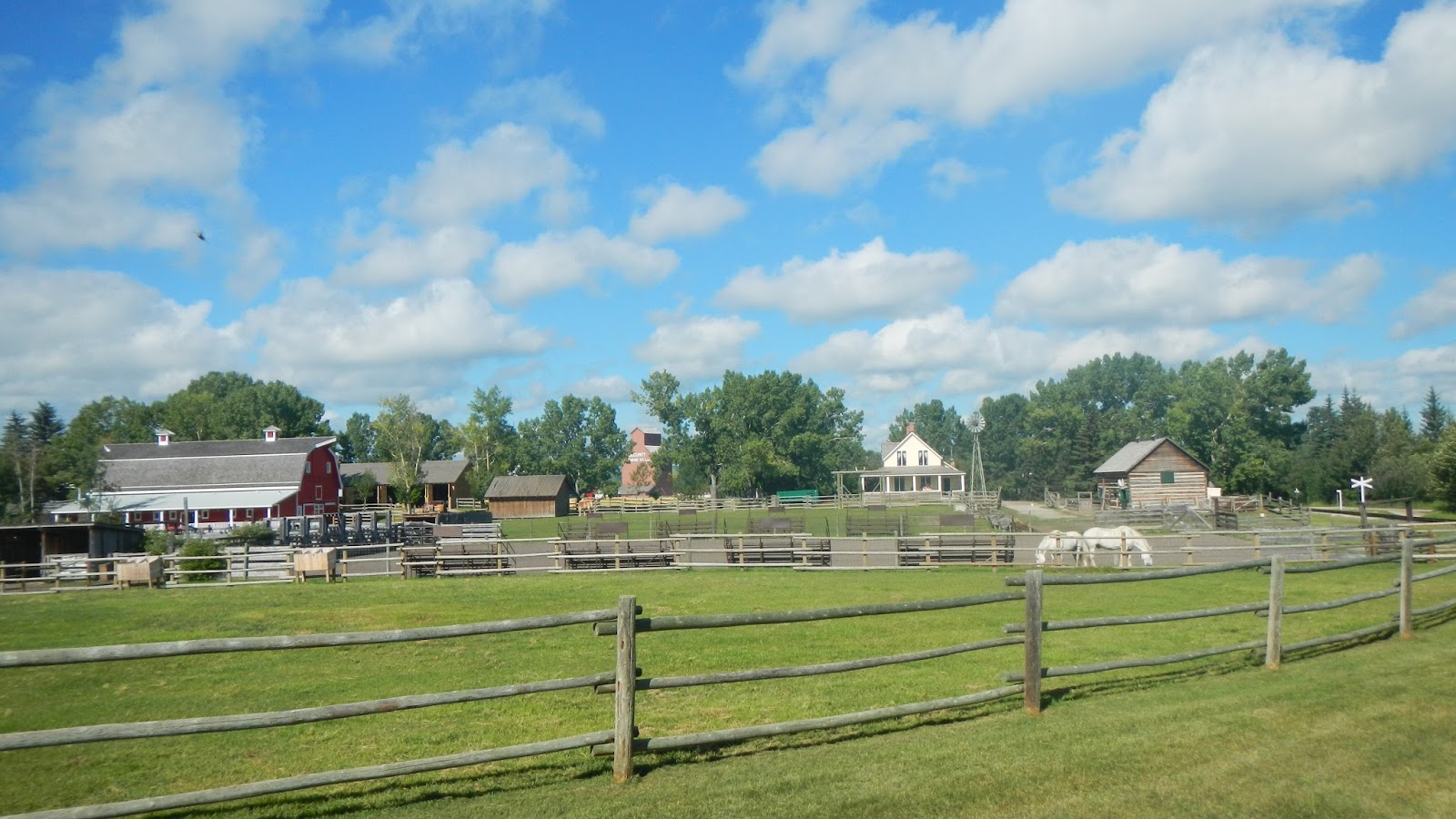
This is the former Berry Creek North West Mounted Police Barracks or, as they call it ‘encampment’.  It was built in 1905 about 90 miles east of Calgary.  There was a serious problem with horse rustling…and many thought that some of the thefts had been the work of Montana’s Hole-in-the-Wall gang.
Heavily armed bands of outlaws used to sweep up from the coulees of the Missouri River to make periodic raids upon lonely Alberta ranches.  Then they would drive the stolen livestock back across the border. The Mounted Police of the Berry Creek detachment made regular patrols of the surrounding countryside to prevent these thefts.  In just a few years, horse and cattle rustling in the region was greatly reduced and the Berry Creek detachment was disbanded in 1915.
Laurie and I like the animals as much as anything… In addition to trolley and steam train rides, free horse drawn wagon tours are available to visitors in the park. 

Laurie and I really liked the fact that all of the work vehicles we saw in the park…as well as their park employees…were in character.  There were trucks and wagons in use that had been built new but which looked old.  It really helped to keep you focused on the time periods that the park strives to project.

This bucolic scene shows a late 1800s, early 1900s ranch/agricultural scene in central Alberta.  It looks so natural that you might think that Laurie had photographed it along the road during our travels…

This is the Burnside Ranch House.  It was built in 1904 by Ewan Donald MacKay.  He established his ranch or mixed use farm in 1887.  ‘Ranches’ in this part of Alberta tended to be relatively small family operated ventures that planted grain and raised livestock.  Among his other operations, MacKay raised and sold registered Clydesdale horses. 
This house, which was located near Cochrane Alberta, was known for its lively parties during the early part of the 20th century.  When naming his ranch, Mackay resorted to his Scottish roots.  ‘Burnside’ in Gallic means ‘beside the creek.’  Subsequent owners donated the home to Heritage Park in 1964.

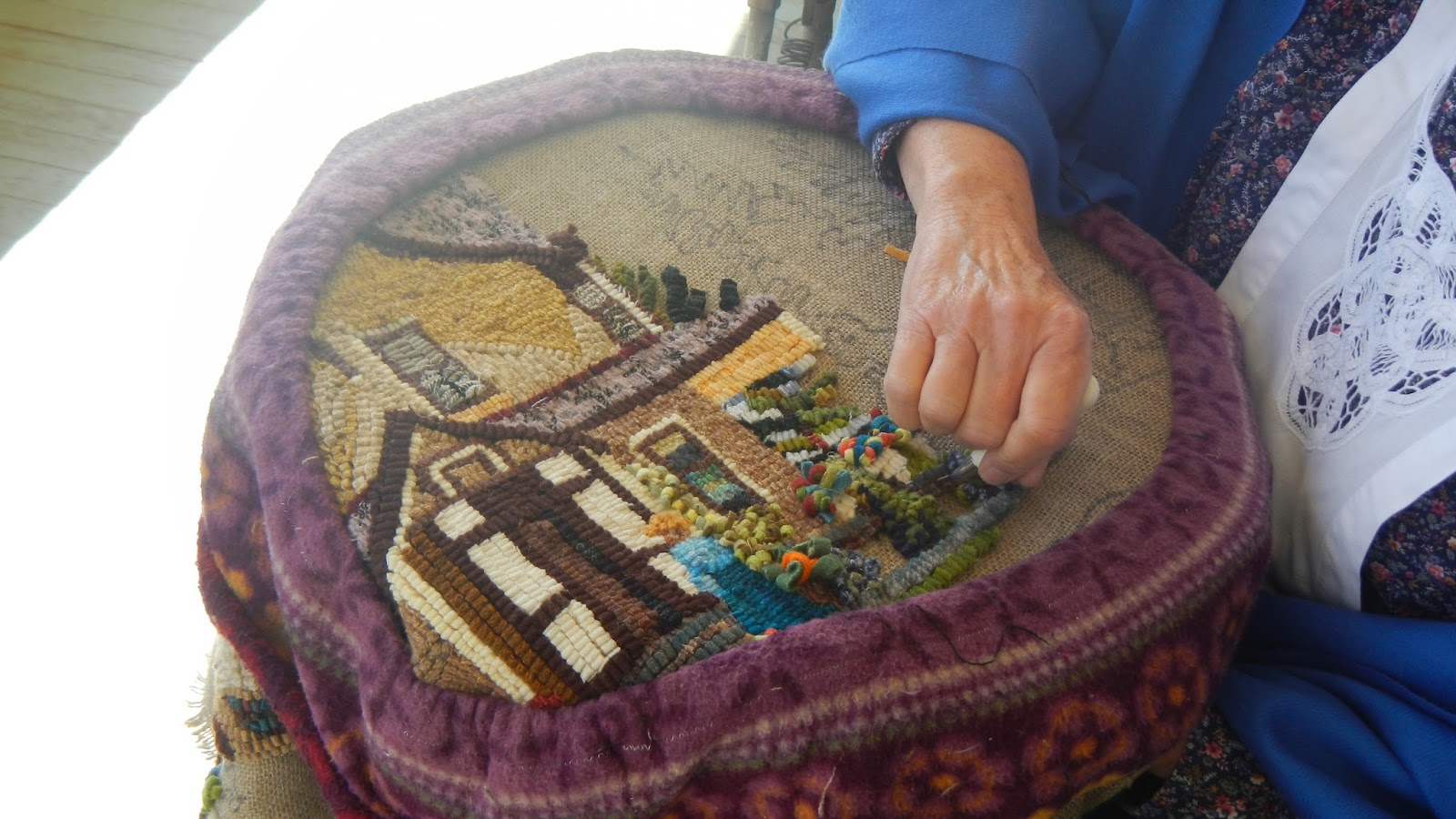
A lady acting as a living history character was on the porch of the Burnside ranch house hooking a chair cover.  Throughout the park, employees either played a part in the life of whatever time period they were representing, or they served as docents explaining the exhibits.
Hooked rugs represent a fond memory for me as both my grandmother and my mother both hooked classic rugs at one point in their lives.  We have 2 very nice hooked rugs from my grandmother that are at least 70 years old and one from my mother that is between 62 and 65 years old.

This docent or re-enactor was hard at work in the kitchen of the Burnside house…baking bread and rolls.

This is a ‘Soddy’ or sod shack.    It’s estimated that between 1900 and 1910, over one million sod houses were in use on the Prairies of North America.  Upon their arrival on the Prairies, many settlers discovered that there weren’t enough large trees in the area for them to build a log cabin.
They turned to the only building material abundant on the prairie, sod. Heritage Park drew on the expertise of many people in erecting its own sod shack in 1971.  An elderly carpenter who had grown up in a sod house in Saskatchewan was instrumental in this reconstruction.  His memories of the many finer points of building with sod, such as attaching factory cotton to the walls using small saplings, helped build the most authentic sod house possible.  I can't imagine living with dirt floors and a roof that gets soggy and drips whenever a hard rain takes place!

This is just one of the many working draft horses on display and/or in use at Heritage Park.  Did I mention that my editor/wife loves horses!  This is a Belgian Draft Horse.

This barn was built in 1927 for the P. Burns and Company Bow Valley Ranch in Calgary.  Its owner, Patrick Burns, was one of the celebrated ‘Big Four’ who first invested in American Guy Weadick's Calgary Stampede in 1912.  Over the years, Burns bought thousands of acres of rangeland throughout Western Canada.  P. Burns Ranches Ltd. of Calgary donated the barn to Heritage Park in 1977.  The Burns' Barn currently serves as the home for the Talisman Heritage Education Centre and it’s also used for the Park's summer camps and educational programs.  It truly is a gorgeous barn!
If you aren’t aware of it, the Calgary Stampede is an annual rodeo, exhibition and festival held every July in Calgary.  The ten-day event, which bills itself as "The Greatest Outdoor Show on Earth", attracts one million + visitors each year.  Activities include one of the world's largest rodeos, a parade, a midway, stage shows, concerts, agricultural competitions, chuckwagon racing and First Nations/Native North American exhibitions.  For more information on The Stampede, go to http://en.wikipedia.org/wiki/Calgary_Stampede.

Here are a couple more of Laurie’s friends…  The one on the right did like the attention…but the one on the left…not so much!

Yes indeed!  What would an historical park be without some representation of riverboat transportation…so critical in those early days.  This is the S.S. Moyie.  In those areas of British Columbia and Alberta that could not easily be reached by road or rail, steamships served as the primary form of transportation.  They could move large quantities of freight and/or passengers.  With their shallow draft and paddles that could function in a few inches of water, paddle wheelers could travel in shallow rivers and access settlements that didn’t have docks.  
The original S.S. Moyie, built in 1898, was intended to ferry miners to the Klondike gold rush.  Instead, the Canadian Pacific Railway put her to use on Kootenay Lake to ferry passengers from its rail terminal at Kootenay Landing to Nelson, B.C.   She was named Moyie after a prosperous mining community in the region.  That town got its name from the French word for wet, mouillé.
The S.S. Moyie was North America's oldest sternwheeler that was still in service when she was retired in 1957.  The original ship is still on display in Kaslo, British Columbia, Canada.  Check her out at http://klhs.bc.ca/.  In 1965, Heritage Park commissioned the building of a half-size replica of the S.S. Moyie, which uses a diesel engine.

The cruise was not one of the high points of our visit to Heritage Park Historical Village.  But…it was a welcome break for our feet following about a third of our stroll through the Park!  The S.S. Moyie cruises the shores of the ‘smallish’ Glenmore Reservoir.  At one point, the ship turns around to head back to its dock and, as it turns, there is a good view of downtown Calgary. 

This postcard gives you a better view of the city of Calgary.  With a population of roughly 1,250,000, Calgary is the largest city in Alberta.  As you can see, a river passes through the city.   Widespread flooding throughout southern Alberta, including on the Calgary’s Bow and Elbow rivers, forced the evacuation of over 75,000 city residents on June 21, 2013.  The floods were barely mentioned on US News broadcasts.  Large areas of the city, including downtown, were left without power.  The Calgary Stampede was to open on July 5 and their show grounds and stadium were underwater.  Adopting the phrase, “Come hell or high water”, the city, the organizers and volunteers made it happen!  The 2013 stampede did go on as planned. 
To learn more about Calgary Alberta, you can go to http://www.visitcalgary.com/ or http://en.wikipedia.org/wiki/Calgary.
 Just click on any of the photos to enlarge them…
Thanks for stopping by to take a look at Part 2 of our blogs about Calgary’s terrific Heritage Park!
Take Care, Big Daddy Dave