Friday, January 17, 2014

Reynolds-Alberta Museum – Part II

Continuing with our tour of the Reynolds-Alberta Museum in Wetaskiwin Alberta… As you will see, this is a very eclectic collection!


This is a 1918 Winton Six Victoria Phaeton.  The Winton Company, founded by a Scotsman, was based in Cleveland Ohio and the company sold its first automobile in 1898.  In 1899, the company became the largest producer of gasoline powered autos in the world.  By 1906 Winton had become well known as the manufacturer of large expensive 6-cylinder cars.  With its Victoria top, this was a very stylish auto…but it wasn’t too practical on the cold Canadian prairies!

Factoids:
  • In 1898 the Winton Motor Carriage Company sold twenty-one vehicles, including one to James Ward Packard, whom later founded the Packard Automobile Company after Winton challenged a very dissatisfied James Packard to do better!
  • Winton’s success led to the opening of the first ever automobile dealership by Mr. H.W. Koler in Reading, Pennsylvania. In 1899, in order to deliver the vehicles, Winton built the first auto hauler in America.
  • In 1903, using a Winton automobile, Dr. Horatio Nelson Jackson made the first successful automobile drive across the United States.  The trip took 64 days! 


This is a 2-cylinder 1912 International Commercial Car.  International Harvester ventured into the ‘high wheeler” market beginning in 1907 and built different versions until 1916.  The Commercial ‘Car’ was intended for hauling product and equipment on farms but rear seats were available by special order.  In effect, this was a half-ton pick-up truck!

International Harvester built light trucks from 1907 to 1975.  This version was also referred to as a Model A Auto Wagon or Auto Buggy.  Did you notice that it is a right hand drive model?  It was popular in rural areas for high ground clearance on the poor roads typical of the era. It featured a rear seat convertible to a carrier bed.  For more about International Harvester, go to http://en.wikipedia.org/wiki/International_Harvester.


This is a 1919 4-cylinder 19.6 horsepower Gray-Dort 1 1D “Ace” 5-Passenger Touring Car.  The company was based in Chatham Ontario.  W. Gray and Sons, a major wagon builder, had acquired the rights from the Dort Motor Car Company of Flint Michigan to build Dort automobiles for the Canadian market.

The “Ace” designation was given to this car in honor of Canadian flying aces from WWI.  This automobile had a ‘fat man’ adjustable steering wheel and retractable cigarette lighter.  The original cost was $1,350 (C).  This is one of only 3 known surviving Gray-Dort automobiles. 

As a side note, the Dort Motor Car Company traced its history back to its founding as the Flint Road Cart Company in 1884 by William Crapo Durant and Josiah Dallas Dort.  They originally sold wagons built by local suppliers for $8.00 each.  In 1900, the company, which by now was making 50,000 wagons, carts, and carriages per year, changed its name to Durant-Dort Carriage Company.  By 1915, Dort and Durant cut their business ties.  Dort was out of business by 1924 and Durant went on to help found General Motors…


This is a 1920 Indian “Scout” Motorcycle.  It was built by the Hardee Manufacturing Company in Springfield Massachusetts.  This motorcycle had a 37 cubic inch engine which developed 11 horsepower.  It cost $295. The Scout was an instant success because it was reliable.  It was very popular with companies that needed economical vehicles for in-town deliveries.  This particular motorcycle sports a Great Northern Railway decal.  It’s likely that it was used to deliver telegraph messages. 

The Hardee Manufacturing Company was renamed the Indian Motorcycle Manufacturing Company in 1928.  The company closed in 1953.  The brand is now owned by Polaris Industries. To learn more about Indian Motorcycles, you can go to http://en.wikipedia.org/wiki/Indian_(motorcycle).

FYI…The Great Northern Railroad operated from Duluth Minnesota to Washington State.  It has an interesting history and the company experienced the deadliest avalanche in US history. http://en.wikipedia.org/wiki/Great_Northern_Railway_(U.S.).


OK…time for a little diversity!  This is a 1915 Model-T Ford Runabout mounted on a 1929 Snow Flyer Conversion Kit.  The kit was manufactured by the Snow Flyer Corporation in New Holstein Wisconsin.  As you can see, the kit contained a pair of skis, an axle and 2 all-steel traction belts or treads.
 
Back when roads were less well built and even less well maintained, several manufacturers made these kits that were designed to turn automobiles into vehicles that were better suited for winter travel.  Mankind can be quite ingenious! 


This is a 1935 Maple Leaf 2-ton Truck.  This line of trucks was built by General Motors Canada and the name continued until after WWII.  This model has a 6-cylinder 26.3 horsepower motor.  The Maple Leaf quickly established itself as a major threat to its Canadian arch-rival Ford.

 
Hooray!  Here’s an automobile that was built in my hometown!  This is a 1912 Jackson Touring Car (Model 32).  This 4-cylinder car was built by the Jackson Automobile Company in Jackson Michigan.  The torpedo type body was so-named for the streamlined sloping cowl that transitions the design between the engine hood and the passenger compartment.

The company also built the Jaxon Steam Car back in 1903.  The company’s slogan was “No Hill Too Steep, No Sand Too Deep”.  The Jackson Automobile Company was in business from 1903 until 1923.  To learn more, go to http://en.wikipedia.org/wiki/Jackson_Automobile_Company. 


This is the dashboard of the Jackson Touring Car.  It’s so simple that it is the perfect dashboard for someone who is technically challenged like me!  Note the steering wheel on the right side.  When I got into this car, (it was one that visitors could climb into), that steering wheel and my body-type came into conflict!

Actually, Jackson Michigan was an early hotspot in the manufacturing of automobiles.  There is a long list of cars and car companies that operated in the city.  One of my favorite cars, the Kaiser Darrin, was built in Jackson.  Since the auto business faded in town, it’s been an uphill recovery process.  For a list of cars and auto manufacturers from Jackson, just go to http://www.yeolecarriageshop.com/id15.html.


Enough with cars and trucks for now… This is a 1911 Reeves Canadian Special Steam Traction Engine.  It was built by the Emerson-Brantingham Implement Company of Columbus Indiana.  This 13-ton behemoth had a 2 cylinder 90 brake horsepower steam engine and it could pull 12 fourteen inch plow bottoms.  Power steering and a winch were available options…

With its compound steam engine, heavy-duty rear wheels and axle, this tractor was designed for plowing the western prairies with their thick sod.  Reeves and Co. built farm tractors for 30 years.  It built some of the largest steam traction engines used in North America.  Marshal Reeves was the driving force behind this venture having first invented in a tongueless corn plow in 1869.   Reeves and Company was sold to Emerson-Brantingham.  In turn, after making several acquisitions itself, Emerson-Brantingham was purchased by the J.I. Case Company, now the Case Corporation.


I had to include this photo from Wikipedia… At the same time as Marshall Reeves started building steam tractors, his brother Milton began making automobiles.  This is the 1911 Reeves Octo-Auto.  Time Magazine named this car as one of the most ugly ever produced!  The Octo-Auto was notable or notorious enough for Hemmings to feature it in 2011 as an April Fools' Day article on its website titled “World celebrates the centennial of the Octo-Auto”.  

Do I need to mention that Milton wasn’t anywhere as successful as his brother was…?!


Back to the basics… Featured in this photo (sorry for it not being in focus) is the 1946 Farmall Model M Tractor.  It was built by International Harvester in Chicago Illinois.  This 2 ½ ton 4-cylinder model became one of the world’s best known tractors.  It came with a standard package that included an electric starter, lights and, perhaps most importantly, a hydraulic shock absorbing seat for the farmer!  By the time that production of this tractor ceased in 1952, over 280,000 units had been built.


This is a 1917 Waterloo Thresher.  It was built by the Waterloo Manufacturing Company, Ltd. in Waterloo Ontario.  Jacob Bricker was born in 1818 in Waterloo, Ontario, and learned the trade of blacksmith. He went into the farm machinery business in 1850 and for a while the Company he created built and sold threshing machines.  It cost $1,365 (US) back in the day…

The ad campaign for Waterloo Threshers trumpeted “A triumph of modern engineering.  Ask the man who has one.”  Waterloo Manufacturing continues today, selling and servicing industrial boilers.

That’s about it for Part II of our visit to the Reynolds-Alberta Museum.  Just click on any of the photo to enlarge them…

Thanks for stopping by and joining us for part of our tour!

Take Care, Big Daddy Dave

Wednesday, January 15, 2014

Indian Cuisine in East Tennessee

Our friends, Holly and Joel, asked us if we’d like to join them for dinner at a new Indian restaurant in Knoxville.  They know that we like spicy food and exotic spices!  Plus, Joel and Holly have lived all around the world, including Singapore and the Washington D.C. area.  They've tasted some really good Indian food over the years...so we jumped at the chance for a new dining experience…


This is Bombay Palace.  It’s located at the northeast end of the Turkey Creek Shopping area in Knoxville. 

From what I’ve read, Bombay Palace is an Indian/Pakistani restaurant that is a sister restaurant to Taste of India in the Gatlinburg/Pigeon Forge area.  Indian cuisine seems to be growing in popularity in the Knoxville area.  I can think of at least 5 Indian restaurants in and around Knoxville.


I started out with this Flying Horse Royal Lager Beer.  I usually go for a Kingfisher in an Indian restaurant but I liked the name and it was time for a change!  I liked it every bit as much as I do the Kingfisher label. 

United Breweries Group is an Indian company headquartered in Bangalore India.  The company has annual sales of over US$4 billion and produces about 48% of all beer by volume in India.  A little research provided me with a commonality…both Flying Horse and Kingfisher beers are produced by or under license from United Breweries Group!


Like in most Indian restaurants, we were given a starter consisting of thin naan/bread along with some sauces and condiments to enjoy with it.  We always enjoy trying the different condiments as they tend to wake up the taste buds…in a good way.


Holly and Joel ordered an appetizer…but we forgot to take a photo and I can’t recall what it was… This was our appetizer.  It’s the Chicken Pakora. ($3.95) Basically, these are lightly spiced deep fried chicken fritters.  They were quite nice.  We wouldn’t even have this photo but the waitress brought one of these appetizers out for us to photograph just before we left the restaurant!  For some reason, we at times just start eating before we take a picture! :)
 
There are 12 appetizers listed on the menu at Bombay Palace.   They range in price from $2.95 to $9.95.  There are also 5 soups on the menu and they cost between $2.50 and $3.25.


Jasmine rice came with all of our entrees… We like Jasmine rice as it seems much lighter than the usual Asian ‘sticky rice’.  However, since white Jasmine rice can also be sticky, this texture must have something to do with how it’s prepared…


We love bread!!  Between us we ordered 2 helpings of Garlic Naan. ($2.95) It was great for dipping in and soaking up our sauces!

Indian ‘bread’, roti or naan comes in several varieties at Bombay Palace.  They range in cost from $1.95 for Chapati, (an Indian whole wheat flat bread roasted over open flames), to Keema Naan, Chicken Naan and Piswari Naan. ($3.95 each) Keema Naan is stuffed with ground lamb and spices.  Chicken Naan is stuffed with what else…chicken!  Piswari Naan is stuffed with coconut, raisins and cashews.


Holly ordered the Chicken Tikki Masala as her entrée. ($11.95) This consists of pieces of chicken tikka cooked in a creamy sauce with fresh tomato and exotic spices.  It’s served with rice, mint and chutneys.

FYI…chicken tikka traditionally consists of small pieces of boneless chicken baked in a clay-based oven called a tandoor after being marinating in spices and yogurt.


This is my entrée and my favorite Indian dish above all!  I have a hard time not ordering Lamb Vindaloo, ($12.95), whenever I’m in an Indian restaurant.  Basically, its extra-hot spicy lamb and potatoes cooked in a sharp tangy sauce!  I really like lamb and I do like the heat!  This was very nice indeed…

Yes…I know that all of our entrees look pretty much the same!  With many Indian dishes, it’s all about the sauces that are used with the basic ingredients. 


This is the Chicken Curry. ($9.95) Both Joel and Laurie ordered this dish for their meal.  This is chicken cooked in light gravy with a mild curry although Laurie had hers spiced up a bit.  This dish is served with rice, mint and chutneys.  We had two more happy diners!

At the time I wrote this posting, as per Trip Advisor, Bombay Palace is ranked #11 among the 904 restaurants in the area.  There were 32 Excellent or Very Good reviews and ‘0’ Poor or Terrible reviews.  To check out these reviews, you can go to http://www.tripadvisor.com/Restaurant_Review-g55138-d3671033-Reviews-Bombay_Palace-Knoxville_Tennessee.html.


For dessert, we had to try a little Kheer/Rice Pudding. ($2.99) This sweet Indian pudding is made from milk and rice and then flavored with cardamom.  It's a real palate cleanser following the many spices used in Indian cooking.  There are 7 desserts on the menu.  One of the more unusual…at least to my way of thinking…is the Gajar Halwa. ($2.99) It consists of grated carrots cooked in milk, sugar and butter, then flavored with cardamom.

We thoroughly enjoyed our dinners at Bombay Palace.  The décor is fairly simple, the service was warm and management is eager to please.  The food ranged from very good to excellent.  My only minor complaint was about the unfettered children from a nearby table who were playing underneath the table next to us.  I gathered that they were regulars…

 We will return…as I want to try their luncheon buffet…  Many thanks to Holly and Joel for the invitation!

Bombay Palace is located in the Turkey Creek Shopping Center at 10901 Parkside Drive in Knoxville Tennessee.  Phone: 865-671-6667.  To view a menu, go to http://www.easttennesseedining.com/bombay.html.

Just click on any of the photos to enlarge them…

Thanks for stopping by for a visit!


Take Care, Big Daddy Dave

Monday, January 13, 2014

Yet Another Top Notch Museum – Alberta Canada

When I was planning our Alberta/Canadian Rockies adventure, I noted one last attraction that was on our way back to Calgary and our flight home.  So, on our last full day of travel, we took the secondary route, (2A), south from Edmonton.  Highway 2A runs parallel to Rte. 2, i.e., which is the freeway. 


Before we reached our destination, we passed through the town of Millet Alberta.  The town was founded in 1891 and it has a population of about 2,100. 
In any case, this old piece of firefighting equipment caught our eye as we cruised through the town.  What surprised me was the age of this unit!  It was built by the Dominion Fire Company in Saskatchewan in 1938.  It served the town of Millet from 1939 until 1954!  I was assuming that it was quite bit older than that…and I was startled to see that it was in use in relatively recent times. 

This unit took 2 or 3 men to move it and it could be towed by other equipment.  Its 2 45-gallon tanks contained water mixed with calcium chloride to prevent freezing and the carbon dioxide tanks provided the needed pressure.


This was our goal for the day… It’s the Reynolds-Alberta Museum in Wetaskiwin Alberta.  The Reynolds-Alberta Museum opened in 1992 and is a project of Alberta Culture and Alberta Infrastructure.  This museum is one of 18 government owned and operated historic sites, interpretive centers and museums in Alberta.


The museum is named after Stan Reynolds, a Wetaskiwin businessman and world-renowned collector who donated a core collection of 1500 artifacts to the Province of Alberta.  Mr. Reynolds donated his core collection between 1982 and 1986, but he regularly continued to donate items from his collections until his death in 2012.  To learn more about this prolific collector, go to http://en.wikipedia.org/wiki/Stan_Reynolds.

 
It’s not always about the really, really old automobiles… This is a 1955 Chevrolet Bel Air Nomad.  Its V8 engine developed a ‘whopping’ 162 horsepower!  Other than the Corvette, this was the least produced and most expensive Chevrolet back in 1955…which means it’s fairly rare.  It cost $2,571!  
As you move through the exhibits, it’s not hard to imagine that Stan Reynolds was a very successful auto dealer… At one point he operated 13 auto dealerships across Alberta!


Look up!  This is a 1918 Curtiss Canuck, one of over 1,200 built in Canada to train pilots during WWI.  This plane and its pilot, passenger or trainee could reach speeds of 74 mph with its 90 horsepower motor!  This plane made the first commercial flight in Alberta, flying copies of the Edmonton Journal to Wetaskiwin back in 1919.
 
At this point, I should clarify the mission of the Reynolds-Alberta Museum.  Variety is the name of the game!  The museum’s role is to interpret “the impact of technological change in transportation, aviation, agriculture and industry from the 1890s to the present.  Visitors will see a wide variety of vintage automobiles, motorcycles, bicycles, trucks, stationary engines, tractors, agricultural implements, aircraft and industrial equipment.”


Compare this beauty to the mostly vanilla but efficient designs that we have today!  This ‘boat’ of a car weighs almost 2.5 tons and it is powered by a 413 cubic inch engine that developed 350 horsepower.  This is a 1960 Chrysler Imperial PY1-M Southampton.  You could have purchased this luxury auto for $5,647.  It was designed to compete with the Lincoln and Cadillac models.
Of interest was the “Panelescent” lighting system in this auto.  This system didn’t use any light bulbs.  Instead it used phosphorescent ceramic material on the dash that glowed in the dark when the motor was running.


This original (unrestored) 1959 Cadillac Coup de Ville brings back many memories of my misspent youth in Michigan!  One of my teenage buddies, Tim Southwick, had this family car available for dating.  We would pick up our dates and go off to the drive-in near Big Rapids.  It was a bit of a drive from the family cottage at Croton MI.  I will say nothing else…except that the backseat of this Cadillac was huge!
 
This curvy exaggerated design was a hurried response to Chrysler’s flamboyant Imperial.  This car weighed almost as much as the Imperial…at 4,720 lbs. and its 390 cubic inch engine developed 325 horsepower.  It was great on the open road!  In 1959, you could have purchased this car for $5,252. 


This is an overview of part of the main floor of the Reynolds-Alberta Museum.  To say that the collection is eclectic would be an understatement!

Stan Reynolds had a business slogan…'Stan takes anything in trade' and he did!  His first acquisition was a 1911 Overland touring car that he acquired in a trade and then decided not to sell.  Stan opened a private museum to the public in 1955.   He had collected 2,000 cars, 1,100 tractors, 500 trucks, 200 steam engines, 300 threshing machines, 800 stationary engines and 125 aircraft as well as military artifacts, Native American artifacts and toys.  Talk about hoarding!!


This is a 1905 Curved Dash Oldsmobile Runabout.  It cost $650 new!  With its curved dash, it was reminiscent of a horse drawn sleigh.  It was practical, easy to maintain and it was inexpensive.  This Oldsmobile was powered by a single-cylinder engine mounted underneath the seat.  The engine produced an amazing 7 horsepower!

The gasoline powered Curved Dash Oldsmobile is credited as being the first mass-produced automobile, meaning that it was built on an assembly line using interchangeable parts.  It was introduced by the Oldsmobile Company in 1901 and it continued in production through 1907.   Over 19,000 of these cars were built in total.  Ted Reynolds, Stan’s father, acquired this car in 1910.  This car was the best-selling automobile in the world from 1901 through 1905.


This is a 1912 Triumph “Free Engine” Model Motorcycle.  Its one-cylinder 4-stroke engine produced 3.5 horsepower.  This was the first Triumph motorcycle to have a clutch, allowing the engine to continue to run while the vehicle was stopped…hence, ‘free engine’.

This was the 4th motorcycle model produced by the Triumph Engineering Co. Ltd.   This British motorcycle company was founded in 1885 by 2 German immigrants.  The Company originally was in the bicycle business but in 1902 they built their first motorcycle.  The company went into receivership in 1983, was purchased and brought out of bankruptcy.  It now operates under the name Triumph Motorcycles Ltd.  To learn more, go to http://en.wikipedia.org/wiki/Triumph_Engineering and http://en.wikipedia.org/wiki/Triumph_Motorcycles_Ltd.


This is a 1912 Hupp-Yeats Electric Coach.  This 4-passenger auto was powered by 30 cell batteries operating a Westinghouse 48-volt electric motor.  It was steered from the back seat with a folding lever.  This was not an inexpensive vehicle.  Back in the day, it cost $4,000!  The original owner was a woman in Victoria British Columbia.  She only drove it for 405 miles before putting in a garage next to her mansion.  When Stan Reynolds bought the car in 1959, 10 years after the owner’s death, he had to have the side of the garage removed so as not to disturb the aviary for the former owner’s parrot.  “Louis” was not to be disturbed as per her will…

Robert Craig Hupp was a former employee of Oldsmobile and Ford.  He and his brother Louis founded the company in 1908. Production began in 1909.  In 1910, production increased by more than 5000 vehicles. Following disagreements with his financial backers Robert Hupp sold his stock in the Hupp Motor Car Company and established the short-lived RCH Automobile Company, later the Hupp-Yeats Electric Car Company.  See http://en.wikipedia.org/wiki/Hupmobile.

Related Factoids:
  • ·        In 1914, Eric Wickman tried to establish a Hupmobile dealership in Hibbing Minnesota but he couldn't sell them so he started transporting miners in one of the vehicles.  In the process, the Greyhound Bus Lines was founded. 
  • ·        The National Football League was created at Ralph Hay's Hupmobile dealership in Canton, Ohio in 1920.


This is a 1920 McLaughlin Extra Special Master Six Touring Car.  6,400 of these cars were built at the McLaughlin plant in Oshawa Ontario Canada in 1920 alone.  The cost was $2,090 (C) for these high-end speedy 6-cylinder, 60 horsepower cars.  They had recessed walnut instrument ‘boards’ with a locking glove compartment, beveled glass in the rear windows and they were trimmed in mahogany and leather.  They were a favorite with rum runners in Alberta and they were nicknamed “whiskey sixes”.

The McLaughlin automobile company was started in 1876 as the McLaughlin Carriage Company, a blacksmith's shop in the village of Enniskillen Ontario.  The company began making horse-drawn carriages in the mid-19th Century.  The company was the most successful carriage builder of their time, producing more than 25,000 carriages a year.  By 1915, the company was making one carriage every ten minutes!  In 1907, in response to the changing world, the company began the manufacture of automobiles.


Oh…do I wish I had the money to own this spectacular and beautiful automobile!

This gem is a 1929 Duesenberg Phaeton Royale Model J.  These automobiles were built by Duesenberg Inc. in Indianapolis Indiana but their bodies were built by Alexander Wolfington’s Son, Inc. in Philadelphia.  This car weighs 5,000 lbs. (2.5 tons), and it has a wheelbase of 153.5 inches. It was powered by a straight-line 8-cylinder motor that produced 265 horsepower…and it had a top speed of 116 mph!

For a long and detailed history of Alexander Wolfington’s Son Inc. and the family of master coach builders, you can go to http://www.coachbuilt.com/bui/w/wolfington/wolfington.htm.

Arguably this is one of the greatest automobiles ever built.  It cost $20,000 and during the depression, only key players in Hollywood and a very few others could afford one of these cars.   A total of 470 Duesenbergs were built between 1929 and 1937.


These cars were designed to compete with the finest automobiles of its time…such as Hispano-Suiza, Isotta-Fraschini, Mercedes-Benz or Rolls-Royce.  The Dusenberg brothers, German immigrants, founded the company to build sports cars in Des Moines Iowa in 1913.  They did produce quality automobiles but they weren’t good businessmen or managers. 

It was after E.L. Cord, the owner of Auburn Automobile, bought the company in 1926, that the upscale Duesenberg was born.  Not only did he buy the original company, he also bought the brothers' engineering skills, talent and the brand name.  Cord challenged Fred Duesenberg to design an automobile that would be the best in the world.

Are you in the market for a Duesenberg?  I found one on the Hemming’s website…a 1930 Duesenberg J “Disappearing Top” Convertible Coupe that’s up for auction on January 16th and 17th.  The good news is that the auction estimate is only $2,000,000!  There other bargains available.  Check them out at http://www.hemmings.com/classifieds/carsforsale/duesenberg.


The interior was all chrome, top grade woods and leather…first class in every way!  These cars were a true status symbol and only the wealthiest could afford to own one.  Among the rich and famous who owned a Duesenberg were: Greta Garbo, Al Capone, Howard Hughes, Mae West, Clark Gable and William Randolph Hearst; families like the Mars, Whitney’s and Wrigley’s.  European royalty also coveted these automobiles.  The Duke of Windsor, the Queen of Yugoslavia and the Kings of Italy and Spain all owned Duesenbergs…

To view a number of Duesenbergs…along with Auburns, Cords and other luxury cars, all you have to do is visit the Auburn-Cord-Dusenberg Automobile Museum in Auburn Indiana.  For more information, go to http://www.automobilemuseum.org/. We really enjoyed our tour of this museum when we visited it several years ago!


I love this head-on profile photo!  This Duesenberg reeks of power and money but, beyond the crassness of it all, it is indeed a beautiful work of art!  To learn more about the Duesenberg and its history, you can go to http://en.wikipedia.org/wiki/Duesenberg.

Factoid: A Duesenberg SJ convertible coupe sold for $4.5 million in March 2013!

That’s it for my initial posting for our visit to the Reynolds-Alberta Museum.  Just click on any of the photos to enlarge them…

Thanks for stopping by for a visit!


Take Care, Big Daddy Dave

Friday, January 10, 2014

This ‘n That…

This posting is a short amalgamation of miscellaneous happenings, photos, food and critters from the past 2 months that really didn’t fit into any other blog that I’ve written…


A snow storm in Ohio prevented our usual trip to the eastern suburbs of Cleveland and a visit with our son David II, his wife Amy and our 2 grandsons, David III and Emmett Lee.  So, at the last minute, what to do for Thanksgiving dinner?

We found our answer at Costco…with this unfrozen pre-prepped turkey breast and stuffing.  We were unsure if we’d like the stuffing and since it was just a breast, we thought that the finished product might be a bit dry.  No worries though!  The meat was tender and moist.  The stuffing was decent…not spicy with sausage like we prefer…but pretty good!


We ended up with a lot of leftover turkey and stuffing, never a problem for a guy who really likes turkey and stuffing sandwiches.  But, I’d noticed a recipe for a Cheddar-Bacon Breakfast Casserole posted by Mary Bergfeld from the kitchen of One Perfect Bite. (http://oneperfectbite.blogspot.com/)

I did take ‘just a few liberties’ with the recipe that Mary had posted.  I used turkey…a lot of turkey…instead of 4 slices of bacon or a cup of diced cooked ham.  In addition, I didn’t have any dry French bread around, but what the heck…I had a lot of stuffing!  Add 1 ¾ cups of shredded sharp cheddar cheese, 2 cups of milk, 4 beaten eggs, 2 tablespoons of fresh Italian parsley, ½ teaspoon mustard, a bit more than ¼ teaspoon of black pepper and 1/8  teaspoon of onion powder. 

The big problem was that the stuffing was already moist and there was just too much liquid… The good news is that the problem was solved by just leaving it in the oven well past the suggested 25 – 30 minutes.  The resulting casserole was pretty good…I liked it better than Laurie did…and after the leftover casserole sat for another day or two, it was even more flavorful.  The stuffing actually added flavor and texture…


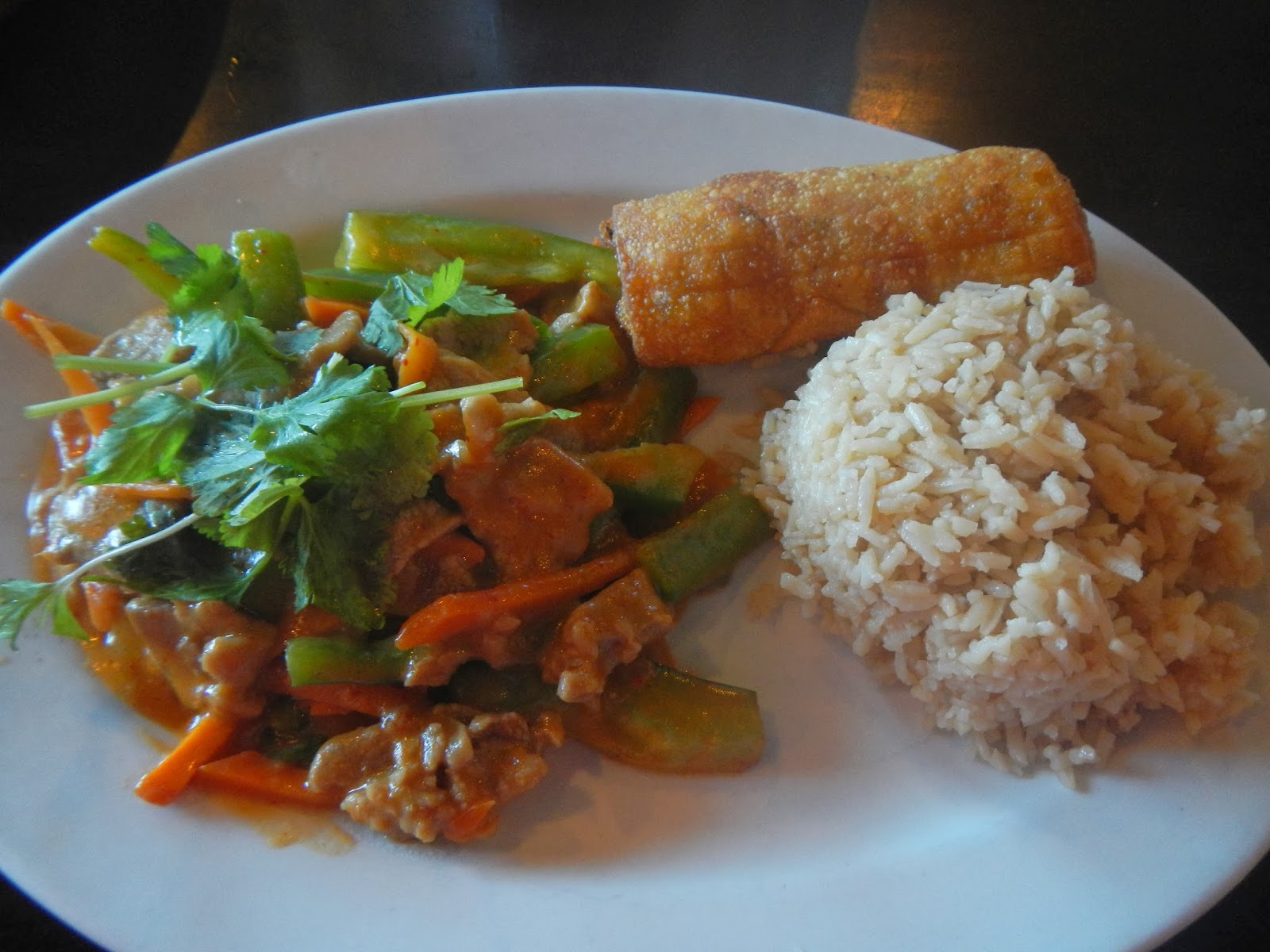
A few days later, we were out running errands and we stopped for lunch.  We had a 2 for 1 lunch coupon for the China Pearl Restaurant in Farragut Tennessee. It is now operating under new ownership and we thought this would be a good time to try it out.  We weren’t sorry!  It was all good… Laurie ordered the chicken curry with carrots, peppers, etc.?  She can’t really recall everything but she loved whatever she had!


I ordered the chicken with broccoli… Both of our lunches came with our choice of 3 different soups and an egg roll.  They even got the spice levels right with just enough heat in my sauce to make my head sweat!

Our cost for lunch with, taxes included but not including the tip, came to a grand total of $10.08!  If you’re in the area, give the ‘new’ China Pearl a try.  This restaurant is located in the same center as the Farragut Kroger Store at 11248 Kingston Pike (US Hwy. 11), in Farragut Tennessee.  Phone: 865-966-6937.


Dawn Marie once again joined us for Christmas in East Tennessee… Here we are decorating the Christmas cookies that Laurie made up.  Given my minimalistic artistic skills, I limited myself to about 3 cookies. We each really enjoyed decorating these cookies & of course, had to sample them to see if they were fit to consume!  Ha-ha J


Dawn was meticulous with her decorations.  She and Laurie decorated most of them.  They were the best Christmas cookies I’ve had in 5 years! The recipe Laurie used for the dough was from The Pioneer Woman, with a simple powdered sugar frosting with a bit more butter added.  She and Dawn like a butter cream frosting!

The recipe for the dough is as follows:1 1/3 c. butter
  • ·        1 ½ c. sugar
  •       1 1/3 c. butter 
  • ·        1 t. orange zest
  • ·        1 t. vanilla extract
  • ·        2 whole eggs
  • ·        3 T. whole milk
  • ·        4 c. all- purpose flour
  • ·        3 t. baking powder
  • ·        ½ t. salt 
Directions:
  • ·        Preheat oven to 350 degrees.
  • ·        In a large bowl, cream butter, sugar, orange zest and vanilla thoroughly.
  • ·        Add in the eggs and beat until light and fluffy.
  • ·        Add in the milk & mix.
  • ·        In a medium bowl, sift together the dry ingredients (flour, baking powder and salt) Then blend this into the creamed mixture.
  • ·        Wrap in plastic wrap and flatten into a disc shape and refrigerate for 1 or 2 hours or freeze for 20 minutes.
  • ·        Roll out dough and use cookie cutters of your choice to cut out shapes.
  • ·        Bake on parchment paper lined cookie sheets until golden brown, about 8 to 10 minutes.  Remove from oven and allow them to cool before frosting.

(Laurie wanted me to point out that the pan the cookies are on is not what she baked them on.  This pan is only used “normally” with foil lining it and we just grab it quickly to place the decorated cookies on to sit till they could be packed in tins.  They were only on the cookie sheet till she took the photo) 


Here’s yours truly cooking a big breakfast for us on Christmas Eve morning.  Laurie’s only complaint about my efforts to cook is that I am really messy!  On the other hand, she doesn’t fry anything…that’s my job…so she’s stuck with me if she wants a basic breakfast at home!


Here’s our breakfast spread…minus the English muffins.  Lots of cheese eggs made with sharp cheddar cheese, a touch of milk and lots of pepper; thick cut bacon from Costco; sausage patties…also from Costco; hash brown potatoes fried with butter, pepper, onion flakes and a touch of garlic powder.  The little plate at the top contained the remnants of Dawn’s Mexican meal from a couple of nights earlier.  She ate it with her eggs.  This was a very good breakfast!


We and 11 other friends were at Karen and Charlie’s for Christmas Day dinner.  It was excellent and we all had a great time!  Laurie tried to take a good photo of one of their cats, a Devon Rex named Ali.  What’s not to love about that face?!  Seeing as Devon Rex cats have no fur, Ali loves the heat.  The fireplace, a blanket or the top of any electronic device that is powered up are all popular spots for her this time of the year!  


Our cat J.D. loves heat too… He searches the house for sunshine but if that isn’t available, he’ll go for the fireplace or a nice bright table lamp.  He does run our house!  He tells us when to feed him, to let him out on the porch, to place a blanket on a lap for his comfort, etc.  He even tells us when it’s time to go to bed.  This latter habit ‘may’ stem from the fact that when its bedtime, he gets a snack, he’s played with one last time and he receives his evening massage. (No, I’m not kidding!  Laurie gives him a massage every night…)

Just click on any of the photos to enlarge them…

Thanks for stopping by for a visit!  I hope that it isn’t too cold where you are…


Take Care, Big Daddy Dave