Wednesday, August 19, 2015

First Stops in Nebraska – Wymore and Beatrice

We slipped across the Kansas-Nebraska State line as we continued our wandering journey to our son’s family home in the Omaha area.  We still had a little exploring to do and another overnight stay planned as well before arriving at our destination…


Our first stop was in Wymore Nebraska.  This is the “Lake Bridenthal House” which is located at 113 South 9th Street.  This home which was built in 1900 is a good local example of the Victorian - Queen Anne style.  Lake Bridenthal started out as a teacher, then became a bookkeeper and then he was the “cashier” for the First National Bank of Wymore for many years. (The position of cashier was the equivalent of a bank officer back in the late 1800s and early 1900s) Mr. Bridenthal was also the owner of a coal and lumber concern, Lake Bridenthal and Company. 

A town of roughly 1,400 residents today, Wymore was platted in 1881 as a railroad town, on land donated by Sam Wymore.  The "Welsh Capitol of the Great Plains," Wymore became home to generations of immigrants from Wales, who continued their culture in day-to-day life, founding a Welsh-language church, school and cemetery, as well as preserving the Welsh traditions of poetry, dance and intricate music.  In 2000, the Wymore Welsh Heritage Project was founded to preserve the legacy of these early settlers. It has since expanded to include a museum, an archive of genealogical records, and one of the largest Welsh-language libraries in North America.  To learn more, go to http://welshheritageproject.org/.

Factoids:

·       In the 2008 United States Census community survey, an estimated 1.98 million Americans had Welsh ancestry.

·       Nine U.S. Presidents had or have some Welsh ancestry.  Many performers, such as Bob Hope, Bette Davis and Taylor Swift also have some Welsh roots.  A list of famous Americans with Welsh ancestry is found at https://en.wikipedia.org/wiki/List_of_Welsh_Americans.


Our next brief stop was in Beatrice Nebraska.  This is the former Burlington Northern Railroad Depot at 101 North 2nd Street in Beatrice.  This relatively modern looking depot was actually built in 1906 for the Chicago, Burlington, and Quincy Railroad in the Neo-Classical Revival style. The building was constructed of Omaha pressed brick with Bedford stone trim at a cost of $35,000. ($1,900,000 in 2013 dollars)

Factoid:
On October 1, 1908, presidential candidate William Howard Taft stopped at this station to speak from his train.  A crowd estimated to number 12,000 had gathered to hear him speak.


The former depot was presented to the Gage County Historical Society by the Burlington Northern Railroad in 1973.  The building is listed on the National Register of Historic Places.  The Museum's displays include the history of people, railroads, industry, medical and Agriculture in Gage County.

Beatrice, with a population of about 12,000 is the county seat for Gage County.  The town was founded in 1857.  We didn’t really have time to explore Beatrice as I had another nearby historic objective in mind which would take some time to visit.  There are no less than 10 places and 2 districts in Beatrice which are listed in the National Register of Historic Places.  Maybe the next time…

Note:

·       In early May, about 3 weeks before we came through Beatrice, the Big Blue River flooded much of the town and it caused considerable damage at this museum.  It is closed until further notice and a fund raiser is underway.  If you visit the museum’s website you will be able to see a drone’s eye view of the flooding at a point where the water had receded somewhat.  http://www.gagecountymuseum.info/index.html.


Did you know that there are over 200 of these Statue of Liberty replicas in 39 states across the United States and in several of its possessions and territories?  I sure didn’t! 

This project was the brainchild of Kansas City businessman, J.P. Whitaker, who was then Scout Commissioner of the Kansas City Area Council.  The copper statues were manufactured by Friedley-Voshardt Co. (Chicago, IL) and purchased through the Kansas City Boy Scout office by those wanting one.  All of were erected in the early 1950's by Boy Scout troops and others to celebrate Scouting’s 40th anniversary theme, "Strengthen the Arm of Liberty."
The statues are approximately 8 1/2 feet tall without the base and they’re constructed of sheet copper.  They weigh 290 pounds and they originally cost $350.00 plus shipping. 

Factoid:

·       Right in front of the Beatrice ‘Liberty’ statue, there is a buried time capsule that is to be opened on July 4, 2057, 200 years to the date that the city’s founders celebrated on the same site.

That’s about it for now… Just click on any of the photos to enlarge them.

Thanks for stopping by for a visit!


Take Care, Big Daddy Dave

Monday, August 17, 2015

Historic Sites in Marysville Kansas (#3)

Marysville was our last stop in Kansas before we moved up into southeastern Nebraska…and eventually our son’s home in the Omaha area.  We visited the sites of 3 more locations that are listed in the National Register of Historic Places. 


This Mission Style building is the former Union Pacific Railroad Depot in Marysville.  It was built in 1927.  The town owes much of its prosperity over the years to the railroad. The railroad has been a major employer in the town for nearly 100 years.  Even today, over 60 trains pass through the town daily. 
However it took a while for all that rail traffic to come to town.  It all started with the completion of the “Topeka Cutoff” in 1911.  Constructed through some difficult terrain including part of the Flint Hills, this route cut about 100 miles off the coast to coast journey. 

Factoid:

·       Two United States Presidents have come through Marysville by train…President Theodore Roosevelt in 1912 and President Franklin Roosevelt in 1943.


This is a view of the back of the Depot.  I was encouraged to see some people working around the building, taking measurements and talking about needed refurbishments.

This classic depot almost fell to the wrecking ball!  Union Pacific had been set to demolish the building.  Passenger service was eliminated in the 1960s.  The depot has sat completely vacant since 2009. 

In the Marysville City Council voted to approve the purchase of the depot from Union Pacific for $151,000.  The railroad company also agreed to pay for the removal of the building’s exterior asbestos and lead paint.  The plan was that after the deal closed, the depot would be sold to the Union Pacific Depot Preservation Society for $20,000.  Part of this agreement allows the city to retain the surrounding land which can be sold to adjacent businesses and used for future development.


The old Marshall County Courthouse is located at 1207 Broadway in Marysville Kansas.  This 2-story Romanesque red building is highlighted with the 5+ story 8-sided tower over the front door.  The building was completed in 1892. 

This building served as Marshall County’s courthouse for nearly 90 years. By the 1970s many felt that it had outlived its usefulness and was too expensive to maintain.  The Marshall County Historical Society took the lead in generating public support to save it.  Eventually the county built a new courthouse next door and in 1979, the old courthouse was deeded to the Historical Society.
Over $200,000 has been spent since then to preserve and maintain it.  Initially some of the rooms were converted to display the growing collection of county history artifacts.  It’s now a full-fledged museum with 21 display rooms.

Factoids:

·       When the cornerstone for this courthouse was laid in July 1981, 3,000 people were there for the ceremonies and a parade!

·       The bonds that were issued back in 1890 and 1891 to help finance construction of the courthouse weren’t retired/paid off until 1941.


The Koester House/Museum was built in 1876 in four different stages as a wedding present from Charles Koester to his new bride Sylvia.  The house, at 919 Broadway, is decorated with items that all belonged to members of the family that lived there.  The brick retaining wall was built around the house in 1883 to keep water from Spring Creek from entering the property when the creek flooded.

Charles Koester was born in Germany in 1841 and he arrived in Marysville ca. 1859.  Mr. Koester was a merchant and a banker.  He served as the Marshall County Register of Deeds as well as County Treasurer.  He was also elected as a town Councilman and he served several terms as Mayor.


In 1878, a newspaper from Kansas City called the home’s yard to be the “most beautiful yard in the country”.  Many of the flowers and trees are still in place from their original plantings, including a buckeye tree that has been there for over a hundred years.  The Koester’s youngest daughter married but continued to live in the house her father had built until she died in 1968… Heirs donated the house to the city of Marysville in 1972, which explains the original furnishings.

The Marshall County Historical Society operates 3 museums in Marysville: The Pony Express Barn; The Old Courthouse, and; the Koester House.  The Pony Express Barn and the Koester House are closed from November through March except via appointment.  The Website for these museums is at http://www.marysvillemuseumsks.org/
  
For the next leg of our trip, we’ll be exploring part of Nebraska.  Just click on any of the photos to enlarge them…

Thanks for stopping by for a visit!


Take Care, Big Daddy Dave

Friday, August 14, 2015

The Pony Express – Marysville Kansas

Continuing with our exploration of Marysville Kansas… We headed to the downtown area to check out and visit a very specific location.


This is the only original Pony Express Home Station that is still located on its original site. (See Note below) The Marysville Pony Express stone barn was built in 1859 by Joseph H. Cottrell and Hank Williams.  In 1860, they contracted with Russell, Majors and Waddell to lease the barn as a livery stable for the Pony Express. The north end of the structure served as a blacksmith shop and stalls were on the other side.

Note:

·       Although all state and local references…as well as the sign in the photo above…refer to this stone barn as the original home station, the National Park Service states that the actual “Pony Express station was located in the Barrett Hotel, on the corner of Eighth Street and Broadway about one block north of the stable.”


This undated and retouched or enhanced photo from a postcard shows the Pony Express Barn as it probably appeared after the beginning of the 1900s.  Note the dirt or mud streets…but that pole could be either an electrical pole or an early telephone pole.

Notes:

·       The Pony Express Barn is the oldest existing building in Marshall County Kansas.

·       Marysville was the first home station on the Pony Express route west of St. Joseph, Missouri.


An annex was added to one side of the barn in the early 1990s.  This portion of the Pony Express Station/Barn complex serves as an interesting little museum with a wide variety of items on display.  In this photo you can see part of the museum’s doll collection on the right and a display of colorful wrenches on the half wall behind the 2-seated road version of a railroad handcar.  This handcar was built in 1900 by a blacksmith for his son.  The passengers simply worked that handle in the middle back and forth to make the handcar move.


Another section of the museum featured a variety of military uniforms from various eras.  Other displays include a large tool collection…far beyond just the colorful wrenches… as well as railroad lanterns, political buttons arrowheads, WPA period and ethnic dolls with dioramas of Kansas including Coronado and native American tribes, First Ladies of Kansas dolls from 1861 to 1955, barbed wire, an original steam engine, a thrasher and binder, a cornknife shoe, ball and chains (leg irons) from first jails of the area, and a large model train collection. 


This is what a rural mail carrier used on his route back in the 1800s and early 1900s.  This one was actually donated by the family of a mail carrier who began delivering mail in 1911.  Today the only time you’re likely to see a carriage like this is if you’re passing through one of America’s Amish communities. 


This 1915 Model-T Roadster was given to the museum by a local couple.  He had courted his wife in a Model-T Roadster and he wanted the museum to have one... He must have been a really romantic fellow!  The museum covers a lot of local history with most exhibits consisting of donations by local residents…


This reproduction Overland Stage Company stagecoach is very impressive.  Note the license plates on one wall and the antique rifles behind the coach.  The museum isn’t big but there is a lot to look at…  

Note:

·       The Butterfield Overland Stage Company, also known as the Butterfield Overland Mail Company, was the brainchild of John W. Butterfield.  In 1850 he enticed his two rivals, Wells and Company and Livingston, Fargo and Company, to merge with his organization, which was called Butterfield, Wasson and Company. This merger formed the American Express Company, the same company that operates under that name today!


The photo was taken inside the original 1859 barn portion of the museum.  Note the dirt floors.  This is a rope-bed bunk bed… The ropes served as the ‘box springs’ and the ropes would usually be covered with a thin mat stuffed with straw.

Note:

·       In June of each year the National Pony Express Association sponsors a Pony Express Re-Ride from Sacramento California to St. Joseph Missouri.  Each year they alternate the direction of the Re-ride, traveling East or West.  Over 550 riders and horses are posted at intervals to take turns carrying the mail.  Each rider takes an oath similar to that used in 1860-1861 and they are issued a Bible in the tradition of Russell, Majors and Waddell. 


The Pony Express Barn was constructed of native limestone.  It now contains the blacksmith hearth, a number of old wagons and a scattering other ‘teamster’ and Pony Express related items.  Note the ventilation holes.  They allow the air to keep circulating in the summer heat.

Notes:
·       The first westbound rider left St. Joseph Missouri early in the evening of April 3, 1860, arriving in Marysville the next morning.  Historians differ as to his identity, but tradition says his name was Johnny Fry.

·       Between April 1860 and October 1861, riders travelled day and night through all weathers to carry letters from St. Joseph Missouri to Sacramento California and back.  Each one-way trip usually took 10 days.  Riders changed horses every 12-15 miles and rode 75 to 100 miles before turning the mail over to a fresh rider at one of the 40 or so "home stations" along the route.


The museum has an informative video about the Pony Express that visitors watch before they start their tour.  Following the video, you tour the displays in the new portion of the museum before moving on into the old Pony Express Barn.  The whole experience was well worth the $4.00 admission charge! 

Note:

·       Sending mail by Pony Express was very expensive.  The original charge was $5.00 an ounce and 5 cents for every additional ounce.  Later the charges were reduced to $1.00 per ounce.  That would be the equivalent of $27.30 per ounce in today’s dollars.

The Pony Express Barn/Home Station is located at 106 South 8th Street in Marysville Kansas.  Trip Advisor shows 13 Excellent or Very Good reviews, 1 Average review and zero negative reviews.  The museum’s website is at http://www.visitmarysvilleks.org/mcocbusinesses/ponyexpbarn/ponyexpbarn.html.

That’s about it for now… Just click on any of the photos to enlarge them.

Thanks for stopping by to check out a legendary part of American History!


Take Care, Big Daddy Dave

Wednesday, August 12, 2015

Historic Sites in Marysville Kansas…

We were closing in on the Kansas-Nebraska state line but we had a few historic sites that we wanted to check out in Marysville Kansas…


Marshall County once had over 100 rural schools.  Improved transportation eventually made school consolidation possible.  The last rural school in the county closed in 1969.  Bommer School was moved to Marysville’s City Park from a rural site.  It was originally painted white.  It’s open for tourists to view in the summer.

Factoids:

·        Marshall County’s population peaked in 1900 with a census totaling 24,355 residents.  In 2010, the county’s census had dropped to 10,117.  Marysville, with a population of approximately 3,295, is the county seat.

·        In May of 1879, an F4 tornado passed through Marshall County.  This tornado had a damage path 800 yards wide, (almost a half mile), and 100 miles long.  A total of 18 people were killed and 60 were injured.

·        Marysville’s City Park also contains a ‘Soddy’, the type of house made from sod that many early settlers first built on the prairie.


Sitting just to the right of Bommer School in Marysville’s City Park is Union Pacific Steam locomotive #460.  This locomotive is a ‘Consolidated’ 2-8-0 type…so called because it has 2 leading wheels and the other 8 are consolidated in one grouping.  From its introduction in 1866 and well into the early twentieth century, the 2-8-0 design was considered to be the ultimate heavy freight locomotive.  The 2-8-0’s forte was starting and moving 'impressive loads at unimpressive speeds' and its versatility gave the type its longevity.


Production of the 2-8-0 type in the United States totaled more than 33,000 locomotives, of which 12,000 were export versions!  The 2-8-0 S160 Class of the United States Army Transportation Corps was built by American manufacturers and was designed for use in Europe for heavy freight work during World War II.  A total of 2,120 of this class were built and they worked on railroads all across the world. 

I couldn’t find any reference to events surrounding this locomotive and it’s completely fenced in.  It was donated to the city by Union Pacific Railroad in 1956.

Factoid:

·        About 50 percent of the Marysville's fox squirrels are coal black…an unusual variation.  Some squirrels show black patterns intermixed with normal coloration.  The best place to look for them is in the City Park.


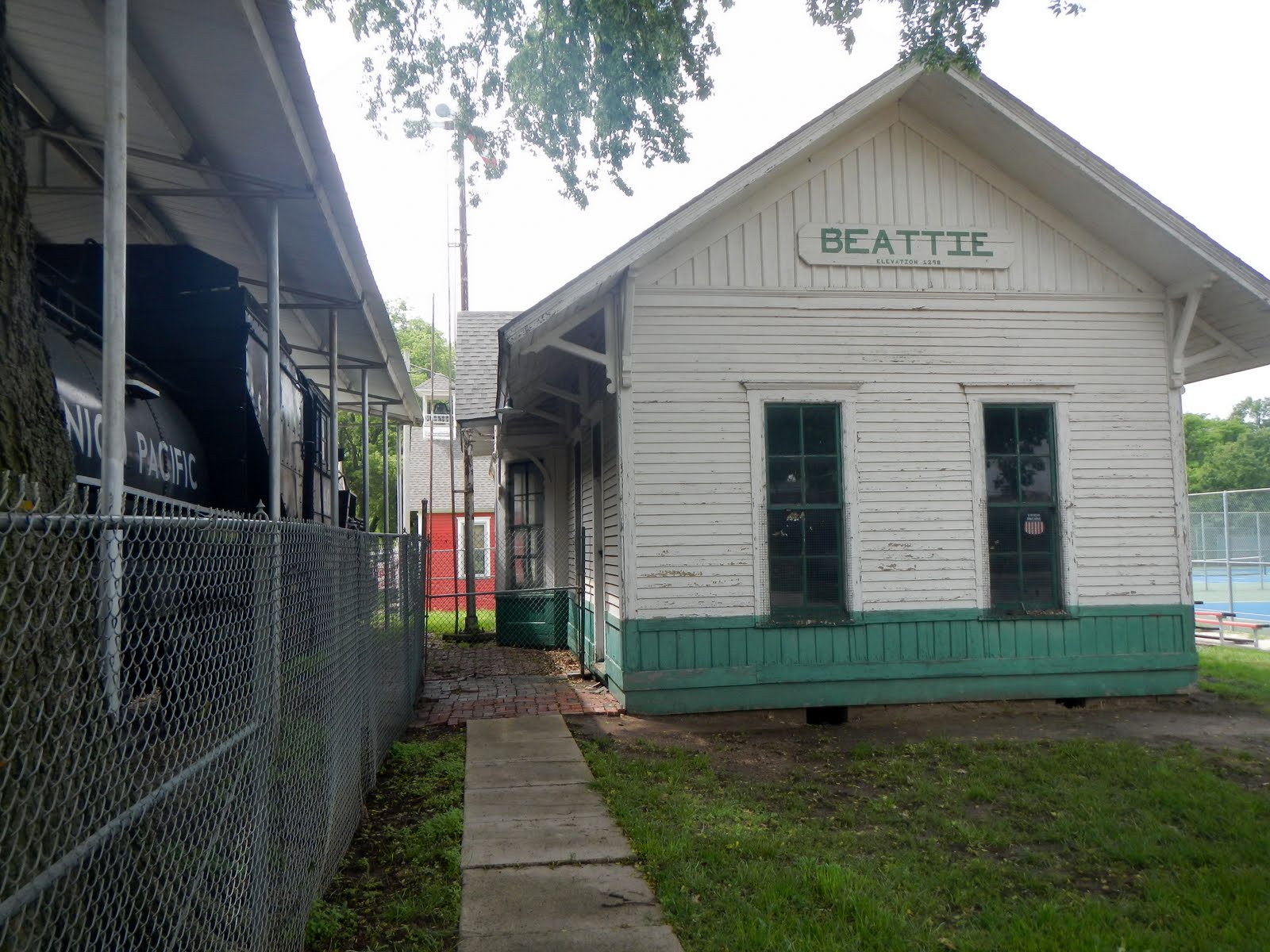
This old Union Pacific Depot is hidden behind the locomotive and it’s tender.  It was moved to this site in Marysville from Beattie Kansas, a small town in Marshall County with a population of about 200.  The railroad first came to Beattie in 1870.  It was known as the St. Joseph and Denver City Railroad and later as the St. Joseph and Grand Island Railroad.  There were many other name changes over the years... This depot dates back to 1901.

Factoid:

·        In order to get the railroad to come through Beattie, the two primary landholders who owned the town site agreed to give the railroad about half of the lots set out for the town’s development.


Beattie still had rail service in late 1938 as I found a Union Pacific schedule on-line that showed 2 eastbound and 2 westbound “Motorcars” daily.  They ran from Seneca Kansas to Marysville, a distance of about 32 miles, with stops along the way.  These self-propelled rail motorcars were much more commonly used in more heavily populated areas of the USA.  

I noted that the Union Pacific had bought 20 of these rail motor cars from the McKeen Motor Car Company, which was basically an offshoot of the railroad itself.  The company was charged with the development of a less expensive way to move passengers between smaller towns.  McKeen Motor Cars were never that successful due to inadequate motors but similar manufacturers subsequently improved on the concept.

Just click on any of the photos to enlarge them…

Thanks for stopping by for a visit!

Take Care, Big Daddy Dave


Monday, August 10, 2015

Off the Beaten Path! (East Central Kansas)

Driving north on US Hwy. 77 from Blue Rapids Kansas, I had a particular National Register Historic Site in mind… I knew that it was on a side road along the Big Blue River so I put the location in our car’s GPS system and off we went!


We passed this old abandoned stone farmhouse along the way.  It’s sad to see beautiful old structures like this slowly crumbling and falling down.  We wondered what stories it could tell…

FYI… While old homes like this just go mostly unnoticed and undocumented, there is an extensive list of Ghost Towns in the State of Kansas on Wikipedia.  You can go to https://en.wikipedia.org/wiki/List_of_ghost_towns_in_Kansas.
Then we came to the point where our GPS took us off US 77…


After about 200 yards we found ourselves on a muddy 1-lane dirt road with no opportunity to turn around.  So we forged on…with Laurie unhappy because her new low wheelbase car was throwing and accumulating more mud with every turn of the wheels!  The good news was that we didn’t get stuck and we eventually reached a muddy but passable 2-lane gravel road.  After several more miles we were able to ‘churn’ on to our destination…

The sign on the fence above reads “Emigrant Camp”.  We had arrived at Alcove Spring Historic Park.  This spot was a popular campsite on the Oregon Trail near the “Independence Crossing” of the Big Blue River.  We were definitely off the beaten path… It was another 20 minutes before we saw a local ranch truck roll by, the first vehicle we’d seen in about 45 minutes.


You could almost feel the spirits of those who had passed through this spot…as well as those who never made it past this point on the Oregon Trail. 

Alcove Spring is the final resting place for many emigrants, most notably Sarah H. Keyes, the mother-in-law of James F. Reed of that famous group of people...the Donner Party.  She was “buried at the foot of a monarch oak in a neat cottonwood coffin made by men of the party, and her grave was marked by a headstone."  The exact location of her grave is unknown today.

Note:

·       If you aren’t aware of the story related to the Donner Party, they were a group of American pioneers who set out for California in a wagon train. Delayed by a series of mishaps and mistakes, they spent the winter of 1846–47 snowbound in the Sierra Nevada Mountains.  Some of the migrants infamously resorted to cannibalism in order to survive.  To learn more, just go to https://en.wikipedia.org/wiki/Donner_Party.


Thousands of emigrants camped near this site while waiting to cross the Big Blue River, which was frequently in flood stage when they reached this part of their trip.  While Native Americans and trappers had certainly used the site previously, it was ‘rediscovered’ in 1846 when the Donner party was delayed by high waters on the Blue River.

Note:

·       John C. Fremont camped near there on one occasion.  He was an American military officer, explorer, and politician who became the first candidate of the anti-slavery Republican Party for the office of President of the United States. During the 1840s, he led 4 expeditions into the American West.  Accordingly the press and many historians of that era called him “The Pathfinder.”


I took this photo of Laurie looking down the walkway leading down to Alcove Springs.  We didn’t venture very far into the surrounding fields and forest as everything was soaking wet or partially underwater. 

Notes:

·       One of the first emigrant groups to cross the Big Blue River at Independence Crossing was the Bidwell-Bartelson Party in 1841.  Nancy Kelsey, who was a member of the group of pioneers, is believed to have been the first white woman to cross the Sierra Nevada Mountains.

·       Its significant to point out that this area was mostly devoid of trees except along larger streams when the settlers passed through here.  During most of their journey across the plains, they wouldn’t have seen much except for miles and miles of tall prairie grass.


Due to the wet conditions and standing water, this ‘borrowed photo’ shows what we missed…the spring and its accompanying waterfall!

The site is well known for the waterfall shown above which is near the spring.  It is called Naomi Pike Falls after the young member of the Donner-Reed party.  Its water is supplied by a wet weather spring.  Consequently, there is only a waterfall in the spring of the year.  By early summer it ceases to flow.  There are many carvings on the ledge of the waterfall and rocks in the surrounding area. Some of the carvings are thought to date from the emigrant era.
 

This wagon swale marks the trail or path of hundreds of wagon trains that moved along the Oregon Trail.  It’s amazing to us that this evidence of their passing is still clear to those who are looking for it… This meadow was a campground for the emigrants and it has many wagon swales traveling from north to south that led to Independence Crossing, where the wagons crossed the Big Blue River.

Note:

·       Marshall County Kansas, where this park is located, is the “Trails Capital of Kansas”.  Parts of at least 9 historic trails pass through the County.  In addition to the Oregon-California Trail, they include the following: Pony Express Route; Overland Stage Route; St. Joe Road; Otoe Trail; Pike’s Peak Trail; Military Road; Chisolm Trail, and; The Mormon Trail. 


The Alcove Spring Historical Park is owned by the Alcove Spring Historical Trust of Blue Rapids and operated by the Alcove Spring Preservation Association.  In 2006, Alcove Spring was named a "Certified Historic Site" by the National Park Service.  They’ve erected this little shelter with information permanently posted on the walls to inform visitors about the history of this place. 

Note:

·       The Topeka Symphony Orchestra will be traveling to Marshall County this September for an outdoor concert at Alcove Spring Historical Park.  “The Orchestra on the Oregon Trail Concert” will be at 6 p.m. Sept. 6 on a meadow at the historic park along on the Oregon-California Trail.  This event will kick off the Orchestra’s 70th Season.  Other activities will include tour-guided and self-guided nature walks, wagon rides, a pioneer encampment, other musical acts, food and cowboy poetry.  Dancing, stargazing and ghost tours will follow the concert.


The road leading us out of the Alcove Spring Historic Park led us through an area that is very lightly populated… There were a few ranches or farms but they were quite scattered.  A number of deserted stone and wood farmhouses sat along the road.

It turned out that there were better roads into the Alcove Spring Historic Park than the one we took to get there.  While they were all gravel, they were wide and fairly smooth.  You can’t always just rely on you GPS for the ‘best’ route!


We passed one farm or ranch that had a number of peacocks on the property.  They aren’t something that you normally see in rural America…especially in the prairie states.

Note:

·       During the Medieval period, the poorer populations (such as serfs) consumed more common birds, such as chicken.  However, the more wealthy gentry were privileged to less usual foods, such as swan, and even peafowl were consumed. On a king's table, a peacock would be served as much for ostentatious display as for food. 


One more very large deserted and gloomy stone house along the route.  Its appearance matched the weather and the feeling of the emigrant’s presence back at Alcove Springs Historic Park…

While looking around the Internet, I came across a You Tube video that features deserted farm houses in Kansas.  The video provides some striking images even if they are simultaneously a bit sad… You can have a look at https://www.youtube.com/watch?v=ypjL5IMPnns.

(We finally got all the mud off the car when we arrived in Omaha. Laurie was very happy!)

Just click on any of the photos to enlarge them…

Thanks for stopping by for a visit!


Take Care, Big Daddy Dave