Wednesday, January 20, 2016

Charleston SC – Walking Tour II

Charleston is very different than New Orleans but in a couple of ways there are similarities… Both are a mecca for fans of American history and both are cities where a person really needs to put on their walking shoes!  Fortunately for my aging bones and joints, Charleston is a much small place to explore…


This is the main entrance to Charleston’s famous City Market.  As per the Market’s website, it is the city’s most visited attraction and it’s been the cultural heart of Charleston since 1804. 

In 1788, Charles Cotesworth Pinckney ceded the land to the City of Charleston for the express use as a public market, and he cleverly stipulated that the land must remain in use as a market for perpetuity. (C.C. Pinckney and his cousin Charles Pinckney were both signers of the US Constitution) To learn more, you can go to http://www.archives.gov/education/lessons/constitution-day/signers.html.


This is the interior of the building shown in the first photo.  In 1841, a few years after the Masonic Hall adjacent to the Market was destroyed by fire, the current Market Hall was erected.  This building was originally used by the Market Commissioners for meetings and social functions, while the space beneath the hall housed vendors.

In 2011, the newly refurbished City Market reopened to the public.  The centerpiece of this historic landmark is the Great Hall.  For folks who don’t like heat and humidity, the good news is that the portion of the Market under the Great Hall with its 20 vendors is now enclosed and air-conditioned! 


To meet Pinckney’s requirement, between 1804 and the 1830’s the city built a number of low buildings—sheds—that stretch from Market Hall to the waterfront.  Today vendors sell everything from clothes to candles, food items, souvenirs (including sweet grass baskets), jewelry and artwork.
 
These sheds originally housed meat, vegetable, and fish vendors.  Over the 2 succeeding centuries, the sheds have survived many disasters, including fires, tornadoes, earthquakes, hurricanes, and bombardment.  In 1944, during World War II, the economy stalled and only 4 vendors remain in operation.  However in 1973 the Charleston City Market was placed on the National Register of Historic Places.  That resulted in a resurgence of popularity and eventual remodeling and updating of the facilities.

To learn more about Charleston’s City Market, you can go to http://www.thecharlestoncitymarket.com/.     


This is the Old Exchange and Provost Dungeon… It was built in 1767-71 and it has served a variety of functions, including as a prisoner of war facility operated by British forces during the American Revolutionary War.  The building was designated a National Historic Landmark in 1973.  The Old Exchange is currently a museum operated by the Daughters of the American Revolution.  For information on the museum, you can go to http://oldexchange.org/.

Notes:

·       In World War I, the building served as the army headquarters of General Leonard Wood and the United States Lighthouse Service—the latter having been in the building since the late 1800s.

·       In World War II, the building not only served as a USO facility and canteen for troops, but served as the Coastal Picket Station for the Sixth Naval District of the United States Coast Guard.

·       In 1965, the Half-Moon Battery, a 1698 fortification, was discovered underneath the building.


We love Charleston’s side streets in the historic center of the city!  Cobblestones combine with the historic buildings and the greenery to create a city environment unlike few others in North America.  A side benefit for these neighborhoods is that unless a person is totally drunk or ‘stoned’, no one speeds down these streets!

Notes:

·       "Cobble", the diminutive of the archaic English word "cob", meaning "rounded lump", originally referred to any small stone rounded by the flow of water; essentially, a large pebble. It was these smooth "cobbles", gathered from stream beds that paved the first "cobblestone" streets.

·       A major change in Charleston streetscapes came from cobblestones that were used as ballast in the holds of colonial sailing ships.  These oblong stones were often dumped on city wharves to make more room for valuable cargoes of rice and cotton, offering a new form of landfill. By the 1720’s the city had officially gotten into the act, offering sea captains tax-free port visits in return for ballast stones, and by the late 18th century, provided pavement for more than 10 miles of streets.

·       According to an old Charleston historic lore, the best remedy for an extended pregnancy was a ride down Chalmers Street, whose bumpy cobblestones worked their magic often enough to earn the street the nickname “Labor Lane”.


This is one of many historic private homes, (not open to the public), in Charleston that has a documented history with a sign posted on the structure by the Preservation Society of Charleston that documents its history.  The Society has placed over 100 markers throughout the old city, with at least 46 on historic homes.  Markers are made available to homeowners at cost plus a small donation to the Society.  

The Caspar Christian Schutt House was built on Bay Street 1892 for Mr. Schutt, who was a successful merchant of German descent.   As was the practice in those days, he operated his business from on the first floor and used the 2 upper floors as his residence.  The lot is quite deep and the property also includes several of the original structures, including a kitchen house, carriage house, servants’ quarters and stables.


This historic home is open to visitors.  The Edmondston-Alston House was built in 1820 on the foundation ruins of Fort Mechanic, which was located here in the late 1700s.  The home was built for shipping merchant Charles Edmondston, a Scottish immigrant from the Shetland Islands.  He’d purchased the low sandy lot in 1817 and when the city built its seawall in 1820, he started building his home.

Charles Alston, a successful South Carolina Lowcountry rice planter and rice producer, bought the property in 1838 for $15,500.  Ownership has remained with the Alston family ever since then!  The house, which was converted to a museum in 1973, is managed by Middleton Place Foundation.  If you would like to visit this historic property, the related website can be found at http://edmondstonalston.com/.  

Notes:

·       General P. T. Beauregard, the Confederate commander who gave the order to fire cannons on Fort Sumter that started the American Civil War, watched the bombardment from the house porch on April 12, 1861.

·       General Robert E. Lee also stayed overnight at the house in 1861.

·       The Edmondston-Alston home is located at 21 East Battery Street.  If you’re in the market for a home in Charleston, there is currently one for sale that is located at 29 East Battery.  Asking price is ‘only’ 4,395,000!


As I mentioned earlier, Charleston built its original seawall in 1820.  The original High Battery seawall, which was reconstructed in 1893-1894, is comprised of a stone wall on the seaward side that is backed by two (2) masonry/concrete walls approximately 10 feet apart.  The space between the two walls is backfilled with soil and the top is capped with stone slabs to create a walkway or promenade.  East Bay Street parallels the seawall…with the harbor view from the homes along the street creating some of the most desirable real estate in Charleston…


As I really like ships…I thought that I’d end this particular posting with a couple of ship sightings from Charleston’s seawall.  The first sighting was of the huge car carrier Tosca as it left port… (At this writing, that ship was moored in the port of Bremerhaven Germany)

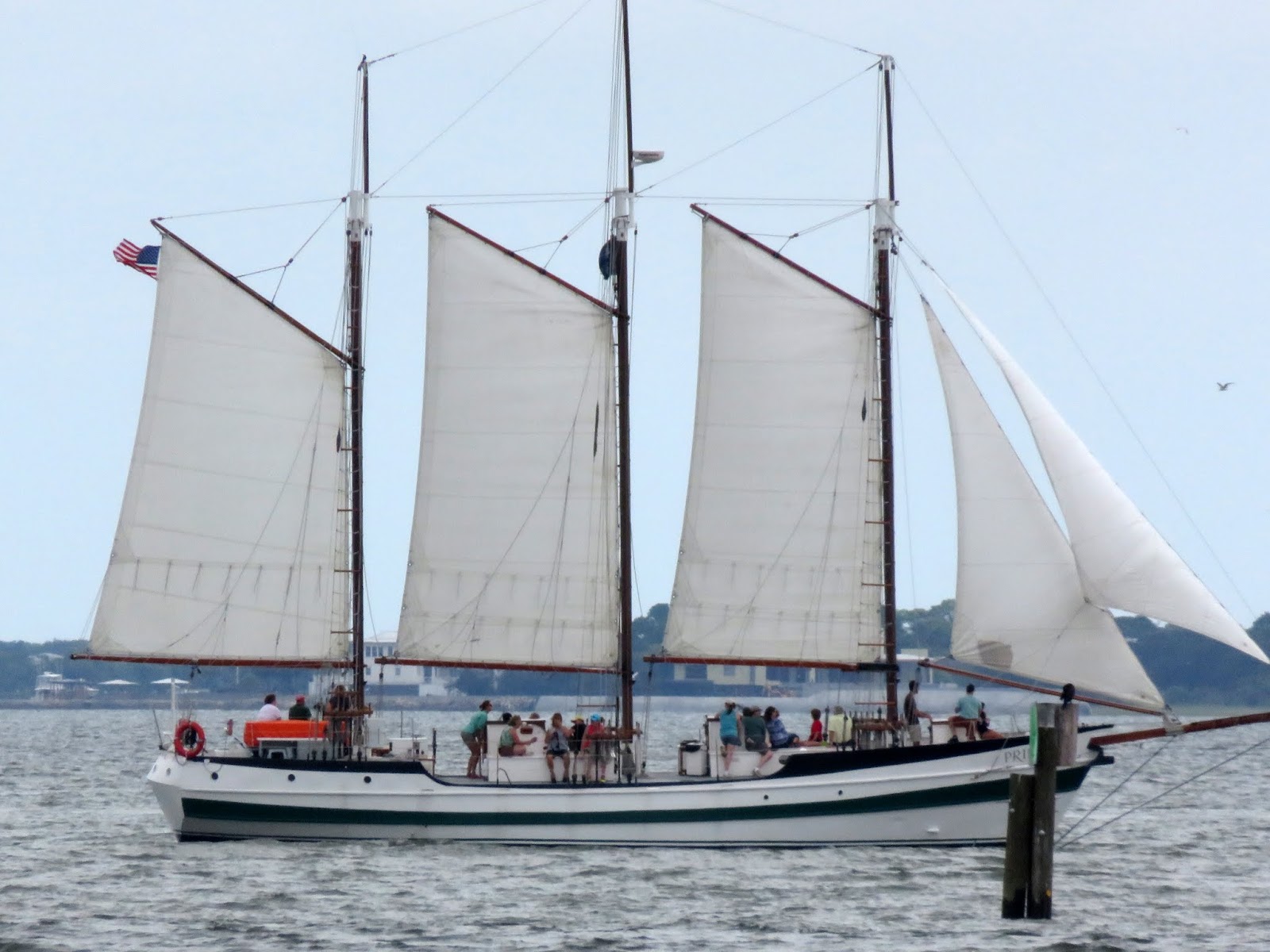
The second vessel is the schooner “Pride”.  It’s an 84 foot tall ship that provides tours of the harbor and it’s a replica of 18th Century schooner that once served Charleston.  This 2-hour tour isn’t typical in that it isn’t a narrated tour.  It’s really just a way to enjoy the serenity of Charleston Harbor with its beautiful views without having to listen to someone drone on about the city’s history and sights. (Yes, the crew is knowledgeable and they will answer your questions) To learn more, just go to http://www.schoonerpride.com/.

Just click on any of the photos to enlarge them…

Thanks for stopping by for another tour!


Take Care, Big Daddy Dave

Monday, January 18, 2016

Another Broken Egg – Charleston SC

We were at Charleston’s historic City Market and we’d been shopping for a while with Laurie’s sister Bonnie and her husband Bill. (The City Market dates back to the 1790s) Then the big question came up… Where to grab a bite to eat? 

As shopping is one of my least favorite pastimes, I’d already been scouting the restaurants on either side of the City Market for possibilities…so when the time came, I knew where we were going for lunch.


This is Another Broken Egg Café in old town Charleston.  While I’d never heard “Another Broken Egg Café”, it turns out that this is one of 52 current locations for this rapidly expanding breakfast/brunch restaurant chain. 

This franchised restaurant group now operates in Alabama, California, Florida, Georgia, Indiana, Kentucky, Louisiana, Mississippi, North Carolina, Ohio, South Carolina, Tennessee and Texas.  About 31 new restaurants are opening soon…which will include the company’s first locations in Arkansas, Colorado and Oklahoma.


The interior of the old town Charleston location is roomy, bright and cheerful… Despite the table that hadn’t been cleared when I took this photo, service was good and the restaurant was clean.  Another Broken Egg Cafés are open daily from 7 AM to 2 PM.  It was toward the end of their work day when we stopped by for brunch…


Here’s another view of the attractive interior of Another Broken Egg Café…with sisters Bonnie and Laurie framing the photo.


Laurie and Bonnie weren’t all that hungry so they split the Turkey, Brie and Pesto sandwich with a side of seasoned country potatoes. ($10.89) The sandwich consisted of smoked turkey, brie cheese and house made almond pesto, served on artisan bread.  The potatoes were good but the sandwich was very good indeed!


Bill opted for Stan’s Mardi Gras Omelette. ($11.99) This creation consists of crawfish, shrimp, Andouille and red peppers, then topped with tomato Hollandaise, green onions and tomatoes.  As you can see, it was accompanied by an English muffin and the seasoned country potatoes.  Bill said the he enjoyed this creative omelette and that he’d order it again…

The menu at The Broken Egg Café is expansive, interesting and extensive!  Segments of the menu include: Apps for Sharing; The Healthy Side; The Yolk; Egg-Straordinary Omelettes; Signature Benedicts; Scrambled Skillets; Salad Creations; Burgers and Sandwiches; Specialty Brunches; On The Side; Juiced Up; Beverages, and; Belly Up.


This was my breakfast… It’s the Cinnamon Roll French Toast. ($10.99) This heap of goodness consisted of a thick sliced cinnamon roll grilled with French toast batter, layered with cream cheese icing, Bananas Foster sauce, mixed berries and whipped cream.  It was excellent and my sweet tooth was satisfied for another couple of days…

As you might be able to tell, we really liked this imaginative upscale breakfast and brunch restaurant.  We only wish that they’d open a restaurant in Knoxville or Farragut Tennessee!  The old town Charleston South Carolina “Another Broken Egg Café” is located at 99 Market Street.  Phone: 843-202-0417.  The company website with location information and the menu can be found at http://www.anotherbrokenegg.com/.

Just click on any of the photos to enlarge them…

Thanks for stopping by for a late brunch!

Take Care, Big Daddy Dave


Friday, January 15, 2016

Our Tour of Ft. Sumter in Charleston’s Harbor

If you visit the Charleston South Carolina area, it’s important to immerse yourself in a little of the history that permeates this city and its environs.  We’d been to Ft. Sumter before, many years ago, but Laurie’s sister Bonnie and her husband Bill had never been to the area…


Since Fort Sumter is built on an island near the entrance to Charleston’s harbor, the only way to access this National Monument is via either a private boat or a tour boat.  Our first stop was the tour boat terminal...

This is a replica of the 33-Star garrison flag that flew over Fort Sumter in 1861.  It’s sometimes called "the flag that started a war."  I didn’t know this but ever since the Mexican-American War (about 1845) the Army had followed an unofficial tradition of using a "diamond" pattern for the stars on their garrison flags. The Fort Sumter flag is a good example of this practice.


The boarding point for the Fort Sumter tours is in downtown Charleston at Liberty Square, adjacent to the South Carolina Aquarium.  The facility is very nice with extensive displays regarding South Carolina  and Charleston history.

South Carolina was the first state to ratify the Articles of Confederation and the eighth state to ratify the U.S. Constitution on May 23 1788.  South Carolina was the first state to vote to secede from the Union on December 20, 1860.  After the American Civil War, it was readmitted into the United States on June 25, 1868.

Note: In 1860, there were 402,406 slaves in South Carolina…out of a total population (black and white) of 703,708.  During the Civil War, South Carolina recorded 18,666 military deaths, which was nearly one-third of the white male population of fighting age.


The SpiritLine Cruises, which operates the Fort Sumter tour boats, has a fleet of 4 boats.  In addition to the “Spirit of the Lowcountry” shown above, they have the “General Beauregard”, the “Spirit of Charleston” and the “Spirit of Carolina”.  The Spirit of Lowcountry is 93 feet long.  She may look really old but this boat was built in 1986.

Note: It was interesting to note that this vessel has had 3 other names…and that she has ties with East Tennessee where we live. Her previous names were “River Queen”, “The Star” and the “Star of Knoxville”.


We sat at the stern of the tour boat on the upper deck.  While this late September tour wasn’t packed, there was still a big crowd visiting Fort Sumter.  Despite the fact that visitors must reach the Fort by boat, recent attendance numbers totaled over 850,000 per year…

The tour boats make between 3 and 6 trips to Fort Sumter each day, depending on the time of the year.  No tours operate on Thanksgiving, Christmas Day or New Year’s Day.  For more information, just go to http://www.fortsumtertours.com/.


These views show historic Charleston from the harbor… Charleston was originally named Charles Town…after King Charles II of England.  The city was moved to its current location in 1680.  Many of the homes, churches and other structures date back to the 19th and even the early 18th century.  When you consider that the city is exposed to the Atlantic Ocean and its storms, despite flooding and damage over the years, this beautiful waterfront is still relatively intact. 


This is a photo of Fort Sumter taken from the pier where the tour boats dock.  When you consider its importance to our history, at first glance it’s not all that impressive.


Here is a much better photo of the Fort from the water…taken by a professional photographer on a clear day with good lighting.

Fort Sumter was one of a number of many special forts planned by the Federal Government after the War of 1812.  It combined high walls and heavy masonry for maximum structural integrity. Work on the fort started in 1829, but was still incomplete in 1860 when South Carolina seceded from the Union. 


This is a view of some of the cannon positions at Fort Sumter.  The park's collection of cannons at nearby Fort Moultrie and Fort Sumter from the period from 1830-1890 represents the best grouping of historic seacoast artillery in the United States.  Fort Sumter alone possesses 40 cannons of various types.  A preservation program, called “Adopt-a-Cannon” raises funds for the preservation of these pieces of history. 

Note: While I think that such fund raising programs are admirable and valuable to our efforts to maintain our National Parks and Monuments, I despair at the lack of funding from our Federal Government. 

The National Parks have almost 300,000,000 million visitors per year and they protect 84,000,000 acres…all on a budget of about $3,000,000,000.  That sounds like a lot doesn’t it?  The National Parks employ about 22,000 full, seasonal and part-time associates, or 1 for every 3,800 acres.  By way of comparison, in order ‘support’ our 435 Representatives and 100 Senators in Congress, the salaries for their staffs total roughly $666,000,000!  Our Congressmen and women employ about 9,500 people… Enough for my soapbox for today!


There are several locations throughout the fort where the shells from the fort’s bombardment are still buried in the walls.

The First Battle of Fort Sumter began on 12 April 1861, when Confederate artillery fired on the Union garrison. These were the first shots of the war, and continued all day, watched by many civilians in a celebratory spirit.  The fort had been cut off from its supply line, and the garrison surrendered the next day.  


After the fort was occupied by the Confederate Army, it remained under their control until February 17, 1865, with the Union Army’s advance on Charleston under the command of General Sherman.  From April of 1863, the fort was under almost daily bombardment and assault by Union forces but it was never captured until the Confederate forces abandoned the ruins.  The Union Army had poured over 7 million pounds of metal shells into the fort in its effort to retake it!  

Keep in mind that the original fort was a five-sided brick structure, 170 to 190 feet long, with walls 5 feet thick, standing 50 feet over the low tide mark.  It was designed to house 650 men and 135 guns with 3 tiers of gun emplacements, although it was never filled to its full capacity.  To learn more and to get an idea of the destruction and to appreciate that anything is left standing, check on the photos on Wikipedia at https://en.wikipedia.org/wiki/Fort_Sumter


The museum located at Fort Sumter is very interesting and it leads you through the history of the fort and the Union and Confederate actions during the Civil War. 

Some exhibits are shown in the collage above…from left to right starting at the top: South Carolina Confederate Palmetto Guard Battle Flag; A model of Fort Sumter before the destruction; some of the pictorial displays in the museum; a standard rifle and ammunition case; various shot and shells that were used in the various assaults on the fort; the Stars and Stripes Fort Sumter Battle Flag, and; a handbook on rifle care and use along with a regulation hat used by the US Army Heavy Artillery units during the war.

To learn about visiting Fort Sumter, you can check it out on the National Park's website at http://www.nps.gov/fosu/index.htm.


On our way back to Charleston on our tour boat, we took a photo of the 8-lane Arthur Ravenel Jr. Bridge that connects Charleston with Mt. Pleasant South Carolina across the Cooper River.  The bridge has a main span of 1,546 feet and it’s the third longest among cable-stayed bridges in the Western Hemisphere.

Note: Arthur Ravenel Jr. is a retired conservative Republican politician, a former Congressman and Senator, who has been the center of a few controversies.  There was even a move to rename the bridge because of some of his utterances…


As we neared the tour boat’s pier I took this photo of this big cargo ship.  She is the M/V Tosca and she is a Pure Car/Truck Carrier, part of the Wallenius Wilhelmsen Logistics’ global fleet.  This ship was built by Mitsubishi Heavy Industries and it has the capacity to carry up to 6,500 vehicles.  Wallenius Wilhelmsen Logistics is based in Oslo Norway.

FYI, the Port of Charleston has 5 public terminals that are owned and operated by the South Carolina Ports Authority. There are additional facilities in the port that are privately owned and operated.  In 2012, the port processed cargo valued at $63,000,000,000!

That’s about it for now.  Just click on any of the photos to enlarge them…

Thanks for stopping by for the tour!

Take Care, Big Daddy Dave


Wednesday, January 13, 2016

Dining with the Swamp Fox in Charleston!

In preparation for our trip, I had spent hours researching Charleston’s historic buildings, attractions, tours and dining opportunities.  I wanted to ensure that we hit the high points in all respects!

However, when it came to dining, I will admit that it didn’t work out as I had planned… With only one exception we ended up stopping for breakfast, lunch or dinner at restaurants that we impulsively stopped at or that someone else had suggested… 


We’d spent a few of hours walking the streets and sightseeing in the downtown area of Charleston…alternatively using their free bus core city bus system as well.  We were close to our Hampton Inn, we were whipped and we had no desire to travel very far to have dinner on our first night…

That’s when we passed the Francis Marion Hotel with its aptly named restaurant, Swamp Fox.  We checked out the menu shown on the wall above and said, “This is the place!”

Note: For those of you who aren’t familiar with the Swamp Fox, aka. Francis Marion, he was a military officer who served in the American Revolutionary War.  He was a persistent adversary of the British in their occupation of South Carolina in 1780 and 1781.  Due to his irregular methods of warfare, he is considered one of the fathers of modern guerrilla warfare, and is credited in the lineage of the United States Army Rangers. He was given the name, the ‘Swamp Fox’ by a British officer who gave up after pursuing Marion through 26 miles of swamp.


This is the interior of the Swamp Fox Restaurant in the Francis Marion Hotel.  It wasn’t fancy but it was perfect for 4 casually dressed worn out tourists looking for some decent food!  FYI…Service was excellent!


The two ladies both ordered the house special adult beverage, the “Swamp Fox”. ($9.00) This mixed drink is a blend of vodka, lemonade, brewed unsweetened ice tea and fresh mint.  They gave it two thumbs up!


I ordered this Half Caesar Salad to accompany my entrée. ($6.00) Unlike many others I’ve eaten in the last couple of years, I could actually taste the anchovy!  It was a very nice salad…


Bill ordered the Fried Chicken Livers with brown gravy, peppers and onions as an appetizer. ($9.00) He said that they were very good indeed!


Bonnie and Laurie took advantage of the fact that this was the last day of “Restaurant Week” in Charleston.  These special dinner packages cost $33.00 each.  Both of them ordered the South Carolinian She Crab Soup with her meal. (Normally $4.00 for a cup) The soup came with a nice hunk of crusty bread.  This was a winner!


I convinced myself that I should try the Chicken N’ Waffles…fried chicken with jalapeno bacon cornbread waffles, mustard “Q” sauce and South Carolina goat cheese grits substituted for collard greens. ($19.00) I really liked the grits and the fried chicken with the mustard based “Q” sauce.  However, I still don’t understand the synergy between fried chicken and waffles…even jalapeno bacon cornbread waffles!


For his entrée, Bill went with the Low Country Catfish. ($21.00) It came with pecan and blue crab coleslaw and grilled tomato tartar sauce.  He opted for the collard greens instead of French fries.  This was another winner!


Both of the ladies ordered the Crab Cakes with Carolina red rice, grilled asparagus and lemon caper sauce. ($24.00) Both of them were very happy with their entrees! 


Following a very nice dinner, our very accommodating and helpful waitress Emily, took this photo of our little group… (From left to right; Bonnie, Laurie, myself and Bill)


Just to end on a 'sweet note', in the preceding photo, you might have noticed that both of the ladies had a dessert in front of them.  Here’s a close-up of happiness!  It was part of their special dinner package… Laurie let me have a taste and it was excellent!

We walked in off the street and we SCORED!  Swamp Fox serves some quality cuisine in a casual setting…far above the average for a hotel restaurant.  Of course, to compete in Charleston, you must have good food or you’d be out of business.  It is important to note that the Swamp Fox Restaurant has been serving diners since 1924…so they must be doing something right!

The Francis Marion Hotel and the Swamp Fox Restaurant are located at 387 King Street in Charleston.  Phone: 843-724-8888.  Restaurant Website: http://francismarionhotel.com/dining/.

…and so ended a successful first day in Charleston.  Just click on any of the photos to enlarge them.

Thanks for stopping by for dinner!

Take Care, Big Daddy Dave


Monday, January 11, 2016

Exploring Charleston South Carolina (#1)

On our second trip in September, we were joined by Laurie’s sister Bonnie and her husband Bill and we set off to explore Charleston South Carolina for a couple of days, followed by a visit to Carolina Beach North Carolina. 

It was a beautiful afternoon when we began looking around historic downtown Charleston…


This is the Vendue Wharf at Charleston’s Waterfront Park.  This park is located in an area which had historically been a center of maritime traffic with several wharfs and shipping terminals.  It had fallen into decline and decay over time.   The park opened in 1989 despite suffering over $1 million in damage from Hurricane Hugo only a week earlier.
 
Vendue Wharf is a wide, wooden pier at the north end of the park which extends into the Cooper River and offers sheltered swings for visitors.  A floating dock is attached at the far end which offers some great views…


Among the views from the floating dock at the end of Vendue Wharf is this one of Castle Pinckney.  The ‘castle’ was a small masonry fortification constructed in Charleston’s harbor in 1910 by the United States government.  An original log and earthen fort, built in 1797 and named after the Revolutionary War hero Charles Cotesworth Pinckney, was virtually destroyed by a hurricane in 1804.
 
Note: On December 27, 1860, one week after South Carolina seceded from the Union, the fort was surrendered to South Carolina militia by its small U.S. Army garrison.  The garrison then retired to Fort Sumter to join Major Robert Anderson in defending that location.  Castle Pinckney became the first Federal military installation seized forcefully by a Southern state government during the Civil War.


Another spectacular sight from that floating dock is the retired Aircraft USS Yorktown which is moored across the Cooper River at Patriot’s Point. (Much more about Patriot’s Point will follow in another posting…)


This is a photo of Laurie’s sister Bonnie and her husband Bill on the Vendure Wharf… Note the beautiful salt marsh tidal grasses behind them.


More photos of our little group followed…including this one of Laurie and her sister.


Charleston’s Waterfront Park received the 2007 Landmark Award from the American Society of Landscape Architects and the National Trust for Historic Preservation.  This award "recognizes a distinguished landscape architecture project completed between 15 and 50 years ago that retains its original design integrity and contributes significantly to the public realm of the community in which it is located."  It is indeed a beautiful setting…


Of course, it was just a matter of time before Laurie took a picture of Bill and yours truly! 


The 12 acre park is about a quarter mile long.  Part of it is occupied by a dense canopy of oak trees and many benches.  Parallel to the shady portion of the park and immediately adjacent to the riverfront, is an open lawn landscaped with palmetto trees.  In the middle of the grassy lawn is the Pineapple Fountain as shown above. 

We had a lot of walking and exploring to do so we didn’t walk on down to the south end of the park.  It is the location of North Adger’s Wharf.  A 17th century pier was rebuilt in the original footprint of the old wharf, using original granite which was fished out of the river and reused.  The ‘new’ pier was reconstructed using log cribbing construction of native palmetto trees that should last for many generations.


The fact is that just about everything in old Charleston has a certain beauty and charm… Even this cemetery we passed on our walkabout projects a quiet and dignified picture.


We liked this ironwork and these classy old wooden doors…which comprise the entrance to St. Mary's Roman Catholic Church at 89 Hasell Street.  This church is the third one to house a catholic congregation on this site.  The current ‘new’ structure was completed in 1839. 


If you’ve never been to Charleston, it really is one of a kind.  My feet will testify that the core old town portion of the city is quite large and very well preserved.   Most streets are narrow and traffic doesn’t exactly wiz along!

Charleston is the oldest and second-largest city in South Carolina.  It was founded in 1670 as Charles Town in honor of King Charles II of England and Charleston adopted its present name in 1783.  By 1690, Charles Town was the fifth-largest city in North America, and it remained among the 10 largest cities in the United States through the 1840 census.


Construction on Charleston’s United States Custom House began in 1853, but was interrupted in 1859 due to costs and the possibility of South Carolina's secession from the Union.  After the Civil War, construction was restarted in 1870 and this imposing structure was completed in 1879.

Note: Cost of this structure’s construction in 1879 was about $2.806,000.  In today’s dollars, that’s roughly the equivalent of $67,600,000.


This building on East Bay Street stood out as being a little different looking than the surrounding structures.  It’s the former Farmers and Exchange Bank.  It was built in 1853-54.  It’s architecturally distinctive, with Moorish Revival features rarely seen in the United States.  The building is recognizable for its use of ‘muqarnas’—characteristic of Persian and North African architecture.

Note: OK…I had to look up muqarna to find out what that was!  As per Wikipedia, they are is a form of architectural ornamented vaulting, the "geometric subdivision of a squinch, or cupola, or corbel, into a large number of miniature squinches, producing a sort of cellular structure", sometimes also called "honeycomb" vaults from their resemblance to these.  What the heck??! I guess I’d have to be an architect to understand… 


Of course, given my side hobby of finding and photographing railroad depots, this seemed like a good place to end this first walkabout in Charleston.  This is the Charleston Visitor Reception and Transportation Center and it’s located in a building that was constructed in stages from 1840 to 1856.  Located right across from our Hampton Inn, this is one of 5 railroad related buildings known collectively as the William Aiken House and Associated Railroad Structures and is listed as a National Historic Landmark District.

Note: This National Historic Landmark District includes structures of South Carolina Canal and Rail Road Company as well as the home of the company's founder, William Aiken.  The combined grouping makes up one of the largest collection of surviving pre-Civil War railroad depot facilities in the United States.

That’s about it for now… Just click on any of the photos to enlarge them.

Thanks for stopping by for the tour!

Take Care, Big Daddy Dave