Wednesday, February 20, 2019

Sunrise – Sunset and Critters vs. Varmints!


…pausing my ongoing posts and narrative re: our August trip to the northeastern USA…

Retirement here in East Tennessee has been a very positive experience for over 9 years now.  Seasons come and go, although much less extreme than in Chicago, and the local critters still come by and entertain us.  Even in Mt. Prospect Illinois northwest of Chicago, we had lots of birds, opossums, an occasional raccoon, cute little squirrels and from time to time, a wandering coyote.

But this is all about life here in East Tennessee…


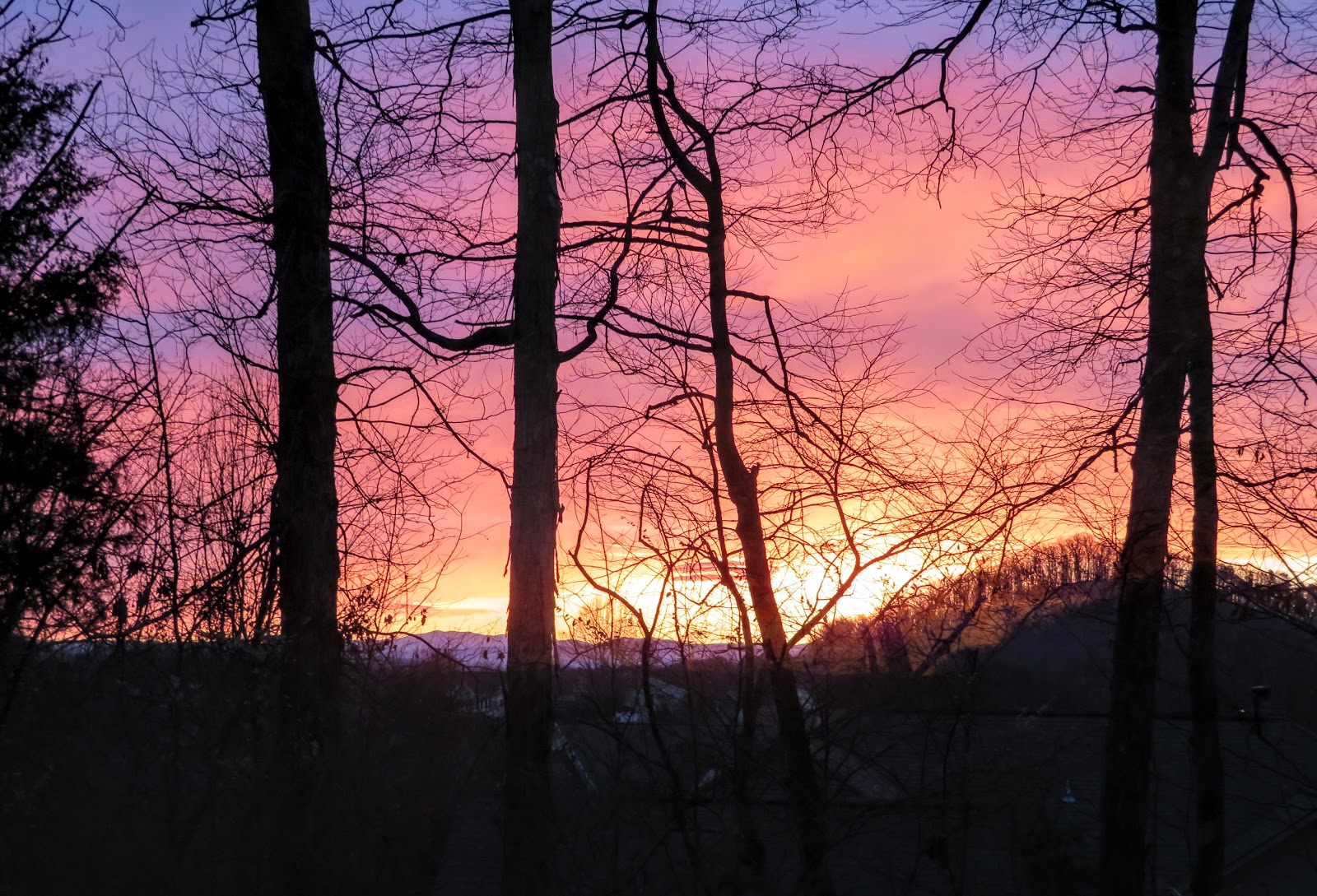
Laurie captured these photos showing a nice sunrise over Tellico Lake.  They are unusual photos because we’re rarely up this early in the morning.  We stay up late and get up late…the reverse of my days in retailing.


Yes, we do get snow here in Paradise… These photos show the result of the only snow ‘storm’ that we’ve had here (south of Knoxville) so far this year. (As of 2/16/19) It melted in a day and a half!


Now about the critters… We do like critters!  The more birds and animals we see in our neighborhood, the happier we are.  Our feeders are well maintained by my better half.  Finches ruled at the moment this photo was taken.  Hawks occasionally visit the feeder too...if you know what I mean.


Flocks of turkey, numbering up to 30 or more frequently graze their way through our yard.  FYI, we haven't seen any coyotes in the neighborhood but we have seen a fox cruising down the street.


We get lots of deer too, although new homes in the neighborhood have reduced the number of visits.  The first photo is of a deer checking us out as we near our home.  The second shows a doe peeping over the deck to see what we’re doing…


Even though we don’t provide meal worms, hungry bluebirds still visit our feeders!


Now the question is, when does a critter become a varmint?  I’ll use these black vultures to define the difference…at least in my mind.  These vultures are sitting on one of our neighbors roofs. 

Note the white fecal blotches in the first photo. (Vultures are carrion eaters…and rotted meat fecal matter stains and smells) On our neighbor’s roof, these vultures are ‘critters’.  If they were on our roof, they would definitely be called ‘varmints’.  Fortunately, my Red Ryder BB-Gun irritates them just enough that they stay off our roof.  They have great memories too.


So, what is this truck from Varmint Busters Wildlife Management Services doing in our driveway?


The answer is quite simple.  A number of ‘our’ critters have now become varmints!  We were invaded by squirrels!  Russell from Varmint Busters has to climb up on our sharply peaked roof to set traps for the buggers.  (Yes, they’re being humanly removed…)

So...as the movie line goes, "Who ya going to call".  This time it was Varmint Busters...


Here is one of our unwelcome guests poking his head out of his temporary home.  We’re not sure how a hole was made above the soffit at the peak of the roof.  Was it a falling branch from a recent tree removal, a bit of chewing where we lost a shingle or what?  We’ll never know.

Since the weather forecast called for significant rainfall, Laurie suggested that Russell should tack down a roofing shingle on one side so that it would keep the rain out but not trap the squirrels under the roof.  In effect, they now had a temporary door on their very temporary abode!

What we do know is that we started hearing critters running around above us in the house.  A mama squirrel apparently delivered her brood under the protection of our roof… For a couple of days, especially in the morning, it sounded like there was a race going all over the ceiling area above us! 


The traps do work!  The little b_____d on the left is asking his sibling, ‘what are you doing in there?  Come out and play!’ 


…and another one bites the dust!  First Russell caught the mama and as I write this we’ve also caught 3 of her offspring.  We think that we have at least 2 more that will have to be moved before we can really squirrel proof that hole in our roof!

Update!  We apparently caught every squirrel that mattered!  No activity for 4 days so Russell repaired the roof and life goes on...
One positive is that the trapping routine has provided a bit of entertainment for ourselves, a few neighbors and especially the construction crew that is already way behind on completing the new house next door.  They checked the traps more than we did!  FYI, Russell has shown us possums and skunks he’s caught in his daily rounds.

Squirrels are expensive… There is a significant initial service charge for evaluation and set up plus a charge for each of the little b_____ds that are removed.  It adds up fast!  Then of course, we needed a little repair work…
Varmint Busters Wildlife Management Services are based in Knoxville Tennessee.  Facebook: https://www.facebook.com/Varmint-Busters-127734886099/. 


So…as the moon rises over paradise, our remaining squirrel population is  wondering where mama and her 3 siblings went, and things are much quieter in the ceiling above us.  It’s been just one small glitch in our happy life in East Tennessee. (Moon rise photos by Laurie)
Just click on any of the photos to enlarge them…

Thanks for stopping by to check out the excitement at our house!

Take Care, Big Daddy Dave

Monday, February 18, 2019

A Brief Exploration of Middlebury Vermont


…continuing with our discoveries during our trip in August 2018.

Following lunch at The Storm Café, we decided to wander around downtown Middlebury.  I took photos and Laurie did a little shopping.


The Star Grist Mill was built in 1837 as a woolen mill, with impressive stone foundations set against the steep slope of Frog Hollow and a 2-story frame structure above.  In 1869, new owners built a grist and grain business on the lower level of the mill, with the woolen mill continuing on the upper level.  

The building was damaged by fire in 1875.  Subsequently, using the original timbers, it was rebuilt as Star Grist Mill.  Water from a branch of the huge penstock serving the Old Frog Hollow Stone Mill turned the turbines in the basement of this mill.  I noted that General Mills bought this mill in 1937 but I don’t know how long they owned and operated it.

The Mill is located a 2 Mill Street.  Current occupants include an attorney’s office, a psychoanalyst and the Riverside Natural Health Center. 


Another retailer from days gone by… Note the going out of business signs on this Ben Franklin Store.  This building at 63 Main Street was built in 1909.  The Ben Franklin Store occupied this site since 1943…serving the community for 75 years!  The owner closed the store due to declining sales.  I found a real estate listing from May of 2018 that showed that the building offered 10,366 sq. ft. of space, including 2 apartments on the second floor.  The asking price was $850,000!
  
So why did I even look at an old retail store?  At one point in my career, I was responsible for security, safety and loss prevention for stores owned by Household Merchandising, a division of Household International.  Ben Franklin was one of eight retail chains I was charged to assist and oversee. 
Ben Franklin originated in Boston in 1877 as Butler Brothers.  Butler Brothers founded Ben Franklin in 1927.  At the company’s peak, they had 2,500 owned and franchised stores nationwide. 

Notes:

·       Walmart founder Sam Walton started in retail by operating a Ben Franklin Store.  The story goes that when Ben Franklin management wouldn’t listen to Walton, he decided to start his own store…and the rest is history.

·       Sam Walton wasn’t the only major retailer who started a retail chain via a Ben Franklin Store.  In 1973, Michael J. Dupey converted a closed Ben Franklin Store in Texas to start the Michaels stores.


I threw in this photo of the Marquis Theater because there are so few small town downtown movie theaters remaining in the USA.  The Marquis Theater and the Southwest Café at 65 Main Street features current movies, food and live entertainment.  On one on-line site, I read that this used to be the Campus Theater.  Phone: 802-388-4841.  The theater’s website is at: http://www.middleburymarquis.com/.


This is the Battell Block, now known as the Battell Block Residences.  This building is located at 10 Merchants Row.  This building was constructed by Joseph Battell following a major fire in Middlebury in 1891.  Battell was the largest landowner in Vermont.  This building set a high bar for future construction in the rest of town.  It wasn’t completed until 1898.

This building is a dominant structure in the center of town.  I noted that only 1 or 2 units were available for lease.  That makes sense since the building is in the middle of Middlebury’s shopping and dining venues.  Interested?  Check out the apartments at http://www.battellblock.com/.

If you’ve been following my blog narrative about our summertime adventures, you have heard the name Battell before.  He was a publisher, conservationist, newspaper editor and author.  One of his books was the “American Morgan Horse Registry”.  He donated his horse farm to the Federal Morgan Horse Breeding Program.

Joseph Battell owned thousands of acres near Middlebury, adjacent to Bread Loaf Mountain.  On his death, the property and buildings were bequeathed to Middlebury College.  Since 1926, the college has held the Bread Loaf School of English and Bread Loaf Writers’ Conferences at that location…but that’s another story.


This isn’t just an impressive old bank building that has changed hands many times or is being used for another purpose.  The locally owned National Bank of Middlebury was founded in 1831 and 188 years later they’re still in business.  This ‘new” bank building at 30 Main Street was built in 1910 and it’s adjacent to the main offices of the National Bank of Middlebury.
   
There have only been 11 bank presidents in the history of this bank.  On March 3, 1933, in the midst of the Great Depression, President Franklin D. Roosevelt ordered the closing of all banks in the nation.  Only 12 days later, the National Bank of Middlebury was declared sound and was allowed to reopen.  It was declared to be “one of the most stable in the nation”.


This beautiful Queen Anne style 3-story red brick structure with lots of ornamentation is right next door to the previous bank building. (Note the single story tan brick at the left of the photo) This is the Beckwith Block at 22 – 26 Main Street but it’s now named after a former President of the bank, Robert Duclos.

This building is the sole survivor north of the bridge from the Middlebury fire of 1891.  With its multi-colored brick, stone and terracotta insets, windows and decorative cornice line, it was intended to impress!  Erected by Smith Beckwith in 1883, it originally served as the Beckwith and Company Mercantile.  At one point in the 1970s it was occupied by a United 5 to $1 Dime Store and a Bike and Ski Touring Center.  However, in 1996, it was purchased by the National Bank of Middlebury as its headquarters and it was connected to the bank next door.   


Sorry for the tangle of wires in the photo but that's the way it is… This attractive building is the Inn on the Green.  This Federal style house at 71 South Pleasant Street was built in 1803.  It was meticulously renovated in 1995 – 1997 in order to create this inn that overlooks the Middlebury village green and the center of town…

Over the years, this home had gone through several major style modifications.  In the 1900s the home passed through the hands of several owners…but by the 1960s it had been converted into an undistinguished apartment building.  More recently, it was abandoned and beginning to fall apart.  The current owners of the Inn on the Green purchased the building in 1995 and they restored it to its former glory.

To learn more about the Inn on the Green and its available accommodations, their website is found at: https://innonthegreen.com/.


This is one view from the stone bridge that was built in 1893 following a major fire in Middlebury that destroyed the old wooden bridge over Otter Creek.  Want to guess who built the new bridge?  The answer is Joseph Battell. (Yet another creek side dining opportunity!)

The Hollow (Frog Hollow) was originally the center of industry for Middlebury.  Beginning ca. 1794, there were forges and gunsmiths.  A nail factory opened in 1796.  In one shop, between 1821 and 1825, a young man named John Deere served his apprenticeship before moving west to Illinois.  There was marble quarrying and milling here too.  A local named Eben Judd developed a machine for sawing the marble.  In 1806 this mill operated 60 soft iron saws.  Much of the marble processed here was quarried in the Hollow and from the bed of Otter Creek above the falls.

Between 1808 and 1837, Judd’s mill sawed between 5,000 and 10,000 feet of marble slab a year.  It was made into tombstones, carrier’s tables, jambs, mantles, hearths, door caps, sills, sideboards, tables and more… When Judd died in 1837, the operation ceased.  In 1851, a wooden pail factory was opened in the Judd building.  It turned out up to 600 pails, butter tubs and other products every day. 


At the left is the Ross Block.  It was built at 64 Main Street in 1903.  In the 1970s, retailers included The Kitchen Shop and Middlebury Darkroom.  Since 1986, this retail space has been operated by Vermont’s Own Products.  Former dairy farmers decided to try something different.  They offer maple syrup, gourmet foods, chocolates and a variety of other Vermont specialties.  You can check out their selection online at https://vermontsownproducts.com/.

The second ‘new’ building in the photo has been known by several names… It’s been the Hanks Block, the Calhoun Block and the Atwood Block. (1903) As the Atwood Block, it burned down in 1909.  Subsequently rebuilt, the most recent occupant was Clay’s, billed as a Unique Women’s Clothing Store. 

Unfortunately, Clay’s closed in June of 2018 after 25 years in this location.  It had been a men’s store in the 1970s.  FYI, Clay’s is still in business with 7 stores in Vermont, New Hampshire and Massachusetts.  Website: https://www.claysclothing.com/.   


This big gray 3-story frame was originally built as a 2-story home in 1801.  The third floor was added and the building was remodeled in 1881, subsequently opening as the Logan House Hotel.   These days it seems to be referred to as the “Leatherworks Building”.  The upper floors provide apartments, apparently appealing to the students from Middlebury College.  As of the day I wrote this post, 1, 2 and 3 bedroom apartments were available.  Rent ranged from $1,000 to $1,800 a month.

The lower level houses an attorney’s office and Dan Freeman’s Leatherworks. (Hence the nickname for the building) Freeman has been making custom shoes and boots here since 1986… As per comments I read, the shoes are quite expensive but they are also excellent and comfortable footwear.  Freeman is a craftsman by all accounts.  He learned the trade in New Orleans from an old Jamaican shoemaker who taught Dan everything he knew, and he “didn’t charge Dan a penny” for the training.  I feel fortunate that Laurie didn’t spot this shop as she has an affinity for fine leather products.  In Freeman’s small retail shop, he sells top quality belts, sandals, wallets and purses.
 
Dan Freeman doesn’t have a website.  Customers come to him from all over the country.  To learn more about this craftsman and his business (with a video), go to http://www.addisonindependent.com/201007freeman-steps-shoemaking-niche.  


The Kitchel House is located at 152 College Street in Middlebury.  A Middlebury College President named Harvey Kitchel built this imposing Italianate style home in 1867.  In 1891, it was renamed Battell Hall and it served at the College’s first women’s dormitory.  Subsequently it was used as a nursing home for many years.  In 2011, Middlebury College purchased the building and restored it.  Today it serves as the home of College Communications.
   
Middlebury College was chartered in November 1800.  Its first President was Jeremiah Atwater.  Middlebury was the first operating college or university in Vermont.  This liberal arts college has about 2,500 students from all 50 states and 74 countries.  It offers 44 different majors.  To learn more about Middlebury College, just go to http://www.middlebury.edu/#story612467.


This is Alexander Twilight Hall.  This 3-story brick structure with Italianate details was constructed in 1867 and it’s located across the street from the Kitchel House.  Over the years, this location has been occupied by a grammar school, college classrooms, college dorms…and then again as a grammar school for the Addison County School District.
   
Middlebury College purchased the building from the school district in 1984 and, after restoring it, in 1986 the College rededicated it and named it Alexander Twilight Hall.  Appropriately, Education Studies occupies a portion of the building…

So who was Alexander Lucius Twilight?  He was an educator, minister and politician.  He is the first African-American man known to have earned a bachelor’s degree from an American College or University, graduating from Middlebury College in 1823.  Twilight worked in education and ministry all his career…  He designed and built the first granite public building in the state.  He also was the first African-American elected as a state legislator, serving in the Vermont House of Representatives.  As such, he was the only African-American ever elected to a state legislature prior to the Civil War.

That’s about it for now… Just click on any of the photos to enlarge them.

Thanks for stopping by for a visit!

Take Care, Big Daddy Dave
Friday, February 15, 2019

Middlebury Vermont – First Look and Lunch

…continuing with our August adventures in the northeastern USA.

By the time we’d finished our visit to the University of Vermont Middlebury’s Morgan Horse Farm, it was time for lunch so we headed back into town to find a restaurant and to see what there was to see.


As we approached Middlebury we had to stop to take a photo of this 2-lane covered bridge over Otter Creek.  The Pulp Mill Covered Bridge was built sometime between 1808 and no later than 1853.  Based on local records and the type of construction, the latter date is most likely.

The bridge is listed on the National Register of Historic Places.  It is over 195 feet long and, unlike the 2-lane covered bridge at Vermont’s Shelburne Museum, this one still carries regular traffic.  It was refurbished in 2012.  This is one of only 7 two-lane covered bridges remaining in the entire USA.  The separate pedestrian walkway at the right of the bridge was added when the bridge was updated. 


In 1891, the Middlebury Railway Depot was located on the west side of the tracks but in 1911 it was moved to the east side to allow an overpass to be built.  This depot served as a Rutland Railway passenger and freight station until 1953 during a strike by railroad workers. 

All service was discontinued in 1961 after even more bitter strikes.  Much of the Rutland Railroad was abandoned, but this section of the railroad was purchased by the State of Vermont in 1963.  The State subsequently leased the line to a new operator, the Vermont Railway, and freight trains still move up and down the line.

The depot was rehabbed ca. 2011 and it’s now the home of Top Floor Business Computer Solutions and chrismorse.net – Computer Sales and Service.  New tech in a 128 year old building!

I did find an article dated 10/25/18 that was all about plans to build a new passenger rail platform across the tracks from the old depot.  The Vermont Agency of Transportation will design and build the new platform in anticipation of an expanded Ethan Allen Express train route that Amtrak is planning to operate along Vermont’s western rail corridor beginning in 2021 or 2022.  Currently, the Ethan Allen operates from New York City to Rutland.  This plan would extend the route to Burlington VT.


Upon arrival in the downtown Middlebury, we found a parking space at the bottom of the hill below the main street that runs through the central business district.  I took this photo looking back at the parking lot.  I have no idea what that old building’s history is but that clapboard siding and huge stone foundation combine to create an eye-catching structure. 


This is the Frog Hollow Stone Mill and it’s located at 3 Mill Street on the banks of Otter Creek.  It was built in 1840 and it’s a historic reminder of the town’s industrial past.  Industrial use of the mill site began in 1789 when a grist mill was built here.  Later it was converted to cotton textile production and then, in 1835, the Middlebury Manufacturing Company occupied the space.


This striking sculpture of an Elk dominated the grounds on one side of Frog Hollow Stone Mill.  Part of the old mill is occupied by M Gallery.  Its stated goal is to aid the professional development of artistically inclined students at Middlebury College.  The gallery maintains rotating exhibits of art work from a plethora of mediums.  Performing arts productions, lectures and other activities relevant to Middlebury’s arts culture are also held here. 

However, since we visited Middlebury, things have changed.  Middlebury College, the owner of Frog Hollow Stone Mill, has agreed to sell it to a local company for $500,000.  If a deal is made, the new company plans to redevelop the building into “a new daily destination for the greater Middlebury community”.  The college had owned the building for more than a decade.


The first photo is an upstream view of Otter Creek from next to Frog Hollow Mill.  Note the pedestrian bridge.  The second photo is a downstream look at the ‘creek’.  By my standards this is a river…its too dang big to just be a ‘creek’.  In any case, this is a pretty place, that’s for sure. 

Otter Creek is about 112 miles long and it is the primary stream running through both Rutland and Addison Counties.  It is one of the largest streams in the State.  Because it’s called a ‘creek’, an unusual situation exists, with several rivers emptying into a creek several times along its length.    


Laurie and I loved this beautiful Cedar Waxwing who posed for us on the rocks along the banks of Otter Creek. 


Before we ventured into The Storm Café, our restaurant of choice for lunch, I took this photo of diners having lunch on the deck alongside Otter Creek.  Looks like a popular venue…and it was past the lunch hour too.


Indoor dining wasn’t too popular on this beautiful sunny day!


For my beverage, I chose a Blueberry Lemonade. ($4.00) It just didn’t work for me but my palate isn’t too adventurous either.  Laurie ordered a Sangria and thought that it was pretty good.  I thought that $10.00 for Sangria was a bit much…


For my lunch, I made an exception to my norm…no meat!  Instead, I continued with the blueberry theme, ordering the tall stack (3 pieces) of Challah French Toast with Vermont Maple Syrup plus blueberries. ($12.00) It was a tasty lunch if a little pricey…


Laurie ordered from The Light Lunch options.  This was Combo III, a half sandwich and a cup of soup. ($11.00) For her soup she chose Potato and her half sandwich was The Dude.  It consisted of North Country apple wood smoked bacon, Vermont sharp cheddar cheese, baby spinach and local tomato on toasted ciabatta bread with a zesty chipotle ranch aioli.  She was very happy with her meal!


After lunch we began exploring a bit.  This is a view from the nearby footbridge over Otter Creek.  It shows Frog Hollow Stone Mill and The Storm Café’s outdoor patio dining area where we ate. 

Apparently, The Storm Café has been in its space for quite some time.  That may change soon so check ahead if you’d like to dine here.  As per the owners of the café, as of late last fall, they’ve been unable to extend their lease…
The Storm Café is at 3 Mill Street in Middlebury Vermont.  Phone: 802-388-1063.  Their website is at http://www.thestormcafe.com/.


“Our” Cedar Waxwing decided to fly up and pose for me along the railing of the pedestrian bridge over Otter Creek.  These birds are native to North and Central America, breeding in open wooded areas in southern Canada and wintering in the southern USA as well as parts of Central America and South America.  They do live year around in parts of the center of the USA.

Cedar Waxwings eat cedar cones, fruit and insects.  This is one bird that isn’t endangered.  Their populations are increasing because fields are growing back into forests and shrub lands and a number of fruiting trees are being planted as landscaping. 


This is Middlebury Falls as viewed from the pedestrian bridge shown in an earlier view of Otter Creek.  The Falls are an 18 foot sheer drop just below the VT Hwy. 125 Bridge (built in 1903) in downtown Middlebury.  Note the local fishing at the right of the photo.  He caught something too! 

Next we wandered up into the center of town to see what we could see…but that’s another story.

Just click on any of the photos to enlarge them…

Thanks for stopping by for a visit!

Take Care, Big Daddy Dave 

Wednesday, February 13, 2019

A Truly American Horse Breed – Plus a Happy Wife!


…continuing with our summer 2018 exploration of New England.

We departed the city of Burlington and headed south along US Hwy. 7.  I had a very specific goal in mind for the day, one that would earn ‘points’ for me with my wife…and I can never have too many points!


As we headed south I spotted this old depot along the highway.  This is the former Rutland and Burlington Railway combination depot from Ferrisburgh Vermont.  It was built in 1862.  It was moved a little south to Old Covered Bridge Farm along the highway.  It looks like it’s in great shape now but I found a photo that showed that it suffered through some ‘hard times’.  At one point it was being used as a store that was named “The Emporium”.  According to the most current information I could find, it was most recently used as a furniture studio.


This is the former Vergennes combination passenger and freight depot.  It was moved from Vergennes to Ferrisburgh next to the tracks at the ‘park and ride lot’ located at the corner of US Hwy. 7 and VT Hwy 22A.  Confused now?  I am! 
In any case, this wooden structure is the oldest known in Vermont that was moved to another location and restored.  This depot began serving passengers in Vergennes back in 1849!  Male passengers entered the depot on the left hand side and females had their own entrance on the right side.

The original plan re: moving this depot involved its restoration and its use as a visitor’s center, provide office space and serve as a location where local history could be displayed.  The park and ride lot was in use and the old depot has been restored, however I didn’t see signs that it was being used.


Yes indeed!  We did stumble across one more depot on this short drive south. This is the New Haven Junction Depot.  This attractive little depot, built in the early 1850s, is located at US Hwy. 7 and VT Hwy. 17 in New Haven.  It has been fully preserved and it now serves as the offices of Roundtree Construction.  That company has nicely restored this old Italianate style brick depot.

The Rutland and Burlington Railroad was chartered by the State of Vermont in 1843.  By 1867, its name was officially changed to the Rutland Railroad.  In the second half of the 1800s, the railroad was a key transportation artery for Burlington’s lumber industry and Rutland’s marble quarries.


Then we arrived at the most important attraction for the day!  This is the University of Vermont’s Morgan Horse Farm.  In 1905, the United States Department of Agriculture established a Morgan horse breeding program at Burlington Vermont.  The purpose of the program was to produce horses with true Morgan attributes, while increasing their size and retaining the positive virtues of the breed…strength, athletic ability, endurance, versatility, temperament and economy. 

Just 2 years later, Colonel Joseph Battell (first editor of the American Morgan Horse Register), donated his farm near Middlebury and the experiment farm’s breeding stock was relocated.  This was the founding of the United States Morgan Horse Farm… Today, this working farm that dates back to 1878, is home to more than 40 Morgan horses.


This statue in front of that beautiful old working barn was erected in 1921 in commemoration of Justin Morgan.  He was born in Massachusetts but by 1788 he’d settled in Vermont.  In addition to being a horse breeder and farmer, Morgan was a singing teacher and composer.  He also served as town clerk in Randolph Vermont.  

Morgan horses are named after Justin and it all began with a small bay stallion that he owned.  His name was “Figure” and he became the foundation sire of the Morgan horse breed… FYI…Interestingly, Justin Morgan only owned “Figure” from 1792 – 1795 during which time, he advertised him for stud in nearby New Hampshire.

“Figure” is thought to have stood about 14 hands and to have weighed about 1,000 pounds.  He was known for his genetic dominance…his ability to pass on his looks, conformation, temperament and athleticism.  His parentage is unknown although his sire is thought to be an English Thoroughbred stallion. 


This skeleton of a Morgan horse is on display in the barn near the gift shop.  No…it’s not the Skeleton of ‘Figure’, the founding stallion.  This is ‘Blackhawk’, #20 in the Morgan horse registry and #5 in the American Trotting horse registry.  “Blackhawk” lived from 1833 to 1856.  He was 15 hands tall and weighed 1,000 lbs.  He was an undefeated harness racing champion…

The Morgan horse is one of the earliest horse breeds developed in the United States, and the only early breed to survive to the present time.  All Morgans trace back to “Figure” that stallion who was born in West Springfield Massachusetts in 1789.  In 1792 “Figure” and 2 other horses were given to Justin Morgan in payment of a debt.  What a deal that was!  The “Justin Morgan horse” evolved into the name of the breed. 


Throughout the barn there are displays of horse related equipment (included these carriages), plaques, photos, old stud service advertisements, art work, tributes and much more. 

The University of Vermont – Middlebury (UVM) Morgan Horse Farm features seasonal events and educational opportunities, apprenticeships, and of course an interesting attraction for visitors, especially horse lovers.


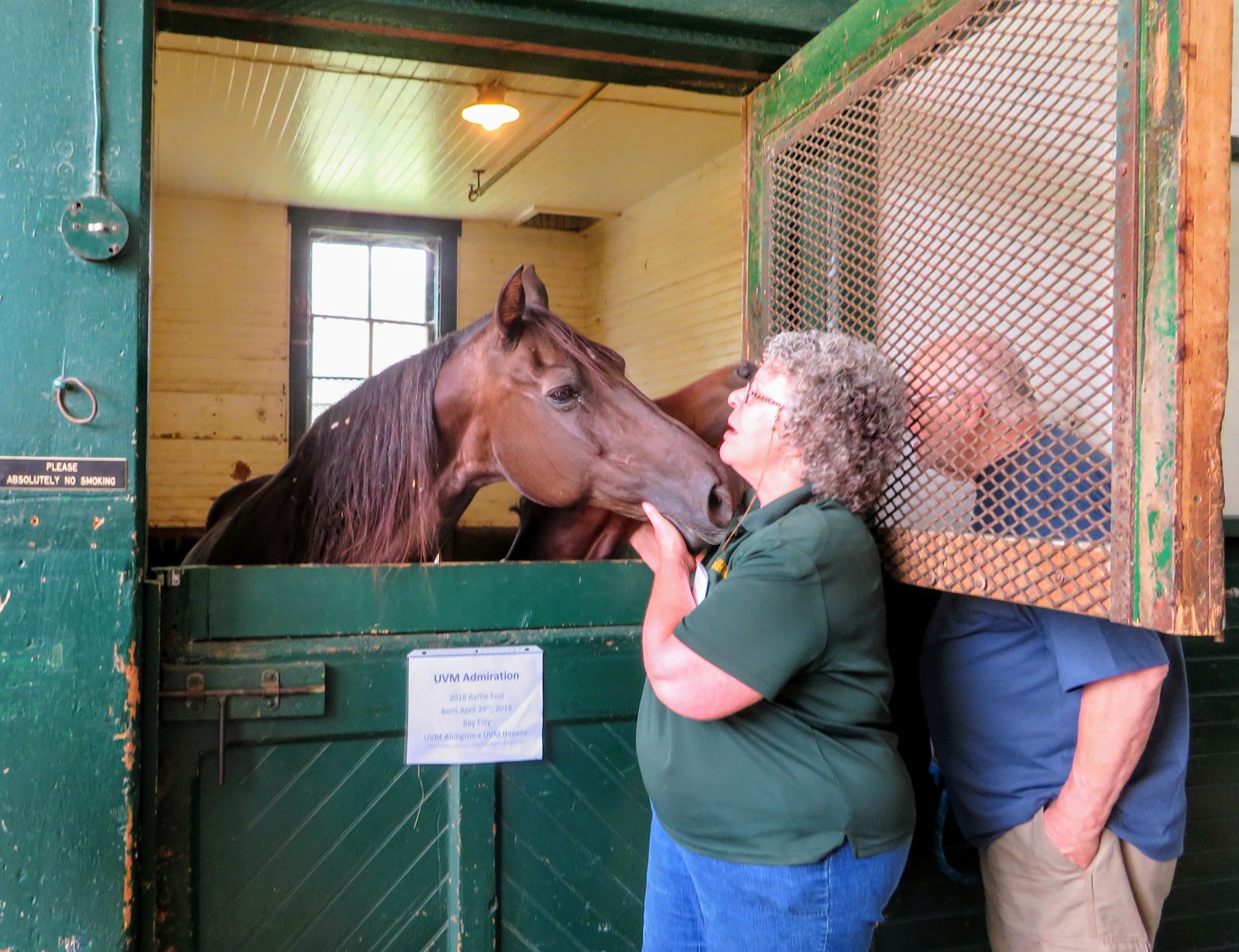
The first part of our tour included a stroll through the barn where several horses were in their stalls.  Viewed through the mesh, this particular horse is “Otter Brook Xenophon”.  This black chestnut stallion will be twenty-seven years old in April of this year.

Here’s a little more about “Figure”, the breed’s founding stallion.  First of all, he changed owners quite often.  I tried counting them up but it appears that he had at least 15 owners over the years.  Other than standing at stud, “Figure” had many other jobs.  He raced, cleared land, worked in the logging industry, reviewed troops, won a pulling contest, worked on farms, hauled freight, was exhibited at fairs…and he served as parade mount for President James Monroe in 1817.  In 1821 “Figure” died in Vermont after being kicked by another horse.  He was 32 years old… 


Here I’m peering over the tour guide’s shoulder to take a good look at the mare and foal in this stall. 

The UVM Morgan Horse Farm is dedicated to the preservation and improvement of the Morgan Horse through breeding and selection.  The farm itself is listed on the National Register of Historic Places.  For over 60 years the farm has provided educational experiences and training for students and visitors.  The farm is responsible for perpetuating 3 different Morgan horse bloodlines that can be traced back to “Figure”.


Here our guide shows us both of the horses in that stall.  The mare was quite patient with her curious youngster!

Morgan horses served many roles in the 1800s.  They were used as coach horses, harness racing, riding for pleasure and work and as cavalry horses during the Civil War on both sides of the conflict.  Morgans have also influenced other major American breeds including the American Quarter Horse, Tennessee Walking Horse and the Standardbred.  They have also been exported to other countries.  In England, a Morgan stallion influenced the breeding of the Hackney Horse. 


Then we watched these 2 young ladies grooming this handsome stallion.  There were about 2 dozen people in our tour group.


Then, one or two at a time, visitors were able to approach the horse and pet him.  He was very patient… In this case, I think that the mom and daughter were really into the experience!


After departing the big barn we were free to wander the grounds.  We strolled over to the old “Remount Barn”.  It was built in 1914 for use as a stallion barn.  During this period of time, the farm was supplying the US Cavalry with breeding stock for remounts.  The barn is now serving as a maternity ward for up to 10 foaling mares.


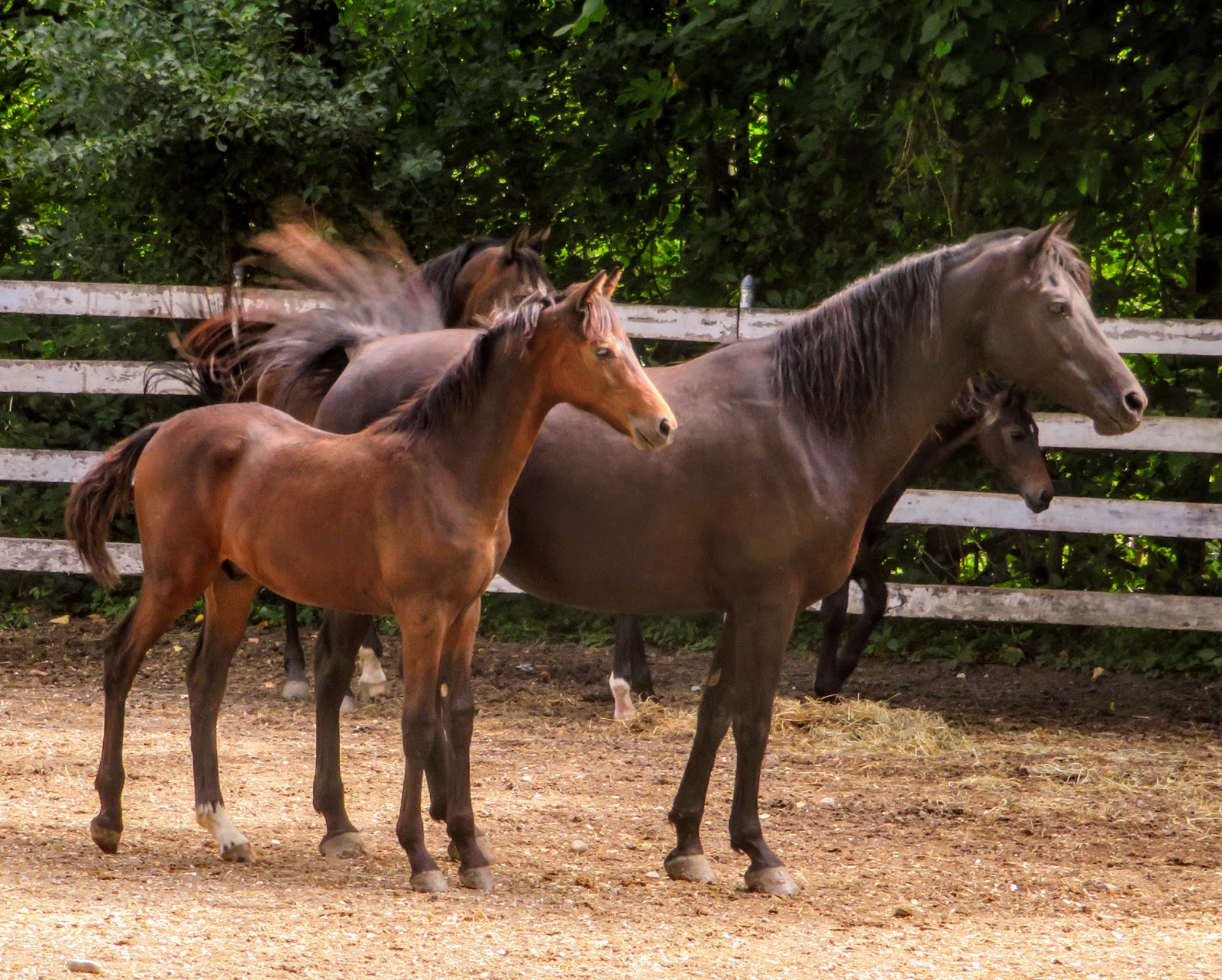
This mare and her foal were fascinated by some workers in their paddock who were trimming trees and working on the fence.  Nice pose, don’t you think?  There aren’t too many things more striking and fun to watch than a young foal!

The farm actually supplied Morgan’s until the 1950s for cavalry mounts.  The line termed the “Government Morgans”, (there are 4 lines in total), are regarded as substantial in bone/structure and they’re considered superbly athletic.  The UVM Morgans are superior broodstock, they’re very versatile and they make great family horses.
 
If you’d be interested in buying a Morgan horse or two for your farm or children, they are available for sale at the UVM farm.  Check it out at https://www.uvm.edu/cals/morganhorsefarm/horses-sale.


Our next to last stop at UVM’s Morgan Horse Farm was the Colt Shed.  There were several juveniles just lounging around like most juveniles around the world. 

The Farm also offers stallions to the public for stud services.  Currently, “Abington”, “Equity”, “Jubilant” and “Unchallenged” are offered at stud.  Back in 2005, there was an estimated population of 175,000 Morgan horses worldwide…

To learn more about Morgan horses and their history, you can go to https://en.wikipedia.org/wiki/Morgan_horse.


Considering Vermont’s climate, it wasn’t surprising to find that they have a large indoor riding rink.  The young lady on the horse (both inside and outside of the riding rink) may be part of the Apprentice Program at UVM.  The program offers an intensive experience.  Apprentices spend a year living, working and learning at the farm.  They are involved in a wide variety of the farm’s overall operations. 

We both considered the UVM Morgan Horse Farm one of our favorite experiences during our 3 week adventure.  The Farm is open to visitors daily from May 1 through October 31.  The price is right.  Admission is only $5.00 for adults, $4.00 for teens and $2.00 for kids 5 or older. 

The University of Vermont at Middlebury is located at 74 Battell Drive in Weybridge Vermont.  Phone: 802-388-2011.  You can visit their website at https://www.uvm.edu/cals/morganhorsefarm/about-us.

Just click on any of the photos to enlarge them…

Thanks for stopping by for a visit!

Take Care, Big Daddy Dave