…returning to our tour of the “The Great Smoky Mountains Heritage Center”. We finished our perusal of the indoor exhibits in the main building, focusing primarily on the area’s Native American culture and history. Now we went outdoors and followed the path through the early Appalachian/Smoky Mountain settler’s historical structures.
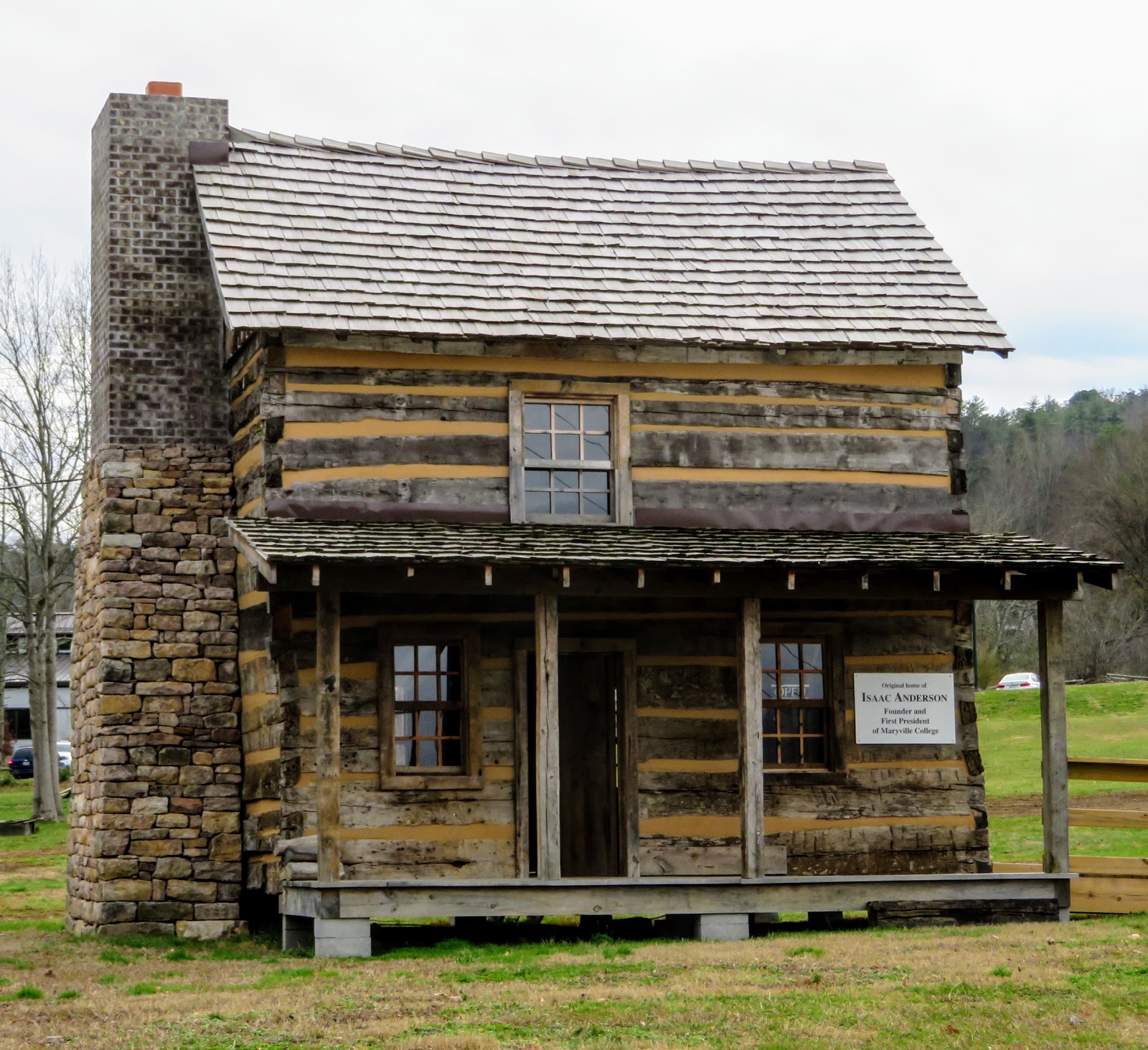
Before we visit the path and take the tour behind the building, this solid looking log home is situated near the entrance to the Heritage Center. As it turns out, just a year ago this solid looking 2-room cabin was opened in its new location. It had been completely dismantled and moved here from its location adjacent to a northeast Knox County Tennessee subdivision where it had been abandoned. It had been slated for demolition but through a fund raising effort, it was saved.
Historically, the cabin is the 218 year old former home (ca. 1800) of Maryville College founder Issac Anderson and his wife Flora. When they lived in the cabin Issac taught young men who hoped to enter the ministry and the young couple provided room and board for those who were unable to pay. Panels on the walls inside the cabin tell Anderson’s story. Maryville College was founded in 1819 as the Southern and Western Theological Seminary. In 1818 Anderson also founded the Second Presbyterian Church in Knoxville.
I’m not sure that this little tractor has much to do with early settlers but I’m sure that the museum didn’t want to turn down such an interesting donation. This is a 1949 Massey-Harris Pony II Utility Tractor. It was manufactured in Woodstock, Ontario, Canada. With only 10 HP, it was designed for maneuverability and versatility…not so much for heavy workloads.
Back to the tour of historic building at the back of the museum and gift shop. This still isn’t all that old but it is representative of the many stills built by Appalachian families in order to supplement their meager funds. The production of ‘white lightning’ or ‘moonshine’ was a cottage industry in the mountains. This still was built by Charles J. Williams in 1960. It had been cleverly hidden under a shed on the family’s farm in Carr Creek Tennessee. It is on loan to the museum by Charles’ son…
Anyone under 40 (or maybe a bit older) will not know what this little building is unless they were raised in the country. Oh, I may have startled Laurie! Back in the early days an indoor bathroom was a big city luxury. In the country, ‘outhouses’ served the same purpose.
Actually, when I was in the fourth grade (ca. 1951), we lived in a huge 2 story brick farmhouse near Jonesville Michigan. Our outhouse…yes, we had a working outhouse…was an all brick 2-seater. I could never understand the 2 seat configuration although in our tours of old homes, I have seen a 3-seater, with one of the seats set very low for the youngsters. The family that…never mind.
The Maples Pole Barn was built by the Maples family near Gatlinburg Tennessee in the 1820s. The characteristic feature of this type of barn is a second story loft that is cantilevered over 1 or 2 log cribs. This provides the farmer with convenient weather protected wagon access to the various areas of the barn. The cribs were used for livestock or storage while the second level was used to store hay.
FYI, 90% of all cantilevered barns in the USA are found in Eastern Tennessee, primarily in Blount and Sevier Counties.
We’d never seen wooden hinges before. These hinges were used on the doors or gates for the cribs in the pole barn… Very cool and inventive!
This cabin is called the “Montvale Station”. Built in the 1830s, the Montvale Station represents a stagecoach stop that once stood nearby the late 1800s Montvale Springs resort. The building also served as a Post Office for local families and it’s believed to have been used as an Inn for travelers. The cost for half a bed (a shared bed) in the 1830s was 12.5 cents but the bedbugs were free!
Between 1892 and 1895, James Cardwell built this cabin between Pigeon Forge and Gatlinburg Tennessee. It was the first home for him and his bride Martha. The single-pen cabin was built with logs he’d cut down on the property. He cut down other trees for the lumber and bark, which helped pay for the 100 acres he’d purchased. Although he was a skilled carpenter, he worked primarily as a farmer raising wheat, vegetables, tobacco, cattle and hogs. The couple had 10 children but only 6 survived. In the 1920s, the Cardwell’s moved into a new house and Uncle Willie moved into this cabin.
I’ve included the above 3 photos of the interior of the Cardwell cabin just to show what life in these close quarters might have been like. There was an upstairs loft where the children would sleep. Nevertheless, with 6 children and 2 adults, it must have been very ‘cozy’ indeed! Note the remnants of paper on the walls. Newspapers and catalog pages were often used for a little extra insulation, especially around the chinks between the logs.
The Cardwell Cabin was donated to the Heritage Center by a Gatlinburg resident named Wilma Maples, one of the center’s benefactors.
This picture shows the slate chimney on the Cardwell Cabin. It’s a great piece of stone work…and the photo is pretty good too.
This is the Long Family’s Granary. It was built in the early 1900s.
This is the historic Wilder Chapel Church. It was moved here from a location near Maryville Tennessee. This A.M.E. Zion Church is 110 years old, having been built in 1910. The last known service conducted in the church before its move was in 1974.
The Wilder Chapel Church was donated to the Heritage Center by the Wilder Chapel Cemetery Association and the building’s move was paid for by another member of the Maples family. It was moved to the center of the Heritage Center’s historic village. The chapel is available for weddings!
Laurie and I thought that this was pretty clever. Instead of a drain pipe, this chain directs the flow of water off the eves of the church. We saw it on other buildings as well.
This big cantilevered barn was built ca. 1886 by Issac Long. His great grandson, Howard and his wife Cathy donated the barn to the Heritage Center. This large structure had room for horses, cows and mules plus a big overhang that provided protection for some farm equipment. The open center of the barn was used to thrash wheat.
At a later date, the outside of the barn was enclosed, providing additional stalls and storage. (It also helped protect the structure itself) As Laurie pointed out, it looked like they may have hung tobacco up to dry in the barn as well. She was right… When tobacco was king, it was hung all over the inside of this structure.
This is the inside of the Wainwright Shop at the Heritage Center. The availability of wainwrights and wheelwrights were critical when everyone needed wagons, buggies and carriages of all types for farming, transport and travel. The 1820 census for Blount County Tennessee revealed that 52 wainwrights and 2 wheelwrights were operating in the county.
This big hunk of machinery is located in one corner of the wainwrights shop. William Baxter patented the “Baxter’s Portable Steam Engine” in 1868. The Colt Fire Arms Company was seeking diversification following the Civil War as the demand for weapons had collapsed. Under license from Baxter, Colt produced 300,000 of these engines over the next 30 years. Like Colt’s fire arms, the parts were interchangeable between the engines.
This particular Baxter-Colt Steam Engine was rebuilt in Chattanooga in 1940 for the M.L. Ferguson Machine Shop in Loudon Tennessee. It was converted from wood burning to coal burning in order to power the boiler.
I like classy or different looking vehicles and although I don’t know anything about either the buggy or the tanker wagon, I just thought they look too good to leave out…
This structure is the saw mill. It was built ca. 1885. For a time, lumbering brought prosperity to the Smoky Mountains. The virgin forests in the mountains drew a lot of attention from logging companies in the late 1800s.
The Little River Lumber Company bought over 80,000 acres of wilderness in what is now the Great Smoky Mountains National Park. The company’s business plan was very simple. Buy the land, log it completely and, once the area was logged, sell it. Railroads were built to access the logging sites and then to transport the lumber back to Tuckaleechee Cove for processing at the lumber mill.
Laurie and I noted this giant cross section of wood laying up against one wall of the mill. It didn’t really have anything to do with the mill. It came from a giant elm tree that was located near the site of the Tellico Dam and its lake.
Known as the “Trigonia” elm because of the community where it was located, this massive American elm shaded almost a half-acre of land. It was over 160 feet tall, had a crown spread of 147 feet and was 24 feet 7 inches in circumference. It was estimated to be over 300 years old and it was considered to be the largest American elm in the country for many years. It died in 1979 following repeated lightning strikes.
I borrowed the first photo from the Internet. (As you can tell it wasn’t mid-winter when the photo was taken) This little building is a “setoff” house from the Little River Lumber Company. This is the type of home that was commonly found in logging towns in the late 1800s. Logging communities were set up along the railroad tracks that led up to the logging camps.
Trains would bring in the small block-like semi-portable “setoff” houses on flat cars…and then ‘set them off’ at the next site. When the lumber was exhausted, they’d set the little houses back on the flat car and move them to the next location. In effect, these were truly the first ‘mobile homes’. The workers and their families had a place to live the men were making more money than they ever had before. Love that early linoleum!
A single man or a man and his wife might live in a house like this one. If they had children, 2 houses would be put together to accommodate the family. The sign on the table in the home tells of a former resident who’s “set off” was so close to the tracks that whenever a log train came by, the family would run out of the house into the yard for safety. Logs were known to just roll off the flat beds and crash into an occasional home! With the houses all ‘strung’ along the tracks in a line, these temporary logging settlements were referred to as ‘stringtowns’.
Thanks for stopping to learn more about our visit to the Great Smoky Mountains Heritage Center. The Center is open Monday through Saturday but they are closed on Sunday. Admission is $10.00 for adults, $8.00 for seniors and $7.00 for children from 6 through 17 years old. This Museum is located at 123 Cromwell Drive in Townsend Tennessee. Phone: 865-448-0044. Website: https://www.gsmheritagecenter.org/.
Just click on any of the photos to enlarge them…
Take Care, Big Daddy Dave