Tuesday, December 13, 2022

A Quality Lunch and a Bit of Exploration

After driving from the east coast of Michigan on Lake Huron, after a short drive we arrived at the first of several tourist towns on the State’s west coast along Lake Michigan.  Our destination was Petoskey Michigan although in fairness, a gathering of 3 towns along little Traverse Bay are close enough together that one could consider them a single destination.  In addition to Petoskey, Bay View and Harbor Springs complete the threesome.  

It was still rainy…the last of the day and a half of rain we encountered on our late summer road trip to Michigan and beyond.  It was time for lunch and I’d done a bit of research so we parked in downtown Petoskey and got out our umbrellas for a short walk.

Now known as City Park Grill, this is one of Petoskey’s oldest structures, with the original portion being completed in 1875.  Back in the early days, it was known as a McCarty Hall, a males-only billiard parlor that offered cigars and ‘intoxicating beverages’.  In 1888, dining and entertainment were added to serve an adjacent hotel and the building was renamed “The Annex”. 

When the building and its clientele was transformed into “The Annex” in 1888, a large patio was added to the east side of the restaurant and this 32 foot long solid mahogany bar was installed.  At that time, there were no windows and gas lighting was used to brighten up the room.

From the 1910s into the 1920s, author Ernest Hemingway made northern Michigan his summer home.  He loved to sit at the end of this big bar…actually the second seat from the end…and write down his ideas for short stories and books.


The next owner took over “The Annex” in 1897.  He expanded the restaurant, added a bowling alley in the basement and built the Grill CafĂ©.  The latter opened in July of 1910.  Laurie took the first photo of the dining room featuring yours truly looking at the menu.  We loved the feeling of the dining room bar area with all its wood, color, the tin ceiling and that gorgeous bar.  It actually felt like being in the days gone by…

I felt good about my choice for lunch even before we had lunch.  We both felt much happier when the first of 3 helpings of these beautiful hot rolls and soft butter was delivered by our very helpful and friendly waitress.

Have you noticed that very few restaurants automatically bring bread to the table even with entrees for evening meals?  Well, City Park Grill hasn’t served a single meal in more than twenty (20) years without first delivering the best biscuits in America to its diners.  In 2019, the digital magazine, “Only in Your State” (www.onlyinyourstate.com) named City Park’s “buttery, flaky, incredibly delicious…perfectly baked” biscuits as Number 1 in the United States.  We definitely concur…Just amazing!
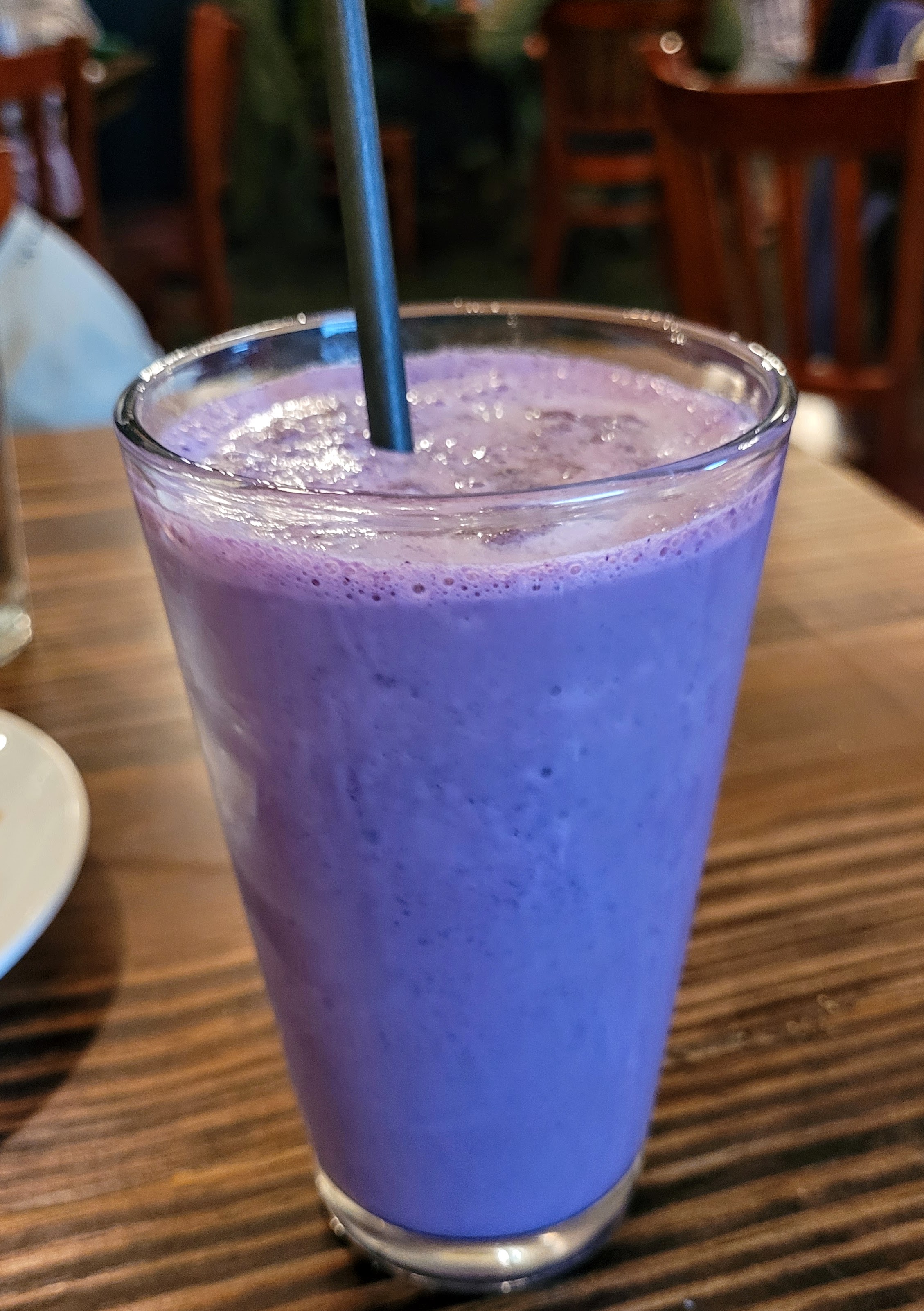
We didn’t order anything too exotic for our lunch with the possible exception of my Blueberry Milk Shake.  It was excellent as well as different from the norm.

I decided on the Classic Hamburger with lettuce, tomato and cheddar cheese. ($13.90) For my side I had a choice of BBQ chips or coleslaw.  It was a nice juicy burger, cooked perfectly to my liking…

I checked out the dinner entrees too.  They included a Filet Mignon, Strip Steak, Marinated Flank Steak, Jambalaya, 2 salmon offerings, Whitefish, a couple varieties of pasta, Chicken Cordon Bleu and a Smoked Pork Chop.

Laurie wasn’t too hungry…perhaps the first of her 3 fabulous fresh biscuits and butter might have had an impact…but in any case her luncheon choice surprised me.  City Park Grill’s soup specialty is their French Onion and that is Laurie’s favorite.  However, Laurie decided to opt for the Shellfish Chowder and it turned out to be a good choice. ($8.50 bowl) Not only was it filling, it was also loaded with tasty seafood.

City Park Grill is open for lunch and dinner 7 days a week.  It is located at 432 East Lake Street in Petoskey Michigan.  Phone: 231-347-0101.  Website: https://www.cityparkgrill.com/.

Many old homes and commercial structures can be found throughout Petoskey.  The town is the county seat for Emmet County Michigan and it was founded ca. 1879.  The Petoskey Downtown Historic District includes 102 commercial properties and 2 institutional structures.  These buildings are located along a 10 block area…although my photos are limited to just East Lake Street.  Contributing structures for the historic district range in age from 1979 into the 1920s. 

Prosperity and preservation must primarily due to the tourist industry as the area has been a popular place to relax and enjoy life almost from the beginning.  Wealthier folks from the Detroit area, and to some degree, Chicago have flocked here for a long time.  The old Grand Rapids and Indiana railway tracks can still be seen in the downtown area and the area around them has been turned into a small park.

The large brick building to the left of the photo is the G&A Building and it is relatively new, having been built in 1907.  Its home to a book store and Roast and Toast, a casual restaurant operated by the same folks that own City Park Grill.  The building was the former home of the Petoskey Normal Business School.  I love the building in the middle.  Home to J.W. Shorter and Sons, selling antiques and gifts, it was built in 1881.

The one-story store at the right of the photo is home to Linda Michael’s (Formerly Little Traverse Jewelers).  The owners make jewelry from stones from Michigan set in silver or gold.  The stones include Lake Superior Agate, Fordite, Kona Dolomite, Greenstone, Leland Blue, Pudding Stone and of course, Petoskey Stones. 

FYI, a Petoskey stone is a rock and a fossil.  It’s composed of fossilized rugose coral.  Basically, there are pieces of a coral reef that was originally deposited during the Devonian period…millions of years ago.  Using lapidary techniques, the distinctive mottled pattern of the six-sided coral fossils emerge.  They are made into decorative items or, in this instance, a gemstone.

Grandpa Shorter’s Gifts was Petoskey’s original souvenir/gift store.  This family owned business was opened in 1946.  It is an historical site dating from 1876.  The historic downtown area is a shopper's dream...

Petoskey has a population of about 5,900 residents and has been fairly stable over recent years.  The name Petoskey is said to mean “where the light shines through the clouds” in the language of the Odawa Native People.  After the 1836 Treaty of Washington when representatives of the Ottawa and Chippewa nations of Native Americans ceded about 37% of what is now Michigan, Odawa Chief Ignatius Petosega wisely purchased lands in this area.  His father was a French Canadian fur trader and his mother was Odawa.  Today, the Little Traverse Bay Band of Native Americans has 13 scattered reservation areas in and around Petoskey.  They own and operate a casino in town.  Check it out at https://odawacasino.com/.

The Little Traverse Historical Museum is housed in the former Chesapeake and Ohio Railway Station located in Petoskey’s Pioneer Park.  This Victorian Shingle style depot, listed on the National Register of Historic Places since 1970, was built in 1892.  To learn about the museum, go to Little Traverse Historical Museum - Home (petoskeymuseum.org).

The Grand Rapids and Indiana Railroad started service to Petoskey in 1874.  A second railroad, the Chicago and West Michigan Railway purchased this land on the shore of Little Traverse Bay to build their depot.  In 1899, the Chicago and West Michigan Railway and this station were absorbed into the Pere Marquette Railway.  The Pere Marquette and its successor, the Chesapeake and Ohio ran the “Resort Special” night train from Chicago.  This depot continued to serve passengers until the 1950s when it was abandoned...although passenger trains served the town until ca. 1963.

FYI, well known personalities and celebrities from Petoskey and Emmet County include: Alan Hewitt, keyboardist with Moody Blues and Earth, Wind and Fire; Mark Farner, a member of Grand Funk Railroad; actor Megan Boone, best known for her recent leading role in TV’s “Blacklist” and: Bruce Catton, a historian and journalist who is best known for his books on the American Civil War.

In 1899, shortly after Petoskey was incorporated as a city, Dr. Norman J. Perry built the Perry Hotel after giving up his dental practice after one of his patients had died from a multiple tooth extraction.  Dr. Perry continued to operate the hotel until 1919 when he sold it to 2 other doctors.  One of the new owner’s nephew managed the hotel for over 40 years.  Under his direction, the Perry Hotel became the place to be…and it was expanded, adding the four-story, 46 room wing in 1926.

Stafford’s Hospitality purchased the Perry Hotel in 1989 and extensive interior and exterior restoration has been completed.  Of the 21 hotels in operation in 1900 and, after 122 years, the Perry Hotel is the only one still operating today.  The hotel feature 75 guest rooms, the H.O. Rose dining room, the Noggin Room and, in the summer months, the Rose Garden Veranda Restaurant.  To learn more about this historic hotel, its accommodations and dining opportunities, you can go to https://www.theperryhotel.com/.

Just click on any of the photos to enlarge them…

Thanks for continuing to follow us on our late summer road trip!

Take Care, Big Daddy Dave

Friday, December 9, 2022

ON THE ROAD TO WESTERN MICHIGAN

…continuing with our late summer road trip to Michigan and beyond.

Driving north along US Hwy 23, I turned onto side roads at Lakewood Michigan, following them for about 35 miles through the towns of Bell and Presque Isle before returning to the highway.  Along the way, we enjoyed the lack of traffic and the scenery in this semi-‘lost’ area of Michigan.

While it may be lost or ignored by the majority of people, the upper eastern portion of the lower peninsula of Michigan represents a vacation tradition to many with plenty of cabins and small resorts along the way. 

The Fireside Inn is a good example of the relaxing rustic resort possibilities in the Grand Lake-Presque Isle area.  The main lodge, 2-stories high, 24 feet wide and 40 feet long, was built by the then owners in 1908 for $350.00.  It still stands and is the core of the resort.  The resort is just 18 miles north of Alpena and it is situated on 5,660 acre Grand Lake.  The lake contains several islands and it is narrowly separated from Lake Huron.  For more about the Fireside Inn, go to http://www.firesideinngrandlake.com/.

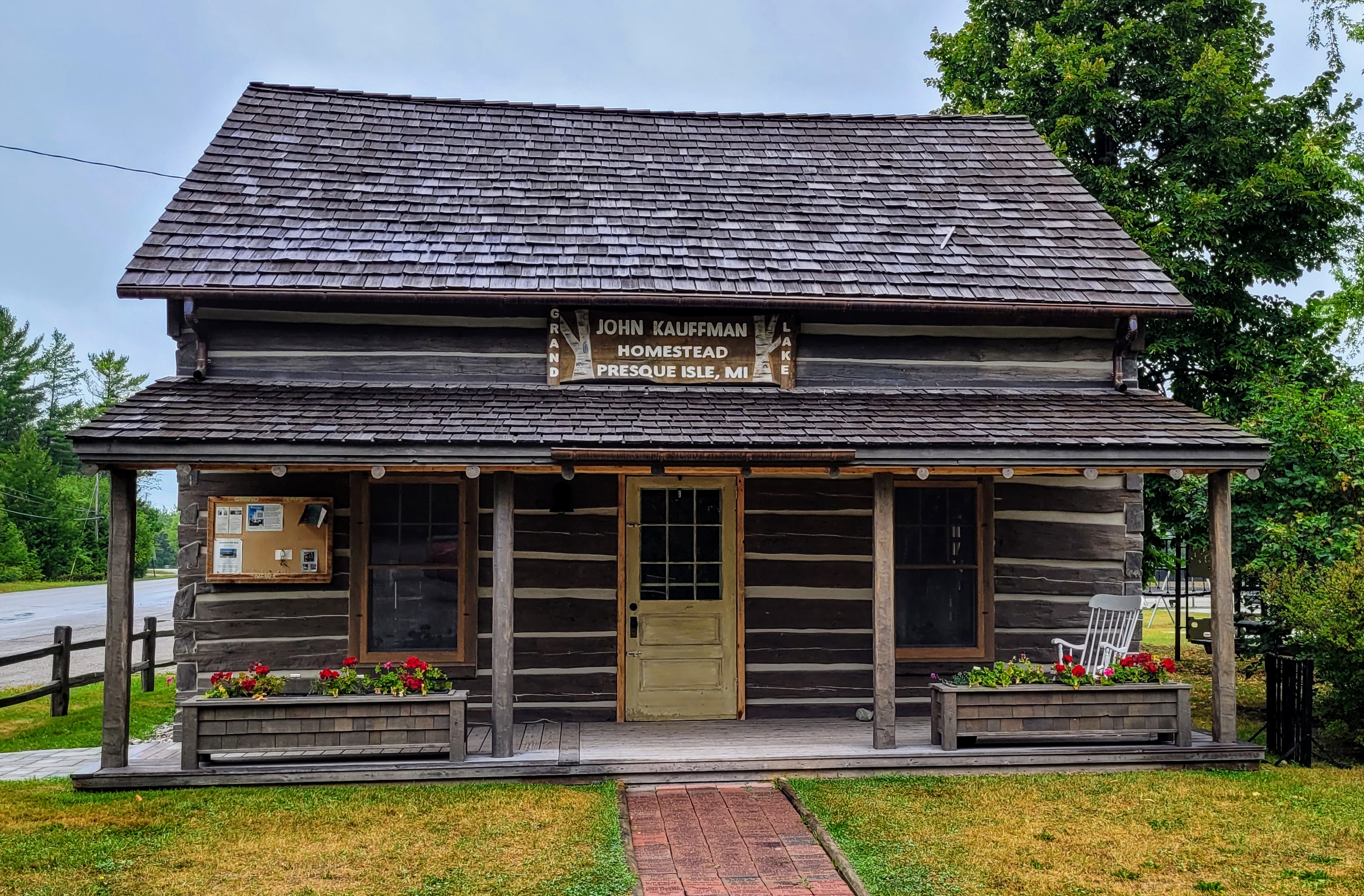
A bit further along the way, we stopped to take a photo of the John Kauffman homestead.  John Kauffman swam ashore near here after the vessel he was traveling on broke up on the shoals near Presque Isle during a fierce storm on Lake Huron.  He applied for a homestead in 1862 and then he built this log cabin… Originally located on Grand Lake, harsh winters and snow drifts off the lake caused Mr. Kauffman to dismantle his home, reconstructing it at its current location in 1876. 

Sometime after John passed on, the Kauffman family deeded the home to The Grand Lake Association.  That organization maintains the home and operates a gift and handicrafts shop here from Memorial Day thru the Labor Day weekend.  I suspect that I’m safe in saying that John Kauffman was related to the Kauffman family that built and operated the Fireside Inn (previous photo) for many years.


We continued north on US Hwy 23 to Rogers City Michigan.  Before heading west toward Lake Michigan and the state’s west coast, we stopped and took a couple more photos of Lake Huron.  It was kind of a nasty rainy day and even the sea gulls were hunkered down on the beach waiting for better weather. 

The last time I was in Rogers City was in the summer of 1962 when I worked as a counselor at a nearby summer camp.  The camp didn’t even have a phone and to call someone, we had to go to town.  Rogers City, population 2,850, is the county seat for Presque Isle County.  The number of residents in the city peaked in 1960 at 4,722. 

The world’s largest open-pit limestone quarry, the port of Calcite, is located within the city limits.  It has the best harbor or port along the east coast of Michigan from the tip of the Lower Peninsula south to the city of Port Huron with an average of almost 7,000,000 tons loaded each year.  Is it a coincidence that the largest cement plant in the USA is located just a little south in Alpena? 

From Rogers City, we headed west on MI Hwy 68 across the northern tip of Michigan’s Lower Peninsula.  We were still in Presque Isle County when we came to the village of Millersburg. (Population 169) Back in 1910, when the lumber industry drove the economy, the town had 519 residents.  Millersburg was founded in 1897 and by 1899, the village had an operating sawmill.  The Detroit and Mackinac Railway Depot shown above was reportedly built in 1916 to replace an earlier one.

The next town along our route was Onaway Michigan, population 890 in 2020. (2,789 in 1920) This is the Presque Isle County Courthouse, aka the Onaway Courthouse.  We were still in Presque Isle County and I was a bit confused since the county seat is located in Rogers City.

A businessman named Merritt Chandler made a fortune in lumbering and then road building and then in 1886, he platted the village of Onaway, and by 1903, about 3,000 people lived here.  In 1980, Chandler had this building constructed.  Then he donated it to the county in an effort to move the county seat from Rogers City to Onaway.  His effort failed but a compromise was reached with county court sessions being alternated between Rogers City and Onaway.  This arrangement lasted until the 1940s.

Onaway is considered the Sturgeon Capital of Michigan with a nearby river serving as this fish’s breeding area.  Also of note is that the beginning of the 20th Century, Onaway was the home for one of the world’s largest bicycle wheel manufacturing…producing about 65% of the world’s wooden bicycle wheels. 

The former Grand Rapids and Indiana Railway depot in Alanson Michigan survives today, having most recently serving as the Alanson Depot Restaurant.  I’m happier if these early depots are saved as community centers or local museums but a second use like this is far better than demolition.  My concern now is, what will this property’s new owner do with the old building? 

Alanson was settled in Emmett County Michigan ca. 1875.  Originally it was called Hinnman.  With 778 residents, Alanson is about as populous as it ever was… At one point Alanson was the northern terminus of the Petosky region resort commuter train service.  Several rail operations have persisted or started and restarted involving the depot or adjacent trackage.  Initially, about 135 years ago, this depot was primarily used by the logging industry.  Eventually it became a train-themed tourist attraction, an antique shop, a snowmobile dealership, a pizza shop, a BBQ restaurant and, most recently as the Alanson Restaurant.

Talk about survivors!  W.W. Fairbairn and Sons Hardware in Alanson, celebrated their 125 anniversary in 2020.  The business was founded by Walter Wayne Fairbairn in 1895.  He came to Alanson in 1888 as a government surveyor.  Settling in Alanson in 1892, Fairbairn established a hardware and plumbing business in this building in 1895.  The building also housed the local post office.

Now in its fifth generation, W.W. Fairbairn and Sons Hardware is still a family-owned and operated business.  The location in the big building on the corner in downtown Alanson hasn’t changed… In 2004, the State of Michigan listed the building as a State Historic Site.  It is a handsome grouping of related structures!

Of course it was too late in the day and in the season to visit this structure and its adjoining facilities.  The Michigan Fisheries Visitor’s Center is also known as the Oden State Fish Hatchery.  The original fish hatchery was established in 1920 and it continued to operate until 2002.  The main hatchery was located track-side on the Pennsylvania Railroad.  During the 1920s and 1930s, fish were loaded on ‘fish cars’ for distribution throughout the state. 

When the new hatchery complex was completed in 2002, the old hatchery was transformed into the Michigan Fisheries Visitor Center.  This facility includes a Great Lakes watershed interpretation area and interactive displays as well as a gift shop.  Weekly nature programs are available and there are self-guided hiking/nature trails.  Admission and programs are free…but to feed the fish, you’ll need a pocket full of quarters.  

This re-created 1914 – 1935 Wolverine train car is located at one side of the front of the Michigan Fisheries Visitor Center.  This exhibit shows how employees of the old Michigan Department of Conservation lived on the train while transporting and stocking fish across the state.  Displays included the sleeping berths and a kitchen.  My dad, Ronald Myers worked for the Michigan Department of Conservation prior to World War II.


The Michigan Historic marker caught my attention as we prepared to continue our drive.  Michigan was a favorite nesting ground for passenger pigeons.  Back in 1878, at nearby Crooked Lake, a passenger pigeon nesting site covered 90 square miles…that’s more than 57,000 acres.  It is estimated that at one point in the 1800s, there were as many as 3 to 5 Billion Passenger Pigeons in North America.  Like the buffalo, they were hunted and killed.  Packed in barrels and shipped to major cities they were a low cost source of meat.  The last confirmed ‘kill’ of a passenger pigeon in the USA took place in 1901.  The last of these birds in captivity died in 1914.

Just click on any of the photo to enlarge them…

Thanks for stopping by for a visit!

Take Care, Big Daddy Dave 

Tuesday, December 6, 2022

Overnight in Alpena Michigan

…continuing with our late summer road trip to Michigan and beyond.

Our overnight goal for this particular day was the Holiday Inn Express in Alpena Michigan.  Alpena is the county seat and the only city in Alpena County Michigan.  It was founded in 1840 and persevered despite disastrous fires in 1871, 1872 and 1888.  It has a population of about 10,197, down from 14,682 in 1960. 

Located along the shores of Lake Huron and Thunder Bay, the Thunder Bay National Marine Sanctuary is located in the city.  This marine sanctuary protects an estimated 116 historically significant shipwrecks, dating from wooden side-wheelers in the 1800s to steel-hulled steamers from the 1900s.  To learn more about the Sanctuary and to view the list of shipwrecks, go to https://en.wikipedia.org/wiki/Thunder_Bay_National_Marine_Sanctuary.  Also of note is the Michigan Islands National Wildlife Refuge located on islands in and around Thunder Bay.

Automobiles, trucks, trolleys, trains, ships and boats…some of my very favorite things for me to photograph and research.  The 95 foot long ‘MV Spencer F. Baird’ is a research vessel operated by the U.S. Fish and Wildlife Agency that is used for Great Lakes research, fish population assessment and for the release of lake trout on offshore spawning reefs.  There are roughly 90 vessels working on various marine science projects across the 5 Great Lakes, but the ‘M/V Spencer F. Baird’ is the only hatchery fish distribution vessel.

Spencer Fullerton Baird (1823 – 1887) was an American naturalist, ornithologist, ichthyologist, herpetologist and museum curator.  He was the first curator to be named at the Smithsonian Institution in 1850, later serving as Secretary of that institution from 1878 to 1887.  Under his guidance, the natural history collections of the Smithsonian increased from 6,000 specimens in 1850 to over 2,000,000 in 1887

Another vessel noted in Alpena’s harbor was this craft operated by the National Oceanographic and Atmospheric Administration.  The 50 foot long ‘RV Storm’ is operated by NOAA’s Great Lakes Environmental Research Lab (GLERL) and it is dedicated to supporting the Thunder Bay National Marine Sanctuary.  The ‘Storm’ is just one of about 40 watercraft operated by NOAA from Hawaii to the Florida Keys.

And then it was time to find a place to eat.  I’d chosen Courtyard Ristorante for our dinner as it was TripAdvisor’s #1 ranked restaurant in the Alpena area.  It was a bit too cold and rainy to eat in the Courtyard.  During our trip, the weather definitely favored us as we only had about 1 ½ days of intermittent rain.


Founded in the early 1980s, the Courtyard Ristorante and the Olde Rooste Lounge has been considered to be one of the best restaurants in northeastern Michigan.  It was a Sunday evening so both the bar and the dining room were fairly quiet.  In keeping with the north woods theme, the restaurant has utilized a lot of stone and wood in both construction and dĂ©cor.

The young man in the second photo above was our waiter.  Evan was friendly, helpful and talkative.  We learned about his future plans for both he and his girlfriend.  Good Luck Evan!


I thought that Laurie was just taking a photo of my Miller Lite ($3.75) and her Moscow Mule ($8.00)…but she also ‘included’ yours truly in the picture.  A basket of homemade bread came with our meals and it was really great bread.  Evan brought us a second serving after we ravenously devoured the initial portion.

For an appetizer, we opted for the Calamari. ($12.00) The nori-sriracha dusted calamari rings were served with garlic-chili aioli.  It was a great choice.

We had considered 2 other possibilities for our appetizer.  First there was the Ahi Tuna Poke, sashimi tuna sautĂ©ed in sesame oil, soy sauce, nori, sesame seeds, onions and served with ocean salad and wasabi aioli. ($16.00) The other choice would have been the Seared Shrimp, 6 jumbo shrimp sautĂ©ed in a Thai-chili garlic butter and then topped with a chipotle glaze a parmesan baguette. ($14.00)

For her entrĂ©e, Laurie chose the Wild Yellow Belly Perch. ($22.00) She could have ordered it either breaded or pan seared.  Note that all entrees are paired with the diner’s choice of pasta, vegetable of the day, baked potato or steak fries.  A twice baked potato would have been $2.00 more.  A house salad was another $3.00, a specialty salad was $5.00 and the made from scratch soup was another $5.00.

While Laurie said that she really liked her meal, I thought that the visual of her fettuccini Alfredo was off-putting and $22.00 seemed a bit steep for 4 small perch filets.  Of course the most important factor is that she enjoyed her entrĂ©e…

She had also considered the Mac N’ Cheese Bake for her entrĂ©e. ($15.00)  This macaroni and cheese offering involved Trottole pasta with the Courtyard’s blend of Gruyere, aged sharp cheddar, goat and cream cheese, baked with mozzarella and parmesan cheese.  Depending on what other protein a diner might want with their Mac N’ Cheese, the price would have ranged from $20.00 with chicken up to $25.00 with Langostino. 

For my meal, I chose the Chicken Tetrazzini. ($18.00) The bocconcini pasta was tossed with Courtyard’s house-made Bianca sauce with chicken, spinach and parmesan cheese.  It normally comes with mushrooms and caramelized onions as well but I don’t like either of them.  I did enjoy my dinner…

I will admit that I was tempted to order the Almond-Encrusted Gorgonzola-Stuffed Chicken. ($22.00) The almond-encrusted chicken breast was stuffed with gorgonzola, broccoli and prosciutto and then it is drizzled with gorgonzola butter and it’s served on a bed of parmesan white truffle oil risotto.

The Courtyard Ristorante and Olde Roost Lounge is open for dinner 7 days a week beginning at 4 PM.  There is live music every Thursday…and they also have pizzas on the menu.  The restaurant is located at 2024 US Hwy 23 South in Alpena Michigan.  Website: http://www.courtyardristorante.com/.  

As we departed from Alpena the next morning to begin the next leg of our road trip, I did manage to photograph one historic place as listed on the National Register of Historic Places. 

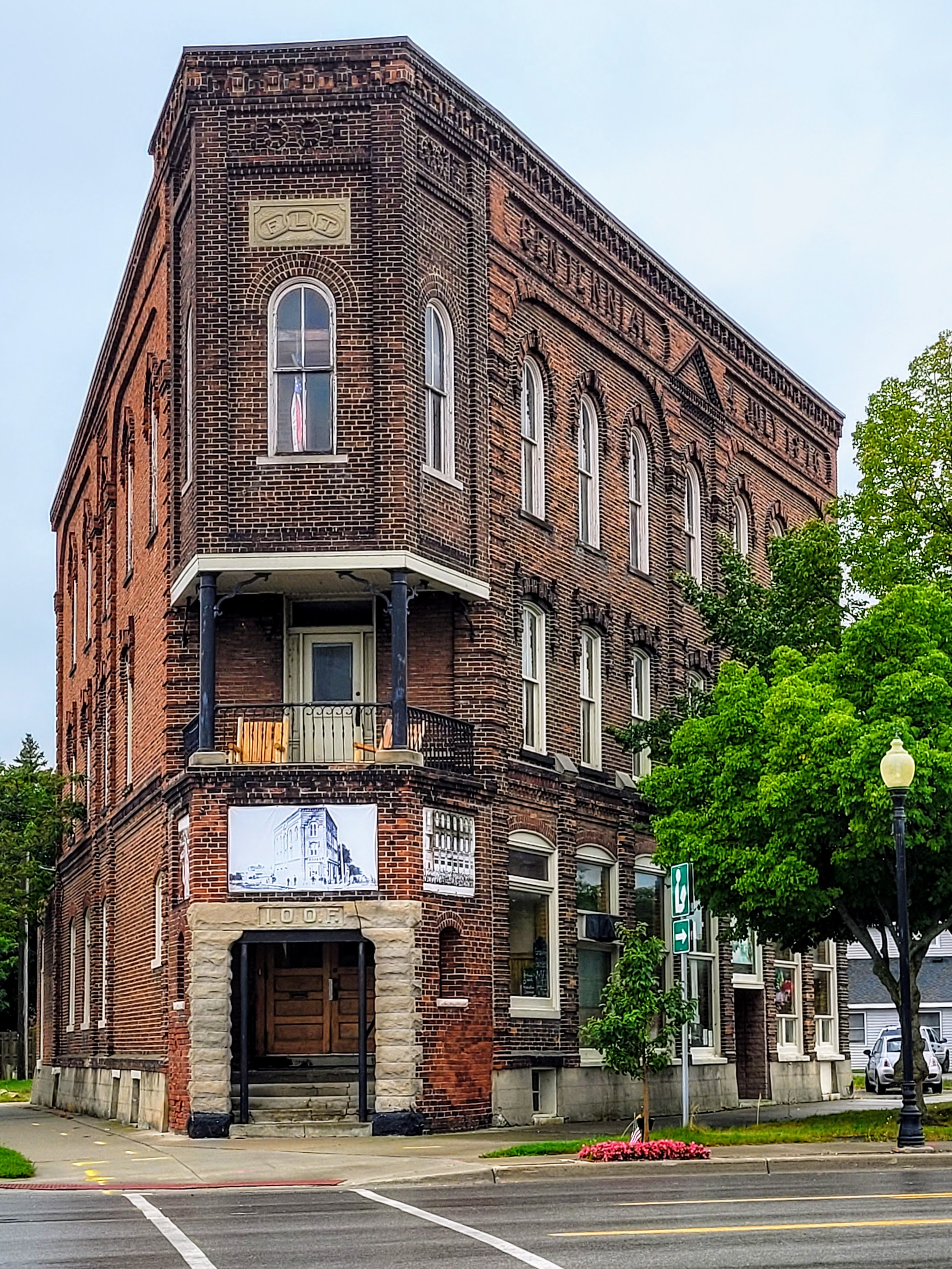
The I.O.O.F. Centennial ‘flatiron’ Building at dates back to 1876.  It’s a mix of late Victorian commercial Italianate architecture.  It’s referred to as a ‘flatiron’ building given its wedge shape and its visual resemblance to old fashioned cast iron clothes irons.

Originally built for Samuel E. and Samantha Hitchcock, in 1901 it was sold to the local chapter of the Independent Order of Odd Fellows, where Samuel was a member.  Various chapters of the I.O.O.F. occupied the building for 93 years.  Other occupants have included book and music stores, the city library, the Red Ribbon Society…a forerunner of the Women’s Christian Temperance Union and a restaurant.  Based on the chairs on the upper balcony, someone is living here…and another occupant is the Alpena County Veterans Affairs Office.

Just click on any of the photos to enlarge them…

Thanks for stopping by for a visit!

Take Care, Big Daddy Dave

Friday, December 2, 2022

Late Summer Road Trip – Michigan’s East Coast headed North

…continuing our late summer road trip.

After leaving my cousin Nathan and his better half Janice in Fenton, Laurie and I headed north along Interstate I-75, exiting from the ‘super-slab’ on US Hwy 23 toward Standish.  Our goal for the next couple of days was to drive north along the east coast of Michigan to Rogers City and then cut across the two-lane highways to the west coast of Michigan.  We had never driven along the east coast of the state which borders Lake Huron so it was discovery time...

Almost as soon as we entered Standish, we spotted the old railway depot I’d wanted to find.  The first railroad to serve Standish came about due to the construction of the Jackson, Lansing and Saginaw Railroad’s new line from West Bay City Michigan to Mackinaw City.  The first depot was built in 1871 or 1872 probably from white pine.  By 1885, there were 8 passenger trains coming through Standish on a daily basis. 

In 1887, the Michigan Central Railroad told the citizens of Standish that the railroad would provide the stone masons to build the depot if local farmers would haul their large field stones to the site for the new depot.  The depot was completed in 1888.  The depot was our first stop on the US Hwy 23 “Heritage Route”, a 200 mile stretch of roadway the runs from Standish to Mackinaw City near the bridge over to the Northern Peninsula of Michigan.

The last steam engine passenger coach to be pulled into the Standish Depot was on October 28, 1955.  I don’t know when the above photo was taken but I was interested to note that the locomotive appears to be Pere Marquette steam locomotive #1225…now owned by the Steam Railroading Institute in Owosso Michigan.  By 1965, all passenger service was discontinued.

I ran across this little historical tidbit as I did my research.  “February 1, 1916: Sam Good expects to ship another carload of horses from Standish next Tuesday by express.  They will be shipped to Chicago where they are reshipped to Europe for use in the war.  The express charge for this carload of horses headed to Chicago was $50.00.”

To learn more about the historical Standish Depot, its museum room, the Visitor’s Center and the adjacent War Memorial, just go to http://standishdepot.org/.  We love to see old buildings that have been adapted and preserved for the community...


I couldn’t easily get close to the second depot that was built in Omer Michigan to serve this small town and the Detroit and Mackinac south division main line.  The first structure has been used as a Senior Center in the years since the railroad ceased service.

I did find a photo of the earlier depot (ca. 1889) at this location complete with a train pulled by a steam engine.  A branch line to Au Gres Michigan was also located here at one point. 

Omer was settled ca. 1966 on the Rifle River after a saw mill was built here.  Originally the town was named Rifle River Mills but the first postmaster wanted to name it Homer.  But another town in Michigan already had the name so he simple dropped the leading “H”…hence “Omer”.  Omer has the distinction of being Michigan’s least populated city with 259 residents being recorded in the 2020 census.

We took this photo of wildflowers and weeds just because we thought that the composition was quite appealing.  


Our next stop was in Tawas City, the County Seat of Iosco County Michigan.  The views shown above are all from a pier down along the town’s waterfront on Lake Huron.  Those condos look pretty inviting… As for that photo of yours truly, I think that I scared off the seagulls.

Tawas City was founded in 1854 and it has a population of 1,834.  When considering the population of Tawas City, one must consider that it shares a border with East Tawas, a bit larger town with a population of 2,663.  As with Omer, originally Tawas City was all about the lumber industry and the fact that Tawas Bay offered shelter from the storms on Lake Huron.  Native Americans had camped here for eons…notably a band from the Saginaw Michigan tribe of Chippewa (aka Ojibwa).  Their leader was Chief O-ta-was and the bay was known as O-ta-was Bay.  Verbal evolution changed O-ta-was to Tawas City…or Tawas Bay

While driving through Tawas City, we spotted this old building…the Liberty Building Shoppes…at 402 Lake Street/US Hwy 23.  We love antiques and collectables so we had to check it out.  The building was constructed in 1885 and it is one of 8 listed antique shops that are located in Tawas City or East Tawas.


I did find that old photo of the Liberty Building from back in the ‘horse and buggy days’, probably from around 1900.  The second photo gives you an idea of the large eclectic collection of antiques and collectables on display in the store.  The owners live in the building and…oh yes, it is haunted by a ghost named Mary.

To learn more about Liberty Building Shoppes, you can go to: https://www.facebook.com/people/Liberty-Building-Shoppes/100068592204767/.  They are open 7 days a week.


To be honest, I don’t remember where I met “Bigfoot”.  It probably was in Tawas City.  Apparently I wasn’t his type.  Heck, I even held hands with him in an effort to win him over.  Michigan has been a ‘hot spot’ for Bigfoot aka Sasquatch hunters…but I didn’t have to look very hard to find one.

This view of Lake Huron from the side of a very pretty and well situated cottage really grabbed our attention. 

For those who don’t know about or who don’t understand the size of Lake Huron, here are a few facts.  The lake is one of the 5 Great Lakes that stretch from Minnesota to New York State in the USA and from Ontario into Quebec in Canada.  The name of the lake came from early French explorers who named it for the Huron people who inhabited the region.  The lake is connected to Lake Michigan with a 5 mile wide 120 feet deep channel at the Straits of Mackinac.  The lake’s primary inlet is the St. Mary’s River and its primary outlet is the St. Clair River.

Lake Huron has a surface area of 23,007 square miles.  By way of comparison, that is just a little smaller than New Jersey, Connecticut and Massachusetts combined.  It is the 3rd largest fresh water lake in the World.  The lake’s average depth is 195 feet and its maximum depth is 750 feet.  More than 1,000 ship wrecks have been recorded in Lake Huron.

This photo is of the Lake Huron Pier at the Oscoda Beach Park in Oscoda Michigan.  We love to walk out on piers and just chill out…

However, in this case, despite a cloudy day  and a cool breeze, ‘chilling’ wasn’t in the cards.  The pier is where we encountered Thor’s twin brother. (Thor himself is shown above) 

Even I was impressed by the 6’6” handsome beast of a man with flowing locks of hair and a muscular wedge-shaped build.  He even had a nice dog with him…plus he was friendly and easy to talk to.  OK…fact is that Laurie didn’t really notice the dog due to our Thor carbon copy encounter.  No, sorry ladies, I didn’t take a photo!

Back to reality!  Not only does the Oscoda Beach Park feature a nice pier, it also has a long and expansive stretch of nice sandy beach for family fun.  There are benches along the board walk, picnic tables and restrooms as well.  

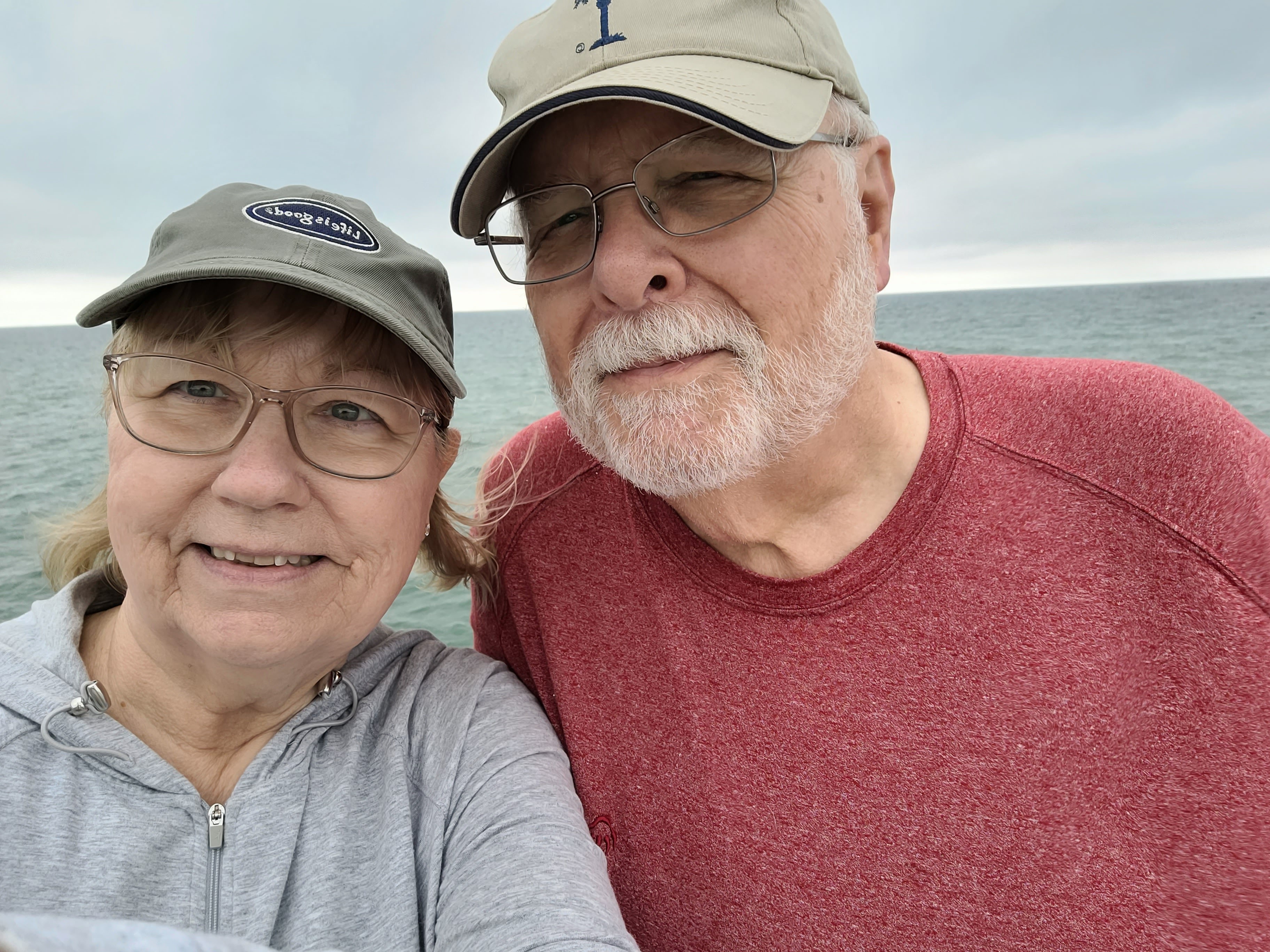
In lieu of a photo of Thor’s twin and his dog, Laurie took this selfie of us on Oscoda’s pier. 

The area was first settled as early as 1867 when a firm bought land here and platted the community.  It was all about the lumber business.  Both Oscoda and the adjacent ‘town’ of Au Sable are unincorporated census designated places.  However, the 1890 census showed that the area booming!  Oscoda had a population of 3,593 and Au Sable had 4,328 residents. (7,921 combined!) A huge forest fire in 1911 pretty much wiped out both towns.  In 1931, Au Sable only recorded 61 residents.  Today, the combined population of both towns only totals 2,369.

Harrisville is my last stop for this segment of our Michigan adventures.  Finding the former Detroit and Mackinac Railway Depot was a bit of a challenge.  It is not in what would be considered a central point in this small town but as you can see, we persevered.  Like the depot in Standish, this old passenger depot is made with stone…one of only 2 along the rail route. 

The depot was completed in 1902 to serve Harrisville and it was a busy place.  Several daily passenger trains departed for locations such as Cheboygan and Detroit.  Like the other towns along the shore of Lake Huron, the lumber business was the initial driving commercial force.  The last passenger train left this station on March 31, 1951.  Mail and freight service continued through the early 1960s. 

Harrisville was incorporated as a village in 1887 and as a city in 1905.  With a population of about 470 residents, it is the county seat of Alcona County.  The population peaked here in the city back in 1890 with 987 residents.  The city is located near a variety of state parks and beach areas.  It also has a safe harbor for pleasure craft that is protected with a series of jetties.


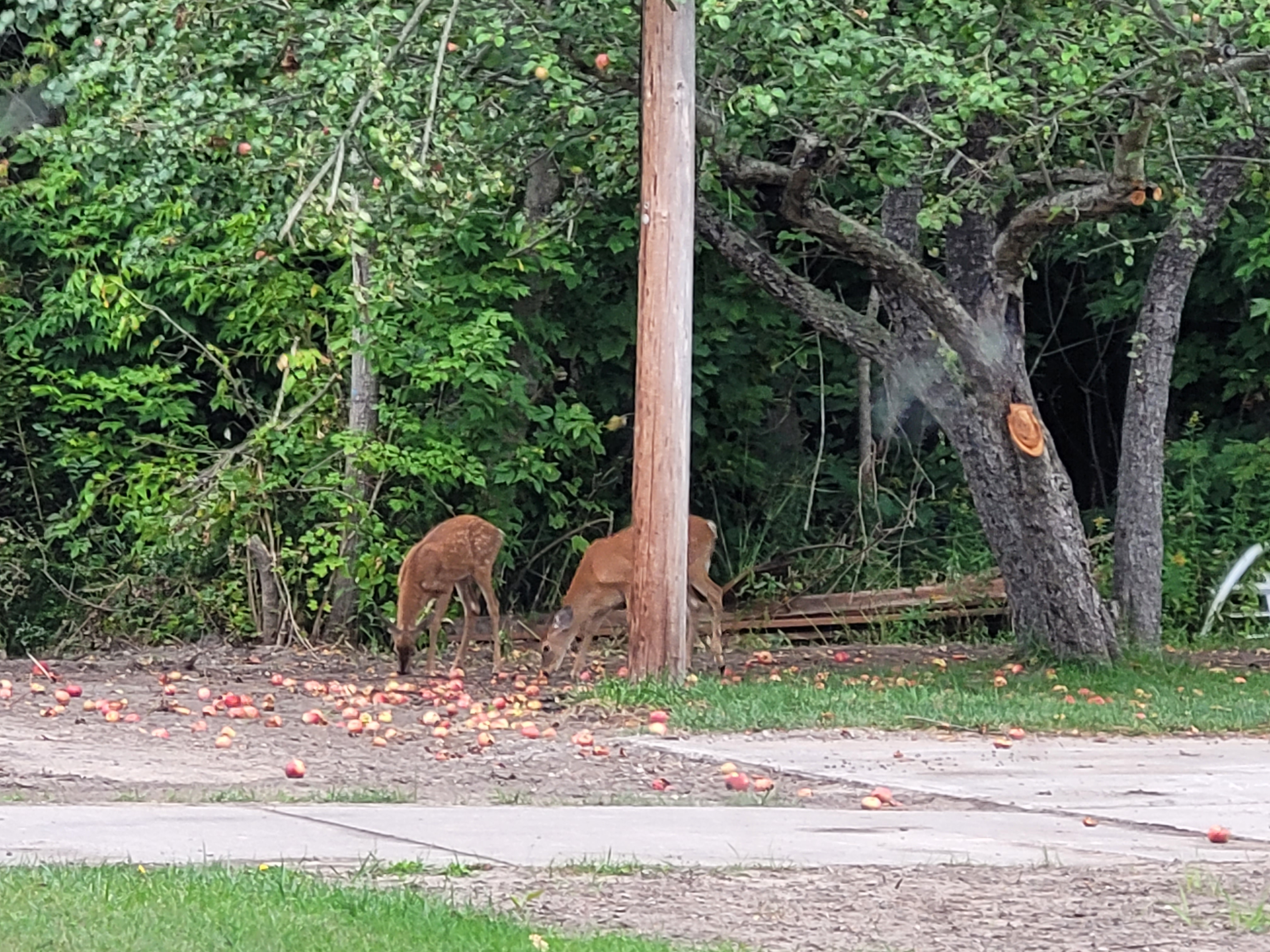
Our search for the old Detroit and Mackinac Railway Depot in Harrisville took us down a couple of side streets or roads and through a residential neighborhood.  Then we saw these deer… They slid into the woods when we passed them to approach the nearby depot, but when we returned, they’d either decided that we weren’t a threat or that this apple feast was worth the risk.  Question… Can deer overdose on ripe apples?  Apparently a few apples won’t hurt them but too many apples can do significant harm to their digestive system.  We hope all of these pretty deer survived their feast!

Just click on any of the photos to enlarge them…

Thanks for stopping by for a visit!

Take Care, Big Daddy Dave