Showing posts with label Aircraft. Show all posts

Friday, February 10, 2023

The United States Air Force Museum – Part II

…continuing with but nearing the end of our late summer road trip to Michigan, Indiana and Ohio.  Here is a second brief look at the National Museum of the United States Air Force in Dayton Ohio.

I included this photo to try to convey the size and scope of the Air Force Museum.  The collection is housed in 4 huge buildings like this one plus there is a giant missile/rocket silo and there are aircraft parked outside on the tarmac.

I went through the museum’s listings for the different galleries and I counted 274 aircraft on exhibit.  In addition, I counted up the other historic exhibits in just the Early Years, WWII, Korea, SE Asia and Cold War Galleries…and there are 279 of them in just those 5 galleries that are available for visitors’ to view.  Add in the separate exhibits of engines, weapons and videos, not to mention the Missile/Rocket silo…which we skipped, and it was all a bit overwhelming.  To do the museum justice, it would take 2 full days to semi-thoroughly review everything available to the public.

What follows is a second (and last) random sampling of some of the aircraft and other exhibits we saw and photographed during our visit to the museum.

This odd looking mash-up of 2 P-51 Mustang’s conjoined into a single aircraft is a bit deceiving.  The North American F-82G Twin Mustang was a totally new design.  With a pilot and a co-pilot/navigator, it was conceived as a long-range bomber escort for the B-29 Superfortresses in World War II but the war ended before production deliveries began in 1946.  The F-82 was the last propeller-driven fighter aircraft that was purchased in quantity by the USAF.  In total, 273 of these planes were built.  Having 2 pilots on board helped reduce fatigue on long range bomber escort missions.

The F-82s were used by the Strategic Air Command as long range bomber escorts during the early days of the Cold War.  During the Korean War, F-82Gs based in Japan were among the first USAF aircraft to operate over Korea…shooting down the first 3 North Korean aircraft that were destroyed by U.S. forces.

The F-82 fighters could reach speeds of 400 mph and they had a range of about 2,240 miles.  This particular aircraft is nicknamed “Betty Jo”.  In February 1947, equipped with an extra fuel tank, Betty Jo made a non-stop trip from Hawaii to New York without refueling.  That flight took 14 hours and 32 minutes and if covered 5,051 miles.  It is still the longest non-stop flight ever made by a piston/propeller driven fighter aircraft.

This is one of the many non-aircraft exhibits that are found everywhere in the Air Force Museum.

These walls came from the “Warrior’s Lounge” at the U.S. Air Force Contingency Aeromedical Staging Facility at the Balad Iraq Air Force Theater Hospital.  Patients waiting for transport stayed there for as many as 3 days.  Patients and visitors were encouraged to sign the walls as an informal way to display unit pride, remember friends, or to just say ‘thank you’.  The messages pay tribute to patients and medical staff who served in Operation “Iraqi Freedom”.

Balad Air Base, aka Al-Bakir Air Base was the largest military base in Iraq.  The USAF maintained this medical staging facility at Balad from 2003 – 2011.  During that time, Air Force medical personnel treated more than 43,000 wounded or ill patients…and then moved them to destinations in Europe and the United States.  In 2010 plans to remove these walls led to efforts to save them.  The Air Force Medical Service and others worked to preserve them and by 2016, the exhibit was put on display in the museum.


…and this is another exhibit not involving an airplane.  This is the Vapor Special Operations Supercar.  It showcases U.S. Air Force ingenuity, state of the art technology and innovation.  It was one of two custom-built automobiles commissioned by the Air Force Recruiting Service in 2009 for its “Project Supercar” recruiting campaign.  This ‘supercar’ toured the USA for more than 7 years with the Air Force Recruiting Service, educating the public on opportunities for both officers and enlisted airmen.

This is a fully customized Dodge Challenger.  It is outfitted with special gull-wing doors, a carbon fiber body kit, and a ‘stealth’ exhaust system that, when activated, allows the Vapor to run almost silently.  This automobile features a Forward Looking Infrared system for night operation and a high-resolution 360-degree surveillance camera with a quarter mile range.  The interior, a blacked-out ‘command center’ is equipped with aircraft style controls, a passenger side steering wheel and a windshield heads-up display with both night and thermal vision capability.  The Vapor’s computer system allows remote operation of the vehicle from anywhere in the world with an internet connection

Visitors are permitted to walk through this cavernous Douglas C-124 Globemaster II.  The first flight of the C-124 took place in late 1949 with deliveries of these aircraft beginning in late spring 1950.  The U.S. Air Force bought 448 of these aircraft before production ended in 1955.  Most C-124s were transferred to the Air Force Reserve and the Air National Guard by 1970 and all were released from service in 1974. 

The C-124 features ‘clamshell’ loading doors and hydraulic ramps in the nose and an elevator under the aft fuselage.  It could handle tanks, field guns, bulldozers and trucks.  Converted into a troop carrier, it could carry 200 fully-equipped soldiers or 127 litter patients and their attendants in its double-decked cabin.  C-124s provided heavy airlift capabilities during the Korean War and the War in Southeast Asia.  These aircraft had top speed of 320 mph and a flight range of 2,175 miles.

This is a Douglas B-26C Invader.  During the Korean War these aircraft played an important part in the U.S. Air Force’s campaign against invading communist ground forces.  Most missions were flown at night as the Chinese/North Koreans had introduced MiG-15 jet fighters into the fray.  The top speed for the B-26 Invaders was 373 mph while the MiG-15s could reach speeds of 669 mph. 

Douglas B-26 aircraft were a WWII attack aircraft used for level bombing, ground strafing and rocket attacks.  It was first delivered to the Army Air Corp in August of 1943.  By the time production ended after the war, a total of 2,502 Invaders had been built.  Early in the Southeast Asia War, the Invader returned to action for the third time.  Forty of these aircraft were reconfigured with more powerful engines and increased structural strength.  These later updated Invaders were designated as B-26Ks and they undertook special air warfare missions.

The B-45C Tornado resulted from a wartime initiative that was launched by the U.S. War Department during WWII.  The goal was to develop a jet-propelled bombers equal to those being fielded by Nazi Germany.  North American Aviation received the contract to build its proposed bomber.  WWII ended and progress was stalled by post-war cutbacks.  However, tensions between the USA and the Soviet Union resulted in a production contract and the first prototype took flight in February of 1947.  Only 143 of these aircraft were built.

B-45s served in the Korean War performing both aerial reconnaissance and conventional bombing missions.   Forty of these aircraft were extensively upgraded so they could be equipped with nuclear weapons.  Upgrades also included their defensive systems and fuel tankage to increase both survivability and range.  The Tornado was important to the United States’ defense strategy…nuclear deterrence…for several years.  These aircraft were retired from the USAF’s Strategic Air Command until 1959.

The B-45 Tornado was the first operational jet bomber to enter service with the USAF and it was the first multiengine jet bomber to be refueled in midair.

The Douglas A-1E Skyraider is not a prepossessing aircraft and yet it entered service with the USAF/Army Air Corp in 1945 and it continued in service with the Air Force until the early 1970s and with other nation’s air forces until the early 1980s.  Originally designed as a U.S. Navy carrier-based aircraft, the Skyraider first flew in 1945.  It turned out to be a very versatile and rugged airplane capable of carrying what was a record setting amount of fuel and weapons.  The Skyraiders were transferred to the USAF and modified to fill a counterinsurgency role. 

A total of 3,180 A-1 Skyraiders were built.  They served in both the Korean War and the War in Vietnam.  These aircraft were a true exception to the modernization of the USAF, remaining in front-line service well into the Jet Age.  Not only did they serve with the USN and the USAF, but they also served the US Marines, the British Royal Navy, the French Air Force, the Republic of Vietnam Air Force and others.

The A-1E Skyraider on display at the National Museum of the United States Air Force was flown by Major Bernard Fisher.  During the Vietnam War he rescued a fellow pilot by landing in enemy territory while under heavy fire and then flying him to safety.  For his actions, Major Fisher was awarded the Medal of Honor.  This is believed to be the only surviving fixed-wing Medal of Honor aircraft...

In 1951, development of a supersonic tactical fighter-bomber was initiated by Republic Aviation.  The goal was to replace and improve upon the older aircraft then operating in the USAF.  The product of this new effort was the F-105 Thunderchief.  The first prototype flew in October of 1955 and production followed.  The first upgraded F-105D flew in June 1959.  In total, 833 Thunderchiefs were built, including 610 F-105Ds.

F-105s served in the Vietnam War beginning in the summer of 1964, shortly after the Tonkin Gulf incident. (An attack on US Navy vessels followed by another attack that really never happened) The USAF used the F-105Ds extensively in the “Rolling Thunder” air campaign against North Vietnam.  The Thunderchiefs could reach speeds of 1,390 mph and cruise at 778 mph.  They had a 2,200 mile range and they could carry 6 tons of ordinance.  Gradually replaced by the F-4 Phantom, the last F-105D was withdrawn from service in 1980

As I’d mentioned, my photos from the museum were randomly selected.  Leaving Vietnam, and moving back to WWII, the aircraft shown above is a Messerschmitt Bf-109G-10.  This aircraft was the result of a fighter competition by manufacturers on behalf of the Luftwaffe (German Air Force) that was initiated in the early 1030s.  Messerschmitt’s creation included a truly advanced aerodynamic design for its time.  The aircraft had retractable landing gear, an enclosed cockpit, automatic slats, cantilever wings and stressed skin construction.  The first production version of the Messerschmitt, the Bf-109B came off the production line in 1936.

An early version of this aircraft first entered combat with the German-manned “Condor Legion” units during the Spanish Civil War.  Early in WWII, upgraded versions completely dominated and outfought allied air craft.  The Bf-109E was involved in the air battles over the English Channel and beyond…and its short range proved to be its Achilles heel.  For example, these fighters couldn’t escort Luftwaffe bombers all the way to London…which was a significant plus for Great Britain.

The last major upgrade/design change for the M-109s was the K series.  The rapidly deteriorating war situation for Germany aggravated by Allied bombing limited production of the “K” series to less than 2,000 aircraft.  There is no doubt that the Bf-109 was the backbone of the Luftwaffe fighter force.  By the war’s end, Germany had built more than 30,000 of these aircraft.  Even after the war, production of the Bf-109 continued in Czechoslovakia until 1949 and in Spain until 1958.  It is the most produced fighter aircraft in history

While the German Nazi Air Force fielded the Messerschmitt B-109, Japan’s Imperial Navy used the Mitsubishi A6M2 “Zero”, the example of which is tucked in under the wing of a larger aircraft.  It was the most famous symbol of Japanese air power during WWII.  The Zero flew for the first time in April of 1939 and Japan produced 10,815 Zeros from 1940 through the end of the war in 1945.  Mitsubishi designed the Zero based on Japanese Navy requirements that were established in 1937.  Designed as a carrier-based fighter, it was very light in comparison with its opposing aircraft.  In addition it was fast, very maneuverable and had great range.  Its maximum speed was 316 mph and they had a range of 1,916 miles.

The A6M Zero first saw combat in China in the late summer of 1940…and Japan dominated the air in Asia.  When Japan attacked Pearl Harbor on December 7, 1941, 125 Zeros from 6 aircraft carriers participated.  In the early part of the war, due to its speed and turning ability, allied aircraft were at a disadvantage in a dogfight with a Zero that was flown by a skilled pilot.  The allies learned that the key to fighting the Zero was to stay out of dogfights, instead using superior armament with hit-and-run diving attacks against the relatively fragile Zeros.  In the battle for the Philippines in late 1944, more than any other aircraft, the Japanese used Zeros in kamikaze attacks on allied ships...

The Consolidated B-24D Liberator was used in bombing operations in every combat theater during WWII.  Its top speed was 303 mph and its cruising speed was 175 mph…but it had a range of 2,850 miles.  This heavy bomber was perfect for long-distance missions such as the famous raid from North Africa against the Axis oil industry at Ploesti, Romania.  That range also made it very suitable for long over-water missions in the Pacific.  More than 18,000 Liberators were built, 8,685 of them by the Ford Motor Company.

Early British Royal Air Force Liberators were the first aircraft to routinely cross the Atlantic Ocean. The B-24 was a modern design featuring a highly efficient shoulder-mounted, high aspect ratio wing.  That design gave the aircraft a high cruise speed, its long range and the ability to carry a heavy bomb load.  It should be noted that air crews didn’t love this plane as much as the General Staff did.  The plane was relatively difficult to fly, it had a lower ceiling, had poor low speed performance and it was less robust than other bombers…such as the B-17.  The Indian Air Force retired the last B-24 Liberators in 1968.

As a side-note, after the war Australia’s Qantas Airlines used Liberators as passenger aircraft…using them on the 3,077 mile air route from Perth Australia to Columbo Ceylon.  It was 17 hour flight…

Time for an allied aircraft…quite a few are on display in the Museum.  This is a British Bristol Beaufighter.  This fighter aircraft first entered service with the Royal Air Force in July 1940 as a day fighter.  When the USA entered the war, the Beaufighter filled the need for an effective night fighter for the Army Air Corp until an American aircraft could be produced.  The powerful and heavily armed night fighter version of this aircraft entered service just as the Luftwaffe began its “Blitz” night attacks on London in September of 1940.  Beaufighter crews accounted for more than half of all of the Luftwaffe bombers shot down during the Blitz.

American Night Fighter Squadrons received more than 100 ‘reverse Lend-Lease’ Beaufighters in the Mediterranean during the summer of 1943.  Purpose built American P-61 Black Widow night fighters began to replace the Beaufighters in late 1944 but the US Army Air Force Beaufighters continued to fly night cover for allied forces until the end of the war

The Junkers Ju 88D-1/Trop was one of the most versatile airplanes of World War II.  It served nearly every type of combat role, including dive bomber, level bomber, night fighter, daytime interceptor, photographic reconnaissance, tank destroyer and even as an unpiloted missile.  The Ju 88 made its first flight at the end of 1936 and hundreds were still in use when the war in Europe ended in 1945.  15,000 Junkers 88s were built…

This particular Ju 88D-1/Trop is a long-range photographic reconnaissance version that had been modified for tropical use.  Known as the “Baksheesh”, it was the best known Ju 88 of them all.  It was delivered to Romania…an Axis member and German ally…in June of 1943.  In July, a disillusioned Romanian pilot flew the aircraft to Cyprus to defect to the British forces there.  The “Baksheesh” was turned over to the US Army Air Forces and it was flown to the USA where test pilots flew the aircraft extensively.  This particular aircraft is fittingly painted in Romanian Air Force markings…the same ones it carried in July 1943.

This is one of my favorite aircraft from World War II.  It isn’t the best fighter of the war and others had a bit more style, but the Curtiss P-40E Warhawk has stories to tell.  The P-40 was the Unites States’ best fighter available in large number when WWII began.  P-40s actually engaged Japanese aircraft at Pearl Harbor and in the Philippines in December of 1941.  But for me, the story of the P-40s with the famed Flying Tigers in China in 1942…is one of persistence, making do with what you had…and bravery.

The Flying Tigers, known officially as the 1st American Volunteer Group, were a unit of the Chinese Air Force, recruited from U.S. Navy, Marines and Army Aviators.  They were highly successful against the Japanese forces in China and their feats were widely publicized by international reporters to help boost public morale at home.  In just a little over 6 months, the Flying Tigers destroyed 297 Japanese aircraft with a loss of just 4 of its own P-40s in air-to-air combat.  To learn more about the Flying Tigers, just go https://en.wikipedia.org/wiki/Flying_Tigers.

The P-40 Warhawk was also the aircraft used by the 99th Fighter Squadron in North Africa in 1943.  This was the first African American United States fighter unit.  These planes served just about everywhere during WWII, some were even sent to Russia.  Slower and less maneuverable than its opponents, the P-40 had a reputation in battle for extreme ruggedness…aka survivability.  These aircraft continued to serve throughout the war.  More than 14,000 P-40s were built and they served in the air forces of 28 nations.

…and that’s about it for my long posts resulting from our visit to the National Museum of the United States Air Force in Dayton Ohio.  Between my 2 posts, I used about 35 or 36 photos…but I took over 100.  If you love planes and you love history, this is a great museum to visit.  To learn more, go to https://www.nationalmuseum.af.mil/.  By the way, both parking and Admission to the museum are free!

Just click on any of the photos to enlarge them…

Thanks for stopping by for a visit!

Take Care, Big Daddy Dave 

Tuesday, January 31, 2023

Back at the A-C-D Museum – Other ‘Off Brand’ Vehicles

…continuing with our late summer road trip to Michigan and beyond, as well as our exploration of the Auburn-Cord-Duesenberg Museum in Auburn Indiana.  In this segment, I’ll explore some of the other vehicles that comprise an important portion of this first class museum’s total collection.

Charles H. Black was the owner of a carriage works and blacksmith shop in Indianapolis Indiana.  After driving a neighbor’s Benz in 1891, Black felt the urge to build his own ‘horseless carriage’.  He is thought to have completed his car in 1893.  He used a buggy for the coachwork and its drive was supplied by two different belts, one providing low gear and the other high gear.  This vehicle was powered by a single cylinder motor producing 8 HP.

Mr. Black drove this automobile around Indianapolis for more than 20 years.  His daughter donated the car to the Indianapolis Children’s Museum in 1927.  In the late 1890s and into 1900, Black built a more refined version of his gasoline ‘buggy’.  Most carried his name but a few were named “Indianapolis”.  In 1900 he sold his patents to investors for $20,000 and they produced the “Black” under 

Continuing with the lesser known or unusual early automobiles, this is a 1908 2-passenger Zimmerman Model G.  It came with a 2-cylinder engine that produced 14 HP.  The Zimmerman was more elegant than many of the early ‘motor buggies, with its engine in place under that lovely curved hood.  This Zimmerman was the first automobile to be donated to the Auburn-Cord-Duesenberg Museum. 

‘Highwheelers’ like this one were very popular in the early years of the automobile industry.  Rural customers needed vehicles that could withstand the rough and rutted roads that existed in those days.  Basically, a ‘highwheeler’ was a buggy with an engine.  Many if not most of the companies building ‘highwheelers’ had initially been in the carriage industry.  FYI, the Zimmerman Manufacturing Company was based in Auburn Indiana and they produced automobiles from 1907 to 1915.


Now for another automobile made in Auburn Indiana… The W.H. McIntyre Company, with its predecessor, the W. H. Kiblinger Company, built cars in Auburn from 1907 to 1915.  The first photo above is a 1908 McIntyre Model M ‘Autobuggy’.  This vehicle is a combination passenger auto and commercial car.  The Autobuggy’s rear seat is removable and the rear section of the car has a tailgate on it.  Once that second seat was removed and the gate was put in use, the Autobuggy became a commercial truck that could carry 1,200 pounds of product.  The Autobuggy was powered by a 2-cylinder motor producing 18 HP.

The second photo is a 1909 McIntyre Model 251.  It is a light duty truck that was equipped with a 2-cylinder engine that produced 20 HP.  This is the only surviving example of this type of McIntyre vehicle.  It was badly damaged in a fire in 1993.  The Museum’s volunteer maintenance team, working in conjunction with a carriage restorer and museum staff members, completely restored this truck.  In 1995, it was actually driven into the museum.  FYI, this light truck cost $800 new.

This unusual automobile is considered a premier early sports car from Belgium.  The 4-cylinder 14 HP Metallurgique was delivered new in 1911 to Ballindallach Castle in Scotland.  This early boattail speedster was restored in 1964 and it received a first place award from the Antique Automobile Club of America. 

This is believed to be the only Metallurgique in the U.S.A.  This car is a movie star…as it was in the movie “The Great Race” in 1965.  The chief engineer for the Metallurgique left Belgium in 1923 and he took over as the assistant chief engineer for Stutz in Indianapolis… Metallurgique autos were built from 1898 until 1927.

This is a 1911 Izzer.  It was named “Izzer” because the man who ordered it wanted an up-to-date, custom-built car with all the modern improvements…not just the ‘was-ers’ or ‘has-beens’ that filled America’s roads back in this period.  He took his auto-building ideas to the Model Gas Engine Works in Peru Indiana…and he commissioned the “Izzer”.

The owner of the Model Gas Engine Works was so happy with the vehicle that he built that he built 2 more Izzers.  One was for himself and the other was for his office manager.  The Izzer Runabout has a 4 cylinder engine that produces 20 HP.  This is the only Izzer to survive and it is the one that was specially built for the original owner.  The original cost was $1,995.

If you though that “Izzer” was an unusual name for an automobile, how about this 1913 “Imp” 2-seater Cyclecar!  Between 1913 and 1915, there was a cyclecar craze in the U.S.A.  A large number of manufacturers offered light-weight, belt-driven vehicles with motorcycle-like engines.  The Imp’s engine was a 2-cylinder version that produced 15 HP. 

Cyclecars were relatively inexpensive and they were a fun way to own an automobile.  William B. Stout, who later designed and built the Ford Tri-Motor airplane and his own line of autos, designed the Imp.  He sold the idea to the McIntyre Company and they set up a new division, the Imp Cyclecar Company.  The Imp was only produced in 1913 and 1914

The 1923 sporty looking Stutz Speedway Four Roadster has a 4-cylinder engine that produces 88 HP.  With the available horsepower, (more than Cadillac and Packard Autos of this period), the Stutz could reach speeds of up to 80 miles-per-hour.

The Stutz Motor Car Company of Indianapolis Indiana was an American manufacturer of high-end sports and luxury cars.  Production began in 1911 and ended in 1935.

With improved profits in the years after WWI, Stutz was in a good position to push for increased sales… But by 1921, the auto industry was in a period of decline and Stutz needed to find a way to increase the demand for their autos.  This 4-cylinder motor with its horsepower was their answer.  However, low demand killed off the demand for this model and production ceased.  Only a handful of this model of the Stutz Roadster still survive.

Yes, this is a Studebaker and we had just visited that museum…and I just featured plenty of vehicles made by Studebaker.  But, just in the interest of showing the variety of automobiles featured at the Auburn-Cord-Duesenberg Museum, here is just one more Studebaker.

This is the very elegant 1932 Studebaker President Eight Four Seasons Roadster.  The President Eight (8 cylinder engine producing 122 HP), was in production from 1927 until 1942.  This model represents one of the most desirable and beautiful Studebakers ever built.  Only 9 known examples of this automobile exist.

Yes, I know.  This is ‘just a 1933 Ford’.  However it was part of a Special Exhibit at the Auburn-Cord-Duesenberg Museum that featured John Dillinger memorabilia.  It was entitled “John Dillinger, Hoosier Hoodlum”.

On October 14, 1933, part of Dillinger’s gang actually robbed the Auburn Indiana Police Department.  They stole bullet-proof vests, ammunition and a number of weapons, including a Thompson submachine gun.  Although the prized piece on display was that very same submachine gun as shown above, it also included a 1933 Ford V-8 that once belonged to Sheriff Lillian Holley, who was stationed at Indiana’s Crown Point jail during Dillinger’s short stay there in 1934.  That was where Dillinger used a wooden gun to famously escape.  He then stole the Sheriff’s Ford and headed north to Chicago.  Yes, that item at the lower right of the display that features the submachine gun is indeed Dillinger’s death mask.

The variety of automotive displays continues.  This is a 1933 Chrysler Imperial Roadster.  Love that maroon trim!  This auto was powered by an in-line 8 cylinder engine that produced 132 HP.  Only 155 Imperials were produced in 1933 and of those, only 9 roadsters were built…of which only 6 exist.  When new, this automobile cost $3,295.

The Great Depression hit all of the major automobile companies hard.  High-end models suffered the most.  Of course this was the year that Chrysler built 2 new series of Imperials with the “Custom Line” designation.  These were the most expensive series of Chrysler automobiles that year.  It featured a silent 3-speed transmission and that long cowl-less hood as well as a coincidental starter and accelerator…both being accomplished with the same pedal

In an earlier post, this airplane was visible in a photo of a Cord Automobile.  So why is the airplane in the Museum? 

The airplane was built by the Stinson Aircraft Company of Dayton Ohio.  The company was founded by Eddie Stinson in 1920.  Automotive mogul E.L. Cord acquired 60% of Stinson Aircraft’s stock in 1929…and that cash infusion allowed Eddie Stenson to offer 6 different models of his airplanes in 1930.  Among them was the Stinson 600 Trimotor, a 10 passenger aircraft used by many early airlines.

The airplane on display is a 1946 Stinson V-77 Gullwing.  Actually, these airplanes were built for military use during WWII as utility aircraft and especially by the Army Air Corp for training.  After the war, they were sold as surplus as the V-77 Gullwing.

Incidentally, Eddie Stinson was killed when the plane he was flying crashed on a golf course in Chicago.  At that time, he was the world’s most experienced pilot with more than 16,000 flight hour logged.

We both love Auburn, Cord and Duesenberg automobiles.  However, we also love Packard automobiles!  This is a 1938-39 Packard Twelve Convertible Victoria with V-12 engine developing 175 HP.  It has 4-wheel hydraulic brakes.  These cars set the standard for refinement, class and distinction.  This particular car is a 59,000 mile original that has only been repainted once in 1995, and it is still sporting its original Chinese red paint color.  It has only had 4 owners.

The donors of this classic maintained it for over 35 years.  Among the unusual features are dash, bumper supports and hubcap trim stripes painted in body color.  The Packard Twelve was available in two different wheelbases and 14 body styles.  This particular style was the most expensive of this series at $5,320.  Given the fact that the Great Depression was still hanging on, it is a bit surprising to me that 566 Packard Twelves were produced in 1938

I know that this automobile is unusual.  It is a prototype 1948 Tasco.  It is powered by a V-8 engine that produces 150 HP.  The front fenders are made of fiberglass and the roof panels are plexi-glass.  The name Tasco stands for The American Sports Car Company.

A group of investors who wanted to build a sports car that would be suitable for a European type race to be held at Watkins Glen New York.  One member of this investor group was Gordon Buehrig, one of America’s most well-known and prolific automotive designers.  Among his designs there was the Stutz Black Hawk, the Model J Duesenberg, the Auburn 851 Boattail Speedster and the Cord 810/812.  He also designed automobiles for Studebaker and the Ford Motor Company.

Buehrig performed the design work on the Tasco and he oversaw the production of this single prototype vehicle.  It has an aluminum body and it was the first car in the world with a T-top roof, an idea Buehrig patented.  He later sued General Motors when the 1968 Corvette came out with a T-top roof.  The original development and production cost for this prototype was $57,000.  They had hoped that the production version would sell for somewhere in the $7,500 range.  The numbers didn’t work and the car was never put into production

This is the last automobile from our visit to the Auburn-Cord-Duesenberg Museum in Auburn Indiana.  It is a 1951 Jaguar XK 120.  The XK series of Jaguars was born during the dark days of WWII by two designers during the few minutes they had between their war related efforts.  This series of sports cars was introduced in 1948 and its sleek design was a media sensation.  It was a new standard of sports car luxury while still providing sports car performance.  Relatively lightweight, it is powered by an in-line 6 cylinder engine with twin overhead cams.  The engine produced 160 HP and this Jaguar could reach speeds of up to 120 miles per hour.  If you had purchased this car new, it would have set you back $4,039.

Looking for any automotive brands in particular?  There are many more Auburns, Cords and Duesenberg’s on exhibit in the museum.  Beyond those…and in addition to the automobiles I’ve listed above, there are many more vehicles in the collection.  In no particular order, here are some of the brand names: Locomobile, Haynes, Crosley, Westcott, LaSalle, Cadillac, Pierce-Arrow, Checker, Rolls-Royce, Cole, Thunderbird, Sunbeam, Lincoln, International Harvester, Ruxton, Premier, Graham, Cunningham, Eckhart, Mitchell, Kiblinger, Cisitalia, Marmon, Lexington, Corvette, Chevrolet, Apperson, Waverley Electric and, Stearns-Knight. 

Well, that’s about it for the Auburn-Cord-Duesenberg Museum… In addition to all the autos, there are special and focused exhibits.  One that was underway during our visit involved 150 or so auto hood ornaments and emblems.  It was very artistic and spectacular all by itself.

We would highly recommend a visit to the Auburn-Cord-Duesenberg Museum.  You don’t have to love cars to appreciate the design…the art behind these spectacular automobiles.  The Museum is located at 1600 Wayne Street in Auburn Indiana.  Phone: 260-925-1444.  They are open from 9 AM to 5 PM daily.  Website: https://automobilemuseum.org/.

Just click on any of the photos to enlarge them…

Thanks for stopping by for a visit!

Take Care, Big Daddy Dave 

Tuesday, November 8, 2022

The Henry Ford aka the Henry Ford Museum of American Innovation

This indoor portion of the Henry Ford Museum and Greenfield Village can best be described as huge with a wide variety of displays ranging from key historical happenings to pop culture.  While we may have seen 50% of Greenfield Village, I doubt that we saw more than 30% of exhibits in the Henry Ford Museum of American Innovation…


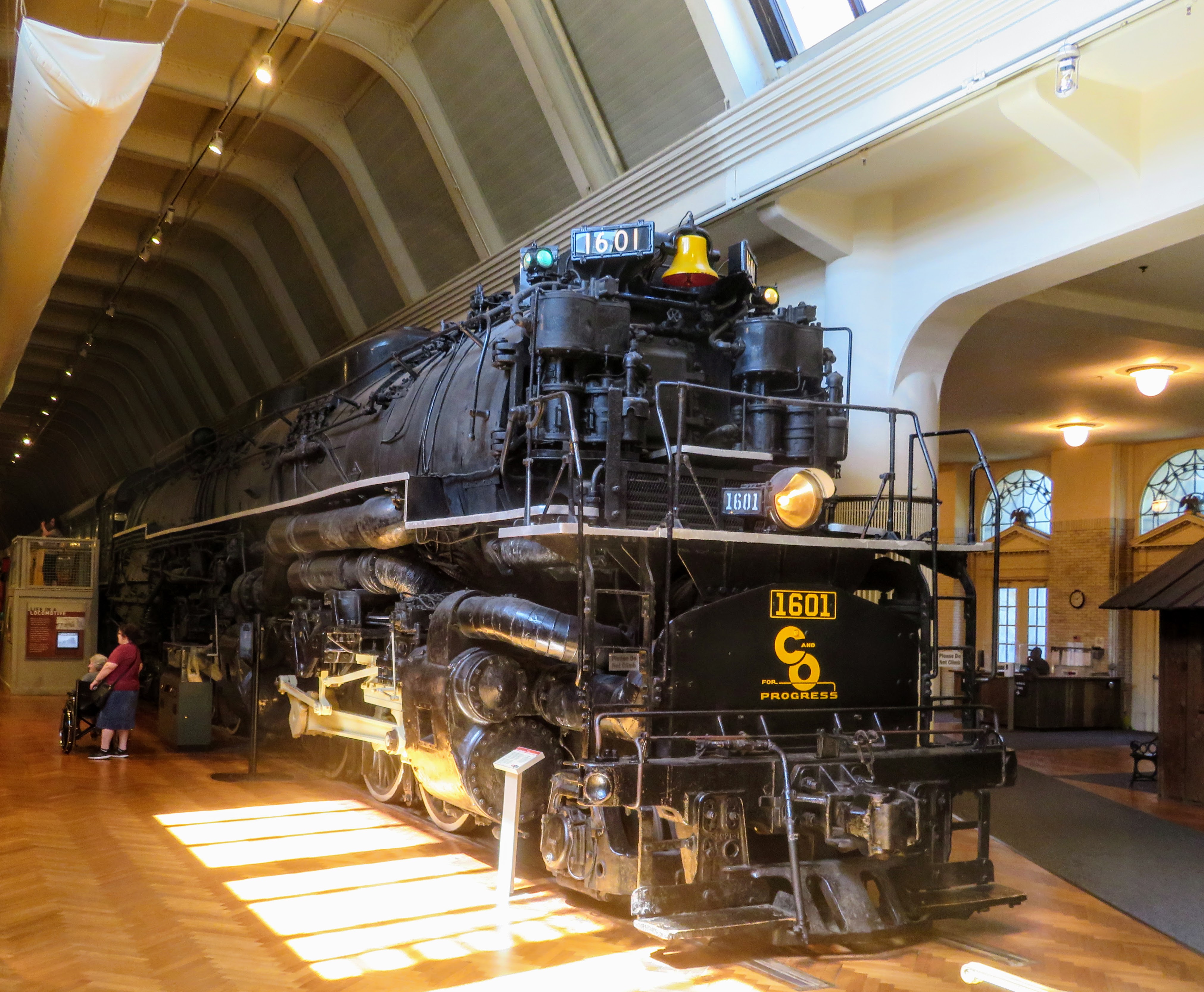
We walked into “The Ford” and came face to face with this giant H-8 Class steam locomotive.  This heavy duty series of locomotives were named “Alleghenies” and they were built by the Lima Locomotive Works for the Chesapeake and Ohio Railway between 1941 and 1948.  A total of 60 of these beasts were built and only 2 survive.  Locomotive #1601 was the 2nd of the type that was built. 

Laurie stood next to #1601 to illustrate just how big this locomotive is… It is 124 feet long, over 11 feet wide, almost 16.5 feet tall, and it weighs 771,000 lbs., over 385 tons!  These H-8 Class locomotives were designed to haul heavy trains over the steep grades of the Allegheny Mountains.  They could pull 160 coal cars, each with a 60-ton load.

Diesel locomotives began replacing the Alleghenies in 1952 and of them were retired by 1956.  #1601 was donated to The Henry Ford in 1956.  It was pulled to the Detroit area on the rear of a freight train.  It was so large and so heavy that it took 3 attempts to get the locomotive into the museum.

This fancy 2-passenger ‘chariot’ was built between 1792 and 1802 by coach maker William Ross of New York City.  It was purchased by Angelica Bratt Campbell who used it in and around Schenectady New York where her husband had made his fortune as a merchant.  Only the wealthy could afford closed carriages like this one.

Of course, in ancient times the term chariot referred to a 2-wheel vehicle used for war and racing.  Around the mid-1600s the term was applied to elegant half-coaches…cut in two just in front of the door.  The design made the coaches less expensive and they were lighter as well.

FYI…a plethora of different horse drawn vehicles are on exhibit at The Ford.  They include trolleys, a landau carriage, a hansom cab, beer wagon, hearse, farm wagon, hay wagon, a mail wagon and more.


This replica of the DeWitt Clinton was built by the New York Central Railroad for the 1893 World’s Columbian Exposition in Chicago.  This replica traveled to fairs, expositions, and promotional events across the New York Central system into the 1950s.  The replica and its coach cars were given to the Henry Ford in 1935.  Basically, those fancy passenger cars are stagecoaches modified to operate on railroad tracks.

FYI, the original DeWitt Clinton 0-4-0 was built in New York City in 1831 and it operated on the Mohawk and Hudson Railroad.  It’s historically recognized as not only one of the first to operate in the United States, but also as the very first to offer regularly scheduled passenger service.  The locomotive was named after a former governor of New York State. To learn more, go to http://www.uppermadison.org/history/railroad.


This eye-catching steam locomotive was built in 1858 by the Rogers Locomotive and Machine Works in Paterson New Jersey.  This company built more than 6,000 locomotives for railroads all over the world.  Most U.S. railroads owned at least one Rogers-built locomotive.  The company’s most famous one was a locomotive named “The General”, which was one of the principals of the “Great Locomotive Chase” of the Civil War.

This particular Rogers steam locomotive is the only known locomotive remaining that served the Atlantic and Gulf Railroad.  When Henry Ford took possession of it, he named it “Sam Hill” after an engineer he knew, but it was renamed “The President” in 1929 when it brought President Herbert Hoover to the museum for its opening and the 50th Anniversary of Thomas Edison’s invention of the first practical lightbulb. 

The yellow coach behind the locomotive and coal tender replicates a typical passenger car used on American railroads ca. 1860.  Opening windows offered ventilation in summer and a woodstove provided heat in the winter.  Other amenities included a drinking water dispenser (usually one cup for all to use) and a small restroom, which was basically a seat with a hole in the bottom of the car for disposal.  This replica was built ca. 1928.

The next area we visited included a lot of automobiles and other transportation related objects.  Since I already focused on early autos in my posts about Ye Ole Carriage Shop in Spring Arbor Michigan, my commentary will be shorter than usual.  This beauty is a 1931 Duesenberg Model J Convertible Victoria. 

Fred Duesenberg was determined to build an automotive masterpiece.  Superior engineering included a 265-horsepower engine.  The car could reach 116 mph as its top speed.  No two of these autos are identical because the body styles/specifications were determined by the buyers and independent coachbuilders crafted each auto body.

Much more about Duesenberg automobiles and the company itself will be forthcoming in a month or so…

This sleek beast is a 1931 Bugatti Type 41 Royale Convertible.  This extremely rare automobile is longer than a Duesenberg and it has double the horsepower of a Rolls-Royce.  Plus, it cost more than the combined cost of both the Duesenberg and a Phantom II Rolls-Royce.  This was the ultimate automobile.  Bugatti only built 6 ‘Royales’ versus Duesenberg with 481 Model J’s and 1,767 Phantom IIs.

Ettore Bugatti was an Italian who manufactured high-performance automobiles in Germany starting in 1909.  These automobiles were known for their design beauty and for many racing wins.  The company shut down operations in 1952.  In the intervening 43 years, Bugatti only built 8,000 cars.  The Bugatti name was purchased by investors and you can still buy a Bugatti today.  You’d better have a fat pocketbook though… Prices range from $1.9 million to $12 million or more.  The Bugatti at the ‘lower’ end of the price range develops 1,001-horsepower and has a top speed of 258 mph.

This is a 1927 LaSalle Roadster.  Back in 1926, Alfred Sloan Jr., then the President of General Motors felt that the company needed a lower-priced companion to the Cadillac line in order to complete the full scope of the company’s product line.  He hired a custom auto designer named Harley Earl to design the LaSalle.  The 1927 LaSalle was the first mass-production automobile to be consciously ‘stylized’.  It was actually built by Cadillac.  The LaSalle line of automobiles was dropped by GM by 1940 but the stylish and more affordable LaSalle marked the beginning of the end for individually designed and truly expensive custom cars.


This unusual looking automobile is a 1948 Tucker 48 Sedan, aka the “Tucker Torpedo”.  It was conceived by Preston Tucker and it was produced in Chicago for one year only…1948.  Including the prototype, only 51 of these cars were ever produced before the company was forced to declare bankruptcy.  Negative publicity initiated by the news media, an SEC investigation and a high-profile stock fraud trial insured the end of the company.  

FYI, the stock fraud allegations were proven to be baseless and the company and Tucker himself were fully exonerated.  Tucker claimed that the Big Three Automakers and a Senator from Michigan helped insure the company’s demise.  A movie was made by Francis Ford Coppola in 1988.  It was all about Tucker, his revolutionary automobile and the demise of the Tucker automobile. (See: “Tucker: A Man and His Dream”.

With swooping fenders and 6 exhaust pipes, Tucker resembled a rocket ship.  But the car featured many practical design concepts.  That center headlight turns with the front wheels to cast light around corners.  The tail lights are visible from the side for safety.  Doors curved into the roof for easier entry and exit.  Those grills on the rear fenders fed cooling air to the rear mounted engine.

This 1903 Packard Model F Runabout was only the second automobile to be driven across the USA from coast-to-coast.  A Packard plant foreman and a journalist made the trip in this car from San Francisco to New York City in 61 days!  The biggest challenge to their accomplishment was that roads were rare west of the Mississippi and many in the eastern part of the country were not much more than dirt paths.

The Model F involved a major change in design from earlier automobiles, venturing away from the ‘buggy’ style and embracing more modern designs.  The Runabout had a base price of about $2,250, and if you wanted a rear ‘tonneau’ cover included, you could add another $250 to the total expense.  This was the most expensive Packard up to this point in time…

To give an idea of the wide variety of offerings at the Henry Ford Museum, this is a 1959 Volkswagen Westfalia Camper.  Volkswagen first introduced the VW Type 2 Bus, nicknamed it’s “box on wheels”, in 1949.  A few years after the VW bus was introduced the company contracted with Westfalia and they introduced the converted camper.  In 1956, VW and Westfalia first exported these post-war recreational lifestyle vehicles to the USA.  Soon thereafter Americans took to the highways and backroads to explore the great outdoors.

James Ward Packard built his first car in Warren, Ohio, in 1899. By 1903 a group of Detroit investors had purchased the company and moved the operation to a new factory in Detroit. One of the first cars built there was the Model L touring car. It was the first four-cylinder Packard and the first with the tombstone-shaped radiator shell that became a Packard trademark. 

Packard, Peerless and Pierce-Arrow were the companies best known for building high-quality luxury automobiles prior to World War II.  Owning any of these cars was a sign of success and prestige. Packard automobiles featured numerous innovations.  These included the modern steering wheel, air-conditioning in a passenger car and one of the first 12-cylinder engines to power an automobile.  The last Packard was built in South Bend Indiana in 1958.

Most people think of Checker as an operator of taxicabs, but from 1922 through 1982 they also manufactured cabs. Checkers featured big back seats and trunks and rugged, durable construction. This Checker's basic design dates to 1956 and was substantially unchanged until production ceased in 1982.  Checker Motors Corporation was based in Kalamazoo Michigan and they manufactured taxicabs used by Checker Taxi and others.  The company was originally established in Chicago…but was moved to Kalamazoo in 1923. 

Checker taxis were the iconic American taxi cab.  They withstood heavy use well, had extra wide rear doors, as well as large rear seats and trunks.  The problems were that they couldn’t compete with larger auto company’s fleet discounts or the economies of scale when it came to purchasing components for Checker automobiles. 

In 1962 – 1963, I drove a taxi whenever I had a break from college classes.  Heck, I needed the money!  I was always happy when I was assigned to drive one of the Checker model taxis…happy fares equaled better tips.  My Checker taxi was powered by a Chevy engine and it was quite a bit ‘boxier’ than the 1981 Checker Marathon shown in the photo.

This streamlined tank truck connected local Texaco service stations to a larger national distribution network. Each of America's competing oil companies had a branded fleet of trucks that took gasoline from refineries to its retail service stations. Even independently operated stations had to buy gasoline from a big oil company's refinery. This truck's tanker capacity is 1175 gallons.

The Dodge Airflow tanker truck was a special request model truck that Dodge introduced in late 1934 and it was available through 1940.  The ‘swept back’ look was inspired by the designs found in the Chrysler Airflow cars and the Divco 1937 Model-B delivery vans.  Most of the 265 trucks produced were fitted with these streamlined tank truck bodies.  They were utilized by such major oil companies at Texaco, Socony-Vacuum Oil Company and Esso.

FYI, Divco was the company who built many of the home-to-home milk/dairy delivery trucks/vans that I remember from my youth…


Another display of interest…and large enough to catch our eye during our rather limited exploration of “The Ford”, involved Presidential vehicles.

So, I’ll start with Theodore (Teddy) Roosevelt’s Brougham carriage from 1902.  This handsome carriage was used by President Roosevelt on official occasions.  Even after automobiles began replacing horse-drawn vehicles during the Taft administration, the housekeeping department continued using this brougham to run errands and haul groceries.  In 1928, a Ford Model A was purchased for these tasks and this carriage was retired.

This 1939 Lincoln Limousine was the first car built expressly for use by American Presidents.  It was nicknamed the “Sunshine Special” because President Franklin Delano Roosevelt loved to ride in it with the top down.  After the Japanese attacked Pearl Harbor in Hawaii in 1941, this Lincoln was brought back to the factory where it was refitted with armor plate as well as both bullet-resistant tires and gas tank.  The “Sunshine Special” was retired in 1950.

This was the 1950 Lincoln Presidential limousine that replaced the “Sunshine Special”.  This huge convertible Lincoln was built for President Harry S. Truman in 1950, but it is most associated with President Dwight D. Eisenhower, who succeeded President Truman.  Eisenhower used this car for both of his terms in office…1952 – 1960.  He was responsible for the addition of the limousine’s distinctive ‘bubble top’.  Both Presidents John F. Kennedy and Lyndon B. Johnson used this car as a spare until it was retired in 1967.

This was President John F. Kennedy’s Presidential limousine.  Ford Motor Company built the car at its Lincoln plant in Wixom Michigan in January 1961.  Then, Hess and Eisenhardt of Cincinnati Ohio customized the car so it could function as a presidential parade limousine.  They literally cut it in half, reinforced it and then extended it so that it was 3.5 feet longer than when it was built.  It first debuted at the White House in June of 1961. 

President Kennedy was assassinated in this limousine on November 22, 1963.  The car remained the property of the Ford Motor Company, which had leased it to the Secret Service for the nominal price of $500 a year.  Subsequently, this midnight blue, un-armored convertible was rebuilt with a permanent roof, titanium armor plating and a more somber black paint.  It was then returned to the White House and remained in service until 1977.

This is the 1972 Lincoln Continental Presidential limousine that was used by President Ronald Reagan.  President Reagan was getting into this car when he was shot by John Hinckley on March 30, 1981.  This car subsequently carried President Reagan to the hospital.  FYI, Presidents Richard Nixon, Jimmy Carter and George H.W. Bush also used this car.

…and then we were out of both time and energy! 

This last photo is of Douglas DC-3 #N21728, which certainly is an attention getter for visitors to “The Ford Museum”.  This record setting DC-3 had a 36 year career serving Eastern Airlines for 13 years before it was purchased by North Central Airlines.  North Central used this plane in passenger service until 1965, after which the company converted it to a VIP aircraft.  This airplane had flown over 12,000,000 miles and logged 84,875 flying hours when it flew into Dearborn for display at the museum in 1975.

I’ve only flown on a DC-3 on one occasion.  It was on a Lake Central Airlines flight from Detroit Michigan to Erie Pennsylvania and onto Buffalo New York.  I was attending DeVeaux School in Niagara Falls at the time.  I loved the flight…huge windows, lots of leg room, and the plane flew low and slow so you could see everything.

DC-3s continued flying with major second tier or ‘trunk’ airlines well into the 1960s.  My flight happened in 1960 or 1961.  In the 1970s and 1980s, these aircraft continued to fly with smaller carriers and they dominated the commuter airline scene in South Florida.   The first one of these airplanes rolled off the assembly line in 1940.

I must admit that we missed a lot of significant exhibits at The Ford Museum but our time was up!  Key exhibits we missed included: The “Rosa Parks Bus’; a Fokker Trimotor airplane, the first to fly over the North Pole; a selection of rare violins dating from the 1600 and 1700s including a Stradivarius; George Washington’s camp bed, and: Lincoln’s rocking chair, the one he was sitting in when he was assassinated at the Ford Theatre in Washington D.C.  

The Henry Ford Museum of American Innovation and Greenfield Village are not to be missed if you love history and you’re touring Michigan.  It is an amazing place!  To see it properly, it really would take 2 full days.  To learn more about “The Ford”, just go to https://www.thehenryford.org/.  It should be noted that a 3rd attraction available to visitors is a tour of the Ford Motor Company’s River Rouge factory.  One of my step brothers worked there for more than 40 years.  To learn more about the huge River Rouge complex and its amazing history, you can go to https://en.wikipedia.org/wiki/Ford_River_Rouge_complex.

A bit of relief is coming for those who are tired of museums.  The next post will involve family and food!

Just click on any of the photos to enlarge them…

Thanks for staying the course with my wordy and long museum related posts!

Take Care, Big Daddy Dave