Showing posts with label Parks. Show all posts

Friday, January 10, 2025

Heading East Across North Central Pennsylvania...

 ...continuing with our October road trip, after leaving Ridgway Pennsylvania, we followed US Hwy 219 north and then picked up US Hwy 6 toward Wellsboro and Mansfield.  Of course we were bound to come across some history and architecture along the way.


The next town that we came to that grabbed my attention was Smethport Pennsylvania.  William Halsey Wood, who is well known for designing dozens of churches across the USA and even in China, designed this spectacular church.  Saint Luke's Episcopal Church was designed with the 14th Century English Gothic style in mind.  This church was completed in 1892 and it has survived in near pristine condition.


St. Luke's Gothic ornate design continues inside the church as well.  This is a view from the area of the altar toward the front entrance.


This view of St. Luke's church from a postcard sent in 1907 shows the scope of the entire complex.

To learn more about William Halsey Wood and his spectacular church designs, go to https://en.wikipedia.org/wiki/William_Halsey_Wood.


This very imposing structure is the McKean County Courthouse in Smethport Pennsylvania.  It isn't as old as it first appears.  Courthouses in McKean County have had a tough time.  This is the fourth courthouse in the county.  With its six Ionic columns and that cupola, it was completed in 1942.  Its only a little over 60 years old.


The first courthouse in the county was built in 1826 and then it was replaced by a larger structure in 1851.  In 1880 it was decided that a larger structure was needed and the third courthouse was completed in 1881.  It lasted for almost 60 years but then it was destroyed by a fire in 1940.  Fortunately most of the McKean County records were saved.  That ill-fated third courthouse is shown above in photos I found on the Internet...before and after.  

Dutch land investors founded Smethport in 1807.  They'd purchased a large tract of land from the Commonwealth of Pennsylvania.  The town was named in honor of a Dutch banking family, the De Smeths, who had financed the land investments.  The lowest temperature ever recorded in Pennsylvania was at Smethport in January of 1904.  It got down to -42F.  In July of 1942, a storm produced over 30 inches of rain in less than 5 hours.


Moving east along US Hwy 6, the next town we stopped to take a look at was Coudersport Pennsylvania.  This is the former Coudersport and Port Allegany Railroad Depot.  This short line railroad operated in Potter and McKean Counties between 1882 and 1964.  Originally a 3 foot narrow gauge railroad, it was converted to standard gauge (4 feet 8.5 inches) in 1889.  The railroad prospered with a lumber boom that ended in the early 1900s.  It was purchased by the Wellsville, Addison and Galeton Railroad in 1964 but the line was eventually abandoned in 1970.

The Coudersport and Port Allegany Railroad began construction on their new brick and sandstone depot in Coudersport in 1899, opening it for business in January 1900.  The population of Coudersport more than doubled from 1890 to 1900, increasing from 1,525 to 3,217.  The estimated population in 2021 was 2,351.  The completion of this handsome red brick station in 1900 was a much-heralded event.

Coudersport purchased the station in 1975 and then they restored it.  It was listed on the National Register of Historic Places in 1976.  It currently serves as the police station and as an office building for local government.  It is the only remaining building left from the Coudersport and Port Allegany Railroad.


The passenger rail car shown above is located at the Coudersport Arboretum which is adjacent to the old Coudersport railway depot.  The local Lions Club purchased the rail car from the former Knox and Kane Railroad, saving it from the scrap heap.  That railroad was a short line railway that went from a freight transfer function to a freight and tourist line...eventually closing altogether.  The passenger car was probably a Long Island Railroad commuter car.  The Arboretum also features an old caboose and it serves as a music venue as well.  Learn more at https://www.facebook.com/people/Coudersport-Arboretum-Association/100071173741302/.


One tourist attraction of note in Coudersport is the Eliot Ness Museum.  Celebrating the career of Ness, the famous American Prohibition Agent who assembled a team labeled the "Untouchables" by the press.  Ness and his team went after Al Capone and his bootlegging operations in the Midwest.  

The museum, located in 2 buildings, listed on the National Register of Historic Places, features antique cars and trucks as well as many exhibits that are designed to learn about the historic allure surrounding Eliot Ness and his team.  The structures were built after a devastating fire that destroyed much of downtown Coudersport in 1880. The building at the right apparently originally served as a hardware store.  To learn more about the museum, go to 
https://www.eliotnessmuseum.org/.


Eliot Ness was born in Chicago and he graduated from the University of Chicago.  So, what was his connection with Coudersport Pennsylvania?  To make a long story short, after 1951, in order to make a living, he worked as a bookstore clerk, and a wholesaler...of electronics parts and frozen hamburger patties.  In 1956, accompanied by his 3rd wife, he went to work for a startup company in Coudersport that supposedly had developed a new method of Watermarking official documents to prevent counterfeiting.  The company had misrepresented its 'process' and Ness spent much of his free time in a local bar recounting stories from his law enforcement career.  He was nearly penniless when he died.  Learn more at https://en.wikipedia.org/wiki/Eliot_Ness.


The old Potter County Jail in Coudersport Pennsylvania is brutal looking but by the standards of the time when it was built, its a straight-forward building lacking the embellishments many such structures had at the time.   Missing are the 'battlements and Gothic 'decor' that were so popular.  This jail was built ca. 1835.

The local community had been so angry over the cost of the new courthouse that apparently the jail was built from stone that was salvaged from the old courthouse.  The 20 foot high walls of the exercise yards on both sides of the jail were constructed with a greenish hued stone.  I was unable to discover what the old jail is being used for as it has been replaced with a modern facility.


The Potter County Courthouse is referred to locally as the "jewel of Coudersport".  The lower two floors of the building were designed in the Greek Revival style and they were completed in 1853.  The gabled upper portion is quite picturesque and it was added in 1888.  The statue of Justice is quite unusual in that she lacks the the traditional blindfold.  A copy of the original statue tops the structure while the original is on display inside the courthouse.  Between 1933 and 1934, the Depression Era Civil Works Administration strengthened the foundation and excavated the basement to create more office space.


The Coudersport Historic District encompassed 73 contribution buildings.  Most of them were built soon after the 1880 fire that destroyed most of the commercial district.  The fire was driven by high winds and it threatened the courthouse too.  As a result of the fire, new building codes required that commercial structures had to be constructed using bricks.  The fire took place on May 18, 1880.  By July 27th, a local brick factory was up and running, capable of producing 10,000 bricks a day.

The first building shown above is home to a couple of quasi governmental operations, the Potter County Domestic Relations office and the Chamber of Commerce/Artisan's Center.  In the middle one can shop at "Always in Bloom", a flower and gift shop.

The second building above is occupied by Cornerstone Abstract and Settlement as well as Acker and Larson P.C., Attorneys.  A Masonic symbol adorns the top of the building.  Apparently, this structure served as a Masonic Temple until the early 1900s when the Coudersport Consistory became a key center for Masons in Pennsylvania.  The Consistory has over 3,000 members as compared to the population of Coudersport with an estimated population of 2,351.  

FYI, Coudersport was named for Jean Samuel Coudere, a Dutch banker who loaned money to the Ceres Land Company of Philadelphia for their Pennsylvania land acquisitions.  Ceres also donated the land that the city was built on.  Lumbering was the dominant industry in the area for over 100 years.


Following our stop in Coudersport, we continued our drive east along US Hwy 6 toward Wellsboro and our 2-night layover at Mansfield.  There was plenty of fine scenery along our route, although I could have done without that Quality Inn sign way off in the deep center of the second photo…

Just click on any of the photos to enlarge them.

Thanks for stopping by for a visit!

Take Care, Big Daddy Dave

Tuesday, November 12, 2024

Headed to Paris - Again!

Hard to believe that we visited Paris only 2 days earlier...Western Tennessee that is.  This time its a different Paris and in this case it is located in north central Kentucky, just a little northeast of Lexington.  We decided stop and take a look around town before heading on to our destination for the evening.  Paris had a couple of things going for it...places to shop for Laurie and Paris is horse country.  Laurie loves horses and shopping so the area fit her needs. 


This elaborate gatehouse is worthy of an entrance to a nice park or a fairgrounds.  But it serves neither of those functions.  Instead it is the gatehouse for the Paris Cemetery...which was incorporated way back in 1847.  The gatehouse itself was built of granite in back in 1862.  It is listed in the National Register of Historic Places. 


Yes!  Paris Kentucky also has its own version of the Eiffel Tower... However this model, located at 801 Main Street, is only 20 feet tall...about a third of the height of the Eiffel Tower located in Paris Tennessee. (I borrowed this photo from the Internet)


Folks of a certain age remember the J.J. Newberry stores.  This five and dime chain of stores was founded in 1911 in Pennsylvania and at its zenith this family owned company had about 565 stores serving the northeast, southwest and western USA.  The company, which had been purchased by McCrory Stores in 1972, was completely liquidated in 2002.  

Love the fact that the old J. J. Newberry sign has been preserved and that the 1930s structure is being appropriately reused.  Located at 627 Main Street, most of the building is occupied by Ardery's Antiques and Collectables.


In general, I'm not a big shopper or fan of shopping.  However, this store occupying most of the J. J.  Newberry site, was loaded with antiques, collectables, quality recycled clothing and much more.  Lots of interesting 'stuff'.  From my viewpoint, another plus was the pricing...very reasonable...a bargain in many cases.  My purse 'addicted' better half scored a branded purse for a very nice price.


The other portion of the old J.J. Newberry's store is home to a popular local spot for coffee, breakfast and lunch.  This is Lil's Coffee House and yes, you can still experience dining at an old time dime store counter.  Talk about nostalgia for us 'older' folks!  

Lil's is open from 8 AM until 3:30 PM Monday through Saturday.  While old timey favorites like tuna salad, egg salad and chicken salad sandwiches are on the menu, so is a daily quiche, Scotch eggs and toast, tomato pie and an olive nut sandwich, along with a wide variety of coffee 'treats'.  Trip Advisor reviewers give Lil's 4.5 'stars'.  You can learn more about Lil's Coffee House at https://www.facebook.com/LilsCoffee.  


Laurie 'scored' again at Loch Lea Antiques, which is located right across the street from the old J.J. Newberry's store.  Loch Lea has a nice selection of actual antiques, not just old stuff like so many 'antique' stores offer these days.  She picked up an antique corn bread iron skillet.  I even got into the act, adding a couple of nice antique postcards to my collection.  Loch Lea Antiques is on Facebook at https://www.facebook.com/LochLeaAntiques/.


As we cruise through small and medium size towns on our trips, murals while certainly engaging, have become commonplace.  This huge 3-story mural of legendary racehorse, Secretariat, was just completed in November of 2022.  The Paris area was home to this truly famous racehorse.  

Artist Jaime Corum started the painting on the anniversary of Secretariat's death and she finished the mural on the anniversary of his retirement to nearby Claiborne Farm back in 1973.  The mural is on the wall of the old Baldwin Hotel, that was built in 1933.  Today the old hotel is home to 6 fully equipped and furnished suites that are rented to travelers or business people for 30 days or longer.


Guess what is located right nest to that mural!  This park, which features this life-size bronze sculpture of Secretariat, was created by famous equine sculptor, Jocelyn Russell.  It depicts 'Big Red', (Secretariat's nickname), running at nearby Claiborne Farm...and its a companion piece to that huge mural.  

The park just opened in November of 2023, 50 years after Secretariat arrived at Claiborne Farm for his breeding career.  Not only does the park celebrate Secretariat, but it also pays honor to the 90 horse farms that populate Bourbon County.  Paris is the county seat for Bourbon County.  

Secretariat is considered the greatest or one of the greatest thoroughbred horses in American racehorse history.  He set many records, some of which still stand today.  To learn more about this amazing horse and his history, go to https://en.wikipedia.org/wiki/Secretariat_(horse).


Artist Jaime Corum was at it again with another big mural during our visit.  This mural is right across the street from the Secretariat mural.  This mural depicts Curlin, another American thoroughbred racehorse.  He was the American Horse of the Year in 2007 and 2008, having won a plethora of major races during his racing career.  Per my research, this mural was completed in October of 2024.  To learn more about Curlin, go to https://en.wikipedia.org/wiki/Curlin.


Once again, those of us of a certain age remember structures like this one.  It was a former Pure Oil Gas Station.  Thankfully, it has been preserved and readapted as an Edward Jones office.  This former Tudor or English Cottage style gas station was built in 1926.  Back in the early days of automotive expansion, designs like this were an effort by gasoline companies to built stations that were more compatible with residential neighborhoods.


The center of Paris Kentucky includes the Downtown Paris Historic District.  This very large historic district covers more than 96 acres and it includes more than 220 contributing buildings and 15 contributing structures.  Basically, I could point my camera in any direction and I'd be recording a bit of area history... 


This handsome structure is the former Elks Lodge building.  Its located on Courthouse Square at Bank Row and Main Street in Paris.  One of the tallest buildings in town, this four stories building is a mash of Neo-classical and Romanesque Revival styles.  

Built ca 1901 as the headquarters for the local Elks lodge, it was intended to accommodate a number of uses.  The local Masonic Lodge bought the building in 1926.  In the 1940s the upper floors were home for the Bourbon Hotel and the first floor served a number of businesses until the hotel went out of business.    Neglected for many years, most recently it was refurbished in order to provide apartments for the elderly.


The 1899 Agricultural Bank Building is right across Main Street from the Elks/Masonic Building.  This structure's design is unique as it was inspired by northern European architecture.  Topping the facade, that Flemish wall dormer with its hemispheric dome pierced by oculi style windows really sets this building apart from others in town.  Architectural changes to the first floor show a Georgian modification.

I couldn't find much information about the former tenants or owners of this old bank building but it does appear that it served the banking industry for many decades.  The most recent occupant seems to have been Kentucky Bancshares, Inc.  Currently this striking building is on the commercial real estate market.  You can own this structure!  The asking price is $860,000.


The centerpiece of courthouse square is of course the Bourbon County Courthouse.  It is the dominating architectural landmark in the city of Paris.  Located on the highest point in downtown Paris, it is the fourth courthouse constructed on this site.  Ca. 1902, this Beaux-Arts building replaced an 1874 building that was destroyed by fire at the beginning of the 20th Century.

Bourbon County is one of Kentucky's nine original counties and of course, it's best known for its historical association with Bourbon whiskey.  The county was established in 1785 from a portion of Fayette County Virginia.  In gratitude for King Louis XVI's assistance during the American Revolutionary War, the county was named after the French House of Bourbon.

Just click on any of the photos to enlarge them.  Our next overnight stop was on the Ohio River.  

Thanks for stopping by for a visit!

Take Care, Big Daddy Dave

Friday, October 25, 2024

On Our Way and Exploring Paris...Tennessee That Is!

Of course, in order to experience a 'found family gathering' in Paris Tennessee as previously reported, we had a bit of a drive to get there.  The distance was about 290 miles...not a particularly long drive for us.

Note:  Tennessee is a long and narrow state.  If one was to drive from the northeastern most point in Tennessee to the southeastern most point, you would cover about 424 miles.

We had skipped breakfast at home before leaving, giving us a good excuse for a meal break and a chance to stretch our legs.  I can't remember where we found this Waffle House location, but I think that it was in Clarksville Tennessee.  There are 124 Waffle House restaurants in Tennessee. 

Waffle House has been our 'go to' road stop in the Southeast USA for many years but, right or wrong we both feel that the quality or consistency has slipped.  Other alternatives are in our future...


This isn't a bridge over the Seine River approaching Paris (France).  Rather it's a bridge over one part of Kentucky Lake approaching Paris Tennessee.  Kentucky Lake is a navigable reservoir created by Kentucky Dam along the Tennessee River.  It has 2,064 miles of shoreline and a surface area of 160,309 acres.  It is the largest reservoir in the USA east of the Mississippi River.  It is connected via a free-flowing channel to Lake Barkley, a reservoir that impounds the Cumberland River and adds another 58,000 acres to this huge dual lake complex.


A short time later, we entered the town of Paris Tennessee.  One of the first things we noticed was this welcome sign topped with a giant blue catfish.  The sign states that Paris is the home of the World's Biggest Fish Fry... To explain this claim, a giant fish fry is held at the Fairgrounds during the last full week of April every year.  Most recently, attendees at this festival consumed about 12,500 lbs. of catfish!  Other events included a carnival, parade, rodeo, a catfish race, arts and crafts offerings, a demolition derby and much more.  For more information, just go to https://www.worldsbiggestfishfry.org/.


Yes indeed, this is the Eiffel Tower!  Paris Tennessee has it's own version of Paris France's original... This iteration of the Eiffel Tower is 60 feet tall.  It is a 1:20 scale replica that was completed in 1993.  It can be found in Paris' Memorial Park.  FYI, there are at least 10 Eiffel Tower replicas in the USA with 32 other nations having replicas of their own. 


I 'borrowed' the first photo of the Henry County Courthouse from Wikipedia as it shows how the courthouse appeared before the current and ongoing efforts to refurbish and upgrade the structure.  It was originally completed in 1897.  The city of Paris Tennessee is the county seat.  While the city was named "Paris" in honor of the Marquis de Lafayette, a hero of America's Revolutionary War, the county was named in honor of one of our country's founding fathers, Patrick Henry.


I just had to include a photo of this 40 inch catfish statue that I noted on Courthouse Square.  A total of 15 catfish statues with different colors and decor were placed around Paris in early 2019.  The idea was to add another promotional element to the city's annual fish fry festival.   


...and then Laurie found a shop open while I was exploring the town square!  American Honey Mercantile does indeed sell honey...plus quality costume jewelry, home decor, women's and kid's clothing, pantry items, kitchen cooking supplies, pet accessories and more.  This store is located in one of 4 sections of a large 4-bay mercantile structure that was built in 1899.  American Honey Mercantile is located at 108 North Market Street in Paris Tennessee...and Laurie did make a purchase. 


Looking around the Courthouse Square, I thought that this 3-story Italianate commercial building was worthy of a photo.  I like the different color schemes and I love those old windows.  The structure was built ca. 1880.

I was quite sure that I'd photographed these buildings on a previous road trip.  We did wander through Paris several years prior to Laurie learning that she had relatives in the area... (See link to previous blog post at the end of this one)

I may have even previously photographed the Post Office in Paris.  It was built in 1908.  This structure, as well as the previous three buildings as shown above, are all part of the Paris Commercial Historic District.  The District is listed in the National Register of Historic Places.  There are a total of 44 'contributing' structures in the Historic District.  To learn more, you can go to https://npgallery.nps.gov/AssetDetail/NRIS/88001424.  


This is the James Davis Porter house, which is located at 407 South Dunlap Street in Paris.  The Federal style home was built by Thomas Crawford, a wealthy merchant, ca. 1850.  Porter family in-laws purchased the home in 1859.  The home is most notable as being the residence of Tennessee Governor James Davis Porter between 1887 and his death in 1912.  The home stayed in the family until at least 1972.

In addition to being a 2-term Governor of Tennessee, James Porter also served in the Tennessee Legislature, was a Lt. Colonel in the Confederate Army, then served as a judge.  Under President Cleveland Porter was the First Assistant Secretary of State and later served as the Minister/Ambassador to Chile.  The former Governor also served as the President of the Nashville, Chattanooga and St. Louis Railroad for 4 years.


This is the Thomas P. Jernigan House.  This beautiful Classical Revival home was built at 918 Dunlap Street in Paris ca. 1905.  Thomas Jernigan was a banker and investor who grew rich through his investments in the E.W. Grove Medicine Company.  That company prospered through the sale of its well-known patent medicine products, including Grove's Tasteless Chill Tonic and its Laxative Bromo Quinine tablets.


A few years back I posted a blog that included the old Paris railway depot.   It was built in 1891 to serve the Paducah, Tennessee and Alabama Railway...or in 1896 to serve the Nashville, Chattanooga and St. Louis Railway...too many conflicting dates.  Passenger service was available here until the depot was closed in 1951.


As I researched the history of the depot, I ran across my previous blog post about Paris Tennessee, including the depot.   Apparently I took this photo from the other end of the building.  These days the depot seems a bit more worn out although it is in use as the home of the Paris-Henry County Arts Council.

To view other historic sites in Paris Tennessee that I'd included in my previous post from a little over 6 years ago, you can check out my earlier exploration of the city at https://bigdaddydavesbitsandpieces.blogspot.com/2018/09/on-to-paris-tennessee-that-is.html.

That's all for now.  Just click on any of the photos to enlarge them...

Thanks for stopping by for a visit!

Take Care, Big Daddy Dave

Friday, October 18, 2024

Focusing on Railroads...Depots and a Little History (#3)

OK, I'm back at it...into my series that revisits groups of my favorite road-trip railway depot photos.  Moving a bit further back in my blogging history, this group of photos begins in early 2019 and ends in mid-2018.  Of course some of the most interesting depot photos I've taken were of derelict depots with interesting architecture...some of them quite massive.  But I decided to go with the positive photos.  I hope that railroad and railway depot fans agree with me...


This classic railway station with the covered portico is located at the Shelburne Museum near Burlington Vermont.  The depot once served as the original depot for the town of Shelburne.  The station was built in 1890, serving passengers for both the Central Vermont and Rutland Railroads.  It was designed by the same architect who designed the nearby Vanderbilt-Webb estate.  The founder of the Museum, Electra Havemeyer Webb and her family frequently used the depot for their trips to New York City.  Rail service to Shelburne ceased in 1953 and Mrs. Webb had the station moved to its current location at the museum. 

Note: The steam locomotive peeking out of its protective shed, No. 220, was built by the American Locomotive Company in 1915 for the Central Vermont Railway.  This locomotive became known as the 'Locomotive of the Presidents", as it powered special trains carrying Presidents Coolidge, Hoover, F.D. Roosevelt and Eisenhower.


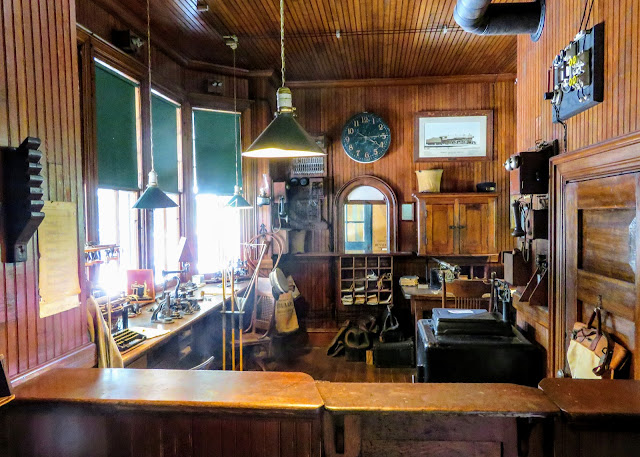
The Shelburne Depot also serves as a railway museum.  Exhibits include waiting rooms for men and women, the stationmaster's office, telegraphic equipment, maps, historic photos, early telephone equipment, and much more.


I thought that this classic little railway depot was built for the township of Milton Maine in 1873.  It was constructed by the Maine Central Railroad.  Further research indicates that it served as the Depot for Jay (The Bridge) Maine.  I did find a post card showing this depot, that was dated in 1914.  At the time we stopped by this 512 sq. ft. structure was listed for sale at $50,000.  I discovered that it sold for $42,500.  Someone new now owns a little piece of railway history.


The Gilead Maine Railway Station was built in 1851.  It is the oldest known surviving railroad depot in the State of Maine as well as the oldest surviving depot that served the former Grand Trunk Railway.  It was relocated to the town of Auburn Maine for about 20 years but it was returned to Gilead in 2001.  It is maintained by the Gilead Historical Society.  In 1850 Gilead had a population of 359 but now its down to 195. 

The Grand Trunk Railway was founded in 1845, connecting Montreal Quebec Canada to Portland Maine.  It provided a means to ship goods to Montreal via an ice-free port during the winters.  The railway operated the route until the 1920s.


During our New England road trip a few years ago, we drove through St. Johnsbury Vermont.  That's where we discovered this large and very eye-catching former railway depot.  At one point in the mid-1800s, St. Johnsbury became a junction for east-west and north-south rail lines.  In 1883 the Connecticut and Passumpsic Rivers Railroad and the St. Johnsbury and Lake Champlain Railroad joined in the construction of this big French Chateau-style station.  The depot now serves as a Visitor's Welcome Center and it contains the town's municipal offices.


This former railway station in Rockland Maine was built in 1917 by the Maine Central Railroad.  It is the eastern terminus of the Rockland Branch, a state-owned track connecting Rockland and Brunswick Maine.  The Maine Central operated passenger service to this depot until 1959.  For a while, until 1996, it served as Rockland's City Hall.  Currently, it is occupied by a restaurant.


Still moving in reverse order by date...and in this case during our road trip to New England a few years ago...the depot shown in the 2 photos above is located at Boothbay Maine's Railway Village.  

The founder of the Village decided that he had to have a place for his collection of railway memorabilia and, in 1963, he discovered that the nearby Freeport Maine railway station was up for sale.  So he bought, had it cut into 9 sections and then moved each section 50 miles to Boothbay.  Then it was reassembled and it now is the centerpiece for the Railway Village.  Originally it was built by the Maine Central Railroad Company in 1912.


During our New England road trip, as we cruised through Alton and Alton Bay New Hampshire, we noted a collection...a gaggle of little railroad depots.  There were 4 small depots in total and this one had the most curb appeal.  

This particular depot once served as the Loon Cove New Hampshire combination passenger and freight station.  The depot was built in 1891 by the Concord and Montreal Railroad and it served that railroad's Lake Shore Line.  When the line was shut down, the depot was modified and used as a private residence until 2005.  Today all 4 depots are part of the Boston and Maine Railway Park in Alton New Hampshire.


Moving south, this is the old Railway Station in East Stroudsburg Pennsylvania.  This depot was built in 1856.  The name on the Depot is a bit confusing, but that was the name of the restaurant that occupied the building when we overnighted in Stroudsburg.  It now appears that the restaurant has closed and it is being used as an event center, for live music, etc.

The depot was originally built by the Delaware, Lackawanna and Western Railroad.  Passenger service ceased in January of 1970 when the railroad discontinued their "Lake Cities" service.  The structure was partially destroyed by fire in the early 2000s but the community rallied and it was rebuilt and refurbished.  In the Spring of 2021 Amtrak announced plans for a New York - Scranton Pennsylvania route so there is hope for renewed rail service.  Some of Scranton's Steamtown National Historic Site's excursion trains do stop here.


As we followed along our route in the Pocono Mountains we crossed a bridge over a railroad track and Laurie caught a glimpse of a little railway depot down in the hollow below us.  This is the former Delaware, Lackawanna and Western Railroad's Cresco Depot.  Thanks to its preservation by a local businessman, it now serves as the Cresco Station Museum.


The Cresco depot was completed ca. 1880.  The Poconos became a summer refuge for city dwellers and, a little later on, a destination for skiers in the winter.  I'm guessing that this photo of the depot, (right side of the picture), was taken sometime in the early to mid-1920s.  At its peak the depot processed up to several trains per day and up to 1,000 passengers.  The depot was closed in 1968.  The local historical society now maintains and operates the museum.


This stone railway depot with is pillared passenger platform is located at a very historic spot in American history.  The Valley Forge Train Station is located on the grounds of the Valley Forge National Historic Park.

The station was built in 1911 by the Reading Railroad.  It was the point of entry for most visitors to Pennsylvania's Valley Forge State Park.  The depot was built using the same type of stone that was used to build Washington's Headquarters at Valley Forge.  

The State Park was established in 1893 and it was Pennsylvania's first State Park.  Passengers arriving from Philadelphia disembarked here to visit the park.  The depot continued to operate through the 1950s.  Valley Forge became part of the United States National Park System in 1976.  The structure is now being used as a museum and information center.


Getting somewhat closer to our home in East Tennessee, this handsome 2-story railway depot near downtown Hagerstown Maryland, was built by the Western Maryland Railroad in 1913.  The second photo, which was taken from a postcard dated 1915, shows the depot in use during its early days.  This then new depot had replaced an earlier single story depot.  Western Maryland Railroad's tracks had reached Hagerstown by 1872.  Passenger service to the city ended in June of1957.  The former depot now serves as Hagerstown's Police Headquarters.


This last entry in my third edition revisiting handsome or eye-catching old railway depots, skips over to Decatur Illinois.  This is the former Wabash Railroad Station and Railway Express Agency building. These buildings were built in 1901 in the classic-revival style.  It is now serving as the Wabash Depot Antique Centre.  


This photo of Decatur's Wabash Railway Depot and Railway Express Agency buildings is dated ca. 1907.  The buildings were actually two different structures built to look the same and joined in the middle.  It is a bit mind-boggling but by 1907 as many as 72 passenger trains stopped at this depot every day!  Passenger service by Wabash's successor, the Norfolk and Western Railroad ceased in 1971.  Amtrak started a new service here in 1981 but it was short-lived, as it was discontinued in 1983.

That's all for now... Just click on any of the photos to enlarge them.

Thanks for stopping by for this glimpse of railroad history.

Take Care, Big Daddy Dave