Showing posts with label World War II. Show all posts

Monday, May 26, 2025

Memorial Day - 2025

 In Memoriam

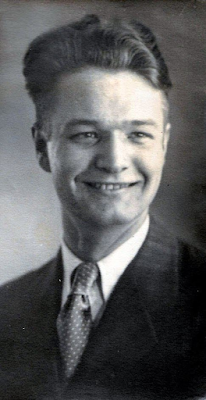
Ronald Allen Myers


Born on April 2, 1911

Killed in Action on May 6, 1945, 80 years ago this month.

World War II in Europe officially ended on May 8th, 1945. 


Staff Sergeant Ronald Myers in a column crossing Germany just a little over 3 weeks before he was KIA in what was then Czechoslovakia.

This local memorial for my Dad is located in the Pilsen area of what is now the Czech Republic, near the town of Tesov, where he was killed.


Ronald Allen Myers' final resting place is in the Lorraine American Military Cemetery near Saint-Avold France. (Rest in Peace Dad)

God Bless America and as well the millions of men and women who have fought and died for our freedom!


This flag was used on D-Day at Utah Beach as American forces fought their way ashore.  It is part of the Smithsonian collection.  It stands as a testament to the lives that have been sacrificed for our freedom...

Monday, May 27, 2024

Ronald Allen Myers – Memorial Day 2024

Memorial Day…a day when I always wonder what my life would have been like if my father, Ronald Allen Myers, had survived World War II.  He probably would have returned to his career as a conservation officer in Michigan.  I certainly would have been given more exposure to nature and the great outdoors.  I probably still would have gone to Michigan State University but my major probably wouldn’t have been in Social Sciences – Police Administration.

But, since my dad was KIA in Czechoslovakia while fighting one of the last engagements with German troops, I’ll never know what the future would have been for my mother or myself.  I just wish that I could remember my dad…but I was only about 2 and a half years old when he was killed on May 6th, 1945.

This photo of my dad and me is from sometime in 1944… It was probably taken in front of my material grandparent’s home on Prospect Street in Jackson Michigan.  I would have been about 2 years old.

Over the past several years I have been in contact with a WWII researcher – David Foud, from Pilsen in the Czech Republic; Andrew Woods, a Research Historian from the First Division Museum at Cantigny Park in Wheaton Illinois, and through Andrew another Czech researcher, Martin Schmid.  They have all provided me with bits of information about my father’s last days… I’m hoping for additional information as their research progresses.

Andrew Woods’s focus is the US Army’s First Division, the Big Red One.  My dad’s unit was part of that famous American fighting force.  David Foud is a civilian who has been working on a project that commemorates fallen American soldiers in Czechoslovakia in 1945 and 1946.  Martin Schmid is specifically researching the battle between German and American forces on May 6, 1945 near Cheb/Eger, in what is now the Czech Republic.

This photo of my dad, with a column of American soldiers and armor, apparently moving toward Czechoslovakia, was taken by a US Army photographer.  David Foud sent the photo to me.  He’s obtained it from the 16th Regiment Association.  The official label on the photo reads “Sgt. Ronald Myers advances down a road towards the German town of Riefensbeek, 14 April, 1945.

Martin Schmid forwarded a considerable amount of information to Andrew Woods who then passed it on to me.  Martin, a student at West Bohemia University in Pilsen, was writing a thesis on the WWII battle fought near Tesov in the Cheb Region in 1945.  He stated that he is “an avid collector of the American First Infantry Division”. 


I believe that this photo was forwarded to me by Andrew Woods and that it was originally sent to Andrew by Martin Schmid.  It is a local memorial to my father placed somewhere near the location where he was killed in what is now the Czech Republic.  I was very happy to see this local remembrance and that it has been so well maintained.  After the war, my dad was exhumed and then reburied in the Lorraine American Military Cemetery in Saint-Avold, France.

The following information was also forwarded to me by Andrew Woods.  It was apparently sent to him by Michael Rund of the Muzeum Sokolov in the Czech Republic.  The excerpts below were taken from a book entitled “Kveten bez Seriku” or “May without Lilies”.  It was written by Vladimir Bruzenak.

“Companies I, K and L of the 3rd Battalion attacked from Jesenice and Okrouhai in the Milikov area…near Tesov.  The soldiers of Company L encountered resistance from German soldiers, members of the RAD and Volksstrum.  German machine guns and handguns started firing from the wooded hill above the village.  They were answered by gunfire from the American tanks and fire from infantry weapons.  The entire firefight lasted about an hour.  Only after a platoon of K Company soldiers joined the fight did most of the Germans either scatter into the surrounding woods or surrender.  The body of the German commander was said to have been found only a few days later.  Staff Sergeant Ronald Myers, the last dead of the entire 18th Regiment in this war, was killed by German fire.”

Many thanks to my father and the thousands of other members of our armed forces who have given their lives to ensure our liberty and freedoms.  God Bless America!

Take Care, Big Daddy Dave

Monday, May 29, 2023

Memorial Day – 2023

As is my tradition on Memorial Day for the past few years, I am publishing a post relating to my dad, Ronald Allen Myers.  In 1945, he was killed in action in Czechoslovakia…now the Czech Republic.


After he graduated from High School in Jackson Michigan, my dad attended the Jackson Community College for a while before attending Michigan State College (now University).  He didn’t have any money so he did what he could to get by.  In this case, he worked as a soda jerk in a drug store…sometimes sleeping on a pallet in the back room.  It was during the Great Depression and very few people were prosperous.  This photo was taken by my mom in 1936 and although there isn't a note on the back of the photo, its almost a certainty that that painter on the ladder is my dad. 

My mother, Elizabeth had graduated from the St. Joseph’s College of Nursing in Detroit and she was her second phase of training at Mercy Hospital in Jackson… One day she stopped into a drug store near the hospital.  She was feeling ‘kind of down’ so she ordered a cherry Coke from the young fellow behind the counter.  I think that you can guess who served her that Coke and who cheered her up…  The rest, as they say, ‘is history’.

Dad graduated from Michigan State in 1938 with a major in soil conservation and a minor in forestry.  My parents got married in January of 1939 and my dad got a job with a fish hatchery in Wolf Lake Michigan.  They lived in a little trailer on site… After a bit, he was accepted as a State Conservation Officer and the couple were able to share some great experiences in the wilderness areas of Michigan.  After the attack on Pearl Harbor and war broke out, my dad joined the Army in 1942.

In the meantime, nature had taken its course and in 1942, while they were living in a rental house in or around St. John’s Michigan, yours truly entered their lives…


The first family photo above is of my parents and chunky little me and it was taken in late 1942 or early 1943.   The second one is of me ca, 1944 being held by my dad.  My dad had his college degree and as a consequence the Army sent him to officer’s school for a while…until they discovered that he was color blind.  At one point my mom and I spent some time in Killeen Texas where dad was in training.

Then in January of 1945 my dad was shipped out to the European Theater to fight the German Army and to help end the war. 


This is the last known photo of S/Sgt. Ronald Allen Myers.  He was photographed on April 14, 1945, by an Army photographer as he led a column near Riefensbeck Germany.  Apparently, these troops, part of the American 3rd Army, were on their way to liberate western Czechoslovakia from German forces.

My dad was KIA (killed in action) near Pilsen, likely around the town of Tesov Czechoslovakia on May 6, 1945, about 3 weeks after this photo was taken.  The War in Europe ended 2 days after he was killed… I had not yet reached my 3rd birthday.

So what does this photo have to do with my dad?  Some years ago I was contacted by David Foud, a local historian and researcher from Pilsen, who was and is involved in the development of a Virtual Memorial for the American soldiers who died fighting to liberate Western Czechoslovakia.  David provided me with the photo of my dad with the Army column as well as other related information.  To learn more about David’s efforts, you can go to his website at http://www.mnofu.com/. But I still haven’t explained the photo have I?

On May 6, 1945, the day my dad was killed, American forces arrived in Pilsen.  It was the last place where the Allied troops reached on their march east.  With the Russians and Communism dominating the country until 1989, no one could or dare to celebrate the liberation of the area by American Forces.  However, every May since 1990, Pilsen has held a Liberation Festival honoring the American forces who ended the German occupation.  From what I can determine, this is the biggest annual event that take place in Pilsen…now part of the Czech Republic.  To learn more, go to Liberation Festival 2023 - Fotogalerie - Liberation Festival Pilsen (slavnostisvobody.cz).  There are lots of photos with really large crowds celebrating the event…

Thanks to all who have made the greatest sacrifice to protect us as well as those who continue to fight for our freedom…

God Bless America and Take Care

David Myers, aka Big Daddy Dave

Friday, February 10, 2023

The United States Air Force Museum – Part II

…continuing with but nearing the end of our late summer road trip to Michigan, Indiana and Ohio.  Here is a second brief look at the National Museum of the United States Air Force in Dayton Ohio.

I included this photo to try to convey the size and scope of the Air Force Museum.  The collection is housed in 4 huge buildings like this one plus there is a giant missile/rocket silo and there are aircraft parked outside on the tarmac.

I went through the museum’s listings for the different galleries and I counted 274 aircraft on exhibit.  In addition, I counted up the other historic exhibits in just the Early Years, WWII, Korea, SE Asia and Cold War Galleries…and there are 279 of them in just those 5 galleries that are available for visitors’ to view.  Add in the separate exhibits of engines, weapons and videos, not to mention the Missile/Rocket silo…which we skipped, and it was all a bit overwhelming.  To do the museum justice, it would take 2 full days to semi-thoroughly review everything available to the public.

What follows is a second (and last) random sampling of some of the aircraft and other exhibits we saw and photographed during our visit to the museum.

This odd looking mash-up of 2 P-51 Mustang’s conjoined into a single aircraft is a bit deceiving.  The North American F-82G Twin Mustang was a totally new design.  With a pilot and a co-pilot/navigator, it was conceived as a long-range bomber escort for the B-29 Superfortresses in World War II but the war ended before production deliveries began in 1946.  The F-82 was the last propeller-driven fighter aircraft that was purchased in quantity by the USAF.  In total, 273 of these planes were built.  Having 2 pilots on board helped reduce fatigue on long range bomber escort missions.

The F-82s were used by the Strategic Air Command as long range bomber escorts during the early days of the Cold War.  During the Korean War, F-82Gs based in Japan were among the first USAF aircraft to operate over Korea…shooting down the first 3 North Korean aircraft that were destroyed by U.S. forces.

The F-82 fighters could reach speeds of 400 mph and they had a range of about 2,240 miles.  This particular aircraft is nicknamed “Betty Jo”.  In February 1947, equipped with an extra fuel tank, Betty Jo made a non-stop trip from Hawaii to New York without refueling.  That flight took 14 hours and 32 minutes and if covered 5,051 miles.  It is still the longest non-stop flight ever made by a piston/propeller driven fighter aircraft.

This is one of the many non-aircraft exhibits that are found everywhere in the Air Force Museum.

These walls came from the “Warrior’s Lounge” at the U.S. Air Force Contingency Aeromedical Staging Facility at the Balad Iraq Air Force Theater Hospital.  Patients waiting for transport stayed there for as many as 3 days.  Patients and visitors were encouraged to sign the walls as an informal way to display unit pride, remember friends, or to just say ‘thank you’.  The messages pay tribute to patients and medical staff who served in Operation “Iraqi Freedom”.

Balad Air Base, aka Al-Bakir Air Base was the largest military base in Iraq.  The USAF maintained this medical staging facility at Balad from 2003 – 2011.  During that time, Air Force medical personnel treated more than 43,000 wounded or ill patients…and then moved them to destinations in Europe and the United States.  In 2010 plans to remove these walls led to efforts to save them.  The Air Force Medical Service and others worked to preserve them and by 2016, the exhibit was put on display in the museum.


…and this is another exhibit not involving an airplane.  This is the Vapor Special Operations Supercar.  It showcases U.S. Air Force ingenuity, state of the art technology and innovation.  It was one of two custom-built automobiles commissioned by the Air Force Recruiting Service in 2009 for its “Project Supercar” recruiting campaign.  This ‘supercar’ toured the USA for more than 7 years with the Air Force Recruiting Service, educating the public on opportunities for both officers and enlisted airmen.

This is a fully customized Dodge Challenger.  It is outfitted with special gull-wing doors, a carbon fiber body kit, and a ‘stealth’ exhaust system that, when activated, allows the Vapor to run almost silently.  This automobile features a Forward Looking Infrared system for night operation and a high-resolution 360-degree surveillance camera with a quarter mile range.  The interior, a blacked-out ‘command center’ is equipped with aircraft style controls, a passenger side steering wheel and a windshield heads-up display with both night and thermal vision capability.  The Vapor’s computer system allows remote operation of the vehicle from anywhere in the world with an internet connection

Visitors are permitted to walk through this cavernous Douglas C-124 Globemaster II.  The first flight of the C-124 took place in late 1949 with deliveries of these aircraft beginning in late spring 1950.  The U.S. Air Force bought 448 of these aircraft before production ended in 1955.  Most C-124s were transferred to the Air Force Reserve and the Air National Guard by 1970 and all were released from service in 1974. 

The C-124 features ‘clamshell’ loading doors and hydraulic ramps in the nose and an elevator under the aft fuselage.  It could handle tanks, field guns, bulldozers and trucks.  Converted into a troop carrier, it could carry 200 fully-equipped soldiers or 127 litter patients and their attendants in its double-decked cabin.  C-124s provided heavy airlift capabilities during the Korean War and the War in Southeast Asia.  These aircraft had top speed of 320 mph and a flight range of 2,175 miles.

This is a Douglas B-26C Invader.  During the Korean War these aircraft played an important part in the U.S. Air Force’s campaign against invading communist ground forces.  Most missions were flown at night as the Chinese/North Koreans had introduced MiG-15 jet fighters into the fray.  The top speed for the B-26 Invaders was 373 mph while the MiG-15s could reach speeds of 669 mph. 

Douglas B-26 aircraft were a WWII attack aircraft used for level bombing, ground strafing and rocket attacks.  It was first delivered to the Army Air Corp in August of 1943.  By the time production ended after the war, a total of 2,502 Invaders had been built.  Early in the Southeast Asia War, the Invader returned to action for the third time.  Forty of these aircraft were reconfigured with more powerful engines and increased structural strength.  These later updated Invaders were designated as B-26Ks and they undertook special air warfare missions.

The B-45C Tornado resulted from a wartime initiative that was launched by the U.S. War Department during WWII.  The goal was to develop a jet-propelled bombers equal to those being fielded by Nazi Germany.  North American Aviation received the contract to build its proposed bomber.  WWII ended and progress was stalled by post-war cutbacks.  However, tensions between the USA and the Soviet Union resulted in a production contract and the first prototype took flight in February of 1947.  Only 143 of these aircraft were built.

B-45s served in the Korean War performing both aerial reconnaissance and conventional bombing missions.   Forty of these aircraft were extensively upgraded so they could be equipped with nuclear weapons.  Upgrades also included their defensive systems and fuel tankage to increase both survivability and range.  The Tornado was important to the United States’ defense strategy…nuclear deterrence…for several years.  These aircraft were retired from the USAF’s Strategic Air Command until 1959.

The B-45 Tornado was the first operational jet bomber to enter service with the USAF and it was the first multiengine jet bomber to be refueled in midair.

The Douglas A-1E Skyraider is not a prepossessing aircraft and yet it entered service with the USAF/Army Air Corp in 1945 and it continued in service with the Air Force until the early 1970s and with other nation’s air forces until the early 1980s.  Originally designed as a U.S. Navy carrier-based aircraft, the Skyraider first flew in 1945.  It turned out to be a very versatile and rugged airplane capable of carrying what was a record setting amount of fuel and weapons.  The Skyraiders were transferred to the USAF and modified to fill a counterinsurgency role. 

A total of 3,180 A-1 Skyraiders were built.  They served in both the Korean War and the War in Vietnam.  These aircraft were a true exception to the modernization of the USAF, remaining in front-line service well into the Jet Age.  Not only did they serve with the USN and the USAF, but they also served the US Marines, the British Royal Navy, the French Air Force, the Republic of Vietnam Air Force and others.

The A-1E Skyraider on display at the National Museum of the United States Air Force was flown by Major Bernard Fisher.  During the Vietnam War he rescued a fellow pilot by landing in enemy territory while under heavy fire and then flying him to safety.  For his actions, Major Fisher was awarded the Medal of Honor.  This is believed to be the only surviving fixed-wing Medal of Honor aircraft...

In 1951, development of a supersonic tactical fighter-bomber was initiated by Republic Aviation.  The goal was to replace and improve upon the older aircraft then operating in the USAF.  The product of this new effort was the F-105 Thunderchief.  The first prototype flew in October of 1955 and production followed.  The first upgraded F-105D flew in June 1959.  In total, 833 Thunderchiefs were built, including 610 F-105Ds.

F-105s served in the Vietnam War beginning in the summer of 1964, shortly after the Tonkin Gulf incident. (An attack on US Navy vessels followed by another attack that really never happened) The USAF used the F-105Ds extensively in the “Rolling Thunder” air campaign against North Vietnam.  The Thunderchiefs could reach speeds of 1,390 mph and cruise at 778 mph.  They had a 2,200 mile range and they could carry 6 tons of ordinance.  Gradually replaced by the F-4 Phantom, the last F-105D was withdrawn from service in 1980

As I’d mentioned, my photos from the museum were randomly selected.  Leaving Vietnam, and moving back to WWII, the aircraft shown above is a Messerschmitt Bf-109G-10.  This aircraft was the result of a fighter competition by manufacturers on behalf of the Luftwaffe (German Air Force) that was initiated in the early 1030s.  Messerschmitt’s creation included a truly advanced aerodynamic design for its time.  The aircraft had retractable landing gear, an enclosed cockpit, automatic slats, cantilever wings and stressed skin construction.  The first production version of the Messerschmitt, the Bf-109B came off the production line in 1936.

An early version of this aircraft first entered combat with the German-manned “Condor Legion” units during the Spanish Civil War.  Early in WWII, upgraded versions completely dominated and outfought allied air craft.  The Bf-109E was involved in the air battles over the English Channel and beyond…and its short range proved to be its Achilles heel.  For example, these fighters couldn’t escort Luftwaffe bombers all the way to London…which was a significant plus for Great Britain.

The last major upgrade/design change for the M-109s was the K series.  The rapidly deteriorating war situation for Germany aggravated by Allied bombing limited production of the “K” series to less than 2,000 aircraft.  There is no doubt that the Bf-109 was the backbone of the Luftwaffe fighter force.  By the war’s end, Germany had built more than 30,000 of these aircraft.  Even after the war, production of the Bf-109 continued in Czechoslovakia until 1949 and in Spain until 1958.  It is the most produced fighter aircraft in history

While the German Nazi Air Force fielded the Messerschmitt B-109, Japan’s Imperial Navy used the Mitsubishi A6M2 “Zero”, the example of which is tucked in under the wing of a larger aircraft.  It was the most famous symbol of Japanese air power during WWII.  The Zero flew for the first time in April of 1939 and Japan produced 10,815 Zeros from 1940 through the end of the war in 1945.  Mitsubishi designed the Zero based on Japanese Navy requirements that were established in 1937.  Designed as a carrier-based fighter, it was very light in comparison with its opposing aircraft.  In addition it was fast, very maneuverable and had great range.  Its maximum speed was 316 mph and they had a range of 1,916 miles.

The A6M Zero first saw combat in China in the late summer of 1940…and Japan dominated the air in Asia.  When Japan attacked Pearl Harbor on December 7, 1941, 125 Zeros from 6 aircraft carriers participated.  In the early part of the war, due to its speed and turning ability, allied aircraft were at a disadvantage in a dogfight with a Zero that was flown by a skilled pilot.  The allies learned that the key to fighting the Zero was to stay out of dogfights, instead using superior armament with hit-and-run diving attacks against the relatively fragile Zeros.  In the battle for the Philippines in late 1944, more than any other aircraft, the Japanese used Zeros in kamikaze attacks on allied ships...

The Consolidated B-24D Liberator was used in bombing operations in every combat theater during WWII.  Its top speed was 303 mph and its cruising speed was 175 mph…but it had a range of 2,850 miles.  This heavy bomber was perfect for long-distance missions such as the famous raid from North Africa against the Axis oil industry at Ploesti, Romania.  That range also made it very suitable for long over-water missions in the Pacific.  More than 18,000 Liberators were built, 8,685 of them by the Ford Motor Company.

Early British Royal Air Force Liberators were the first aircraft to routinely cross the Atlantic Ocean. The B-24 was a modern design featuring a highly efficient shoulder-mounted, high aspect ratio wing.  That design gave the aircraft a high cruise speed, its long range and the ability to carry a heavy bomb load.  It should be noted that air crews didn’t love this plane as much as the General Staff did.  The plane was relatively difficult to fly, it had a lower ceiling, had poor low speed performance and it was less robust than other bombers…such as the B-17.  The Indian Air Force retired the last B-24 Liberators in 1968.

As a side-note, after the war Australia’s Qantas Airlines used Liberators as passenger aircraft…using them on the 3,077 mile air route from Perth Australia to Columbo Ceylon.  It was 17 hour flight…

Time for an allied aircraft…quite a few are on display in the Museum.  This is a British Bristol Beaufighter.  This fighter aircraft first entered service with the Royal Air Force in July 1940 as a day fighter.  When the USA entered the war, the Beaufighter filled the need for an effective night fighter for the Army Air Corp until an American aircraft could be produced.  The powerful and heavily armed night fighter version of this aircraft entered service just as the Luftwaffe began its “Blitz” night attacks on London in September of 1940.  Beaufighter crews accounted for more than half of all of the Luftwaffe bombers shot down during the Blitz.

American Night Fighter Squadrons received more than 100 ‘reverse Lend-Lease’ Beaufighters in the Mediterranean during the summer of 1943.  Purpose built American P-61 Black Widow night fighters began to replace the Beaufighters in late 1944 but the US Army Air Force Beaufighters continued to fly night cover for allied forces until the end of the war

The Junkers Ju 88D-1/Trop was one of the most versatile airplanes of World War II.  It served nearly every type of combat role, including dive bomber, level bomber, night fighter, daytime interceptor, photographic reconnaissance, tank destroyer and even as an unpiloted missile.  The Ju 88 made its first flight at the end of 1936 and hundreds were still in use when the war in Europe ended in 1945.  15,000 Junkers 88s were built…

This particular Ju 88D-1/Trop is a long-range photographic reconnaissance version that had been modified for tropical use.  Known as the “Baksheesh”, it was the best known Ju 88 of them all.  It was delivered to Romania…an Axis member and German ally…in June of 1943.  In July, a disillusioned Romanian pilot flew the aircraft to Cyprus to defect to the British forces there.  The “Baksheesh” was turned over to the US Army Air Forces and it was flown to the USA where test pilots flew the aircraft extensively.  This particular aircraft is fittingly painted in Romanian Air Force markings…the same ones it carried in July 1943.

This is one of my favorite aircraft from World War II.  It isn’t the best fighter of the war and others had a bit more style, but the Curtiss P-40E Warhawk has stories to tell.  The P-40 was the Unites States’ best fighter available in large number when WWII began.  P-40s actually engaged Japanese aircraft at Pearl Harbor and in the Philippines in December of 1941.  But for me, the story of the P-40s with the famed Flying Tigers in China in 1942…is one of persistence, making do with what you had…and bravery.

The Flying Tigers, known officially as the 1st American Volunteer Group, were a unit of the Chinese Air Force, recruited from U.S. Navy, Marines and Army Aviators.  They were highly successful against the Japanese forces in China and their feats were widely publicized by international reporters to help boost public morale at home.  In just a little over 6 months, the Flying Tigers destroyed 297 Japanese aircraft with a loss of just 4 of its own P-40s in air-to-air combat.  To learn more about the Flying Tigers, just go https://en.wikipedia.org/wiki/Flying_Tigers.

The P-40 Warhawk was also the aircraft used by the 99th Fighter Squadron in North Africa in 1943.  This was the first African American United States fighter unit.  These planes served just about everywhere during WWII, some were even sent to Russia.  Slower and less maneuverable than its opponents, the P-40 had a reputation in battle for extreme ruggedness…aka survivability.  These aircraft continued to serve throughout the war.  More than 14,000 P-40s were built and they served in the air forces of 28 nations.

…and that’s about it for my long posts resulting from our visit to the National Museum of the United States Air Force in Dayton Ohio.  Between my 2 posts, I used about 35 or 36 photos…but I took over 100.  If you love planes and you love history, this is a great museum to visit.  To learn more, go to https://www.nationalmuseum.af.mil/.  By the way, both parking and Admission to the museum are free!

Just click on any of the photos to enlarge them…

Thanks for stopping by for a visit!

Take Care, Big Daddy Dave 

Monday, May 30, 2022

In Memoriam - My Dad

 This post is to honor and remember my father who died in action in Europe during World War II


This photo shows my father, S/Sgt. Ronald Allen Myers, leading a United States Army column near Riefensbeck Germany on April 14, 1945.  

He had been shipped out to the European Theater to fight the Germans in January of that year.  He was KIA (killed in action) about 3 weeks later on May 6, 1945, while in combat with German forces near Pilsen Czechoslovakia, now the Czech Republic.  I was about 2 years and 10 months old at the time.  The War in Europe ended 2 days after he was killed... 

Thanks to all who have made the greatest sacrifice to protect us as well as those who continue to fight for our freedom...

God Bless America and Take Care

David Myers, aka Big Daddy Dave

Thursday, July 1, 2021

Touring the Mississippi Armed Forces Museum at Camp Shelby

One of my trip planning notes included information about a military museum at the Camp Shelby Joint Forces Training Center near Hattiesburg Mississippi.  Since we were exploring around the area, we decided that this would make a great stop on a hot day…air conditioned comfort, except for the military hardware on exhibit next to the museum…


Bonnie and Laurie paused on the museum’s walkway and Bill was already up by the doors when I took this photo.  We were impressed with the size and appearance of the building that houses the Mississippi Armed Forces Museum. 

The museum is designed to honor the servicemen and women from all branches of the military who either were from Mississippi or were trained here in times of war.  The goal is for the exhibits to tell the personal stories of American heroes while serving to educate future generations about the price that is paid for our freedom and prosperity.

The ceiling of this hall just inside the entrance to the museum displayed a colorful array of flags.  I’m guessing that the flags are from the many units and/or states from across the USA as this camp is where many, many of our soldiers have trained during wartime.  I noted a flag from Illinois among those close to where I was standing.


During World War II members of the 45th Women’s Army Corp (WAC) Detachment trained at Camp Shelby.  Other WAC’s served as nurses at the camp’s hospital.

I noted a special display for WAC Geraldine Horne from Lucedale Mississippi.  She was assigned to Lt. General Mark Clark, commanding General of the 5th Army.  She served the duration of the War in Italy and reached the rank of Sergeant.  Sgt. Horne was awarded a Bronze Star for her service.


Although Camp Shelby wasn’t established until World War I, the museum has exhibits showing Mississippian’s involvement in earlier conflicts.  As you can see above, these included the American Civil War and the Spanish-American War.  The museum’s exhibits follow a time line from the earliest days on through current conflicts.

The state’s actual military history began in June of 1799 when it was still a territory.  That is when the 155th Infantry, aka “Mississippi Rifles” was formed.  It is the state’s oldest National Guard Unit.  A squadron of light dragoons (cavalrymen) was formed in 1814.  Both the Mississippi Rifles and the Mississippi Dragoons served under General Andrew Jackson at the Battle of New Orleans.

The Camp Shelby military post was established in 1917 to support the mobilization and training of US forces during World War I.  Today the Camp Shelby Joint Forces Training Center occupies over 134,000 acres just a few miles south of Hattiesburg.

The size of Camp Shelby allows for battalion-level maneuver training as well as field artillery practice and Abrams M1 tank operations.  As the normal annual training location for National Guard and Reserve units from Mississippi, Alabama and Tennessee, the camp hosts about 100,000 personnel each year.  It was very quiet when we were there.  The base is the largest state-0wned military training facility in the USA. 

The Camp is named after Issac Shelby (1750 – 1826), a hero of both the Revolutionary War and the War of 1812.  He later became the first governor of Kentucky.  To be honest I’d never heard of Issac Shelby before but given his personal history, I should have!  To learn more about this American patriot, go to Isaac Shelby - Wikipedia.

On to a sampling of just a few of the displays in the museum… If you are into weapons as well as history, the Mississippi Armed Forces Museum satisfies both interests. 

The revolver to the left is a Colt 1860 model.  This single action revolver fired a 44 caliber bullet with an effective range of about 50 yards.  These revolvers were issued as a pair with a single stock that could be attached or detached in a few seconds.  The stock was either attached to the soldiers mount or to his person and it greatly improved the revolver’s accuracy.  About 200,000 of these weapons were manufactured.

The revolver at the lower right is a Whitney 6-shot single action pistol.  Introduced in 1857, it was the first successful solid frame revolver that was adapted to military use.  33,000 of these revolvers were built.  Consider this…both the Colt and the Whitney revolver weigh 2.68 pounds.  Try holding something that heavy and pointing it, hoping to hit your target…

Throughout the various conflicts exhibited in the museum, artifacts, including weapons, uniforms and other period equipment is shown.  Parts of the WWI or “Great War” gallery provides the feeling that you are walking across a battlefield into the trenches of the Western Front. 

Details of the conditions experienced as well as the people who served in WWI are part of this gallery.  They include animal warfare, ‘trench foot, and the stories of black Mississippians who served under French and Canadian commands.  Early in the conflict, black Americans weren’t permitted to serve in combat units and later, they were assigned to fight with French forces.

By way of example, one soldier who is honored in the WWI exhibit is James Howell Grantham.  He was a hospital apprentice first class and he was awarded the Navy Cross for his bravery.  Grantham was killed in action in the Battle of Argonne Forest on November 1, 1918, just 10 days before the war ended.

This is a WWI German muzzle-loading trench mortar that was built in 1917.  It had several advantages over many mortars of its time.  It could fire a variety of ammunition, it could be converted from indirect to direct fire, it could be fired from its base or when it was mounted on its wheels.  It could even be used as an anti-tank weapon in an emergency. 

In 1977, this light tank was found abandoned and decrepit in Mississippi at a former training facility.  As you can see it’s been meticulously restored.  It is the only M2A2 Light Tank known to exist.  Only 134 of these tanks were built at the Rock Island Arsenal in Illinois.  With its crew of 4 and its weight of 19,100 lbs., this tank was severely ‘under gunned’ and too lightly armored.  When it was built, the thought was that tanks would only be used as mobile infantry support units and its armament consisted of 2 machine guns… Because of these deficiencies, they were relegated to training facilities.


On to World War II… In addition to German weapons, the museum has an interesting display of German military uniforms and other related items.  I found that ornate dagger and the Hitler youth knife in the first photo and the carved wooden shoe as well as the tropical field cap of particular interest.

During the WWII Camp Shelby, was expanded to cover 310,000 acres with an additional 400,000 acres leased to allow for more space for military maneuvers.  It also served as a prisoner of war camp.

When the famous or infamous “Afrika Korps”, which fought under the command of German General Erwin Rommel, was forced to surrender, British and American forces found themselves with 275,000 German and Italian POW’s to take care of.  It was determined that it would less burdensome and less costly to house and feed these prisoners in the USA than in North Africa.  Plus we could put them to work…

In the last 4 months of 1943, prisoners began arriving in the USA from teirh compounds in North Africa.  Four major POW base camps were established in Mississippi.  Camp Shelby itself housed 5,300 prisoners.  Many prisoners were sent to one of the 15 branch camps and were assigned jobs such as working in cotton fields or in the forestry industry. 

Note:

         ·         At its peak, there were over 425,000 mostly German POW’s being held in camps across the USA.

There was a section of the museum that paid homage to the famous Tuskegee Airmen from Mississippi.  Imagine being black and discriminated against at every turn, but still wanting to fight for the USA despite the obstacles encountered… In total there were 992 Tuskegee Airmen who graduated from this famous flight school.  Here is a little information on just 4 of them.

·       Captain Edward L. Toppins flew 144 missions in his P-51D Mustang during WWII.  He shot down 4 enemy aircraft.  Sadly, he died in a training exercise after the war when a B-52 bomber crashed for reasons unknown…

·       Lt. Colonel Alva N. Temple flew 120 missions during the war and continued to serve in the Air Force when the war ended.  Colonel Temple died in 2004 at the age of 86.

·       Lt. Colonel Herbert E. Carter was one of the 33 original Tuskegee Airmen and after WWII he stayed in the Air Force.  He flew 77 missions during the war.  He was the last surviving Tuskegee Airman who was from Mississippi when he died in 2012 at the age of 93.

·       Lt. Quitman Walker was assigned to the 99th Fighter Squadron in the 332nd Fighter Group.  He was flying his 29th mission when he was shot down.

Almost every Japanese soldier received a flag like this one.  Made of silk, family, friends and comrades in arms would autograph the flag, sometimes just with their names but often including messages encouraging loyalty to the Emperor.  Since most Japanese were expected to fight to the death, most of these flags were taken from them after being killed in action.  Note my image in the reflection...poor photography!

There are displays of Japanese uniforms, weapons and other items which give visitors a sense of what the US forces were dealing with.  Japanese swords are always interesting.  The most unusual piece of equipment in this case is the trench periscope at the right center.  The rifle shown is a sniper’s rifle.  The Sergeant’s jacket was a standard issue garment for that rank in the Imperial Japanese Army. 

The light machine gun at the bottom left could fire 850 rounds per minute…but each magazine only held 30 rounds of ammunition.  Just above the machine gun is a so-called ‘knee mortar’.  It got this nickname due to the erroneous belief that these grenade launchers could be fired by propping its plate against a soldier’s leg.  In reality, the recoil could break the user’s leg if they tried to fire the weapon in this manner. 

A large display memorializes Mississippi’s Medal of Honor recepients.  These men went on and above expectations to save others or to accomplish their objective.  These first 3 examples include:

Master Sergeant Hubert L. Lee (1915 – 1982).  In the Korean War, Lee’s unit led an attack to retake a vital position.  His commanding officer was wounded and Lee took command.  Despite being seriously wounded 3 times, he led his group forward taking the objective.  In the last assault he was so badly wounded he actually crawled forward firing as he went.

Major Ed W. Freeman (1927 – 2008) Ed “too tall” Freeman was a helicopter pilot in the Vietnam War.  In the midst of a major conflict, and in an effort to assist a trapped American battalion, “too tall” flew numerous missions bringing in supplies while taking out the wounded…this despite taking a hail of gunfire from the Viet Cong surrounding the trapped ground unit.

Pvt. 1st Class Milton L. Olive III (1946 – 1965) Pvt. Olive selflessly threw himself on a Viet Cong grenade, covering it with his body and saving the other troops who were with him.  He was only 18 years old…

Here are 3 more examples of Mississippi’s Medal of Honor Recepients:

·       Air Force Captain Hillard A. Wilbanks (1933 – 1967) Captain Wilbanks was serving as a forward air controller in Viet Nam when he flew over some advancing US Rangers.  He could see from the air that they were walking into a Viet Cong ambush.  He used his phosphorus rockets to mark the enemy’s position and to slow their advance.  When he determined that air support would not arrive in time and despite heavy ground fire directed at his Cessna O-1E Bird Dog, he used his M-15 to strafe the Viet Cong and slow them down.  In the process, he was shot down just as the F-4 Phantoms arrived on the scene…

·       Marine Corporal William Kyle Carpenter (1989 - ) is the youngest living Medal of Honor recipient.  Under attack by Taliban insurgents in Afghanistan, he threw himself on a grenade saving the life of his fellow Marine.  He was medically retired and has undergone many surgeries to repair the damage done to his body.  He lost one eye as well…

·       Marine Lance Corporal Roy M. Wheat (1947 – 1967) He and 2 other Marines were providing security for a construction unit and he was about 10 feet from the other Marine’s position when he heard the hiss of a Viet Cong Mine.  He called out and threw himself on the mine to protect his unit.

As with all of our other wars, there was a representative sampling of material and weapons that were used by the Viet Cong during the Vietnam War. 

One of the Viet Cong’s ubiquitous ‘black pajama’ uniforms is shown in the upper right portion of the display.  In normal times, this was what was commonly worn by South Vietnamese who lived in rural areas. 

The rifle is a Chicom 7.62 caliber SKS weapon with an attached bayonet.  Right under it is a Chicom AK-47 assault rifle.  That long narrow tube is an RP62, a single shot reloadable rocket launcher.  It was both popular and effective in combat.

There are a few full scale vignettes here and there throughout the museum.  In this case, there is a scene from Vietnam showing a Huey helicopter with its medivac team arriving to evacuate a wounded American soldier.  One of his army comrades in arms is helping him to the aircraft.

Now…on to the outdoor exhibit.


There is a large and impressive display of armor and support aircraft lined up just outside the museum’s entrance. 

That big helicopter in the first photo is a CH-54 Tarhe…nicknamed the “Sky Crane”, these choppers recovered more than 380 downed American aircraft during the Vietnam War.  In addition, a transport pod could be attached underneath the CH-54, and it could carry 87 combat loaded soldiers.  Other Army helicopters as well as a fixed wing forward observation airplane were also on display.

That line of Armor in the second photo includes a wide variety of historical military equipment, ranging from light to heavy tanks, troop transports, mobile artillery and anti-aircraft vehicles.   Yet another line includes a series of field artillery pieces…

What follows are a few samples of the armored vehicles on display.

In addition to the American hardware on display, there were a number of Soviet armored vehicles, something I hadn’t seen before.  This is a ZSU 23-4 “Shilka” anti-aircraft gun.  It was the first mass produced self-contained anti-aircraft gun system with its own onboard target acquisition radar and it could fire while in motion.  About 6,500 of these vehicles were built…

This is an M-7 “Priest” self-propelled gun.  In WWII the US Army realized that they needed mobile artillery to support our troops in battle.  The “Priest” is equipped with a 105 mm howitzer.  Its nickname came from the British Army due to the M-7’s pulpit-like machine gun ring.  I was surprised to learn that one of the M-7’s builders was the American Locomotive Company.  About 3,500 “Priests” were built and they’ve been in service with 15 countries in addition to the USA.  This is one of the few examples of this armored support vehicles that remains…


This is an M-60 ‘Patton’ Medium Tank.  This tank was never officially named after the earlier M-48 Patton Medium Tank but informally the designation stuck.  With its rifled 105 mm gun, this was our ‘Main Battle Tank’ throughout the Cold War.  It last saw action in the 1991 Gulf War and the last of the M-60’s were retired from the US National Guard in 1997. 

Several different versions of the M-60 were built as technology changed but over 15,000 of these tanks were built.  As of 2015, over 3,200 M-60s were still in service in Egypt, Turkey and Saudi Arabia.

Several other early American tanks are on display at the Mississippi Armed Forces Museum.  They include the M-4 Sherman, the M-5 Stuart Light Tank and the M-48 Patton Medium Tank.


The top photo is of an M1 Abrams main battle tank on exhibit.  The second photo is of an M1 Abrams in desert camouflage near what looked like a barracks at Camp Shelby. 

This third generation main battle tank was designed by Chrysler Defense…now General Dynamics Land Systems.  It was named for General Creighton Abrams.  This is one of the heaviest tanks in service, weighing about 68 tons, and it introduced several innovative features.  These include a multi-fuel turbine engine, Chobham composite armor, a computer fire control system and separate ammunition storage in a ‘blow-out’ compartment.  The early versions of the M1 were equipped with 105 mm Royal Ordnance L7 guns but later variants feature a Rheinmetall 120 mm L/44 gun. 

Many countries have developed their own comparable versions of a Main Battle Tank.  However there are 7 countries that use the M1 Abrams.  Production of the M1 began in 1979 and variants of this tank are still being built today.  Over 10,000 of them have been built.

To learn more about the Camp Shelby Joint Forces Training Center, just go to https://en.wikipedia.org/wiki/Camp_Shelby.  To find out more about the Mississippi Armed Forces Museum, go to https://armedforcesmuseum.us/.  This fine museum is open Tuesday through Saturday and admission is free although they do accept donations.

I hope that all Americans enjoy their Fourth of July Holiday...and remember what its taken to gain and to keep our freedoms!

Just click on any of the photos to enlarge them…

Thanks for stopping by for a visit!

Take Care, Big Daddy Dave