Showing posts with label Weavings. Show all posts

Friday, February 14, 2025

Odds and Ends Around Our Home

...taking yet another break from our October 2024 road trip blog spot 'saga'.  This time its all about 'not much', or as the title reads...just odds and ends. 


What a difference just two years make!  While the seasons are obviously not comparable/matchy-matchy, the view from our front yard tells the story.  None of the houses in the second photo existed about 2 years ago...and, while the building in the area continues, demand has dropped off so new construction has slowed as well.  


As winter's end approaches, Laurie and I are digging through drawers, closets and boxes, rediscovering 'stuff' as well as heirlooms that we'd sort of forgotten about.  One 'discovery' of note was this half-moon petit point rug.  It was made by my grandmother, Estelle Sibbald Weed, back in 1951.  It now complements an antique brass double bed that Laurie and I bought many, many years ago.


Grandma Weed also created this much larger (roughly 4' x 6') oval petit point rug that we have on the floor in the middle of our bonus room.  We have both of them in locations that keep them out of direct sunlight so they won't fade.  The larger rug has to date somewhere between 1950 and 1952.  Just another 25 years or so and both rugs will qualify as antiques... 

Petit point is a type of canvas embroidery.  These items are worked on an even-weave needlepoint canvas instead of a tightly woven fabric.  A blunt-tipped tapestry needle is used to create petit point pieces.  Petit point is more difficult/complex than needlepoint.


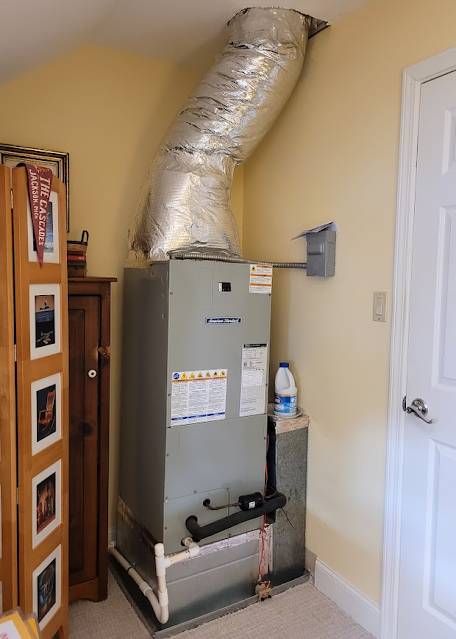
These photos show one corner of the dormer room in our home in which I pay bills, focus on my postcard and other collections, and more... I have bookcases, a nice desk and artwork on the walls.  As you can see, I've been sharing this room with this big HVAC unit.  For the last 15+ years, I've been 'hiding it' with that folding screen that I 'improved' with photos from my annual Smithsonian week by week calendars.  

FYI, until last year the room also featured ugly indoor/outdoor carpeting.  We never understood why the dormer rooms weren't carpeted like all the other rooms on the second floor of our home.  


So recently we had a closet built for the HVAC unit, using folding doors so the unit can be serviced as needed.  For those that are attentive, the unit needs to breath and the cold air return vent is in the hallway outside on the other side of the wall on the right... In any case, I now have a much nicer view as I pay the bills!


A week or two ago, Laurie and I were at Terry's home.  She is our new neighbor and she live right behind our house.  There is a narrow strip of woods and brush between our homes and it does attract critters.  We've seen Mr. Fox before, most recently trotting down the street in front of our house.  Of course, we didn't have a camera on hand at the time.  This time, Mr. Fox was foraging for mice, voles, and other rodents along the tree line in Terry's backyard...and Laurie had her new smart phone at the ready!  


Some cabinets and drawers in the kitchen were recently 'deconstructed' as regarded their contents.  We have so too much stuff, much of which we don't use.  In addition, reorganization was badly needed.  As a consequence, we loaded up that laundry basket with items we don't need or use, much of which will be donated to some deserving organization.  As for those 17 glass plates, (or are they chargers?), neighbors Sue and Steve entertain more than we do so the plates have a new home.  

What else will we discover this spring as we root through the closets, nooks and crannies in our home?  More items for charity, some throwaways and perhaps a few things to sell on "Nextdoor"...  

That's all for now.  Just click on any of the photos to enlarge them.

Thanks for stopping by for a visit!

Take Care, Big Daddy Dave

Friday, October 29, 2021

Museum of the Fur Trade (II)

…continuing with our July road trip through northern and western Nebraska to include more highlights of our exploration of the Museum of the Fur Trade near Chadron.

As I’d mentioned in the previous post, the Native American artifacts on display at this museum is both extensive in quantity and impressive as regards quality.  This spectacular Sioux woman’s blue dress features a collar piece or yoke made up with 4,000 detanlia shells!

Dentalium or detanlia shells were an international trade item among the Inuit, First Nations and Native Americans.  Traditionally, the shells of the mollusk Dentalium pretiosum were harvested from deep waters around the western coast of what is now Canada as well as the northwest coast of the USA.  Among the Plains Indians, dentalium shells have long been associated with wealth.  In addition to the yokes on women’s dresses, they were used on capes, as hair ornaments, necklaces and as dangling earrings. 

This large exhibit area has been added to the Museum of the Fur Trade since we last visited it over 35 years ago.  That reproduction 36 foot long trading canoe is pretty impressive.  I can imagine a group of fur traders with 3 or 4 of these canoes loaded with furs and skins headed downriver to Ft. Pierre… It must have been a hard way to make a living.


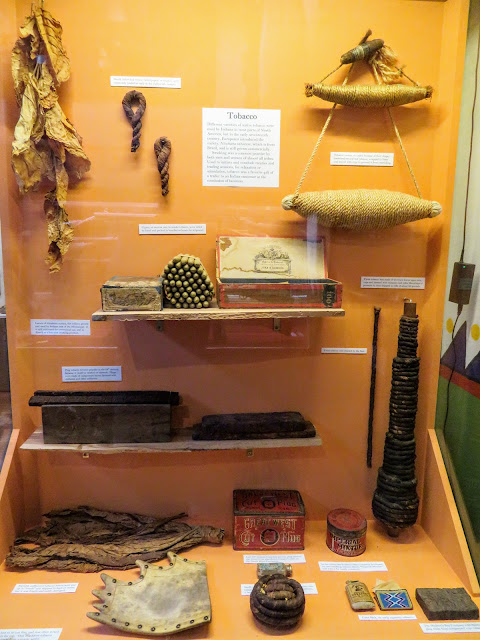
Many trade items are on display in this large hall.  Of interest to me were these displays of tobacco products.  Sorry for the glare on the first photo.  I would have left it out except for the fact that I’d never seen tobacco packaged like this… These solid packages of tobacco are very rare and most collectors are elated if they can even secure pieces of the foil bands.  They were produced by the Lorillard Tobacco Company.  That company was founded in New Jersey in 1760 and was purchased in 2014 by Reynolds American for $27 billion.

The second photo shows a variety of tobacco products, ranging from small twists (referred to as pig or hog tails), to rope tobacco and cigars.  Rope or twist tobacco was made with deveined leaves spun into rope, then ‘dressed’ in molasses or other flavoring to preserve them.  They were frequently shipped in 90 lb. rolls. 

While many varieties of native tobacco were used by Native Americans prior to the arrival of the Europeans, the latter introduced a more commercial type that was grown in Brazil.  Both men and women smoked to relax and tobacco was used in ceremonies and to initiate or conclude treaty negotiations or trading sessions.  It was a favorite gift for a trader to give when dealing with his Indian trading partners. 

Since my mother was a weaver and she wove many sashes, these beauties caught my eye.  Great Lakes Native peoples started buying many shades of dyed yarn from French traders and then wove the yarn into exquisite sashes, bags, garters, straps and belts.  In turn, these items became part of the trade business.

Other items on display in this large hall include gunpowder…complete with powder horns, tins and barrels for powder trading as well as a display of powder grades.  In addition there is a display of different types of flints that could be used in the old flintlock rifles.  I also noted a 25 unopened bags of .40 caliber lead balls and a huge display of iron and copper trade kettles.  Another display includes the oldest known American made beaver trap…made in 1755.

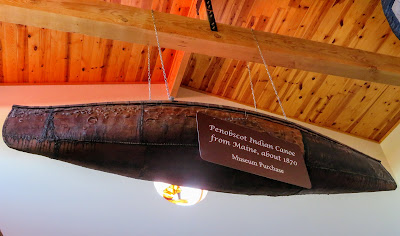
This canoe built in 1870 by Penobscot Indians from Maine caught my eye.  The Penobscot peoples from the Northeastern Woodlands Region began trading with the Europeans in the 1500s…and they were steadily forced off their lands.  Today they are organized as a federally recognized tribe in Maine and as a First Nations band government in Canada’s Atlantic Provinces as well as Quebec.  About 2,300 Penobscot tribal members are listed in the USA.  

There are plenty of antique and historical firearms, mostly long guns,  on display at the Museum of the Fur Traders, enough to satisfy even the most avid weapons collector or historian.  This pair of pistols belonged to a Hudson’s Bay officer.  They were made by Phillip Bond, a Hudson’s Bay Company gun inspector or ‘viewmaster’.

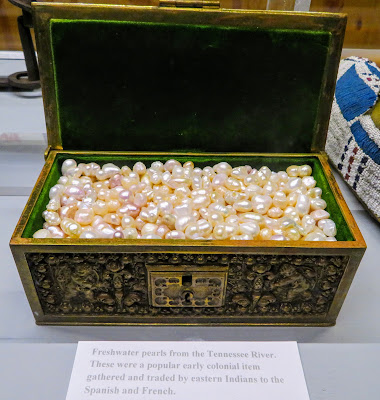
This is a rather spectacular trade item… This handsome chest is full of freshwater pearls from the Tennessee River.  These pearls were quite popular among early colonialists.  Native Americans along the Tennessee River valley gathered them and traded them to obtain goods from both Spanish and French traders.

This photo with all its glare and reflection, gives the viewer an idea of the number of long rifles on display in what I can only describe as an almost overwhelming antique arsenal.  To be clear, weapons are also displayed throughout the museum as they were key to trading, hunting, self-defense, inter-tribal warfare and battles between the European traders and the Native Americans.  In total, the long gun…the northwest trading gun collection…at the museum includes weapons dating from 1640 through 1911…


Several historic owner specific rifles are on display.  This weapon belonged to the famous Shawnee Chief, Tecumseh. (1768 – 1813) Shipments of shorter ‘chief’s guns’ began arriving from England in 1811.  At least 6,000 of these flintlock muskets were distributed by the British to their Native American allies.  The British Indian Department depot at Amherstburg on the Detroit River gave Tecumseh his weapon.  During the War of 1812, the Shawnee fought with the British against the Americans in several battles.  He even fought with the British fleet on Lake Erie as a sharpshooter. 

Tecumseh was killed in the Battle of the Thames in late 1813.  This battle is also known as the Battle of Moraviantown.  It resulted in an American victory in the War of 1812 against Tecumseh’s Confederacy, (an alliance including several thousand warriors), and their British allies.  The British lost control of southwestern Ontario as a result of the battle…and the Confederacy fell apart.

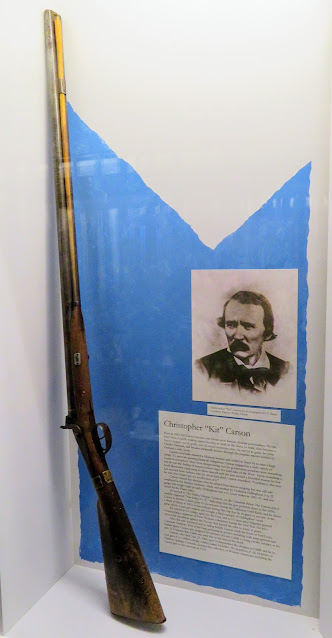
This shotgun belonged to one of America’s most famous frontier personalities, Christopher “Kit” Carson. (1809 – 1868) He did it all…a trapper, scout, mountain man, US Indian Agent and as a Brigadier General leading a regiment of New Mexican volunteers during the American Civil War.  Carson was a favorite with eastern writers who were eager for sensational stories about the American west.  He did nothing to deny many of the adventures credited to him…

The shotgun was made and marked by James Heilinghaus, a respected gun maker from St. Louis Missouri.  It is a 22 gauge shotgun and it weighs 8 pounds.  As a Civil War General and Indian Agent, Kit had been given the services of an aide and it was well documented that as Carson’s health declined, he presented the shotgun to that aide.

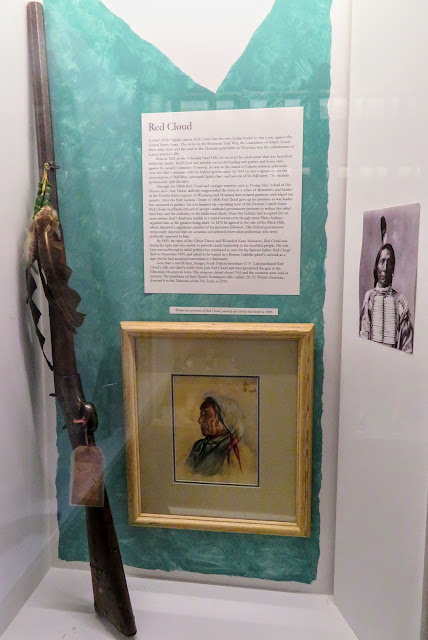
This Remington .50-70 caliber rifle belonged to Red Cloud, Chief of the Oglala Sioux. (1821 – 1909) Red Cloud, who was born in the Sand Hills in what is now Nebraska, was the only Indian leader to win a war against the US Army.  He was the victor in the Bozeman Trail War.  As the result, 3 army forts were closed and destroyed and the trail to the Montana gold fields was shut down. 

In the 1860’s, accompanied by younger warriors such as Young Man Afraid of His Horse and Crazy Horse, Red Cloud repeatedly outgeneraled the US army in a series of skirmishes and running battles.  Finally, as per the Treaty of Fort Laramie in 1868, he gave up his position as war chief.  He went on a speaking tour of the eastern United States where he gained much popularity.  His son was with Red Cloud when he died in December of 1909.  Two months later, Jack Red Cloud sold this rifle to a South Dakota merchant…and after a string of donations, it ended up in the collection here at the Museum of the Fur Trade.

FYI…the carbine owned by Young Man Afraid of His Horse, another respected Sioux leader, is also on display at the museum as are many weapons from Canada’s frontier history and the battles between that country’s First Nation people and the Canadian government.  


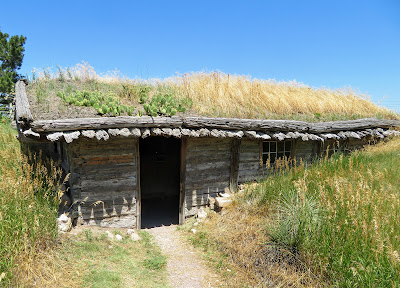
What you see here is what the original trading post at this site looked like. Although this is a reconstruction, the original post holes and layout were faithfully followed.  The land itself is considered to be a historic archeological site. 

The original trading post was established for trade with the Brule Sioux Indians in 1840.  The post was operated by James Bordeaux and his 2 Brule wives every winter until 1849 when Bordeaux moved on to Wyoming where he had a stock operation, a ranch and a store.  However, in 1850 operation of this trading post was taken over by Francois Boucher, the son-in-law of Spotted Tail the head chief of the Brule Sioux.  For several years, Boucher apparently provided the Sioux with rifles and ammunition…almost certainly contributing to the defeat of Custer and the Seventh Cavalry at the Little Big Horn.  The trading post was closed after the US Army caught Boucher with 50,000 rounds of ammunition…

Well, that’s about it for our exploration of the Museum of the Fur Trade.  This is a compact but well organized world class museum that’s located in the far northwestern corner of Nebraska.  The museum features over 6,000 primary artifacts that have been gathered and donated over time.  It is home to the most complete collection of historical items covering the fur trade period of commerce.

The Museum of the Fur Trade is located at 6321 US Hwy 20 just 3 miles east of Chadron Nebraska and just 60 miles south of South Dakota’s Black Hills.  The museum is open daily from 8 AM to 5 PM from May 1 through October 31.  Appointments are required during the winter months.  Phone: 308-432-3813.  Did I mention that entrance to this museum is a true bargain?!  Persons over 18 are charged $5.00 each… Check out the museum and its exhibits at Chadron, Nebraska | American History | Museum of the Fur Trade.  Laurie and I feel that this is one of the best relatively small museums in the USA…5 stars for sure!

Just click on any of the photos to enlarge them…

Thanks for stopping by for a visit!

Take Care, Big Daddy Dave

Monday, October 2, 2017

Arts and Crafts by Beth Thomson - #4

My first 3 posts were all related my mother’s paintings.  This final posting in the series delves into her use of different mediums for her creations… She was always trying something new and some of her efforts were whimsical or cute and others were true works of art.

You be the judge…


 We really like this little wooden decoupage tray with the cone flowers… My grandmother made quite a few things in this fashion but as far as I know, this was my mom’s only creation of this type. 


Mom started out early on…drawing and painting from childhood.  Around the the time that she met my stepfather, Hugh Thomson, he’d been painting for some time.  My mom married Hugh in the 1947 and I was about 4 when they met at an adult education art class in Jackson Michigan.  They were part of the group that founded the Jackson Art Club with Hugh serving as the first Vice President and Beth as the first Secretary.

I do know that this photo about my mom’s “Bartendas, Inc.” was taken at our house on First Street in Jackson…and I was in the First Grade.  I have vague memories of these papier-mâché liquor bottle figures all over the house…


Mom tried just about every artistic medium over the years.  This photo from 1966 shows a head that she decided to carve from a large piece of wood…
FYI…Beth also wrote a couple of children’s stories that she sold to Playmate Magazine.


Another phase of creativity were these large ‘natural’ collages constructed using seeds, leafs, stems, weeds, little stones, etc.  We still have one of them but it’s slowly deteriorating. 


Clay became another medium… Among other things such as painted tiles, she created these little folk-style figurines.


I think that this owl painted on an old piece of barn wood is a little scary…


Then there were a few works involving flattened, pounded, cut and painted tin images tacked on a wooden board…


I think that I was in the 6th grade when mom came up with Wee Bonnie Lass Ready to Sew Doll Fashions. We lived at 304 Douglas Street in Jackson Michigan at the time.  It was a cute and creative idea but it didn’t become a burgeoning business…


Dolls… Mom made a lot of dolls.  She sold a bunch of them, she gave some out as gifts and we have still have a few of them.


Beth drifted in and out of fabric related creations for many years.  She made a lot of quilt style pillows.  We still have a couple of them…


This is one of my mom’s finest works from a couple of perspectives.  Number one…she made it for me when I was about 8 or 9.  I loved the west with Cowboys and Indians and like most boys in the early 50s, trains were a big thing! 

The second reason I know that this hooked rug is a winner involved an incident that took place at Laurie and my former home in Mt. Prospect Illinois.  We had a couple of old worn but high quality oriental rugs that we offered to sell to a rug dealer who came our house.  He didn’t want them…but he did covet this hooked rug! (NO SALE!)


My mother made a lot of ceramic owls… This one was far and away the biggest and most startling of the bunch.  She made and sold a lot of small hand painted and kiln fired owls at local art fairs in Jackson and East Lansing Michigan.


…not just ceramic owls either.  She also hand painted and fired a number of colorful plates.  Laurie and I still use these when we serve dessert to guests.


…and as time went on, mom got more and more into fabric art, in this case a woven cover for a decorative pillow.


Talk about whimsy!  This chess set is about as whimsical as one can be… Mom didn’t play chess and neither do I.


More weaving…this time combining plant fiber with wool. 


Here was another use for mom’s kiln.  She started making jewelry…painting the metal flats and then firing them in the kiln and attaching backs to them.  Back in the early 1960s she sold a lot of these items at art fairs.

I do recall an Art Fair in East Lansing Michigan in the early 60’s (GO SPARTANS!) where I helped mom set up and tend her booth.  She sold some little owls, a little handmade jewelry similar to the earrings above and then she sold a ton of ceramic beads.  

I’d convinced her to bring a bunch of ceramic beads that she’d been experimenting with.  At a dollar apiece she sold out in about 3 hours.  That night, we went home and dug up a bunch of beads that she disposed of in the garden because she didn’t like them.  She sold out again on the second day!


But, she kept coming back to fabric related creations…like this quilt top.


It was like a mental battle… Where would her creativity go next?  This little hand painted ceramic figurine is definitely reminiscent to her primitive folk paintings.


Don’t ask me why…but I like this cork, chain, nail, brad and tacks with bits of ‘this and that’ creation on a board.  It now resides at our son’s house in Omaha.


Weaving slowly evolved as her primary artistic medium.  This is one of her earlier creations. 


She even wove this little Sherpa style jacket…


Then she really got into weaving!  Despite her new artistic ‘love’, she still dabbled in mixed media weaving these feathers into this wall hanging.
FYI…The person hiding behind the weaving is my wife Laurie.  This photo was taken ca. 1980 behind our home in Bridgeton Missouri.


Mom wove this little hanging complete with critters for her grandson David II when he was just a tyke…


Bright and bold… Amazingly, she preferred natural dyes.  That’s one reason I cringe at the sight of walnuts.  I had to help make dye from those noxious husks.  She used a variety of plants to create the colors she wanted so it wasn’t unusual to arrive for a visit and be greeted by a pot of some kind of dye on the stove…


She saw art everywhere…even in these balls of home dyed material for her weavings.


As she progressed, her designs got more and more complex.


Eventually, she had 2 or 3 small looms at her house plus a giant loom with a foot treadle…


After a bit, some of her weavings became more like paintings…


…or they became complex eye-numbing creations like this one.


I have no idea what became of this small complex weaving…but I like it.


…still more yarn poised (and posed) and ready for the loom.  Note the woven belt.  She made and sold a lot of belts!


This is another fanciful and complex weaving whose fate is unknown to me.


These 2 large weavings (posed against a table) were unusual in that they were more basic design-wise.


Yep…more feathers were incorporated into this small wall hanging.  I believe that she got the feathers from her guinea fowl.  She had 5 acres on Sears Road in Jackson County for quite a number of years.  She had a garden, canned some of her own produce, raised chickens for a while and was entertained by a number of cats and a dog. 


This is a display of my mom’s weavings at a local arts and crafts show.  She did sell a lot of her weavings over the years…


This subtle artistic weaving is one of our favorites…an impressionistic image that I can wrap my head around.   


This very large and colorful wall hanging is on display in our home here in East Tennessee.


…and we love this handsome pillow with its complex design and earth tones.


Here is another big wall hanging… I see the beach, sea and sky.  What do you see?

  
Finally…my mom made this king size quilt for Laurie and me.  We love the colors and the cheer it brings into a room!

Well…this ends the 4 part adventure that was my mother’s artistic and creative side.  Thanks for coming along for the ride!

Just click on any of the photos to enlarge them…


Take Care, Big Daddy Dave