Monday, October 13, 2014

Fast Food…Pasta?!

During our visit to Omaha Nebraska, Nana (aka Laurie) and I were hanging out with our grandson Emmett Lee.  It was time for lunch so we decided to drive around a couple of the local shopping areas to look for something a bit different than the usual chains…


That’s when we ran across Newman’s Pasta Café… We didn’t know what to expect especially since the restaurant didn’t use Italian in their name.  But what the heck, we decided to give it a shot!


Like most other fast food restaurants, customers place their order at the counter and, when they call your number, you go and pick up your order.  The menu is posted on the wall to the right of the counter.

Newman’s does offer Italian pasta dishes…9 of them in total.  They also offer 5 ‘American’ pasta entrees and 4 different Asian options.  In addition, there are 4 starters/appetizers, 3 different soups and 6 salads on the menu.


The interior of the restaurant is a bit industrial but it is softened by the shape of the ceiling and the wall treatments.  It was very clean and the staff was friendly and helpful. 


Laurie ordered the Margherita Pasta. (Full order $6.99/half $4.99)  It consisted of farfalle pasta tossed with tomatoes, basil, garlic, red pepper flakes, white wine and extra virgin olive oil.  It was garnished with fresh basil and Asiago cheese.  All of the pasta orders came with a soft breadstick.


Emmett’s palate is still under development… For his lunch he ordered the Noodles from the Kid’s menu. ($4.99) This curly pasta was served with buttered noodles simply topped with asiago cheese.  He was a happy camper!  

Spaghetti, Mac ‘n Cheese, Alfredo and individual cheese pizzas are the other options on the Kid’s menu.  Everything on this portion of the menu is priced at $4.99 and Kid’s drinks are only 99 cents!


When it was time for yours truly to place his order, I put the emphasis on cheese!  This is the Three Cheese offering from the Italian portion of the menu. (Full order $5.79/half $4.79) My lunch was made with cavatappi pasta with a special blend of melted cheeses and fresh cream and finished with a heap of shredded Cheddar and Monterey Jack cheese.  I don’t know how Italian this entrée was, but I had no complaints!

Most of the entrees can be ordered as a half order if that’s what you’d prefer.  The most expensive entrée was only $8.99 although if you added shrimp, beef or chicken to one of the entrees as listed, the price would increase.  FYI…Beer and wine is available. 


Here are Emmett Lee, (10…soon to be 11 years old), and his Nana after finishing our lunch at Newman’s.

Newman’s isn’t serving gourmet food but that’s not the goal here.  Laurie and I liked the concept.  The food was good and the price was right.  We can envision Newman’s as a franchise operation in the near future.  For a quick, satisfying and filling meal…especially for families…this could be a popular destination.
 
Newman’s Pasta Café is located at 2559 South 171st Court in Omaha Nebraska.  Phone: 402-884-2420.  Website: http://newmanspastacafe.com/.  Facebook: https://www.facebook.com/newmanspastacafe. It was interesting to note that all 22 reviews of Newman’s on Trip Advisor were average or higher…with only one being average.  http://www.tripadvisor.com/Restaurant_Review-g60885-d966638-Reviews-Newman_s_Pasta_Cafe-Omaha_Nebraska.html

Just click on any of the photos to enlarge them…

Thanks for stopping by for a new restaurant experience!


Take Care, Big Daddy Dave

Friday, October 10, 2014

History Along Nebraska’s Highways (Part I)

As many of you have noticed, railroad depots and related rolling stock are bits of American history and I do enjoy searching and exploring their background.  But there are many, many other locations, buildings and objects across the USA that are part of our history.  As we drove across a small portion of eastern and central Nebraska, we ‘discovered’ quite a few of these local focal points. 

Here is Part I of our ‘historical’ exploration…


Yes…this is a torpedo!  It has a place of honor in front of the Saunders County Courthouse in Wahoo Nebraska.  So what the heck is a torpedo doing in the middle of the country, far away from the Ocean?  Former members of the US Navy may have the best chance of answering that question. Wahoo was a name given to a famous submarine in the US Navy…

The first USS Wahoo (SS-238) was a Gato-class submarine.  It was first United States Navy ship to be named for the wahoo, a dark blue food fish found around Florida and the West Indies.  Construction started before the U.S entered World War II, she was assigned to the Pacific theatre. She gained fame as an aggressive and highly successful submarine after Lt. Commander Dudley Walker "Mush" Morton became her skipper.  Unfortunately, she was sunk by Japanese aircraft in October 1943 while returning home from a patrol in the Sea of Japan.

The Mark 14 torpedo and a granite marker are a memorial to the U.S.S. Wahoo and its crew of 65.  The submarine was credited with sinking 20 Japanese ships.  Each October a memorial service is held at the courthouse to honor those who gave their lives in submarine warfare.  In 2006, the wreckage of the U.S.S. Wahoo was discovered in Japan’s Soya Strait.


This is a photo of the U.S.S. Wahoo during World War II. (Photo ‘borrowed’ from Wikipedia) To learn more about this submarine and its valiant crew, you can go to http://en.wikipedia.org/wiki/USS_Wahoo_(SS-238).


The Saunders County Courthouse itself is listed in the National Register of Historic Places.  Ashland Nebraska was the first Saunders County seat but after some rumored records thefts from Ashland, voters chose Wahoo as the county seat in 1873.  Within a year the first courthouse was built in Wahoo.  However, by the beginning of the 20th century the county determined that there was a need of a new home for its offices and in 1904 the present courthouse was built.  Construction costs for this massive Romanesque Revival-style building were $87,000!  If it were built today, it would cost over $2,350,000.

The memorial marker on the right, combined with the Mark 14 torpedo as previously shown, is part of the U.S.S. Wahoo Memorial. 


This is the Seward County Courthouse in the city of Seward Nebraska.  Actually, the courthouse is the centerpiece of the Seward County Courthouse Square Historic District, which is listed in the National Register of Historic Places.  The square is one of the finest nineteenth and early twentieth century commercial districts in the state.  In addition to the courthouse, there are a plethora of other structures listed in this Historic District.  To view a complete listing of the many structures included in this historic district, including photos, you can go to this site: http://www.nebraskahistory.org/histpres/nebraska/seward/SW09-Seward_Co_Crthse_Sq_HD.pdf.
 
The 3-story, limestone courthouse was constructed from 1904 to 1906.  It was designed in the County Capitol form by architect George A. Berlinghof. (c. 1862 – 1944) He was a German-born architect who designed a number of important buildings in several cities and towns in Nebraska and adjoining states.  Berlinghof remained active as an architect until 1930.  Between 1911 and 1918, he partnered with Ellery L. Davis in the firm of Berlinghof and Davis.  This company survives today as the Davis Design firm, with offices in Lincoln NE and Vermillion, SD.


This beautiful home is listed in the National Register and it is also located in Seward… The 2 and a half story Harry T. Jones house was completed in 1890.  Mr. Jones was President of the Jones National Bank and he hired none other than the aforementioned George A. Berlinghof to design his home.  This house is considered the best example of the Queen Anne style in Seward.  The property also includes a ca. 1890 brick carriage house. In addition to this home, Mr. Jones was the largest landowner in the county…

To learn more about the design and this home’s detailed description, just go to http://www.nebraskahistory.org/histpres/nebraska/seward/SW09-074_Jones_Hse.pdf.  FYI…The Jones Bank Building ca. 1874 is also included in the Seward County Courthouse Square Historic District.  


I’ve included this photo of the National Guard Armory in Seward as it recently became the home of the Nebraska National Guard Museum.  Two tanks, including a 50-ton Patton M-60 Main Battle Tank and this vintage WWII/Korean War M-4 Sherman as well as 2 Armored Personnel Carriers are on display around the exterior of the armory/museum. The museum is a work in progress with a planned dedication of this project slated for July 4, 2016.

The city of Seward was founded in 1868.  It was named after Seward County which in turn was named after William H. Seward, the acting Secretary of State under President Lincoln. (Seward was behind the purchase of Alaska from Russia) The city has a population of about 7,000 and its best known for its July 4th celebrations.  The city has celebrated our Independence Day almost every year since 1868.  Before automobiles came into general use, special trains were operated to bring people to the event.  In 1979, a resolution in the U.S. Congress named Seward "America's Official Fourth of July City—Small Town USA".  Recent attendance at this gala event has been estimated at about 40,000!

That’s it for this first chapter of our historical tour of Nebraska’s byways and highways… Just click on any of the photos to enlarge them.

Thanks for stopping by for a visit!

Take Care, Big Daddy Dave

Wednesday, October 8, 2014

Breakfast at a Village Inn Restaurant

We were in Omaha Nebraska visiting our son David II, his better half Amy and our 2 grandsons, Emmett Lee and David II.  Amy and David III were out of town at a soccer tournament, the air conditioning was kaput at their new home and it was time for breakfast…


When it comes to negative restaurant experiences, I have the memory of an elephant… It had been probably 25 years since I ate at a Village Inn.  My previous very negative exposure, if my memory serves me right, was in Hannibal Missouri. (If so, that location is long gone!)

In any case, based on David II’s recommendation, I agreed to give their local Village Inn a chance of redeeming this restaurant chain…


This is the interior of the Village Inn.  It was clean and moderately busy for a late morning breakfast.

Village Inn currently has about 200 company and franchisee operated locations in 20 states, with most of them in the center of the USA west of the Mississippi and into the Rocky Mountain region.  There are 3 restaurants in Anchorage Alaska, 1 in Virginia as well as 23 in Florida.  The company was founded in Denver back in 1958.


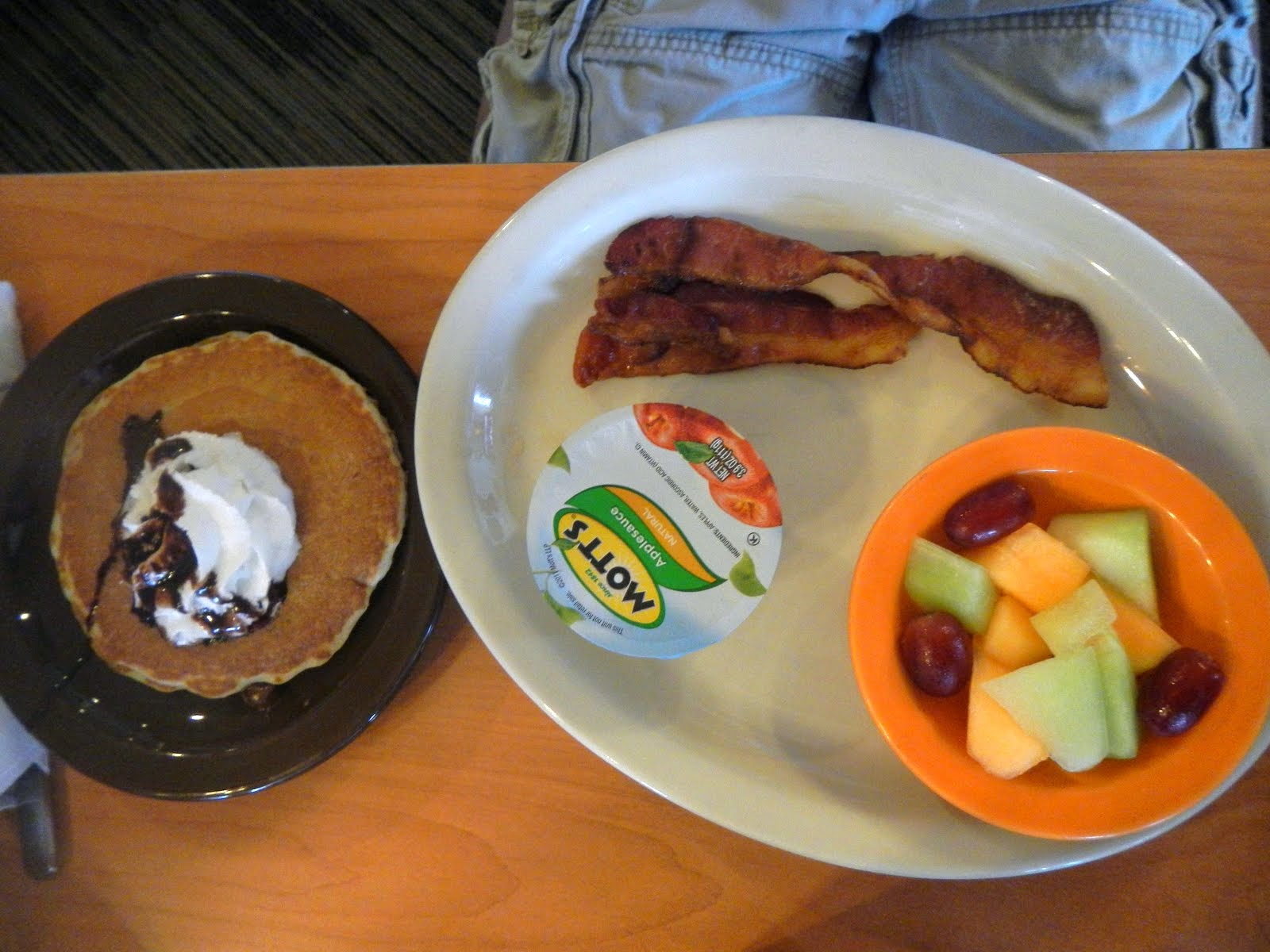
Emmett Lee has some limited and interesting dining habits…but then again he’s 10 years old!  For breakfast, he had a Blueberry Pancake with a bit of whipped cream, applesauce, fresh fruit and a couple of strips of bacon…accompanied by a glass of chocolate milk.


David II ordered the Chicken Fried Steak with Country Sausage Country Gravy accompanied by a couple of Scrambled Eggs and some Hash Browns. ($8.49) He had Rye Toast on the side.  This is one of his favorite breakfasts, and mine too!

Laurie went with her favorite basic breakfast… She had 2 Eggs Easy-Over with 3 Bacon Strips, Hash Browns and Sourdough Toast. ($8.29) Everything was prepared to her liking… The eggs were indeed easy-over, the bacon was crisp and the hash browns were crispy brown on the outside and just right in the center.

Looking on-line at the menu, I can’t recall exactly which listed meal I ordered…but I do know that it cost $9.69.  As you can see, I had 2 Easy-Over Eggs with a Sausage Patty, a Chicken Fried Steak with Sausage Gravy, and an order of Hashbrown Potatoes.  I also had the Marble Rye Toast…

Shoney’s take note!  It is indeed possible to get off my list of terrible restaurants… After all of these years, Village Inn has been redeemed in my eyes!  The food was good…solid and well prepared.  While it wasn’t the best breakfast I’ve ever had, it was very good.  We could use a well-run Village Inn here in East Tennessee!


We were here for breakfast so we didn’t indulge in these great looking pies near the cash register at Village Inn.  Maybe next time!  Note the display of ingredients on the bottom shelf of this pair of pie showcases… Imaginative at the very least…

One of my favorite facts is that breakfast is served all day at the Village Inn.  It is located at 2525 South 180th Street in Omaha NE.  Phone: 402-333-0434.  The company’s website is found at http://www.villageinn.com/

Just click on any of these photos to enlarge them…

Thanks for stopping by for another breakfast with our family!

Take Care, Big Daddy Dave


Monday, October 6, 2014

Railway Depots and More Along the Way

It’s been awhile since we’ve been out cruising along the back roads and byways through a new area of the country… When we do, we always look for historical structures listed on the National Register of Historic Places; railroad depots and other related structures or equipment, and; quality small town dining.

When we visited our son and his family at their new home in Omaha, we took a couple of days off after our Labor Day sojourn with them and then headed west.

This bright yellow Diesel Locomotive belongs to Frontier Coop, a company with 20 different locations in Nebraska.  I took this photo in the village of Mead, which has a population of roughly 600 people.  Every little town in Nebraska seems to have big grain elevators and many of the larger facilities have their own locomotives for use in shuttling and loading grain cars.


This is the grain elevator in Mead.  Frontier Coop’s operation in Mead, all of which is along the tracks, includes a chemical plant, liquid fertilizer storage and a dry fertilizer facility.  The Union Pacific Railroad provides mainline freight service to and from Mead. 

The problem I had was that my Internet research told me that there was a former railroad depot in Mead…


This is it!  Despite Mead being a small town, we just didn’t pick up on this structure and connect it to the railroad.  It wasn’t next to the current tracks and we just missed it!  It looks like a great use was found for the building...

I copied this photo from a very nice website that contains a plethora of depot photos from around the country, all with an interactive map!  It’s called ‘Dynamic Depot Maps’ and you can check it out at http://www.depotmaps.com/.


This classy and well maintained depot is located in Wahoo Nebraska.  This depot was built in 1887 by the Chicago, Burlington and Quincy Railroad and it’s listed on the National Register of Historic Places.

The railroad arrived at Wahoo in 1876.  Eventually three railroads found Wahoo's location ideal for their needs, dissecting the county like a giant pie.  The Union Pacific branch line from Valley to Lincoln was first.  By 1886 the Chicago and North Western established a Fremont to Lincoln line through Wahoo, and the next year, the Chicago, Burlington and Quincy built a branch line connecting Schuyler and Ashland.  Currently, the Union Pacific is the only railroad operating through Wahoo.


This is a view of the Wahoo Depot from the other side of the building.
 
Wahoo was founded in 1870 by predominantly Czech, German, and Scandinavian settlers.  The town has a population of about 4,500 and it’s the county seat for Saunders County Nebraska.  This is the only city in the world named Wahoo…

The town's name either comes from the eastern wahoo, a shrub found on the banks of Wahoo Creek, or from an Indian word meaning "burning bush". (The first attribution is from Wikipedia and the second is from the Wahoo Chamber of Commerce)

With the demise of the caboose in the USA, just about every town that wants one has one on display.  This well maintained caboose is located next to the Wahoo Depot.  The Depot is part of the Saunders County Museum complex.  To learn more about this museum, you can go to: http://www.saunderscountymuseum.org/index.htmly.

Trivia: Darryl F. Zanuck, Academy Award–winning producer, writer, actor, director, studio executive, co-founder of 20th Century Films was born in Wahoo in 1902.  He played a major part in the Hollywood studio system as one of its longest survivors.  He’s credited with such movies as The Grapes of Wrath; How Green was My Valley; Twelve O’Clock High; All About Eve; The King and I, and; The Longest Day.  His son, Richard Darryl Zanuck, was also a film producer who is best well known for his 1989 film, Driving Miss Daisy.


We’d been following Nebraska Highway 92 west from Omaha with plans to follow NE 15 south to Seward Nebraska.  Instead, I diverted north to the well-named town of David City.  This is the only city in the world named David City.  It was named for an early settler.

This is another former Chicago, Burlington and Quincy Railroad depot.  It was built in 1915.  The Union Pacific line from Valley Nebraska arrived in town in 1877, followed by the Chicago, Burlington and Quincy line from Lincoln in 1880, and the Chicago and North Western line from Fremont in 1887.  Freight service is still provided by the UP and Burlington railroads.


Active rail lines still bracket this depot.  One is a siding and the other is a main line track.  As you can see, this building now serves at the Butler County Historical Museum.  However, I couldn’t find a website for the Museum or Historical Society. 

Trivia: Two people of note who came from David City were Ruth Etting and Joyce Hall.  Music lovers may remember that Ruth Etting was an American singing star and actress of the 1920s and 1930s.  She had over 60 hit recordings and her signature tunes included "Shine On, Harvest Moon", "Ten Cents a Dance" and "Love Me or Leave Me".  Too many, including my wife, Joyce Hall had a more important historical role, perhaps even a critical one… She was the founder of Hallmark Cards!

That’s about it for now… Just click on any photo to enlarge it.

Thanks for stopping by for a visit!


Take Care, Big Daddy Dave  

Friday, October 3, 2014

Fast Food in Omaha Nebraska…

While visiting our family in Omaha, there were times when we opted for take-out or fast food vs. going out to a sit down restaurant or cooking at David and Amy’s new home.  We were also inspired by the fact that their air conditioning system at home had died…

As long as we were having fast food, it was an opportunity to experience Omaha area fast food providers…


Our first experience was with Five Spice Food and Restaurant.  Originally, we’d planned to eat at the restaurant but when we arrived, Laurie and I felt that the atmosphere in this ‘modern’ Chinese restaurant was too sterile, too industrial and too noisy, so we took our order home with us.  We should have taken an inside photo but we were too put off to even consider eating here…so David II came back to pick up our order when it was ready.


We certainly ordered plenty of food!  The above photo is a representative picture of our total order.  An egg roll cost $1.95, 4 crab Rangoon were $3.95 and 8 pot stickers cost $4.95.  Individual basic meals…with lots of choices including chicken, beef, shrimp, pork of vegetable entrees, cost $6.95 and they come with 2 crab Rangoon and fried rice.  There is also an extensive list of Chef’s Specialties available, ranging from $11.95 - $15.95.
 
Bottom line… Laurie and I weren’t impressed by the food from Five Spice.  We classified it as just OK…a fuel stop at best.  Still, despite our impressions, the place was busy and it seemed to be quite popular.  If you give it a try let us know what you think… Five Spice Food and Restaurant is located at 2571 South 177th Plaza in Omaha, Nebraska.  Phone: 402-778-9888.  This restaurant is on Facebook at https://www.facebook.com/FiveSpiceOmaha.


We’d never heard of the Runza fast food chain… David II, Emmett Lee, Laurie and I stopped at one of their outlets for lunch one day. 

 Runza is the name of a regional fast food restaurant chain specializing in ethnic cuisine once served by the Volga German immigrants to the United States.  In 1949, Sarah "Sally" Everett and her brother, Alex Brening, opened the first Runza Drive-Inn in Lincoln, Nebraska, and began serving runza sandwiches.  These consist of pastry/a bun filled with ground beef, onion, and cabbage.  Per Runza’s website, there are currently 80 restaurants in this chain, with 75 of them being in the state of Nebraska.


The inside of the restaurant resembled any of the many typical fast-food chains…signs above the counter with the menu and counter service.  The facility was clean and neat and the employees were helpful and efficient…


Laurie snapped this photo of David II, Emmett Lee and me sitting at our table at Runza.  Amy and David II were down in Kansas City for a soccer tournament…

FYI… The runza sandwich originated in Russia during the 1800s and spread to Germany before appearing in the United States.  The recipe was passed down from generation to generation and is available throughout the Americas, particularly in Argentina and the Canadian provinces of Alberta, Saskatchewan and Manitoba. The recipe was spread throughout the United States by the Volga Germans, (i.e., Germans from Russia), and runza sandwiches can be found in North and South Dakota, Michigan, Wisconsin, Minnesota, Illinois, Kansas, Oklahoma, and Nebraska. The term "runza" is registered as a trademark in the United States by Runza Restaurants.


Laurie also took this picture of our grandson Emmett Lee (10…soon to be 11) and his ‘Papa’ (Grandpa).  What ever happened to the young version of me? (That was a fellow who had hair and in high school he'd looked like a young Clark Kent!) Time marches on! 


David II told me that Runza’s hamburgers were pretty good…so that’s what I ordered.  This is my half-pound cheeseburger. I must admit that it was better than most of the fast food burgers around the country!  It was juicy and satisfying…

Emmett Lee had his usual cheeseburger with a strawberry milkshake and lemonade.  David II also had a burger…and the men in our group were happy campers!

Laurie decided to step ‘outside the usual box’ and she ordered a version of what made Runza famous… She ordered the Cheese Runza Sandwich…a bun stuffed with ‘loose’ ground beef, onions, cabbage, cheese and secret spices.  She got fries as her side and David II had ordered some onion rings so she could try them too. 

The French fries were good as were the onion rings… However, while the sandwich tasted alright, the impact of that sandwich on Laurie was similar to the name of this restaurant chain…”Runza”.  She has allowed that she’d go back for one of the hamburgers…but no more Runza sandwiches for her!

I’m not sure of the address of the Runza location that we went to…as David II bought our meal and he got the receipt.  To learn more about Runza Restaurants and to find a location in Nebraska, Iowa, Colorado or Kansas, you can go to the company website at http://www.runza.com/.  

Just click on any of the photos to enlarge them…

Thanks for stopping by for a visit!


Take Care, Big Daddy Dave

Wednesday, October 1, 2014

Horses, Horses and Burros Too!

Anyone who knows my better half knows that she loves horses!  Having lived with her for over 36 years, I am very aware of this passion… Actually, when we first met, she owned a horse named Ranger, but after we looked at our finances at the time, I convinced her to sell him.  For some unknown reason, she still married me!

So… We were in central Nebraska just a little west of Kearney.  I’d turned north at Elm Creek from US Hwy. 30, (Lincoln Highway), onto US Hwy highway 183 and I’d driven a few miles.


After leaving the Platte River valley…with some rolling hills showing up along the way…Laurie said that it would be great if we would see some wild horses galloping across the plains.  As we passed this field of corn…we came across a sight that she hadn’t expected!


The surprise worked!  When I turned into this federal government property…the Bureau of Land Management’s Wild Horse and Burro Facility, she was more than a little excited..!

The Bureau of Land Management (BLM) is an agency which is a part of the United States Department of the Interior.  The BLM administers American public lands, totaling approximately 247.3 million acres, or about 12.5% of the total landmass of the country!  In addition, the Agency also manages 700 million acres of the subsurface mineral estate underlying federal, state, and private lands across the country. With approximately 11,600 permanent employees and about 2,000 seasonal employees, this equals roughly 21,000 acres per employee.


These signs at the entrance describe the nature and source of the facilities feral residents…the wild horses and burros.  They also provide the necessary information, i.e., a starting point for anyone who wants to adopt one of these ‘surplus’ animals…


This is an overview of a few of the corrals or pens for the wild horses/mustangs that have been removed from federal lands…

By definition, a mustang is a free-roaming horse of the North American west that first descended from horses brought to the Americas by the Spanish.  Mustangs are often referred to as wild horses, but there is debate over terminology.  Because they are descended from once-domesticated horses, they can also be classified as feral horses.  In 1971, the United States Congress recognized Mustangs as "living symbols of the historic and pioneer spirit of the West, which continue to contribute to the diversity of life forms within the Nation and enrich the lives of the American people."  Today, Mustang herds vary in the degree to which they can be traced to original Iberian horses.


Laurie captured this photo of one of these magnificent horses at his watering trough… You will notice that he is in terrific shape!  She observed that the horses were very well fed, and were being provided with the best hay, oats and Omolene. 

There wasn’t a puny or run-down looking horse among the hundreds of horses being housed at this BLM facility.  We talked to one of the workers who told us that he’s employed to come by to feed and water the horses a couple of times a day, seven days a week.

The BLM manages all free-roaming horses and burros on public lands across 10 western states.  They classify these animals as feral, but are also obligated to protect them under the Wild and Free-Roaming Horses and Burros Act of 1971.  As horses have few natural predators, populations have grown substantially. The BLM estimates that as of 2009, there were nearly 37,000 horses and burros on BLM-managed rangelands.  Purportedly, that is 10,000 more animals than can exist in balance with other public rangeland resources and uses.  I was amazed to learn that The Bureau of Land Management holds about 32,000 additional animals in long-and short-term holding facilities, adopting out several thousand of them each year.


Have no doubt…these horses are wild!  This group was eyeing Laurie as she took their picture.  They were huffing and snorting at this strange being who might represent a threat in their eyes…

This facility is wide open for visitors.  There is a rudimentary road around the facility past all of the holding pens.  Laurie spent a lot of time outside the car by the fence line taking photos and talking to the horses and burros.  We were told that with the advent of the Internet, fewer visitors actually stop by to check out the horses.  Most adoptions these days are apparently initiated on-line.


In addition to the hundreds of horses, the facility is also home to a handful of wild burros.  While most of the animals at BLM Elm Creek were wary and unapproachable, these Sicilian burros were quite friendly and not at all intimidated by their human visitors.


Actually, they were looking for a scratch and a snack if one was available! 

The first donkeys/burros to reach what is now the United States may have crossed the Rio Grande with Juan de Oñate in April 1598.  From that time on they spread northward, finding use in missions and mines.  Donkeys were documented as present in what today is Arizona in 1679.  By the Gold Rush years of the 19th century, the burro was the beast of burden of choice of early prospectors in the western United States.  With the end of the placer mining boom, many of them escaped or were abandoned, and a feral population established itself.

FYI…a burro is a small donkey.  One source indicated that there are less than 5,000 feral/wild burros in the USA, with Arizona, Nevada and California having the largest populations of these attractive former beasts of burden.


This was the only horse that was in with the wild burros.  Where we live here in East Tennessee, many burros/donkeys are employed as guard animals for cattle and horses.  They are fearless and will raise the alarm and attack any predator that intrudes on or threatens their ‘herd’. 


Here a few more curious wild horses checking Laurie out…

Back in 2009, Secretary of the Interior Ken Salazar proposed a new approach to restore the health of America’s wild horse herds as well as the public rangelands that support them.  His proposal included the possible creation of "wild" horse preserves on the productive grasslands of the Midwest and East.  The proposal also included changes which would make adoptions more flexible in order to encourage more people to adopt horses.  It appears that like most other legislation in front of Congress, nothing has been done with this proposal!


To say that the BLM’s role in managing the wild horse and burro population under the Wild and Free-Roaming Horses and Burros Act of 1971, is an understatement.  There have been suits and countersuits, claims that horses have been sold to investors and ended up at slaughter houses, passionate efforts to expand available lands for these animals, population control through sterilization and also to increase adoptions.  To learn more about this topic, you can go to http://en.wikipedia.org/wiki/Wild_and_Free-Roaming_Horses_and_Burros_Act_of_1971.


This horse seems to be saying, “Please adopt me so I can run over green fields and pastures!”  It was nice to see that the BLM was taking such great care of these horses and burros, but it was a bit sad that they are penned up and can’t really run across the grasslands as they would like.  I know that we fantasized about buying several hundred acres of land and adopting a herd of these wild horses and burros and letting them run free…

Interesting in learning more about these horses and burros?  Perhaps you’d like to adopt a horse or burro… Check out the possibilities at  https://www.blm.gov/adoptahorse/.  On this site, you will find excellent and extensive photos of the horses and burros that are up for adoption.  The site contains many beautiful photos!  Apparently, on-site adoptions are not available at the Elm Creek facility.  The BLM site lists 15 locations where interested parties can go to adopt a horse or burro.  Unfortunately…and counterintuitively…only one facility is located east of the Mississippi… Adoption facilities are located in Arizona, Wyoming, Utah, Colorado, Nevada, Oklahoma, California and Mississippi.

To quote a well-known truth: “Happy wife, happy life!”  I’d earned my brownie points for the day!  Just click on any of the photos to enlarge them…

Thanks for stopping by to check out this interesting stop along the way!

Take Care, Big Daddy Dave