Tuesday, October 12, 2021

Another Small Town along the Way (7)

…continuing with our July road trip.  This segment of the trip continues our exploration of northern and western Nebraska with its small towns and cities.  The next town along US Hwy 20 headed west was the town of Valentine.  It was our destination for the evening.

Laurie and I had last visited Valentine about 36 or 37 years ago.  During our last visit, our only choice for a motel was an old style one level unit with parking outside the door to our room.  I believe that it was a ‘dreaded’ 2 diamond motel… Not so this time and we had a room reserved at a Comfort Inn.

It was time to eat dinner and I’d done a bit of research ahead of time.  My choice for the evening meal was the Peppermill Restaurant and E.K. Valentine Lounge.  This restaurant has been in the same family since 1986…operated by 3 generations of the same family.  No less than 6 generations of this family have lived in the Sand Hills region of Nebraska so their roots are deep!


The bar in the E.K. Valentine Lounge is built with logs and the big high table is covered with a wood slab.  The space is small and cozy.  The dining area was fairly spacious…you can’t see all of it in my photo…with plenty of spacing between tables.  No one on the stall was wearing masks to protect from Covid-19 but then again, this is western Nebraska, an area populated by folks that don’t care much for limitations.


After I had a Miller Lite ($3.50) and Laurie had a Cucumber Mint Mule ($7.00), we both had salads before our entrees arrived.  They were nicely presented and provided a good start to our meal.

Laurie didn’t want to order a big meal so she opted for the Pecan Rib Tip appetizer. ($14.00) There was a full pound of smoked rib tips accompanied by beer battered onions.  She chose the garlic parmesan dipping sauce over the sweet, spicy or bourbon sauces.  There was plenty to eat, but if I remember correctly, Laurie felt that the rib tips were a bit too dry.

For my entrĂ©e, I chose the 12 oz. Joseph Grilled Prime Rib, slow roasted and then seared on an open flame. ($25.99) It was accompanied by a baked potato and au jus for dipping.  The prime rib was medium rare as requested and it was very enjoyable.

The Peppermill Restaurant and E.K. Lounge is closed on Sunday and they only serve dinner on Saturdays.  Monday through Friday this establishment is open for both lunch and dinner.  They are located at 502 East Highway 20 in Valentine Nebraska.  Phone: 402-376-2800.  Their website is at Full-Service Restaurant and Lounge - Peppermill (peppermillvalentine.com).

After dinner it was still light out so I decided to go and look for the old Bryan Bridge…which used to bring US Hwy 20 across the Niobrara River.  It is listed on the National Register of Historic Places…mostly for its construction as a ‘pin-connected arch bridge’.  It was built in 1932.

Nope!!  The photo above is not the Bryan Bridge!  I had thought that I was taking a picture of the right structure…but alas…I failed by making the mistake of taking a photo of the first spectacular bridge I saw.  This is actually the quarter-mile long 148 feet high railway bridge that had been abandoned when the Chicago and North Western Railway ceased service on its “Cowboy Line” in 1992. 

The good news is that this impressive and scenic span was purchased along with the rest of the railroad’s right of way in 1993.  The entire right of way was bought by The Rails-to-Trails Conservancy for $6,200,000.  It was then donated to the State of Nebraska which developed it into a ‘rail trail’.  So that great looking bridge over the river is now part of a biking/hiking trail across much of the state…  

We liked this little memorial nook in downtown Valentine with its big red heart!  The city of Valentine was founded in 1882 and was named for a local statesman, E.K. Valentine.  No surprise if you’ve been following my string of small town posts for Nebraska… Like all of the others, it was the coming of the railroad that led to Valentine’s founding.  The Sioux City and Pacific Railroad began train service here in April of 1883.

Valentine is the County Seat for Cherry County Nebraska.  The town has a population of about 2,700 and that number has been fairly stable since at least 1950.   As for Cherry County, it has a population of around 5,800 and occupies 6,009 square miles.  The largest county in Nebraska, it is larger than the state of Connecticut or the states of Rhode Island and Delaware combined.  The county has less than 1 resident per square mile!

Note:

In 1920, Cherry County had 11,753 residents.  Drought and the depression drove out many small homesteaders.

No, this isn’t an historic building… However, I really liked the fanciful frieze work on the front of the Security First Bank in Valentine.  FYI, this banking group has roots that stretch back to 1898.  Security First Bank is a Nebraska-chartered, privately-held community bank with 26 branch locations and 12 insurance offices in Nebraska and South Dakota.

By early 1884, Valentine had 250 residents and that number had tripled only 2 years later.  Its quick growth and existence at the end of the rail line for a time, led to quite a bit of lawlessness.  It had the reputation of being the ‘toughest town’ in Nebraska.  After a bit of time, pistol practice in the saloons was stopped and guns were removed upon entry.  Outlaws in the area included Doc Middleton and his pony boys, Black Jack’s gang and the short lived escapades of a prolific horse thief named Kid Wade.  Vigilantes caught up to the ‘Kid’, (He was actually 25 years old), and he was found hanging by the neck, swinging from a railroad ‘whistling post’.

The Cherry County Courthouse is located at 4th and Main Streets in Valentine.  This Romanesque-style building was constructed in 1901.  It was listed on the National Register of Historic Places as it is considered to be ‘historically significant’ for its association with politics and local government and it serves as a good example of a county government building in Nebraska.

Cherry County is so big that it is divided between the Central Time Zone and the Mountain Time Zone.  The eastern third, which includes Valentine, is in the Central Time Zone.  Weirdly enough, Valentine was literally split in two until 1967.  Prior to that time, one side of town was in the Central Time Zone and the other side was in the Mountain Time Zone.  To make things even more confusing, the local post office which was in the CTZ would ‘split the difference’ by turn back its clock by only a half hour.  Yikes!


Speaking of the U.S. Post Office in Valentine, the old post office is listed on the National Register of Historic Places.  Located at 348 North Main Street, it was built in 1939 as a project by the Depression era Works Progress Administration.  Most recently it has been known as the Cherry County Sawer Memorial Library Educational Service Unit 17, Media Center.  The building is also home to one of those government sponsored murals through the Interior Department’s Section of Fine Arts.  It was all part of the effort to keep people working. 

The mural was painted by Kady Faulkner, who had been an art professor at the University of Nebraska.  She was paid $700 for the mural.  A total of 12 murals were painted for post offices in Nebraska.  Kady Faulkner (1901 – 1977) was an American muralist, painter and art instructor who gained recognition in the middle of the 1900s.  Her works are included in the permanent collections of the Smithsonian American Art Museum, the Pennsylvania Academy of Fine Arts, the Great Plains Art Museum and others.   

Given the town’s name, it should be no surprise that Valentine participates in an annual re-mailing program where thousands of pieces of mail flow into the new post office so they can be re-mailed with a special Valentine’s Day postmark and verse.

This striking church caught my eye despite the fact that it isn’t listed on the National Register of Historic Places.  Our Savior Lutheran Church was organized back in the mid-1960s as a sister congregation of the Zion Lutheran Church in Crookston Nebraska.  Due to growth of the congregation in Valentine, it was decided to find a ‘preaching station’ in town.  In 1965, arrangements were made to rent the Women’s Improvement Club building, (the old Methodist Church) with an option for a longer lease.

This structure is one of the oldest landmarks in Valentine.  It was built from native stone cut from a quarry near town.  The first service was held in the building in October of 1888.  The tower, belfry and 86 foot tall steeple were added later.  In 1928 a basement was added, followed by the education wing in 1951.  I guess that the original lease worked out well for the Lutherans… 


The old Valentine Public School, located at 3rd and Macomb Streets in Valentine, was built in 1897.  It is considered significant in its listing on the National Register as being a relatively rare example of a school being used for first grade all the way through high school.  With its striking Queen Anne style with touches of Romanesque Revival elements, it is an attention getter as one approaches it.  I read a commentary from a former student who commented that because of its wide multi-age use, stairs are only about 3 inches high and water fountains were just a couple of feet off the floor.  The former student also remembered that class rooms were famously hot or cold…depending on location and the time of the year.

This is the oldest standing schoolhouse in Nebraska.  It is now known as the Centennial Hall Museum.  The museum features a series of 12 themed rooms that feature exhibits on military history, fashion and education.  The museum is rumored to be haunted with some witnesses claiming to have seen items move by themselves…

Operated by the Cherry County Historical Society, this building is open from Memorial Day through Labor Day…Thursday, Friday and Saturday.  A second building and the Historical Society’s offices are located at the corner of US Hwy 20 and Main Street in Valentine.  For more information, go to https://www.sandhillswesternvacations.rocks/museums.

This is the F.M. Walcott House, a historic Classic Revival home located at 431 North Hall Street that is listed on the National Register.  Listed since 1982, the house is significant architecturally “as an example of a vernacular Neo-Classical Revival dwelling.   The home is associated with F.M. Walcott, a county attorney and judge, who had one of the largest legal practices in Nebraska.  Walcott purchased the lot for the home in 1892, paying a grand total of $137.50 for the property.  The house was also completed that year.

You would be correct if you guessed that this building isn’t listed on the National Register of Historic Places.  We noticed it as we pulled out of town after our overnight stay.  Memories!  This Vets Club is ‘registered’ in our minds as a historic memory!  When we last visited Valentine over 36 years ago, we spent a couple of hours here one evening.  We’d asked the owner of the motel where we were staying what was the best place in town for us to have dinner.  She didn’t hesitate!  The Vets Club!  Just pay a couple of bucks ‘for membership’ and there was a big buffet there that night.  What a feast…with a bunch of really friendly folks too!

The Valentine Vets Club is home to the American Legion, Sons of the American Legion, Disabled American Veterans and the Vietnam Veterans Clubs…plus their related auxiliary groups.  Check it out when you visit Valentine.  They are on Facebook at https://www.facebook.com/pages/category/Social-Club/Vets-Club-491198437557814/.

Notes:

In 2007, the National Geographic Adventure Magazine included Valentine in its list of the best 100 adventure towns and cities in the USA.

In the Lakota language, Valentine is known as Oinazin or Mninahaha, meaning “station stopping place” or “water and waterfall city”.

If you’re into history, you should check out this narrative by a fellow who, with his family, moved into the area back in the late 1800s.  https://history.nebraska.gov/sites/history.nebraska.gov/files/doc/publications/NH1938CherryCo.pdf.

Just click on any of the photos to enlarge them…

Thanks for stopping by for a visit!

Take Care, Big Daddy Dave

Friday, October 8, 2021

Out and About in East Tennessee

…once again, I’m taking a break from our July road trip to Nebraska and Missouri.  This little home territory outing happened just a couple days ago.

Our friends Bev and Larry were heading out to check out a KOA campsite near Sweetwater Tennessee.  They asked if we’d like to join them for the drive and an early lunch/brunch. 

This is the restaurant that we chose for lunch.  Bradley’s Pit Bar-B-Que and Grill was one of the first restaurants that Laurie and I ate in when we first came to East Tennessee… At that point in time, I recall that I had been asked to sign a liability release when I ordered a medium rare cheeseburger.  We’ve been back since then but it had been quite a while ago.


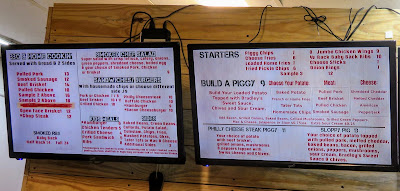
When we entered Bradley’s we encountered the first of several changes.  The website still states that this is a full service restaurant but now customers order at the counter.  Why the change is anyone’s guess but perhaps it’s because of Covid-19, the number of folks doing takeout, an attempt to hold costs down, or the difficulty in finding people to work…  Those order boards now serve as the menu.

While we waited for someone to take our order, I snapped this photo of the dining room.  The restaurant has been reconfigured and we recalled that even the entrance had been relocated. 

We weren’t happy that we had to wait quite a while to place our order…despite the fact that there weren’t any other customers in the restaurant.  The cashier/counter attendant was tied up on the phone with a continuously changing take out or catering order.  She could have put the customer on hold or alternatively, she could have had whomever was in the office, come out to help her serve us…

In any case, she did comp us for our beverages because of our wait.

Once we placed our orders, we grabbed a table and then I took this photo of Larry and Bev.  We’ve known them for many years now, having met them shortly after we moved to East Tennessee.

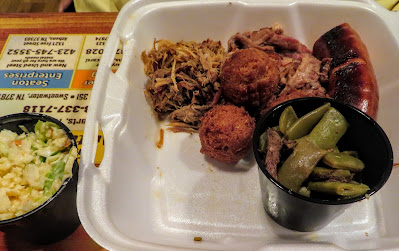
Larry order the “Sample 3” from the Order Board. ($18.00) He chose the smoked sausage, brisket and pulled pork with green beans and coleslaw.  His choice of ‘bread’ were the hush puppies.  Larry is a BBQ maven in my mind and he declared that the smoked meats were pretty good and the hush puppies were excellent.

Bev decided to order the “Sample 2”. ($16.00) In her case, she went for the brisket and pulled pork.  She also picked the hush puppies with her sides being the coleslaw and ‘smothered’ French fries.  There was no charge for ‘smothering’ the fries… She was happy with her meal!

Laurie didn’t feel like BBQ so she ordered a Bacon Cheeseburger. ($10.00) She didn’t want the homemade potato chips that come with the burger and ordered potato salad instead. (+ 79 cents) She was very happy with her burger…it was grilled just right and was nice and moist.

As for yours truly, I ordered a Half Rack of Baby Back Ribs sided with a few of the homemade potato chips and coleslaw. ($14.00) My choice of bread was the Texas toast and I requested extra spicy BBQ sauce.  The ribs were meaty and moist with a nice flavor although I do prefer having to ‘work’ the meat from the ribs while the pork just peeled off the bone in this instance.  The sauce was pretty good…although not very ‘hot’, while the coleslaw and homemade potato chips were pretty average.

Did you notice anything else about service at this ‘full service’ restaurant?  No, we didn’t have to go up to the counter to pick up our orders and the counter gal also came around with beverage refills.  But Bradley’s needs to update their website… Full service restaurants not only have wait staff who take orders, but they don’t serve their meals in take-out containers with wrapped plastic ‘silverware’.  Just saying…writing it off to Covid-19 for the time being.

Bradley’s Pit Bar-B-Que is located at 517 New Highway 68 in Sweetwater Tennessee not far from US I-75.  Phone: 423-351-7190.  Their website is at https://bradleypitbbq.com/.

This is the bakery at Grain Bin Commodities.  After lunch, Larry checked out that KOA campground for a future RV rally, deeming in satisfactory for the event.  Then Laurie mentioned this relatively new entrepreneurial business, Grain Bin Commodities that opened at a dairy farm on a side road not too far from Sweetwater.  Laurie and I had been there together back in May and afterwards I’d posted about our visit.  Laurie has been back since then but Bev and Larry had never been there.  Larry liked the idea as he needed to find activities and places to visit for his future RV/KOA rally so off we went.

Since my last visit, among other improvements, this new pizza oven/pizza patio has been completed.  Using the top from an old silo as the roof covering the patio was very creative and quite eye-catching too.  Those paver stone walkways are new as well.

After Larry and Bev dropped us off back at our house, Laurie assembled the goodies that we’d ‘scored’ at Grain Bin Commodities.  I bought 3 bags of “Fire Crackers”, (saltines baked with cracked red peppers), 2 peanut butter and 2 oatmeal/sea salt cookies, a bag of caramel ‘crack’ and 2 new hot pads for the kitchen.  Those "Fire Crackers" are great with cheese!

Grain Bin Commodities is located at 5215 Holt Road near Sweetwater Tennessee.  Phone: 865-599-9001.  Their website can be found at https://www.grainbincommodities.com/. 

It was great seeing Bev and Larry again.  Larry, aka “Big Dude” is a fellow blogger too.  Check him out at http://bigdudesramblings.blogspot.com/.

Just click on any of the photos to enlarge them…

Thanks for stopping by for a visit!

Take Care, Big Daddy Dave

Tuesday, October 5, 2021

Small Town along the Way + More (6)

…continuing with our July road trip through Illinois, Missouri and Nebraska.  In this chapter, we find ourselves in north central Nebraska and moving west.

At least at this point in our journey, Johnstown Nebraska was the smallest town we’d visited.  I didn’t intend to stop but as I drove by, this scene down Main Street grabbed my attention.  If this isn’t small town America, I don’t know what is! 

Like most towns along US Hwy 20, the coming of the railroad caused Johnstown to be settled in 1883.  The town was named after the man who owned the site at the time…John Berry.  At its height in 1920, the village had a population of 290 residents.  Today, the estimate is 61.

A made for TV movie for the Hallmark Channel was filmed here in 1992.  Its name was “O Pioneers”, and it starred my well known Hollywood actors.  They included Jessica Lange, David Stratham, Anne Heche and Heather Graham.  It was all about the struggles of a Swedish family of immigrants around the beginning of the 20th century.

FYI, there is a place to grab a beverage and get something to eat in Johnstown.  We were too early to partake but I love the photos of the interior of the L Bow Room Saloon.  That’s the tan building by the American flag at the right of the photo.  You can check it out at   https://www.facebook.com/pages/category/Bar/L-Bow-Room-173171246945/.

This group of adjoining buildings actually are an ongoing business…a store…but definitely not your typical retail store!  Sandhills Sage specializes in re-purposed and up-cycled furniture and home dĂ©cor. (What?  How?  In a town of 61 people?  Heck, the whole county has less than 3,000 resident!)

They are all about rehabbing old pieces and making them work again.  The store is only open 4 times a year…spring, summer, fall and winter…and then just for a couple of weekends at a time.  The pieces are unique and the owner and her partners avoid sameness.  Consequently, the items on display are different every time people come to visit.  On those weekends when the store is open, Main Street in Johnstown is packed with vehicles and visitors!  To learn more about this unusual store as well as to view a range of photos, go to: https://www.facebook.com/Sandhills-Sage-125181087591106/.  

Along with the buildings, those wooden sidewalks and hitching posts were featured in that aforementioned Hallmark TV movie, “O Pioneers”.  The movie was based on a book of the same name written by Willa Cather.  Willa had spent her formative years in Nebraska and she became known for her novels of life on the Great Plains.  Other books included “The Song of the Lark” and “My Antonia”.  In 1923, Cather won the Pulitzer Prize for “One of Ours”, a novel set during World War I.

On to the city of Valentine in Cherry County Nebraska where we were staying overnight…  After checking in to our hotel, we were off again for a bit of local exploration.  Our first stop was a state fish hatchery but there wasn’t much to see…wrong time of the year…so we moved on. 

Our next stop was the Fort Niobrara National Wildlife Refuge.  Naturally, that didn’t start well either.  The Refuge office and visitor’s center was closed due to Covid-19 concerns.  So we had to wander off on our own and hope for the best… Bummer!

The Fort Niobrara National Wildlife Refuge is fairly expansive, covering 19,131 acres.  It borders the Niobrara National Scenic River on the west.  The river has eroded into the limestone, creating cliffs and a varied topography…unusual in what you can see in this photo is an otherwise featureless view of the Great Plains. 

From 1879 until 1906 the Fort Niobrara Military Reservation occupied this land and housed a garrison of the U.S. Cavalry.  Fort Niobrara was constructed after the Great Sioux War of1876.  It was part of a military strategy to surround and contain the bands of Lakota people on their reservation lands.  The garrison’s specific mission was to oversee Chief Spotted Tail’s band of about 8,000 Brule Lakota at the nearby Rosebud Agency.  When the garrison was disbanded, an effort was initiated to preserve the former military reservation as a wildlife refuge.  That effort resulted in the creation of the refuge in 1912.

The website for the Fort Niobrara National Wildlife Refuge can be found at Home - Fort Niobrara - U.S. Fish and Wildlife Service (fws.gov).

When we came to this narrow bridge over the Niobrara River, we realized that somehow we must have taken the wrong turn on one of the roads winding through the wildlife refuge.  Consequently, we didn’t see any of the numerous species of wildlife that are reputed to live here.  We didn’t see any Buffalo or any of the elk (wapiti) that allegedly roam the area…

As it turned out, this is the Berry State Aid Bridge.  This historic Pratt through truss bridge is listed on the National Register of Historic Places.  Less than a month before we drove across this bridge, it had celebrated its 100th birthday.

We stopped on the bridge to take a photo of a number of folks tubing down the Niobrara River.  The river, called the “Ni Ubthatha khe” by the Omaha-Ponca Native Americans, literally means “water spread-out horizontal-the” or “The Wide-Spreading Water”.  It is a tributary of the Missouri River and I was impressed to learn that this stream stretches for about 568 miles.

There are several campgrounds along the river that provide opportunities for tubers… In addition, Smith Falls State Park is located just a bit further east.  It features a 63 foot tall waterfall, which is the highest waterfall in the state of Nebraska.  The park offers picnicking facilities, hiking, tent camping, canoeing and fishing and it is very popular in the summer months.  Website: Smith Falls State Park - Nebraska Game and ParksNebraska Game and Parks | (outdoornebraska.gov).

Once we crossed the Niobrara River via the Berry Bridge, we drove along back roads until we came to NE Hwy 12, which is called the “Outlaw Trail Scenic Byway”.  Website: Nebraska Outlaw Trail Scenic Byway Hwy 12

We headed west on NE Hwy 12 toward Valentine but we had to stop suddenly when Laurie spotted this herd of buffalo north of the highway.  She took a few photos but they weren’t close to the road.  Apparently they were someone’s private herd as the Fort Niobrara National Wildlife Refuge is located south of the Outlaw Scenic Byway.  At least we saw some buffalo!


As a scenic highway it was only natural that there was a scenic overlook along the way.  These impressiveviews from the bluffs just south off of NE Hwy 72 overlook the Niobrara River valley.  It should be noted that a 76-mile stretch of the river, stretching from the town of Valentine east to NE Hwy 137, has been designated as the Niobrara National Scenic River.

For some great photos of this National Scenic River, just go to niobrara national scenic riverway - Bing images.


But wait!!  All is not lost!  This is proof that the Niobrara National Wildlife Refuge is the home to buffalo!  These are genuine buffalo patties so apparently they wander around the scenic overlook from time to time.  Then Laurie took the photo of the wildflowers to offset the buffalo ‘sign’ that we’d just spotted.

Buffalo can jump almost 6 feet vertically and they can run between 35 and 40 miles an hour if agitated.  They are difficult to confine as they can easily escape of destroy most fencing systems.  About 500,000 buffalo, aka bison, currently exist on private lands and another 30,000 are located on environmental and government lands.  Roughly 15,000 bison are considered wild…free-range not primarily confined by fencing. 

Before 1800, it is estimated that there were 60,000,000 buffalo in North America.  By 1830, due to hunting, that number had declined to 40,000,000 and my 1900 there were only 300 left in the USA.


We needed gas and I’d learned that South Dakota was just about 12 miles north of Valentine Nebraska.  I’d also noted that the price of gas just over the state line at the Rosebud Casino was significantly lower than in Nebraska.  Plus, the extra drive gave me an excuse to ‘touch’ yet another state on our trip.  FYI, the price of gas at the casino as of 10/4/21 is $2.82 per gallon for regular gas. 

The Rosebud Casino, which is located on US Hwy 83, also features a convenience store with the gas station.  The casino is located on the Rosebud Indian Reservation.  It is the home of the Upper Brule Sioux Nation and the Rosebud Sioux Tribe…a branch of the Lakota people.  The reservation used to be much larger before encroachments by white settlers and ranchers.  Today it covers 1,970,362 acres of mostly arid land.  To learn more about the reservation and the Native Americans that live there, just go to Rosebud Indian Reservation - Wikipedia.

FYI…While I do like playing the slot machines, doing so would have defeated the drive north for cheaper gas, so we gassed up and headed back to Valentine for dinner and our hotel.  For more information about the casino, go to Rosebud Casino.

Just click on any of the photos to enlarge them…

Thanks for stopping by for a visit!

Take Care, Big Daddy Dave

Friday, October 1, 2021

Early Fall in East Tennessee – Flowers and ‘Locals’

 I decided to take another short break from my ongoing recap of our July road trip to visit our family and explore parts of western Nebraska.  This time, it’s all about the end of summer, early fall and the nature around us.

As the summer wound down, I spotted this praying mantis on one of the loropetalum bushes by our front porch.  I hadn’t seen one of these interesting critters in quite a while.

Actually Mantises are an order of insects that includes over 2,400 species.  They are found worldwide in temperate and tropical habitats.  Their upright posture, while maintaining stationary with forearms folded, has led to their common appellation, praying mantis.  Females sometimes practice sexual cannibalism, eating the male after mating.  FYI, mantises are one of the insects most commonly kept as pets.


One of our local honeybees took advantage of the last bloom on one of our bee balm plants… The bee balm is actually a member of the mint family.  This genus of plants is endemic to North America.  Bee balm is also commonly referred to as bergamot, horsemint and Oswego tea.

The planters by the entrance to our home have contained a variety of flowering plants…but there is no doubt that the bees love the begonia blossoms.  The begonias are still blooming and the honey bees are still stopping by...

On a late summer day Laurie spotted this Common Five Line skink lounging in our yard.  He’s quite handsome, don’t you think? 

This lizard is probably the most common lizard in Tennessee.  They measure from about 5 inches up to 8.5 inches long and their color pattern widely varies.  Generally, the body is brown or black with 5 white or yellowish stripes extending onto the tail.  Adult males are brown or olive with faint stripes while an adult female is typically brown with faded stripes and a gray or blue-gray tail.  Juveniles have a bright blue tail and distinct stripes.  Skinks love to eat spiders, termites and beetles along with a variety of other insects.

I doubt anyone needs an introduction to this gold finch.  Males are bright yellow and an olive color in the winter.  Females are a dull yellow-brown shade…just slightly brighter in the summer. 

In any case, there is no doubt that our finch visitors love our purple cone flowers.  When these flowers first bloom they draw the honeybees and butterflies.  When they’re done flowering, they become a big buffet for the local finch population as they seem to love the plant’s seeds.

Coneflowers are a member of the Daisy family.  They are native to the eastern USA ranging from Iowa and Ohio south to Louisiana and Georgia.  They are a perennial…as they are self-seeding.  They’ve popped up every year since Laurie first planted them in our yard.  We’ve noticed a few springing up along the edge of the nearby wooded area too…


Even the herbs that Laurie has planted in pots on our deck are contributing to early fall color…even if the blooms are small.  Those little blue and purple flowers are from her rosemary plants.  The thyme plantings produced those white blossoms.  I know that rosemary is a really a shrub but I think that those colorful yet tiny blossoms resemble orchid blooms…

Laurie captured this picture of one of our Ruby Throated Hummingbirds at one of our feeders.  She looks like she’s just ‘chillin’ or perhaps she’s stoned…or taking a nap.  We’ve never seen this degree of relaxation from a hummingbird!  Laurie had time to spot her, go get the camera and take this photo.  The hummingbird is probably resting up for her flight across the Gulf of Mexico, a 500 mile trip that takes 18 to 20 hours under favorable conditions.  They have to double their weight to make the trip…

Stay Away!  This is my suet cake!  I’m not sharing and that’s why I’m staying here and guarding it… This brown thrasher sat on this suet feeder, pecking away on its contents, for days on end.  Nothing scared him off except for when the big woodpeckers made a hard landing on the seed and fruit feeder just above him.  We could perform minor tasks on the deck and he would just watch us…not leaving unless he absolutely had to!

The brown thrasher is in the same family as catbirds and mockingbirds.  They are the state bird of Georgia.  This bird is noted for having over 1,000 song types, the largest song repertoire of birds.  These are very territorial birds, especially when defending their nests and they will attack humans to chase them away… The brown thrasher is omnivorous.  Its diet includes insects, berries, nuts, seeds, earthworms, snails and even sometimes lizards and frogs.


As I’ve mentioned in past posts on my blog site, our neighborhood is rapidly being built up with new homes everywhere and wooded lots disappearing almost overnight.  We still have a decent strip of woods across street from us although homes are being built on the other side of that little wooded area.  One lot next to us is also still covered with trees and undergrowth.

We did have some visitors recently.  We hadn’t seen too many deer in our immediate area is recent weeks so we were very happy to see this doe and her twins browsing along the side of the street.


The same absence has been noted as regards our flock of turkey.  We’ve seen little of them in recent months but suddenly they’ve returned, grazing in our yard and along the ditch across the street.  They are really big birds!

So what brought the white tail deer and the turkey back? Perhaps they know hunting season is approaching and staying in our village area is safer as no hunting is permitted.  More likely, they’re just looking for some variety in their diets as cold weather approaches. 

This burst of late season purplish-pink flowers has really popped this fall.  These light and airy blooms are Japanese Anemones.  These plants are a late flowering perennial.  Many varieties are available with colors that are pink, white and cream…  Once these plants are established, they are easy to grow and maintenance free.  Originally from China, Japanese Anemones have been cultivated in Japan for hundreds of years.

These plants are considered as invasive in some places and situations.  They not only spread via seeds but also through underground runners or rhizomes… They can take over an area if the conditions are right but if contained they are an enchanting windblown flower in the garden.


Here we have the juxtaposition of black-eyed Susans almost hidden in the background behind one of our azalea bushes.  Black-eyed Susans are native to North America and they are very popular.  They are a member of the aster family and they bloom from June to October.  They are named for the dark, brownish purple centers of their daisy-like flower heads.  Butterflies and bees love them!  However, it should be noted that black-eyed Susans tend to crowd out other flowers and plants growing near them.  

Azaleas are flowering shrubs that are included in the genus Rhododendron.  Traditionally, these shrubs bloom in May and June with their flowers lasting several weeks.  However, about 20 years ago, the azalea industry was upended with the introduction of a fall or repeat blooming variety.  They are labeled as the “Encore” azaleas… Plant enthusiasts have bred and cross-bred azaleas for hundreds of years resulting in over 10,000 cultivars or varieties.

I found it interesting that both azaleas and rhododendrons were once infamous for their poisonous qualities.  It used to be a well-known death threat if a bouquet of these flowers in a black vase were delivered to someone.  These plants contain a substance called andromedotoxins in both their leaves and nectar.  This includes the honey made from the nectar.  In some parts of Turkey and Nepal, this mind-altering and occasionally lethal “mad honey” is frequently produced and used as both a recreational drug and as a traditional medicine.

Just click on any of the photos to enlarge them…

Thanks for stopping by for a visit!

Take Care, Big Daddy Dave