Thursday, December 19, 2013

West Edmonton Mall – Alberta Canada

I must be honest… I spent more than 38 years in retailing and retailing related businesses.  I don’t like to shop and I really don’t like wandering through stores or shopping centers.  From time to time, I still have bad dreams about folding sweaters in stores at Christmastime.  This was due in part, to my ‘volunteer’ work as a corporate type ‘helping’ our stores during the Holiday Season.   I’m sure that the stores would have rather we all stayed in the corporate offices!

In any case, we were in Edmonton Alberta Canada and it is the home of the first big mega-mall in the world.  Given all of its non-retail store attractions, Laurie and I had to check it out…

Driving by one end of the West Edmonton Mall just doesn’t provide the passerby with a clue as to the size and complexity of the place!  We were about to wear out our feet and really work up an appetite for dinner…

The West Edmonton Mall is the largest shopping mall in North America and the tenth largest in the world.  The mall was founded by Iranian brothers who had immigrated to Canada from Iran in 1959.  This was the world's largest mall until 2004.  The Mall covers an area of about 5,300,000 square feet.  There are over 800 stores and services as well as parking for more than 20,000 vehicles.  The mall, its stores and services, employ more than 24,000 people!  Visitors total roughly 32,200,000 per year with between 90,000 and 200,000 guests each day! 
As big as it is, if one measures malls by gross leasable space, with 3,777,000 square feet available, the West Edmonton Mall is only the 13th largest in the world.  By way of comparison, the Mall of America in Minneapolis, (largest US mall), ranks 19th with 2,780,000 square feet.  The largest shopping mall in the world is the New South China Mall with 7,100,000 square feet of leasing space!

This being Canada, one major attraction in West Edmonton Mall is the Ice Palace!  Ice Palace is a scaled down version of a National Hockey League regulation sized ice rink located in the center of the mall.  When the mall first opened in 1981, the NHL’s Edmonton Oilers occasionally practiced here.  As you can imagine, when Wayne Gretzky and the team were practicing here, huge crowds showed up to watch.  The Oilers' contract for using the rink expired and now the rink is used for various hockey and other sporting tournaments as well as for skating by the Mall’s many visitors.

This is the entrance to West Edmonton’s “Bourbon Street”.   This theme related ‘street’ is set up so that it can be closed off from the rest of the mall, allowing for late night operations by its tenants and for any special events that might be scheduled.  The ‘Street’ features clubs and restaurants in a New Orleans-influenced setting.   The lighting in this area is left intentionally darker than other parts of the mall to simulate a nighttime atmosphere.
From upscale dining to casual eateries and nightlife venues, Bourbon Street offers a broad spectrum of food and entertainment for Mall visitors.  Establishments include: Boston Pizza; Earls; Hooters; Hudsons Canadian Tap House; Jungle Jim's Eatery; Marble Slab Creamery; Moxie's Grill and Bar; Mr.  Mikes Steakhouse and Bar; The Old Spaghetti Factory; Oranj Sushi Bar; Rick Bronson's The Comic Strip; Sherlock Holmes; The Red Piano Bistro and Dueling Piano Bar, and; Tony Roma's Restaurant and Lounge. 

This is West Edmonton Mall’s World Waterpark.  This is one photo that gives you an idea just how big this mall is! 
The World Waterpark was built in 1985.  It’s the world's second largest indoor waterpark, covering almost 5 acres!  The Waterpark has the world's largest indoor wave pool.  There are 14 water slides in the park, including the Twister, the Skyscreamer, Skyscreamer Extreme and Cyclone, with the latter being 83 feet high.  The wave pool has six wave bays, each of them generating waves up to two 6 ½ feet high.  You can also bungee jump and zip line directly over the wave pool.

This is another view of World Waterpark at the Mall… There were people lounging on the ‘beach’, tubing, zip lining above us, enjoying refreshments and using the water slides. 
FYI… Riders using the Cyclone Water Slide experience a “near vertical loop” and speeds of about 37 miles per hour. “Sliders step into a glass capsule and after an automated voice counts down from three, the floor drops out from beneath them, sending them on their journey!”

There was always a crowd waiting about mid-pool for the next artificial wave to hit them!  Keep in mind, this good size crowd was visiting during mid-summer.  It must really get crowded on the weekends in Edmonton’s extreme winters…


This is a map of West Edmonton Mall’s World Water Park.  If you enlarge it you can see the detail…to include those 14 water slides.  The place and the action was a bit mind boggling, while at the same time, quite fascinating to watch! 

This particular attraction is called Deep Sea Adventure.  It comes complete with the ‘Santa Maria’, an exact replica of Christopher Columbus' flagship for his first voyage across the Atlantic Ocean in 1492!    There is also the ‘Deep-Sea Derby’, a bumper boat ride with squirt guns.  
Deep Sea Adventure is also home to the mall's aquatic life, most of which are housed beneath the main floor in the "Sea Life Caverns".   The underground aquarium is home to more than 100 species of fish, sharks, sea turtles, penguins, reptiles, amphibians and invertebrates.  In addition, Sea Lions' Rock is home to four California sea lions that perform daily.

This is Professor WEM's Adventure Golf, an 18-hole miniature golf course.  The miniature golf course was originally known as Pebble Beach Mini Golf, and it was designed to be a mini golf version of Pebble Beach Golf Links.  The course was refurbished and given the Professor WEM theme in the mid-1990s.  As West Edmonton Mall continues to update and refresh its attractions, a new ‘black light’ miniature golf course is planned to open this fall.   

This is a map of Galaxyland, West Edmonton Mall’s indoor amusement park.  I’ve started this segment out with a map because it is quite literally impossible to take a picture of Galaxyland that demonstrates the scope of this attraction.
Galaxyland was originally known as "Fantasyland”.  However, as one might expect, after a court battle with Disney, the Mall changed the park's name to Galaxyland.   The Park features 24 rides and attractions.  Galaxyland is the second-largest indoor amusement park in the world.  Only Ferrari World at Abu Dhabi in the United Arab Emirates on the Persian Gulf is larger.
If you’re interested or just curious and you’d like to see what our oil money can buy, you can check out Ferrari World and it’s multitude of luxury attractions at http://www.ferrariworldabudhabi.com/.

As I mentioned above, Galaxyland is so complex and packed with rides and attractions, it’s almost impossible to take meaningful photos…  This photo shows the tangled web of roller coasters in one section of this indoor amusement park.  A couple of the larger roller coasters stretch over most of Galaxyland!
To check out all of the rides at Galaxyland, you can go to either Wikipedia at http://en.wikipedia.org/wiki/Galaxyland or the West Edmonton Mall’s site at http://www.wem.ca/media/43315/gld-ride-information.pdf.

This is another photo of the massive maze of roller coaster track at Galaxyland.  Sadly, there was a major incident with fatalities on one of these coasters…
The Mindbender is the world's largest indoor triple loop roller coaster.  In June 1986, after the one of the ‘trains’ completed the second inverted loop it encountered one of three areas of uplift before the third and final loop.  Missing bolts on the left inside wheel assembly of the last car of the four car train caused the bogey assembly to disengage the track with a full load of riders.  This caused the final car to fishtail wildly.  The passenger’s lap bars disengaged as the car collided with support structures.  Passengers were thrown off.  Then train entered the third and final inverted loop, but it didn’t have the speed necessary to complete the loop.  It stalled at the top, it slid backwards and crashing into a concrete pillar. Three people were killed in this accident and another was seriously injured.

Here is one more photo of a ride at Galaxyland in the West Edmonton Mall.  One of the rides impossible to photograph at this amusement park is called ‘The Space Shot’.   It is a 12 person ride that launches passengers nearly 120 feet skyward and then thrusts them back to earth.   Some of the advanced ‘adult rides’ have names such as Swing of the Century and Cosmos Space Derby.  The Swing of the Century is an adult swing set that moves in a circular, swinging motion.  The Space Derby involves 2-seated bumper cars built for adults!
Note: Galaxyland was even busier than World Waterpark! 
The idea of shopping or visiting the West Edmonton Mall during the Christmas Holidays gives me the shakes, but I’m sure that this is a major Holiday destination for many families!  On-line shopping has become my preference when buying gifts for family and friends… But for the rest of you…to learn more about the West Edmonton Mall and all that it has to offer just go to http://www.wem.ca/.   You should know that I didn't even mention many of the other attractions at this shopping/tourist mecca!
Just click on any of the photos to enlarge them…
Thanks for stopping by and walking through this massive shopping mall with Laurie and I!
Take Care, Big Daddy Dave 

Tuesday, December 17, 2013

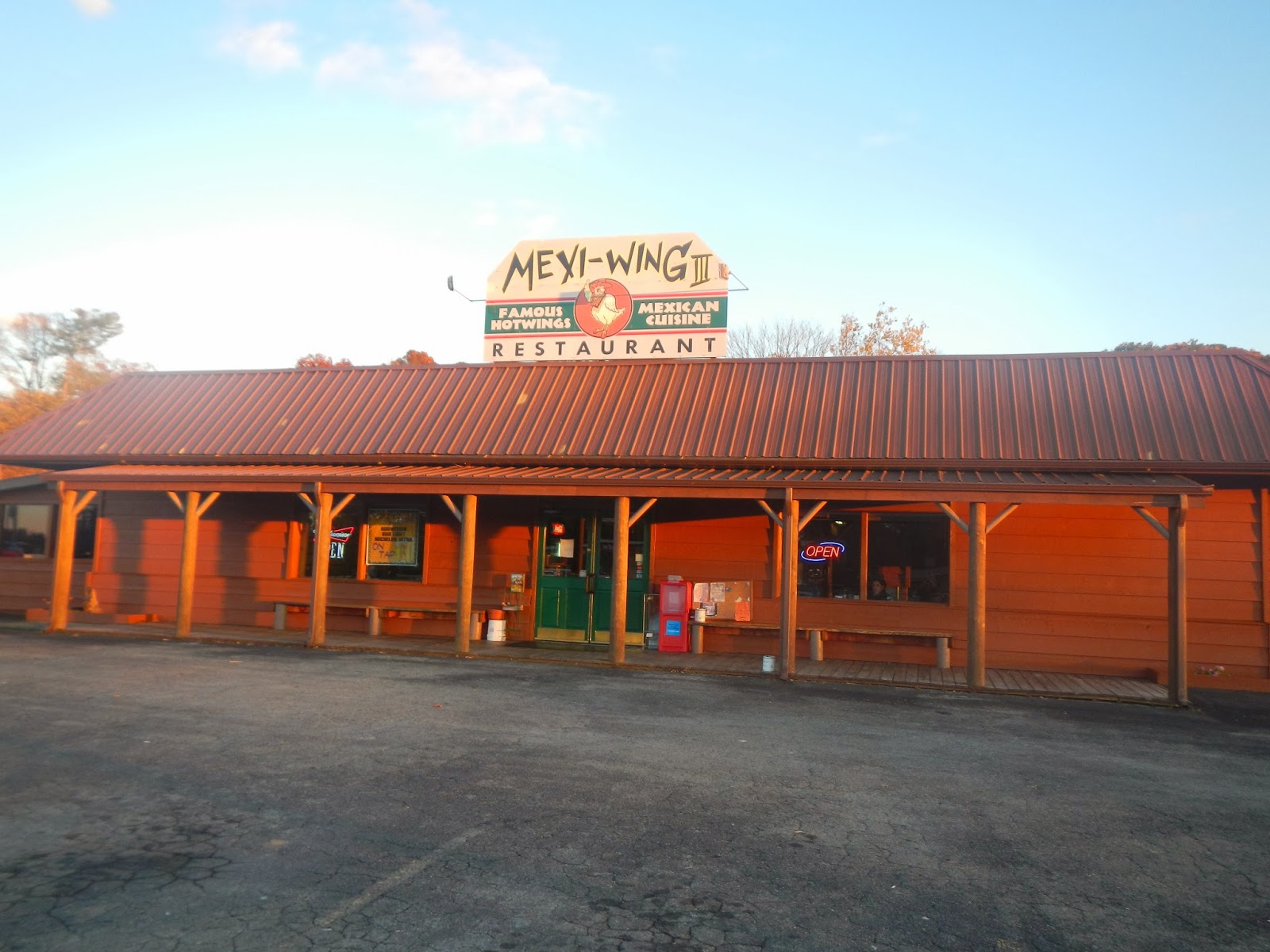
Chicken Wings Plus…in a Mexican Restaurant

As Laurie and I have cruised through parts of Eastern Tennessee, we have repeatedly noted but in 4 + years have never visited a chain of Mexican restaurants that are scattered across the area.  So…today was the day to give one of them a try!


This is Mexi-Wing II, which is located in Madisonville Tennessee.  A search of the Internet revealed Mexi-Wing restaurants numbered up to VII.  I couldn’t locate any corporate office or headquarters location… In any case, I could find 6 of the 7 numbered locations.  In addition to this restaurant in Madisonville, I found Mexi-Wing restaurants in Cleveland, Chattanooga, Athens, Sweetwater and Etowah Tennessee.

This is a photo of the interior of the Madisonville Mexi-Wing location. It was clean if a bit dark.  Customers were few and far between on this weeknight…

As usual with most Mexican Restaurants, our waitress started us out with warm tortilla chips and salsa.  I thought the salsa was good but a bit mild.  Laurie thought that it was just right… I asked if they had a hotter salsa, but the waitress said that this was their only version.  When we ran out of chips, our waitress brought more to the table without being asked.

Hey…if a restaurant is called Mexi-Wings, there must be a reason!  We ordered 10 Hot Wings. ($6.99) They were perfect!  Spicy, crispy and meaty… These wings were as good as any we’ve eaten in the past few years.
How do you like your wings?  At Mexi-Wings you can order them mild, medium, hot, XHOT, super-hot, BBQ, BBQ hot, Teriyaki, lemon pepper, nuclear sauce or Thai chili sauce.  You can choose to accompany them with Ranch or Bleu Cheese dressing for dipping.  We asked for both…  

For my dinner, I ordered the Grilled Steak Chimichanga. ($8.75)  This is a stuffed flour tortilla with slices of grilled steak, deep fried to a golden brown, topped off with cheese sauce and accompanied with lettuce, sour cream, guacamole and pico de galo.  The sides were the omnipresent rice and refried beans. 
I’m not into guacamole so I asked for it on the side as Laurie really does enjoy it.  The Grilled Steak Chimichanga was very good…with lots of grilled steak inside.  Unlike many versions I’ve had before, you could actually taste the steak with every bite.  The sides were OK too…
Once I got home and looked at the menu more thoroughly, I noticed the very reasonably priced dessert menu.  Items included: Flan ($2.99); Fried Ice Cream ($2.99); Sopapillas ($1.99); Sopapillas with Ice Cream ($3.99) and; a Banana Burrito ($3.50).  I was lucky not to have noticed this portion of the menu!

For her entrée, Laurie chose her favorite…a shredded chicken Quesadilla with cheese accompanied by lettuce, guacamole and sour cream. ($7.50) She thought that her quesadilla was very good.
The menu was extensive…with an “American section” in addition to the many Mexican choices.  There are also a number of Lunch Specials, Mexican Combinations, Vegetarian Combos and Appetizers.  We will return!  While we can duplicate the quality of the Mexican entrees at other Mexican restaurants within a 20 mile radius of our home, the wings alone make Mexi-Wings Restaurants a must stop on our casual dining list!
The Madisonville Tennessee Mexi-Wings is located at 4027 US Highway 411.  Phone: 423-442-2544.  To view the menu, just click on this link: http://www.monroecountychamber.org/new/pages/members_dining/mexiwingsIII.pdf
Just click on any of the photos to enlarge them…
Thanks for stopping by for a visit!
Take Care, Big Daddy Dave

Sunday, December 15, 2013

Fort Edmonton Park (#1) - Alberta Canada

As I previously mentioned, Canada does a great job in structuring and presenting its history through its historical parks.  This blog is the first of three which will take you on our tour of Edmonton Alberta’s Fort Edmonton Park. 

One of Edmonton's top attractions, the Park represents four distinct time periods: 1) Explore Edmonton's development from a 1846 fur trading post in the vast Northwest; 2) Then the settlement  Era…an 1885 street; 3) Next the municipal era…a 1905 street, and; 4) Finally, the metropolitan Era…a 1920 street and midway. 

The park features over 75 structures many of which are original.  Costumed interpreters operate everything on site and they ‘live’ in their particular era.  Trip Advisor’s contributors rank Fort Edmonton #3 among area attractions.  Only the Edmonton Symphony and its home venue rank higher.  At the time I was writing this blog, Trip Advisor had recorded 288 Excellent or Very Good reviews vs. only 11 Poor or Terrible reviews. (I think that a 26:1 positive ratio is very positive!) To view Trip Advisor’s reviews regarding Fort Edmonton, just go to http://www.tripadvisor.com/Attraction_Review-g154914-d155546-Reviews-Fort_Edmonton_Park-Edmonton_Alberta.html.


Free steam engine train rides take you from the park’s entrance to the 1846 Fort and Trading Post.  We rode the train twice…as our memory stick for our camera ran out shortly after we arrived…and we had to leave the park to purchase a replacement.

The Edmonton, Yukon and Pacific was named after the first railway built in Edmonton.  The EY and P Railroad operated passenger trains until 1926 and finally ceased all operations in 1951.  The Fort Edmonton Park ride is 2.5 miles long.  The train arrived in Edmonton in 1977 and began service in 1978.

Locomotive 107 is a prairie type (2-6-2) locomotive built in 1919 by the Baldwin Locomotive Works at Philadelphia, Pennsylvania. For fifty years it worked at the Industrial Lumber Company in Oakdale Louisiana until it was abandoned.  The locomotive was completely rebuilt.  Originally designed to burn wood it now burns oil to heat the boilers.  For much more on prairie type locomotives go to http://www.american-rails.com/prairie-type.html.

Locomotive #107 and the coach cars received a new paint job and lettering in fall of 2005.  The train was then used in the Brad Pitt movie, ‘The Assassination of Jesse James’, some of which was filmed at Fort Edmonton Park.

This is a view of the 1920’s Midway as viewed from the train.  A recreation of this 1920's midway opened in 2006 at the end of 1920 Street, near the park's entrance.  Various games of skill may be found on the midway and a carousel featuring hand-carved horses is housed inside a permanent pavilion.  The Fort Edmonton Foundation recently expanded the Midway and Exhibition area to include an Exhibits Building and other rides such as the Ferris Wheel.


This is the first stop in your progressive tour of Fort Edmonton.  This is the Hudson's Bay Company fort, which represents the fur trade era.  This is not the original.  It was built using a 'scaled-down plan' diagram drawn by British Lieutenant Mervin Vavasour, who had visited the original fort in the mid-1840s.  Other accounts, such as the journals of the fort's denizens, or the artwork of Paul Kane, were used to verify and complete the structure and the buildings within. 

A small Cree encampment is just outside the fort's palisade.  It serves as a representation of the First Nations/Native Americans, whose trade in furs and provisions was vital to the fort's and the Hudson Bay Company’s operation.

For information regarding Paul Kane and his artwork, go to http://en.wikipedia.org/wiki/Paul_Kane


This is a photo of the living quarters inside one of the buildings within the fort.  In the early days, residents of these trading posts were mostly men.  Living out on the western frontier of Canada meant isolation, danger and severe weather conditions. 


This imposing building was the residence of John Rowand and his family.  In its day, this massive structure was one of the largest houses in present-day western Canada.  The house has four levels, the lower one for servants, the second one for dining and business, the third for the family and guest rooms, and a garret or attic for storage.

Beginning in 1823, John Rowand was the ‘Chief Factor’ at Fort Edmonton.  As such, he was answerable only to the Governor or Hudson Bay Company’s Managing Committee in London England.  Rowand oversaw the moving of the fort from a floodplain to higher ground following floods in the 1820s.  On this new site, (now home to the Alberta Legislature Building), he had his massive house constructed in the fort's courtyard.  The house was known as "Rowand's Folly" for its extravagance… It is reputed to have been the first house to have glass windows in western Canada. 


This is the stable for the Trading Post’s horses.  They obviously don’t keep any horses inside the Hudson Bay Fort itself, but we liked its look with the rough wood plus the grass and small trees growing on the roof.

The trading post contains many structures and operations of interest other than the Rowand house.  Among others there is the trade store, Columbia house, the watchtower, meat store, Rundle house/chapel, clerk’s quarters, tradesmen’s quarters and a windmill.


This is one of the bedrooms in the family/guest quarters on the third floor of the Rowand house. 

John Rowand’s personal history is quite interesting. In 1810 Rowand suffered a broken leg from a riding accident.  He was rescued by Louise (Lisette) Umfreville, a Metis (mixed blood) woman who nursed him back to health.  Subsequently, John Rowand engaged Louise in a “country marriage”, and received a herd of horses as a dowry.  According to some stories, Rowand also adopted several of Louise's children by another man and they had at least five children of their own.  They lived together for more than 30 years but they didn’t seem to have felt any need for an actual marriage.  Rowand described Louise as "my old friend the mother of all my children" and remain connected with her until her death in 1849. 

For more about John Rowand, go to http://en.wikipedia.org/wiki/John_Rowand.


This is one of the storerooms at the Hudson Bay Trading Post.  Everything had to be shipped in overland using trails and any navigable waterways.  The post or fort was positioned on one of the best means of transportation across Canada at the time…the North Saskatchewan River.  In the early years of John Rowand's administration, overland routes to northern posts such as Fort Assiniboine were established, and Fort Edmonton became a central hub of trade in western Canada.


This is the inside of the trading post itself...complete with a appropriately costumed docent.  Furs of all the different animals that were trading are on display as are the items sought by Native American/First Nations people as well as Metis and other trappers.  One might ask...just how big was the business in pelts and furs…?

At one time, the fur trade was one of the main economic ventures in North America, attracting competition among the French, British, Dutch, Spanish, and Russians. As part of the early history of the United States, capitalizing on this trade and removing the British stranglehold over it, was seen as a major economic objective.  Many Native American societies across the continent came to depend on the fur trade as their primary source of income.  

However, by the mid-1800's changing fashions in Europe brought about a collapse in fur prices and many Native communities were plunged into long-term poverty.  To gain a better appreciation of the size of this business, go to this site to view a list of the hundreds of Hudson Bay Trading Posts that existed at one time or another. (http://en.wikipedia.org/wiki/List_of_Hudson%27s_Bay_Company_trading_posts)

In addition to the train and streetcar system, other forms of transportation are also available at Fort Edmonton Park.  This stagecoach looked terrific as it rolled along a dirt road on the other side of this garden plot.


Here’s another horse drawn conveyance for visitors.  Laurie got to see lots of horses in the park…and she loves horses!  The horse drawn modes of transportation do require a small fee and they are not included in the price of admission to the park.


This is the original building for the Edmonton Bulletin Newspaper which was built in 1878.  The Edmonton Bulletin was a newspaper in Edmonton, Alberta that was published from 1880 until January 20, 1951.  It was founded by a politician and future minister in the Canadian Government and by the city’s first telegraph operator.  It was the city’s undisputed leading newspaper until the Edmonton Journal was founded in 1903.


This is the interior of the Edmonton Bulletin Newspaper building.  I must admit that it brought back many memories for me.  My maternal grandfather had a rubber stamp and printing business, (Weed Rubber Stamps), in Jackson Michigan for many years.  My uncle John ran it for a time after my grandfather died.  I have memories of setting type for both my grandfather and my uncle…a tedious job indeed! Except as a novelty, rubber stamp manufacturing and typesetting are definitely jobs of the past…


The Ross Brothers Hardware Store is a reconstruction of a building originally built in 1884.  The main part of the store housed the store itself, while the rear contained a tinsmithing shop.  A small warehouse addition was added a bit later.  The store was opened by James “Charlie” Ross and his brother Frederick.  The two had traveled to Edmonton from Toronto via Winnipeg. 

The brothers both had a varied work history that included some experience in tinsmithing.  James worked as a firefighter and a carpenter after moving to Edmonton and eventually served four terms as an alderman.  Frederick was said to have been the more entrepreneurial of the two and he eventually became the president of their company.

In late 1888 or 89 the second floor of the original store was converted to a public hall, at which vaudeville shows, plays and balls were held.  The Ross Brothers Hardware building was eventually demolished in 1911.


I just love the detailed organization and presentation of the tools and fixtures shown in this photo.  Understand, I can barely tell a wrench from pliers…and tools themselves are foreign items to me…but I do like old shelves and drawers made out of wood and I appreciate a well-organized operation!

The Ross brothers sold their hardware business in 1912.  In addition to serving as an Alderman in Edmonton, James went on to become director of the Western Canadian Vinegar Company and Vice President of the Alberta Milling Company.

Two relatively small buildings comprise the ‘Secord Complex’.  They are both reconstructions of those built in 1887.  The building’s main operations revolved around the fur trade. The complex of buildings had a store in the front and a back warehouse used to store the furs.

Richard Secord was born in Brant, Ontario on July 19, 1860.  He came to Edmonton by way of Chicago and Winnipeg, arriving September 1, 1881.  Richard helped build the first public school in Edmonton and he taught school in town for 4 years before entering the business world.  He started his own fur-trading business in 1888, and sold it to the Hudson's Bay Company in 1890.


Ever want to work for the Hudson's Bay Company?  This fur press at the Secord Complex would have been used to press/compact a  5 foot tall stack of furs that would weigh in at around 90 lbs.  If you could carry two of these stacks you would qualify for the job with Hudson's Bay!  To watch a more primitive fur press in action, go to http://www.youtube.com/watch?v=p68cYogcQfg.


This is a reconstruction of Lauder's Bake Shop and home.  It’s adjacent to a reconstruction of the Lauder’s Bakery.  The bakery was opened in 1885 and Lauder had a contract to provide bread to the Northwest Mounted Police in Fort Saskatchewan.  The original home was also built in 1885 with the lean-to style addition built to serve as the bake shop.


This is an interior photo of the Lauder home…with a mix of Victorian and Mission style furnishings.

The Lauder family has a long history in Edmonton.  Mount Griesbach (8,800 feet) was named after William Antrobus Griesbach.  He was 28 years old when he was elected mayor of Edmonton…still the youngest Edmonton Mayor ever elected.

What’s the connection with Lauder’s Bakery?  In January of 1906, William married Janet Scott McDonald Lauder, daughter of James Lauder, who had started Edmonton's first bakery.  He went on to become a Brigadier-General in WWI when he was just 39 years old.  After the war, William was promoted to Major-General.  Subsequently, he was elected as a Member of Parliament and in 1921, he was appointed to the Canadian Senate - a post he held until his death of a heart attack on January 21st, 1945. (Behind every good man is a good woman!)


This is Daly's drug store and Dr. Wilson’s office.  This is a reconstruction of the building originally built in 1882.  The original building housed Edmonton's first drugstore.  The doctor's office occupied the rear part of the building…  The building now serves as a gift shop where one can purchase old-fashioned hard candies, soaps, shaving mugs, wooden handled scrub brushes, pitcher and basin sets, and Watkins products.

Regarding Dr. Wilson…he studied medicine and moved to Edmonton in 1882.  He was appointed to official medical positions and for several years, owned the drugstore.  Dr. Wilson served as a consultant to First Nations/Native American reserves near Edmonton. He also became a director of many local corporations. He was elected to the Territorial council in 1885, and soon became its speaker. He maintained a medical practice in town for many years.  Dr. Wilson eventually ran for mayor and he was elected in 1885.


This is a photo inside Daly’s Drug Store/Pharmacy.  I’ve always loved the look of the old 1800's pharmacies.  Most of them have beautiful wood cabinets full of labeled bottles…lots to look at and imagine!

P.E. Daly was born in Neenah, Wisconsin in 1860.   His father was Canadian and he lived in Ontario for many years.  He came to Edmonton in 1886 and bought out Dr. Wilson’s drug business.  He continued the business until 1891 together.  Mr. Daly also established a private bank, he was chairman of the Board of Works of Edmonton and he was a member of the council of the Board of Trade.

One factor that I found interesting at Fort Edmonton Park was that many of the historic structures and reconstructions tie into the city’s history…and the area’s early ‘movers and shakers’.


I wanted to end this segment of our visit to Fort Edmonton Park on an upbeat and happy note… Apparently the park is a popular wedding venue.  This wedding party was celebrating and posing for photos on one of the buildings along the ‘1885 Street’.  We’re wishing them the very best!

Just click on any of the photos to enlarge them…

Thanks for stopping by and taking a first look at Fort Edmonton Park!

Take Care, Big Daddy Dave

Friday, December 13, 2013

The Alberta Aviation Museum – Edmonton Alberta Canada

Continuing with our trip to Alberta Canada…

We still had plenty of daylight when we arrived in Edmonton.  My research had already yielded an interesting attraction and not being one to waste a minute or to just ‘chill out’ when on a trip, we headed straight for another Alberta travel experience!

This is the Alberta Aviation Museum.   I assumed, correctly as it turned out, that Laurie and I would see a number of aircraft at this museum that we wouldn’t normally see on display in the USA.
This museum is located at the Edmonton City Centre Airport, aka. Blatchford Field.  Previously this airfield operated as the Edmonton Municipal Airport.  This airport is the oldest licensed airport in Canada. (1929) American Wiley Post landed there during both of his circumnavigations of the globe.  For many years the Municipal Airport handled all airline passenger traffic in and out of Edmonton.  This airport is scheduled to close by the end of this year…

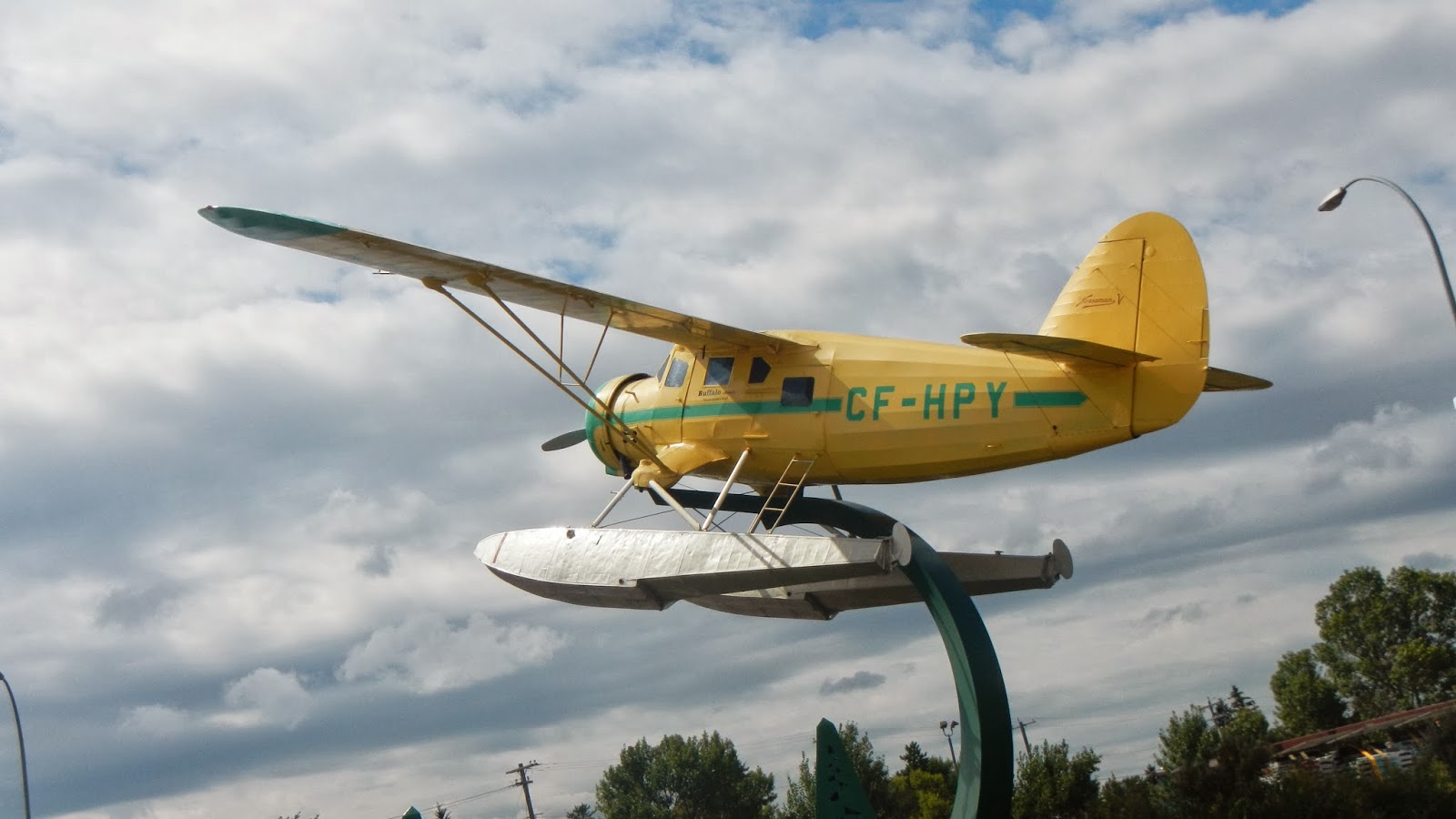
This single engine bush plane is on display right in front of the Aviation Museum.  It’s a Noorduyn Norseman that had been operated by Buffalo Airlines in the Canadian north. Designed by Robert B.C. Noorduyn, the Noorduyn Norseman was produced near Quebec City Canada from 1935 to 1959.  A total of 903 Norsemen were produced, with the US military purchasing 749 of them during WWII. 
Buffalo Airways is a family-run airline that was founded in 1970 that is based in Hay River, Northwest Territories, Canada.   They operate scheduled passenger, charter passenger, charter cargo, firefighting and fuel services.  This airline was also the subject of the History television reality series “Ice Pilots NWT”.  For more on Buffalo Airlines, go to http://en.wikipedia.org/wiki/Buffalo_Airways.
Noorduyn Norseman aircraft have been registered in 68 countries worldwide.  This rugged plane has been flown in the Artic and the Antarctic.  Band leader Glenn Miller was in a Norseman when the plane disappeared over the English Channel in 1944.  The town of Red Lake Ontario Canada, (“The Norseman Capital of the World”), actually stages an annual Norseman Floatplane Festival.

This is a 1937 Avro Anson II.  Its cruising speed was 140 mph and its top speed was only 160 mph.  It had a range of almost 800 miles.   
The Avro Anson is a British twin-engine, multi-role aircraft that served with the Royal Air Force, Fleet Air Arm, Royal Canadian Air Force and many other air forces before, during, and after WWII.  It was named after a British Admiral and it was originally designed as an airliner…before being redeveloped for maritime reconnaissance.  It was soon rendered obsolete for either roles but it was rescued from obscurity by its suitability as a multi-engine air crew trainer.  It became the primary aircraft of the British Commonwealth’s Air Training Plan.  Only 50 of these planes were delivered to the US military…  By the end of production in 1952, I was stunned to learn that a total of 11,020 of these planes were built in Britain and Canada.  To learn more about this aircraft, go to   http://en.wikipedia.org/wiki/Avro_Anson. 

This is a 1943 De Havilland Mosquito B.35.  It had a 2-man crew and it is equipped with 2 Rolls Royce Merlin engines and it could be armed with 2 tons of bombs or 4 20mm cannons, 4 .303 caliber machine guns and a half ton of bombs.   This plane could cruise at 300 mph and it could reach a maximum speed of 415 mph.  It had a range of 1,600 miles and a service ceiling of 37,000 feet. 
The de Havilland DH.98 Mosquito was a British built multi-role combat aircraft that served during the Second World War as well as in the postwar era.  Believe it or not, the Mosquito was one of the few front-line aircraft of the WWII to be constructed almost entirely of wood and, as such, was nicknamed "The Wooden Wonder".  When the Mosquito entered production in 1941, it was one of the fastest operational aircraft in the world.  A total of 7,781 Mosquitos were built.  They were operated by 21 different countries including the USA.  To learn more about the de Havilland Aircraft Company, the Mosquito and its role in WWII, go to http://en.wikipedia.org/wiki/De_Havilland_Mosquito.
Only about 30 non-flying Mosquitos and one airworthy aircraft exist today.  The airworthy version is owned by The Military Aviation Museum in Virginia Beach, Virginia.  For more on that museum and its extensive collection of airworthy historic aircraft, go to http://www.militaryaviationmuseum.org/.

There were a number of large or ‘newer’ aircraft on display outside of the museum itself.  This is a 1957 McDonnell CF-101 Voodoo.  With its 2-man crew and its 2 Pratt and Whitney J-57 engines, it could cruise at 545 mph and achieve a maximum speed of 1,134 mph.  The Voodoo had a range of 1,520 miles and a service ceiling of 58,400 feet.  A total of 807 of these aircraft were built.  They saw service during the Cuban Missile Crisis and the Vietnam War.
Interceptor versions of the Voodoo served with the Air National Guard until 1982, and in Canadian service they were a front line part of NORAD until their replacement with the McDonnell Douglas CF-18 Hornet in the 1980s.  While the Voodoo was a moderate success, it was probably more important as an evolutionary step towards its replacement aircraft, the McDonnell Douglas F-4 Phantom II.  To learn more, go to http://en.wikipedia.org/wiki/McDonnell_F-101_Voodoo.

This is a 1943 North American Aircraft bomber, the B-25J Mitchell.  It is powered by 2 1,850 HP Wright R-2600 Cyclone 14 radial engines.  The B-25 was named in honor of General Billy Mitchell, a pioneer of U.S. military aviation.  With its crew of 5, 8 - 12.7 mm machine guns and 1 ½ tons of bombs, it could fly for 2,700 miles at a cruising speed of 230 mph.  9,984 of these planes were built! 
The B-25 was used by many Allied air forces, in every theater of World War II, as well as by many other air forces after the war ended, and saw service across four decades.  The last active duty B-25 Mitchell was taken out of service by the Indonesian Air Force in 1979…
Of course, the B-25 is most famous as the bomber used in the 18 April 1942 Doolittle Raid, in which 16 B-25Bs led by Lieutenant Colonel Jimmy Doolittle attacked mainland Japan, only four months after the bombing of Pearl Harbor.  The raiders took off from the aircraft carrier USS Hornet and they successfully bombed Tokyo and four other Japanese cities without loss.  The attack on Japan’s main islands gave a much-needed boost in morale to the Americans.  At the same time, it alarmed the Japanese who had believed their home islands couldn’t be touched by enemy forces.  The amount of actual damage wreaked on Tokyo and the other cities was relatively minor but it did force the Japanese to divert troops for home defense purposes for the remainder of the war.

This is a 1952 Avro Canada CF-100 Canuck...affectionately known as the “Clunk”. (The noise it makes when the landing gear is retracted) It’s powered by 2 Avro Canada Orenda 11 turbojets.  The CF-100 was a jet interceptor/fighter that served during the Cold War at NATO bases in Europe and as part of NORAD.  The CF-100 was the only Canadian-designed fighter to enter mass production, (692 were built), serving primarily with the RCAF/CAF and in small numbers in Belgium.  
The CF-100 could cruise for 2,000 miles, it had a service ceiling of 45,000 feet and its maximum speed was 552 mph.  It was armed with 8 - .50 caliber machine guns and it could carry bombs and unguided rockets or missiles.  For more information, go to http://en.wikipedia.org/wiki/Avro_Canada_CF-100_Canuck#Specifications_.28CF-100_Mk_5.29.
Avro Canada, the company that built the CF-100, was started in 1945 as an aircraft plant.  Within 13 years it was the third-largest company in Canada and one of the largest 100 companies in the world…directly employing over 50,000.  In the years since, elements of this large conglomerate have been sold off, merged or closed down.

This is a 1943 Douglas DC-3/C-47 Skytrain or Skytrooper/CC-129 Dakota.  This particular version is a C-47.  Some of these twin engine aircraft are still flying, especially in 3rd world countries.  This plane could carry a crew of 3 and up to 36 passengers at a cruising speed of about 170 mph.  They had a range of a little over 1,000 miles and a service ceiling of about 24,000 feet.   Over 10,000 varieties of the C-47 were built.  In total, between the military versions, cargo versions and the DC-3 passenger versions of this aircraft, total production was 16,079 planes!
During the Vietnam War, the C-47 was modified and pressed into service as the Douglas “AC-47 Spooky”, also nicknamed "Puff, the Magic Dragon".  It was the first in a series of gunships developed by the United States Air Force during the Vietnam War.  A total of 53 of these planes were modified into gunships.  Some air forces around the world still operate C-47s or AC-47s.  To learn more about the C-47 and its variants, go to http://en.wikipedia.org/wiki/Douglas_C-47.
I had the good fortune of flying on the DC-3 passenger version of the C-47 back in the late 1950s…low and slow…great for sightseeing!  Lake Central Airlines was operating DC-3s between Detroit MI, Erie PA and Buffalo NY.  The only remaining scheduled DC-3 passenger service in North America today is by Buffalo Airlines in Canada’s Northwest Territory.  There are flights 6 days a week from Hay River to Yellowknife.  For flight information, go to http://www.buffaloairways.com/. 

This is a 1937 Barkley-Grow T8P.  It is powered by 2 - 400 HP Pratt and Whitney Wasp Jr. engines.  It could carry 2 crew and 6 passengers for 750 miles at an altitude of no more than 20,000 feet.  Its maximum speed was 224 mph. 
The Barkley-Grow Aircraft Corporation was a US aircraft manufacturer established by Archibald Barkley and Harold Grow in Detroit in 1937.  Their goal was to produce a small civil transport.  Sales were disappointing and the firm was bought out 1940.  Although it saw limited production, 11 in total, this plane was well-received as a bush plane in Canada where 7 of the 11 were purchased.  The aircraft’s fixed undercarriage was no obstacle to the fitting of skis or pontoons so they could operate as a bush plane.  Of the 4 purchased in the USA, one was selected for a record flight from Washington D.C. to Peru, and another was used in the Antarctic by the US Navy.  Only 3 examples of this aircraft exist…

This is a fully preserved 1943 Noorduyn Norseman accompanied by a typical load of cargo that these planes might deliver in the vast Canadian north.  This model has a  Pratt and Whitney R-1340 Wasp engine, has the capacity to carry 7 passengers and crew and it can reach speeds of 170 mph.  Surprisingly, at least to me, it has a service ceiling of 22,000 feet.

Anytime that we visit a museum, especially one involving transportation, we’re always encouraged by the sight of ongoing work…continuing preservation of the past so it can be revisited and appreciated by the youth of today and tomorrow.  We noted this large section of the facility with several aircraft that were being worked on, as well as the fabricating shop pictured below…   

The Alberta Aviation Museum is apparently heavily committed to preservation and restoration… I don’t know where they find the talent to fix and maintain the aircraft in the collection, but I suspect that some older gentlemen are involved…men who have experience with these older planes and their upkeep.  
Canada may have an advantage in this regard as there are many older piston driven planes servicing small communities and mining interests in the Northwest Territory, the Yukon, Nunavut (the largest, northernmost and newest territory of Canada, as well as northern Ontario, Quebec, Newfoundland and Labrador.     

For our final airplane…and I didn’t feature all of the aircraft in the collection…this is a 1933 Fairchild 71c.  This early bush plane was powered by a 420 HP Pratt and Whitney Wasp C engine.  It could carry 1 crew member and 6 passengers at an amazingly slow cruising speed of 106 mph.  Its ‘top speed’ was only 133 mph and its service ceiling was limited to 12,500 feet.
The Fairchild 71 was an American high-wing monoplane passenger and cargo aircraft built by Fairchild Aircraft.  It was later built in Canada by Fairchild Aircraft Ltd. (Canada) for both military and civilian use as a rugged bush plane.  The earliest variant of this aircraft was built in 1926.
The Alberta Aviation Museum is located at 11410 Kingsway Avenue in Edmonton Alberta Canada.  Phone: 780-451-1175.  You can check out their website at http://www.albertaaviationmuseum.com/.  The museum is open 7 days a week, 362 days a year.  Adult admission is $10.00; seniors are $8.00; children 13 -17 are $7.00 and; children between 6 and 12 are $6.00.
Laurie and I enjoyed our tour of this museum… There is much more to see then I’ve shown here.  I focused on some of the aircraft and I left out all of the other interesting aircraft related displays…
Just click on any of the photos to enlarge them…
Thanks for stopping by for a visit!
Take Care, Big Daddy Dave