Wednesday, June 15, 2016

Over the Smoky Mountains to Maggie Valley

Despite having lived in East Tennessee for almost 7 years now, we rarely drive over the Smoky Mountains for sightseeing purposes.  With a couple of exceptions, whenever we have gone over the mountains, it was to travel to the historic cities and the seashore.

Consequently, when Larry, (aka. Big Dude at http://bigdudesramblings.blogspot.com/) and his better half Bev, invited us to take a day trip with them to Maggie Valley North Carolina, we jumped at the opportunity.


Larry and Bev’s purpose for the trip was to check out the suitability of an RV park in Maggie Valley for an upcoming RV rally or gathering.  They have become an RV family, traveling all over the USA…

This was the pretty little stream that flows through the RV park that they’d selected for their gathering.


We spent some time driving around the Maggie Valley area in order to check out what might be of interest to the RV group.  However, it was lunch time so we decided to check out a popular local restaurant. 

With almost 400 reviews, Country Vittles is ranked #4 out of 27 restaurants listed in Maggie Valley.  I always look for a 10:1 ratio in the ratings…dropping out the average reviews and just looking at Excellent and Very Good vs. Poor and Terrible.  Country Vittles came close to my desired ratio with 312 positive and 36 negative reviews.


As one might expect in a restaurant named Country Vittles, the dining area is decorated in country kitsch.  It was past 1 PM when we stopped by so the restaurant was quiet and almost empty.

Notes:

·       Maggie Valley has a population of about 1,250 people.  The town gets its name from Maggie Mae Setzer.  Her father John "Jack" Sidney Setzer founded the area's first post office and named it after one of his daughters.

·       Maggie Valley is the birthplace of Marvin "Popcorn" Sutton, a famous moonshiner.   He committed suicide in 2009 rather than report to federal prison after being convicted of offenses related to moonshining and illegal firearm possession.


Larry ordered the Farm Raised Catfish Platter.  It came with 2 sides, catfish with cornbread and biscuits as well as those hush puppies.  As you can see, he chose the French fries and green beans for his sides.  Larry rated the meal as OK…but nothing special.


This is the basket of biscuits and cornbread that came with our meals.  Larry thought that the biscuits were OK but Laurie and I thought that the cornbread was way too dry… 


Bev, Laurie and I all opted for varying fried chicken options.  Good fried chicken is a real treat when you can find it!

The cooked apples were good and I liked the coleslaw.  However, we all agreed that the chicken had been overcooked or fried up for the lunch crowd and had been sitting for a while.  The breading was decent but the chicken was dry…not at all moist. 


This little gift shop occupies the space at the front of the Country Vittles Restaurant.

I’d have to give Country Vittles an average rating at best.  The prices are right but this was just a ‘fuel stop’ and it wasn’t a place I’d seek out if I was in the area.  This restaurant is located at 3589 Soco Road in Maggie Valley North Carolina.  Phone: 828-926-1820.  They are open daily from 7:00 AM – 8:30 PM.  Website: http://www.countryvittlesrestaurant.com/.


Returning to East Tennessee later in the day, Larry drove us over the mountains on US Hwy. 441.  This highway passes right through the middle of the Great Smoky Mountains National Park.  Schools weren’t quite out for the summer and traffic was fairly light. 

The view shown above is from Newfound Gap which is at an altitude of 5,048 feet.   I didn’t know this but prior to the development of the Great Smoky Mountains National Park, Newfound Gap was an ‘undiscovered’ pass 2 miles east of Indian Gap, which was long thought to be the lowest mountain pass over the Great Smoky Mountains.  This National Park is far and away the most visited National Park in the United States…

Just click on any of the photos to enlarge them…

Thanks for stopping by for a visit!

Take Care, Big Daddy Dave


Monday, June 13, 2016

West Wind Farm – Vineyard and Winery

Did you know that every state in the union has at least 1 winery?  Some of them don’t grow their own grapes and others produce wine from fruit other than grapes…but the last article that I read on this topic revealed that even Alaska has a winery. 

We aren’t true wine connoisseurs but we do like a nice glass of wine from time to time…


Tennessee has quite a few wineries and vineyards.  The problem is that the wines we’ve found in-state to date are either too sweet for our palate or they just aren’t great wines.  We haven’t given up our search in Tennessee yet…

When it comes to the number of wineries and vineyards, Virginia seems to have a big jump on Tennessee.  Virginia’s “2016 Winery Guide” lists 252 wineries, 25 wine trails and 10 winemaking regions in the state! (That number includes a few cideries and meaderies) We’d sampled 3 or 4 Virginia wineries on previous trips through the state and since we were headed home from Roanoke, it seemed like a propitious time to check out a couple of locations in the Blue Ridge winemaking region so we could take a few bottles home…  I’d mapped out 4 wineries for possible visits on our way home to East Tennessee.

Our first stop was at West Wind Farm – Vineyard and Winery near Max Meadows Virginia. 


The first grapes were planted here back in 2003.  The pluses of growing grapes in the foothills of Blue Ridge Mountains are the elevation, cool nights and well-drained rocky soil.  Challenges are the short growing seasons with occasional mid-May frosts and an early October freeze.  


The owners of West Wind Farm have managed to keep the farm in the family for 4 generations. (Since 1914) One of their challenges is to preserve the old homestead while running the farm, vineyard and winery…

The winery produces 4 white wines (Galena Creek White, Gewürztraminer, Pinot Gris and Riesling); 4 red wines (Galena Creek Red, Chambourcin, Merlot and Cabernet Sauvignon) and; 4 wines that are listed as the ‘sweeter selection’. (Galena Creek Blackberry, Galena Creek Peach, New River White and New River Red) 


This is the tasting room at West Wind Farm.  It is well stocked with wine of course…and to my dismay, the ‘store’ also features local art, gourmet snacks, wine accessories, gift baskets, fancy soaps, and lots of household gifts.   The wines are made in small batches the ‘old fashioned way’.  Each lot is hand-tended from harvest to bottle and it’s a family operation. 

We usually stay away from the sweet wines but we tried and liked the sipping potential of the 2015 Galena Creek Peach.  In addition we purchased 1 bottle each of the 2015 Galena Creek White, the 2014 Chambourcin and the Cabernet Sauvignon.  In our opinion they were all very competent wines…and we will return for another visit.

West Wind Farm – Winery and Vineyard is located at 2228 Fort Chiswell Road, Max Meadows, VA, 24360.  They aren’t far off of I-81.  Phone: 276-699-2020.  Website: http://westwindwine.com/index.php.

Just click on any of the photos to enlarge them…

Thanks for stopping by to see what we’ve been up to!

Take Care, Big Daddy Dave

Friday, June 10, 2016

On Down the Road to Eastern Tennessee

Despite the fact that we were headed home after our little trip to Roanoke Virginia, I had plenty of depots and historic sites that I wanted to check out along our route back home.


This is one end of the old 1868 Virginia and Tennessee Railroad Combination Depot in Christiansburg Virginia.  When a new depot was built in the early 20th century, this depot became the freight depot for the town.  Looks like someone was setting up a flower bed or small garden…

Built in the 1850s, the Virginia and Tennessee ran through southwestern Virginia.  It extended westward from Lynchburg, through a gap in the Blue Ridge Mountains near the town of Big Lick (the present-day city of Roanoke).  From that point it turned southwestward and followed the Great Valley to Bristol, a total distance of 204 miles.  Through a series of mergers, the railroad became part of the Norfolk and Western system.  Today, much of the former Virginia and Tennessee Railroad remains in service for Norfolk and Western’s successor, Norfolk Southern. 


This is the handsome reverse end of the Virginia and Tennessee Depot.  Currently, this 148 year old depot serves as the home of Whistlestop Books and the Cambria Toy Station.  It used to house a museum where the book store is now… FYI, this is one of the few remaining wooden Railroad Italianate depots left in the United States.  This classic depot was almost torn down.  Learn more at http://www.historiccambria.com/Depot.htm.

The Virginia and Tennessee Railroad played a major role in the Civil War.  It was a key route for the movement of supplies, food and troops for the Confederate Army, particularly from the capital of Richmond to the interior at Chattanooga, Tennessee.  Included in the vital transportation services provided by the railroad was the movement of raw materials from the copper mines near Cleveland Tennessee; the lead mines near Bristol; the salt works at Saltville Virginia and saltpeter caves throughout the region.  Union forces finally captured much of the railroad and destroyed tracks and rolling stock in late 1864.


This is the old freight platform that extends from next to the lower end of the Virginia and Tennessee Railroad Depot.
 
Take note of the building in the distance down the tracks…


This large old 3 story brick building sits right across the street from the main entrance to the Virginia and Tennessee Railroad Depot.

The Cambria Emporium is located in the Surface-Lee Building, the remaining building left from the Surface Block, which was built in 1908.  The Surface Lee Block was built as a wholesale grocery business on the railroad to bring produce to Cambria.  FYI, Cambria was originally an independent town next to Christiansburg.  See http://cambriaemporium.org/.

Of interest is the fact that the elevator in this building was purchased second hand from a company in Roanoke when the Surface-Lee Building was constructed in 1908.  As such, it is actually 30 years older than the building!  According to Southern Elevator, it is the oldest elevator still in operation in the State of Virginia…136 years old and still functioning!


This is the building you could see on down the tracks from that old 1868 Virginia and Tennessee Depot.  This is the ‘new’ passenger depot that was built by Norfolk and Western Railroad in 1907.  It’s only 109 years old!

This depot was built on top of a small spring fed pond, leading to ongoing storm water problems in town and, as I mentioned before, the old depot was converted to a freight station as well as a railroad office for maintenance of ways and engineering.  It should be noted that this new station was built, not because there was a need for a new passenger station per se, but because of the political, social, and cultural demands for segregation.  The old depot, one of only a couple of pre-segregation depots left in Virginia, could not be segregated because of the configuration of the waiting rooms.


The Oaks is a historic home that’s located at Christiansburg.  This large Queen Anne style frame house was built in 1893.  Love that big wraparound porch and the tower.  You can’t see them in this photo, but this house has 4 brick chimneys. 

The inn was built in the late 1800s by Major W.L. Pierce for his bride Julia. Seven of their 8 children were born here.  William Pierce passed on in 1949 but his wife Julia lived in the house until her death at the age of 99.

The Oaks is now a well-known bed and breakfast.  It’s been featured in more than 2-dozen magazine articles and on the TV series “Inn Country USA”.  The Oaks Victorian Inn has also been selected for the cover of 3 books, including the travel guide to inns that was published by the National Trust for Historic Preservation.  To learn more, you can go to http://www.theoaksvictorianinn.com/.


I’ll end this tour with a ‘modern’ structure.  This is the US Post Office in Christiansburg Virginia.  It was designed and built in 1936.  The one-story, five-bay, brick building is in the Colonial Revival style.  It has a nice classic look.  Of note is the fact that the interior features a Depression era Works Progress Administration (WPA) sponsored mural by Paul DeTroot.  That mural depicts local events from the French and Indian War and the Revolutionary War.

United States post office murals were produced in the United States from 1934 to 1943.  The principal objective was to secure artwork that met high artistic standards for public buildings, where it was accessible to all people.  The murals were intended to boost the morale of the American people suffering from the effects of the Depression by depicting uplifting subjects the people knew and loved.  For a list of US Post Offices that feature or used to feature these murals throughout the USA, you can go to https://en.wikipedia.org/wiki/List_of_United_States_post_office_murals.

Just click on any of the photos to enlarge them…

Thanks for stopping by for a short historical tour!

Take Care, Big Daddy Dave 


Wednesday, June 8, 2016

Firehouses, a Depot and More…

Continuing with our tour of Roanoke Virginia’s historic sites…


Located in Roanoke’s City Market Historic District, Fire Station No. 1 is a former fire station listed on the National Register of Historic Places.  It was modeled after Philadelphia's Independence Hall. 

This Fire Station served as one of the longest continuously operating fire stations in the Commonwealth of Virginia from its completion in 1907 through the opening of a replacement facility in 2007.   Today Fire Station #1 serves as a fire museum that’s open to the general public as well as a stable for the Roanoke Police Department's Mounted Patrol.


The Virginian Railway Passenger Station is a former depot listed on the National Register of Historic Places.  The Virginian Station served as a passenger station for the Virginian Railway from 1910 to 1956.  It was the only station constructed entirely with brick along the entire length of the Virginian’s 608 miles of track.  This building was badly damaged by a fire in January of 2001.  As you can see from these photos, a complete restoration is underway.


This is a handsome renovation, that’s for sure!  Love the detail…

In the early 20th century, William Page, a civil engineer and coal mining manager, joined forces with a silent partner, industrialist financier Henry Huttleston Rogers (a principal of Standard Oil and one of the wealthiest men in the world).  Their objective was to develop the Deepwater Railway, a modest 85-mile long short line railroad to access untapped bituminous coal reserves in some of the most rugged sections of southern West Virginia.   Major railroads blocked the project and they wouldn’t give reasonable rates to interchange the coal traffic. 

Using Roger’s resources they quietly incorporated another intrastate railroad in Virginia.  Through that railroad, they secured the right-of-way needed all the way across Virginia to the port of Hampton Roads.  The 2 projects were legally joined and renamed the Virginian Railway in early 1907.  Despite efforts to stop them, they then built the "Mountains to Sea" railroad right under the noses of the big railroads and the elite group of a few industrialists (so-called "robber barons") who controlled them. This modern well-engineered railroad with all-new infrastructure could operate more efficiently than its larger competitors.


This lonely little structure sits between 2 sets of tracks in the rail yard in Roanoke.  It’s just across the tracks and a little down from the Virginian Depot.  I believe that it’s called the “JK Tower” at the “JK Junction”.  In the on-line listing, “Extant Railroad/Railway Structures” as provided by the Railroad Station Historical Society, Inc., despite the ‘tower’ appellation, this building is described as a 1-story cabin.  See the listing of Roanoke railroad structures at: http://www.rrshs.org/Virginia/roanokecity.htm.

As per information that I found on line at http://www.railfanguides.us/va/roanoke/map1/index.htm, JK Tower was not always JK Tower.  Apparently, in the pre-merger days between the VGN and the N and W, it was known as the Walnut St. Tower.  The ‘tower’ was originally a two-story wood building… Back in the day, this building’s purpose was to control the crossing of the Virginian Railroad over the Norfolk and Western Railroad’s Winston-Salem district line.


This is old Fire Station No. 5 and it’s listed on the National Register of Historic Places.  This neighborhood fire station was 1 of 3 built in 1911.  It hasn’t been modified!  It was actually designed to look like a home, architecturally blending into the residential neighborhood.  This station housed one of the city's first fire trucks to be powered by an internal combustion engine.  This building served the city as a fire station until 2010, when it was turned over to a local nonprofit organization.


This huge old home is located close to Black Dog Salvage.  It’s called Mountain View…but it’s also known as the Fishburn Mansion.  Junius Fishburn was a prominent local banker, businessman and philanthropist.  The 2 1/2-story rectangular Georgian Revival style mansion was built in 1907.  The structure features a colossal portico consisting of two clusters of three fluted Ionic order columns. 

Now referred to as Mountain View Center, this elegant 40 room mansion was donated by Mr. Fishburn to the City in 1955.  His stipulation was that it be used solely and exclusively for public recreation purposes.  Today, the house is open to the public Monday-Thursday from 10am-4pm and Friday from 10am-2pm.  The house is available for private rentals.  To learn more, go to http://www.playroanoke.com/community-recreation/mountain-view-center/.  

That’s about it for now… Just click on any of the photos to enlarge them.

Thanks for stopping by for a visit!


Take Care, Big Daddy Dave

Monday, June 6, 2016

Asian Food in Roanoke Virginia

With the exception of Thai cuisine, we’ve been unable to find really good Asian or Chinese food in eastern Tennessee.  Consequently, it’s one of the dining experiences that we search for when we travel.


Cafe Asia is rated #7 in Trip Advisor out of the 300+ restaurants located in the area in and around Roanoke Virginia.  It was our second night in town and we made the drive out into the northeastern suburbs to find this restaurant.  It was rated 173:4, very good and excellent vs. poor or terrible.


The décor of Café Asia is modern and clean with minimal old fashioned Asian decoration or influences… Where we were seated the wood and metal arch above us as well as the colors provided a warm but modern feel to the room.


I started my meal with a Heineken ($3.00), and Laurie decided to try a Tequila Sunrise. ($5.50) She hadn’t had one before and wasn’t sure about Tequila but she liked the drink even if it didn’t make her favorite list.


Laurie has always been a fan of Summer Rolls. ($6.25) These consist of shrimp, lettuce, bean sprouts, rice noodles and mint leaves wrapped in rice paper and served with peanut sauce.  They are refreshing but I prefer something with more of a flavor pop.  Laurie was quite satisfied with this version…


Since it was our anniversary trip…and it was a present to ourselves…we went ‘wild’ and ordered a second appetizer.  The Café Asia version of Fried Calamari ($9.25), was described as lightly breaded and sautéed with Chinese 5 spices…accompanied by dipping sauce on the side.
 
The breading wasn’t particularly ‘light’ but it was different.  We thought that this appetizer was a little bland…even with the dipping sauce, but the breading was a different twist on a standard menu item.  Overall, it was satisfactory.


As it was our anniversary and Laurie loves lobster, she ordered the Feng Style Lobster as her entree. ($30.45) This is described as lightly breaded lobster pieces sautéed with ginger and scallion with cilantro on top.  She also asked for a bit of ‘extra heat’ with the preparation. 

First of all the picture on the menu doesn’t resemble her meal as served.  Where did all of the sweet peppers come from?  Secondly, the lobster ‘pieces’ were still in their shells and they were difficult to remove them so she could eat her dinner.  Finally, there was absolutely no extra spicy ‘heat’ that was detectable… She didn't waste any lobster though!


Rice was nicely served in these pretty little bowls…

Our waiter showed moments of superior service only to get lost from time to time in whatever thoughts or tasks that he was involved in.  He was nice but he needed to stay focused more on his customers instead of the hostess.


This attractive plate of food was my entrée.  It’s the Four Treasures. ($15.25) This entrée consisted of chicken, shrimp, beef, and scallops sautéed in garlic sauce surrounded by broccoli.  It is normally served as a ‘one pepper’ dish, denoting the level of spicy heat that the chef adds to the sauce.  I asked for a ‘four pepper’ treatment!

To start with, I expect lightly cooked broccoli with Chinese food and I like it that way.  My broccoli was barely cooked and it was a bit tougher than usual to eat.  Secondly, to paraphrase an old advertising slogan, “Where’s the sauce?!”  There was almost no sauce to enjoy with my rice or broccoli.  The other problems related to minimal garlic in the little bit of sauce that I had and I had to ask for pepper sauce to achieve any level of ‘heat’ for my entrée.

We were disappointed with Café Asia.  In our opinion it just didn’t live up to its rating on Trip Advisor.  Presentation was above average but the food didn’t achieve an above average rating from our viewpoint…  Café Asia is located at 3940 Valley Gateway Boulevard (Alt. US Hwy. 220) in Roanoke Virginia.  Phone: 540-206-2298.  Website: http://cafeasiaroanoke.com/.


Following dinner, we headed on down the highway toward our hotel.  Laurie took this photo at 60 mph of this sunset!  It was a promise for a beautiful day for our trip back home to East Tennessee…

Just click on any of the photos to enlarge them…

Thanks for stopping by for dinner!


Take Care, Big Daddy Dave

Friday, June 3, 2016

Sights and Landmarks in Roanoke Virginia

As we drove around Roanoke we took photos of several local landmarks and historic sites… The city has a lot to look at and explore.


Laurie grabbed this early evening photo of The Roanoke Star.  It looks down on the city from Mill Mountain Park.  The park is also the home of the appropriately named Mill Mountain Zoo.  We love zoos but we didn’t have the time to visit this one unless we gave up on a number of other trip goals.  To learn about Mill Mountain Zoo, go to http://www.mmzoo.org/.


The following morning, Laurie and I drove up to Mill Mountain and its iconic star… The Roanoke Star is the world's largest freestanding illuminated man-made star.  It was constructed in 1949 and it’s listed on the National Register of Historic Places.  After construction of the star, Roanoke was nicknamed "Star City of the South".  The star is visible for 60 miles from the air.  It sits 1,045 feet above the city.


There is a viewing area right at the foot of the Star and even with a hazy sky, the views of Roanoke and the valley in which it’s situated were pretty impressive.  Roanoke is the largest city in the Roanoke Metropolitan Statistical Area, which has a population of over 310,000. 

During colonial times the site now occupied by Roanoke was an important hub of trails and roads.  The Great Wagon Road, one of the most heavily travelled roads of eighteenth century America, ran from Philadelphia through the Shenandoah Valley to the future site of the City of Roanoke.  This is where the Roanoke River passes through the Blue Ridge Mountains. The ‘Roanoke Gap’ was a useful route for immigrants who wanted to settle the Carolina Piedmont region.  Also at the Roanoke Gap, another branch of the Great Wagon Road, the Wilderness Road, continued southwest into Tennessee.


One of our goals for this short anniversary trip was to check out a number of southwest Virginia’s wineries… This beautiful view of Roanoke and the valley was taken from near the Valhalla Vineyards.  Unfortunately they weren’t open when we stopped by…


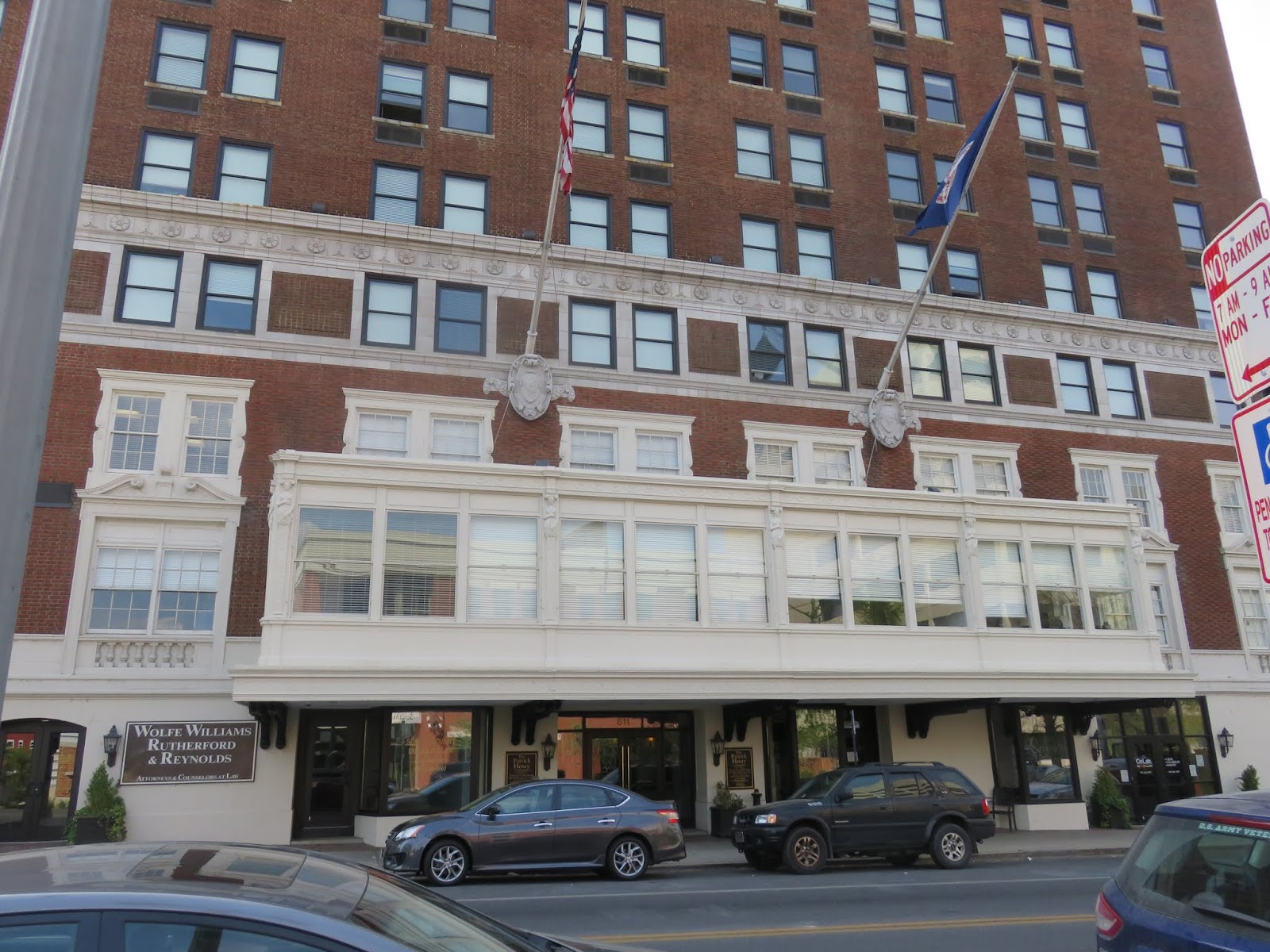
This is the Patrick Henry Hotel in downtown Roanoke.  It’s included on the National Register of Historic Places.  The Patrick Henry Hotel is a Colonial Revival structure that opened in 1925.  It isn’t a hotel any more but the building now features apartments, office space, and a restaurant named “The Patrick Henry” that’s located in the former lobby. 

In 2007, this building was abandoned and condemned for failing to meet modern fire codes.  However in 2009, after foreclosure for failing to pay back taxes, a local developer acquired the property…and a $20,000,000 renovation was completed in 2011.

    
This Moderne style structure is the Roanoke Valley’s Visitor Center as well as the O. Winston Link Museum.  It is also part of the Norfolk and Western Railway Company Historic District.  This former passenger terminal was originally built in 1905 and in 1949, it was renovated by noted architect Raymond Loewy. 


This is one of O. Winston Link’s famous and fabulous railroad related photos… He was a photographer who is best known for his black-and-white photography and sound recordings of the last days of steam locomotive railroading on the Norfolk and Western Railroad in the late 1950s.  Link helped establish rail photography as a hobby.  For more on the O. Winston Link Museum, go to http://www.linkmuseum.org/.


Here are 2 more buildings that are part of the Norfolk and Western Railroad Company Historic District.  These buildings were constructed by the Norfolk and Western Railway.  The closest one is the Neoclassical Revival style General Office Building.  It dates back to 1896 with additions made in 1903.  The second Art Deco building was built in 1931 and it served as the railroad’s General Office Building. 

Downtown Roanoke is just across the tracks to the right and the former passenger depot is just up the street above on this side of the active rail line.  In addition, the Virginia Transportation Museum with all its locomotives and rolling stock is right across from these buildings.


This is the Hotel Roanoke and Conference Center.  On the National Register of Historic Places, it sits right next to the Art Deco Norfolk and Western Office building and right across from the O. Winston Link Museum and former depot.
 
This luxury hotel was originally built in 1882 but it’s been renovated many times.  It is currently owned by Virginia Tech but it’s operated under the “Curio - A Collection” by Hilton Hotels.


Laurie and I checked out the lobby of Hotel Roanoke…and also the 'clubby' wood accented bar where we relaxed with an adult beverage. 

Hotel Roanoke has been host to many famous and well-known guests, including: Dwight Eisenhower; Richard Nixon; Gerald Ford; Jimmy Carter; Ronald Reagan; George H. W. Bush; Douglas MacArthur; Mahalia Jackson; Aerosmith; Spiro Agnew; Dick Cheney; Hilary Duff; Jerry Seinfeld; Ric Flair, and Shania Twain.


In 1927, Harold and Clarence Woods, brothers from Greensboro, North Carolina, established Woods Brother’s Coffee Company in Roanoke.  Harold Woods grew the company by purchasing one 150-pound burlap bag of green coffee at a time. The coffee was hand-roasted, ground and packed and then sold to the local merchants of the Roanoke Valley.

During the war years of the 40’s, Harold made a trip to New York and was impressed by the neon signage used in advertising.  Upon his return to Roanoke, he enlisted the help of a local sign company to design and install the “H and C Coffee” sign on top of the roasting plant.  In 2005, after years of not working, this big neon sign was repaired through funds raised by the local community and moved to its current location.  It is now classified as a Historical Landmark.


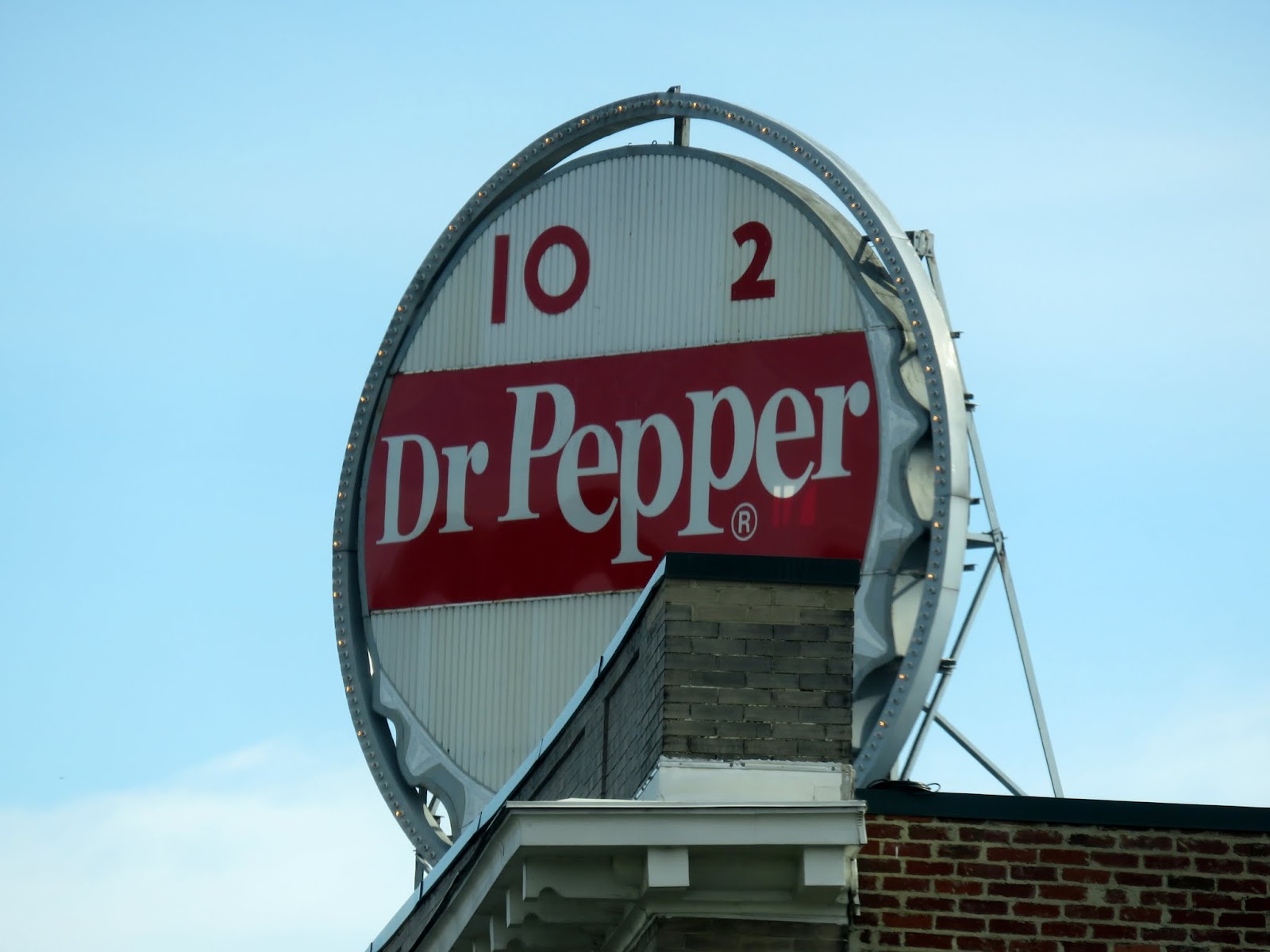
Yet another classic sign… “Drink a Bit to Eat at 10, 2 and 4” was a legendary slogan used by Dr. Pepper for decades.  It reminded Dr. Pepper fans to enjoy their favorite “pick me up” at three intervals during the day when research showed human energy would lag.

In 1936, Bill Davis opened Virginia’s first Dr. Pepper Bottling plant.  Residents of Roanoke consumed more Dr. Pepper per capita than any other place on earth from 1957 to 1959 and again in 1961… To this day, Roanoke has among highest per capita consumption rates in the USA.  The sign has become one of the city’s iconic images…


For just a bit of contrast, this is the Taubman Museum of Art.  It sits across the Norfolk and Western tracks from the former passenger depot.  This ultra-modern facility was opened to the public in November of 2008.   The museum’s permanent collection of more than 2,000 works of art includes prominent 19th and early 20th century American art, as well as significant modern and contemporary art, photography, design, and decorative arts, and several smaller collections including Southern folk art.  

We didn’t have time to tour the museum but it’s on our list for the next trip to Roanoke.  To learn more about the Taubman Museum of Art, you can go to http://www.taubmanmuseum.org/.

That’s it for this tour.  Just click on any of the photos to enlarge them…

Thanks for stopping by for a visit!


Take Care, Big Daddy Dave