Tuesday, February 14, 2023

Last Day – On the Road Home

…continuing with the series of posts resulting from our late summer road trip to Michigan, Indiana and Ohio.

This was our final day on the road...but we’d had a great time and packed a lot of sights and scenes along with a bit of family time into this adventure.

We were in no hurry to get home so I skipped the boring but much faster I-75 Interstate Highway, and from Cincinnati south we followed US Hwy 27 all the way into Tennessee.  FYI, US Hwy 27 was first designated with that number back in 1926.  It stretches all the way from Ft. Wayne Indiana to Miami Florida.

Along the way in northern Kentucky we passed through the town of Falmouth.  That’s where we spotted this historic cabin.  The Alvin Mountjoy Log Cabin is the oldest house still standing in Falmouth.  It was built ca. 1792 by Alvin Mountjoy, one of the town’s first settlers.  Mountjoy was a Lieutenant in the 3rd Virginia Continental Line at the Battles of Princeton and Trenton during the Revolutionary War.  It was at this home that the peace officers, magistrates and commissioners met on July 4, 1799 to draw up Falmouth’s city charter.  Ca. 1776, the town began as a settlement known as Forks of Licking.

In the latter half of the 1900s, Falmouth has seen some rough times.  In 1964, the Licking River went 19 feet over flood stage and put most of the town under water.  In 1968, an F4 or F5 tornado leveled many homes in the town.  Then in March of 1997, the Licking River did it again, this time reaching 24 feet above flood stage, leaving 80% of the town underwater and killing 5 residents.  Lucky that the Mountjoy cabin is still standing.

Since we’d started our drive on this day in Dayton Ohio and we’d skipped breakfast, it was time for something to eat.  Laurie looked for restaurants on her phone as we approached Cynthiana Kentucky and she found a promising place for us to stop.

Biancke’s Restaurant was founded by Guido Bianche and his wife Clementina Poppini in 1894 as a combination fruit stand and restaurant.  Guido died in 1909 but Clementina continued to operate the restaurant until she died in 1952.  Their children, Joe and Amelia continued the business.  Biancke’s has been in this location since 1930. 

The current owners bought Biancke’s in July of 2019 and they live in the apartment above the restaurant.  The restaurant’s website reports that some of the former staff still help run and manage the place.  Biancke’s is located in downtown Cynthiana...

Of course, any restaurant that bake and sells homemade pies is a winner in our book.  With several hours of driving ahead of us, we did refrain from having a slice of pie…or worse yet…purchasing a whole pie.  Besides, we were looking for breakfast if possible.  We made it just in time as the cutoff for breakfast is 11 AM. 

I read a bit about the history of Biancke’s and I noted that they used to have an old-fashioned soda counter…and that they’d employed some locally well remembered ‘soda jerks’.  Well, the counter is still there but it’s stocked with promotional t-shirts and decorated with restaurant memorabilia. 

FYI, my mother met my father in the mid-1930s when he was working as a soda-jerk in a local drug store in Jackson Michigan.

Of course, the Specials Board boasts that Bianche’s has been serving home-cooked meals for 126 years!  I would have liked to try that Pan Fried Chicken…one of my favorites.  Timing is everything.  You don’t see Salmon Croquettes on too many menus in this day and age. 


The dining room areas reminded us of the “Supper Clubs” that are especially popular in Wisconsin.  Dark ceilings and walls, cozy with lots of wood paneling.  Of course, the walls are crowded with photos and more memorabilia.  The 21st Century is marked by that large TV screen…


For my breakfast, I ordered the “Country Boy’s Favorite”. ($13.00) Not a great photo of either portion of my meal… It included 2 eggs easy-over, a fried pork tenderloin, home fries and biscuits with a cup of sausage gravy.  Yes, that is Tabasco on my potatoes and eggs.  Everything was cooked as requested, the sausage gravy was above average and the home fries were excellent.  Other meat options included bacon or a grilled chicken breast.

I stayed away from a larger breakfast, which would have caused me to fall asleep at the wheel after an hour or so… It is the “Big Boy Breakfast”, 3 eggs cooked to order, the diner’s choice of a full slice of country ham, 2 fried pork tenderloins, a hamburger steak or fried catfish.  Also hash browns or home fries, toast or biscuits…and a cup of sausage gravy. ($15.00)

Laurie ate a lighter breakfast than I did… She ordered the “Just for Mama” morning menu offering. ($10.00) It included 2 eggs cooked easy-over plus some very nice bacon plus a couple of biscuits.  We were both very content and ready to hit the road after this pleasant stop.

The lunch and dinner menus at Bianche’s Restaurant are fairly extensive… Lots of burger options and sandwiches along with a variety of appetizers and entrees.  Smothered Chicken, All You Can Eat Catfish, a Kentucky Hot Brown and Fried Banana Peppers are examples of the variety available.  I have to admit I’ve never seen Fried Banana Peppers on a menu before.

Bianche’s Restaurant is located at 102 South Main Street in Cynthiana Kentucky.  They are open daily but close early on Sundays.  Phone: 859-234-3443.  Website: https://www.bianckes1894.com/.

FYI, Cynthiana is located along both sides of the South Fork of the Licking River.  This town of about 6,300 residents was named after Cynthia and Anna Harrison, daughters of the man who had donated land to establish the town center.

Cynthiana was featured in the movie “Blues Brothers 2000” as well as in the comic book series “The Walking Dead”.

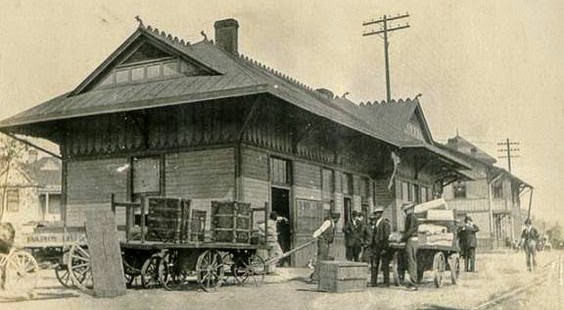
As we passed through Paris Kentucky, I spotted the old Paris railway depot.  The photo shows what it looked like when it was the center of commerce for the town.  In 1853, the first trains came through Paris from Cincinnati and in 1854, branch lines to Richmond, Winchester and Louisville Kentucky began operations.  This depot was built in 1882, receiving 4 ‘fast trains’ each day along with 4 locals that stopped at smaller towns and settlements along the tracks.  For many years, this late American Victorian style wooden depot with a tin roof served as the passenger station of both the Louisville and Nashville as well as the Frankfort and Cincinnati Railroads. 

The railroads…and the depot…helped Bourbon County farmers export their products, with cattle, sheep and hogs going to Chicago meatpackers.  Presidential candidate, Theodore “Teddy” Roosevelt stopped here to make a ‘whistle stop’ speech during his run for President on the Bull Moose Party ticket in 1912.  The only thing more exciting than that was the arrival of the circus train with all their equipment and animals.  By the late 1960’s, the last passenger train pulled away from the depot.  The depot is listed on the National Register of Historic Places.

In the early 1970s, the Chesapeake Railway System gave the depot to the city on a lease that could be terminated at any time…but the railroad kept the land the depot sat on.  A number of businesses occupied the old depot over the years but in 2017, a local family bought the depot from the city with the condition that it be historically preserved.  They also managed to purchase the land from the CSX Corporation.  The result is the Trackside Restaurant and Bourbon Bar that now occupies this historic depot.  For more about this restaurant/bourbon bar go to https://www.tracksideatthedepot.com/.

From Paris Kentucky onward, we just drove along taking in the sights and scenery…but not taking any more photos.  We were finally homeward bound!

Just click on any of the photos to enlarge them…

Thanks for stopping by for a visit!

Take Care, Big Daddy Dave

Friday, February 10, 2023

The United States Air Force Museum – Part II

…continuing with but nearing the end of our late summer road trip to Michigan, Indiana and Ohio.  Here is a second brief look at the National Museum of the United States Air Force in Dayton Ohio.

I included this photo to try to convey the size and scope of the Air Force Museum.  The collection is housed in 4 huge buildings like this one plus there is a giant missile/rocket silo and there are aircraft parked outside on the tarmac.

I went through the museum’s listings for the different galleries and I counted 274 aircraft on exhibit.  In addition, I counted up the other historic exhibits in just the Early Years, WWII, Korea, SE Asia and Cold War Galleries…and there are 279 of them in just those 5 galleries that are available for visitors’ to view.  Add in the separate exhibits of engines, weapons and videos, not to mention the Missile/Rocket silo…which we skipped, and it was all a bit overwhelming.  To do the museum justice, it would take 2 full days to semi-thoroughly review everything available to the public.

What follows is a second (and last) random sampling of some of the aircraft and other exhibits we saw and photographed during our visit to the museum.

This odd looking mash-up of 2 P-51 Mustang’s conjoined into a single aircraft is a bit deceiving.  The North American F-82G Twin Mustang was a totally new design.  With a pilot and a co-pilot/navigator, it was conceived as a long-range bomber escort for the B-29 Superfortresses in World War II but the war ended before production deliveries began in 1946.  The F-82 was the last propeller-driven fighter aircraft that was purchased in quantity by the USAF.  In total, 273 of these planes were built.  Having 2 pilots on board helped reduce fatigue on long range bomber escort missions.

The F-82s were used by the Strategic Air Command as long range bomber escorts during the early days of the Cold War.  During the Korean War, F-82Gs based in Japan were among the first USAF aircraft to operate over Korea…shooting down the first 3 North Korean aircraft that were destroyed by U.S. forces.

The F-82 fighters could reach speeds of 400 mph and they had a range of about 2,240 miles.  This particular aircraft is nicknamed “Betty Jo”.  In February 1947, equipped with an extra fuel tank, Betty Jo made a non-stop trip from Hawaii to New York without refueling.  That flight took 14 hours and 32 minutes and if covered 5,051 miles.  It is still the longest non-stop flight ever made by a piston/propeller driven fighter aircraft.

This is one of the many non-aircraft exhibits that are found everywhere in the Air Force Museum.

These walls came from the “Warrior’s Lounge” at the U.S. Air Force Contingency Aeromedical Staging Facility at the Balad Iraq Air Force Theater Hospital.  Patients waiting for transport stayed there for as many as 3 days.  Patients and visitors were encouraged to sign the walls as an informal way to display unit pride, remember friends, or to just say ‘thank you’.  The messages pay tribute to patients and medical staff who served in Operation “Iraqi Freedom”.

Balad Air Base, aka Al-Bakir Air Base was the largest military base in Iraq.  The USAF maintained this medical staging facility at Balad from 2003 – 2011.  During that time, Air Force medical personnel treated more than 43,000 wounded or ill patients…and then moved them to destinations in Europe and the United States.  In 2010 plans to remove these walls led to efforts to save them.  The Air Force Medical Service and others worked to preserve them and by 2016, the exhibit was put on display in the museum.


…and this is another exhibit not involving an airplane.  This is the Vapor Special Operations Supercar.  It showcases U.S. Air Force ingenuity, state of the art technology and innovation.  It was one of two custom-built automobiles commissioned by the Air Force Recruiting Service in 2009 for its “Project Supercar” recruiting campaign.  This ‘supercar’ toured the USA for more than 7 years with the Air Force Recruiting Service, educating the public on opportunities for both officers and enlisted airmen.

This is a fully customized Dodge Challenger.  It is outfitted with special gull-wing doors, a carbon fiber body kit, and a ‘stealth’ exhaust system that, when activated, allows the Vapor to run almost silently.  This automobile features a Forward Looking Infrared system for night operation and a high-resolution 360-degree surveillance camera with a quarter mile range.  The interior, a blacked-out ‘command center’ is equipped with aircraft style controls, a passenger side steering wheel and a windshield heads-up display with both night and thermal vision capability.  The Vapor’s computer system allows remote operation of the vehicle from anywhere in the world with an internet connection

Visitors are permitted to walk through this cavernous Douglas C-124 Globemaster II.  The first flight of the C-124 took place in late 1949 with deliveries of these aircraft beginning in late spring 1950.  The U.S. Air Force bought 448 of these aircraft before production ended in 1955.  Most C-124s were transferred to the Air Force Reserve and the Air National Guard by 1970 and all were released from service in 1974. 

The C-124 features ‘clamshell’ loading doors and hydraulic ramps in the nose and an elevator under the aft fuselage.  It could handle tanks, field guns, bulldozers and trucks.  Converted into a troop carrier, it could carry 200 fully-equipped soldiers or 127 litter patients and their attendants in its double-decked cabin.  C-124s provided heavy airlift capabilities during the Korean War and the War in Southeast Asia.  These aircraft had top speed of 320 mph and a flight range of 2,175 miles.

This is a Douglas B-26C Invader.  During the Korean War these aircraft played an important part in the U.S. Air Force’s campaign against invading communist ground forces.  Most missions were flown at night as the Chinese/North Koreans had introduced MiG-15 jet fighters into the fray.  The top speed for the B-26 Invaders was 373 mph while the MiG-15s could reach speeds of 669 mph. 

Douglas B-26 aircraft were a WWII attack aircraft used for level bombing, ground strafing and rocket attacks.  It was first delivered to the Army Air Corp in August of 1943.  By the time production ended after the war, a total of 2,502 Invaders had been built.  Early in the Southeast Asia War, the Invader returned to action for the third time.  Forty of these aircraft were reconfigured with more powerful engines and increased structural strength.  These later updated Invaders were designated as B-26Ks and they undertook special air warfare missions.

The B-45C Tornado resulted from a wartime initiative that was launched by the U.S. War Department during WWII.  The goal was to develop a jet-propelled bombers equal to those being fielded by Nazi Germany.  North American Aviation received the contract to build its proposed bomber.  WWII ended and progress was stalled by post-war cutbacks.  However, tensions between the USA and the Soviet Union resulted in a production contract and the first prototype took flight in February of 1947.  Only 143 of these aircraft were built.

B-45s served in the Korean War performing both aerial reconnaissance and conventional bombing missions.   Forty of these aircraft were extensively upgraded so they could be equipped with nuclear weapons.  Upgrades also included their defensive systems and fuel tankage to increase both survivability and range.  The Tornado was important to the United States’ defense strategy…nuclear deterrence…for several years.  These aircraft were retired from the USAF’s Strategic Air Command until 1959.

The B-45 Tornado was the first operational jet bomber to enter service with the USAF and it was the first multiengine jet bomber to be refueled in midair.

The Douglas A-1E Skyraider is not a prepossessing aircraft and yet it entered service with the USAF/Army Air Corp in 1945 and it continued in service with the Air Force until the early 1970s and with other nation’s air forces until the early 1980s.  Originally designed as a U.S. Navy carrier-based aircraft, the Skyraider first flew in 1945.  It turned out to be a very versatile and rugged airplane capable of carrying what was a record setting amount of fuel and weapons.  The Skyraiders were transferred to the USAF and modified to fill a counterinsurgency role. 

A total of 3,180 A-1 Skyraiders were built.  They served in both the Korean War and the War in Vietnam.  These aircraft were a true exception to the modernization of the USAF, remaining in front-line service well into the Jet Age.  Not only did they serve with the USN and the USAF, but they also served the US Marines, the British Royal Navy, the French Air Force, the Republic of Vietnam Air Force and others.

The A-1E Skyraider on display at the National Museum of the United States Air Force was flown by Major Bernard Fisher.  During the Vietnam War he rescued a fellow pilot by landing in enemy territory while under heavy fire and then flying him to safety.  For his actions, Major Fisher was awarded the Medal of Honor.  This is believed to be the only surviving fixed-wing Medal of Honor aircraft...

In 1951, development of a supersonic tactical fighter-bomber was initiated by Republic Aviation.  The goal was to replace and improve upon the older aircraft then operating in the USAF.  The product of this new effort was the F-105 Thunderchief.  The first prototype flew in October of 1955 and production followed.  The first upgraded F-105D flew in June 1959.  In total, 833 Thunderchiefs were built, including 610 F-105Ds.

F-105s served in the Vietnam War beginning in the summer of 1964, shortly after the Tonkin Gulf incident. (An attack on US Navy vessels followed by another attack that really never happened) The USAF used the F-105Ds extensively in the “Rolling Thunder” air campaign against North Vietnam.  The Thunderchiefs could reach speeds of 1,390 mph and cruise at 778 mph.  They had a 2,200 mile range and they could carry 6 tons of ordinance.  Gradually replaced by the F-4 Phantom, the last F-105D was withdrawn from service in 1980

As I’d mentioned, my photos from the museum were randomly selected.  Leaving Vietnam, and moving back to WWII, the aircraft shown above is a Messerschmitt Bf-109G-10.  This aircraft was the result of a fighter competition by manufacturers on behalf of the Luftwaffe (German Air Force) that was initiated in the early 1030s.  Messerschmitt’s creation included a truly advanced aerodynamic design for its time.  The aircraft had retractable landing gear, an enclosed cockpit, automatic slats, cantilever wings and stressed skin construction.  The first production version of the Messerschmitt, the Bf-109B came off the production line in 1936.

An early version of this aircraft first entered combat with the German-manned “Condor Legion” units during the Spanish Civil War.  Early in WWII, upgraded versions completely dominated and outfought allied air craft.  The Bf-109E was involved in the air battles over the English Channel and beyond…and its short range proved to be its Achilles heel.  For example, these fighters couldn’t escort Luftwaffe bombers all the way to London…which was a significant plus for Great Britain.

The last major upgrade/design change for the M-109s was the K series.  The rapidly deteriorating war situation for Germany aggravated by Allied bombing limited production of the “K” series to less than 2,000 aircraft.  There is no doubt that the Bf-109 was the backbone of the Luftwaffe fighter force.  By the war’s end, Germany had built more than 30,000 of these aircraft.  Even after the war, production of the Bf-109 continued in Czechoslovakia until 1949 and in Spain until 1958.  It is the most produced fighter aircraft in history

While the German Nazi Air Force fielded the Messerschmitt B-109, Japan’s Imperial Navy used the Mitsubishi A6M2 “Zero”, the example of which is tucked in under the wing of a larger aircraft.  It was the most famous symbol of Japanese air power during WWII.  The Zero flew for the first time in April of 1939 and Japan produced 10,815 Zeros from 1940 through the end of the war in 1945.  Mitsubishi designed the Zero based on Japanese Navy requirements that were established in 1937.  Designed as a carrier-based fighter, it was very light in comparison with its opposing aircraft.  In addition it was fast, very maneuverable and had great range.  Its maximum speed was 316 mph and they had a range of 1,916 miles.

The A6M Zero first saw combat in China in the late summer of 1940…and Japan dominated the air in Asia.  When Japan attacked Pearl Harbor on December 7, 1941, 125 Zeros from 6 aircraft carriers participated.  In the early part of the war, due to its speed and turning ability, allied aircraft were at a disadvantage in a dogfight with a Zero that was flown by a skilled pilot.  The allies learned that the key to fighting the Zero was to stay out of dogfights, instead using superior armament with hit-and-run diving attacks against the relatively fragile Zeros.  In the battle for the Philippines in late 1944, more than any other aircraft, the Japanese used Zeros in kamikaze attacks on allied ships...

The Consolidated B-24D Liberator was used in bombing operations in every combat theater during WWII.  Its top speed was 303 mph and its cruising speed was 175 mph…but it had a range of 2,850 miles.  This heavy bomber was perfect for long-distance missions such as the famous raid from North Africa against the Axis oil industry at Ploesti, Romania.  That range also made it very suitable for long over-water missions in the Pacific.  More than 18,000 Liberators were built, 8,685 of them by the Ford Motor Company.

Early British Royal Air Force Liberators were the first aircraft to routinely cross the Atlantic Ocean. The B-24 was a modern design featuring a highly efficient shoulder-mounted, high aspect ratio wing.  That design gave the aircraft a high cruise speed, its long range and the ability to carry a heavy bomb load.  It should be noted that air crews didn’t love this plane as much as the General Staff did.  The plane was relatively difficult to fly, it had a lower ceiling, had poor low speed performance and it was less robust than other bombers…such as the B-17.  The Indian Air Force retired the last B-24 Liberators in 1968.

As a side-note, after the war Australia’s Qantas Airlines used Liberators as passenger aircraft…using them on the 3,077 mile air route from Perth Australia to Columbo Ceylon.  It was 17 hour flight…

Time for an allied aircraft…quite a few are on display in the Museum.  This is a British Bristol Beaufighter.  This fighter aircraft first entered service with the Royal Air Force in July 1940 as a day fighter.  When the USA entered the war, the Beaufighter filled the need for an effective night fighter for the Army Air Corp until an American aircraft could be produced.  The powerful and heavily armed night fighter version of this aircraft entered service just as the Luftwaffe began its “Blitz” night attacks on London in September of 1940.  Beaufighter crews accounted for more than half of all of the Luftwaffe bombers shot down during the Blitz.

American Night Fighter Squadrons received more than 100 ‘reverse Lend-Lease’ Beaufighters in the Mediterranean during the summer of 1943.  Purpose built American P-61 Black Widow night fighters began to replace the Beaufighters in late 1944 but the US Army Air Force Beaufighters continued to fly night cover for allied forces until the end of the war

The Junkers Ju 88D-1/Trop was one of the most versatile airplanes of World War II.  It served nearly every type of combat role, including dive bomber, level bomber, night fighter, daytime interceptor, photographic reconnaissance, tank destroyer and even as an unpiloted missile.  The Ju 88 made its first flight at the end of 1936 and hundreds were still in use when the war in Europe ended in 1945.  15,000 Junkers 88s were built…

This particular Ju 88D-1/Trop is a long-range photographic reconnaissance version that had been modified for tropical use.  Known as the “Baksheesh”, it was the best known Ju 88 of them all.  It was delivered to Romania…an Axis member and German ally…in June of 1943.  In July, a disillusioned Romanian pilot flew the aircraft to Cyprus to defect to the British forces there.  The “Baksheesh” was turned over to the US Army Air Forces and it was flown to the USA where test pilots flew the aircraft extensively.  This particular aircraft is fittingly painted in Romanian Air Force markings…the same ones it carried in July 1943.

This is one of my favorite aircraft from World War II.  It isn’t the best fighter of the war and others had a bit more style, but the Curtiss P-40E Warhawk has stories to tell.  The P-40 was the Unites States’ best fighter available in large number when WWII began.  P-40s actually engaged Japanese aircraft at Pearl Harbor and in the Philippines in December of 1941.  But for me, the story of the P-40s with the famed Flying Tigers in China in 1942…is one of persistence, making do with what you had…and bravery.

The Flying Tigers, known officially as the 1st American Volunteer Group, were a unit of the Chinese Air Force, recruited from U.S. Navy, Marines and Army Aviators.  They were highly successful against the Japanese forces in China and their feats were widely publicized by international reporters to help boost public morale at home.  In just a little over 6 months, the Flying Tigers destroyed 297 Japanese aircraft with a loss of just 4 of its own P-40s in air-to-air combat.  To learn more about the Flying Tigers, just go https://en.wikipedia.org/wiki/Flying_Tigers.

The P-40 Warhawk was also the aircraft used by the 99th Fighter Squadron in North Africa in 1943.  This was the first African American United States fighter unit.  These planes served just about everywhere during WWII, some were even sent to Russia.  Slower and less maneuverable than its opponents, the P-40 had a reputation in battle for extreme ruggedness…aka survivability.  These aircraft continued to serve throughout the war.  More than 14,000 P-40s were built and they served in the air forces of 28 nations.

…and that’s about it for my long posts resulting from our visit to the National Museum of the United States Air Force in Dayton Ohio.  Between my 2 posts, I used about 35 or 36 photos…but I took over 100.  If you love planes and you love history, this is a great museum to visit.  To learn more, go to https://www.nationalmuseum.af.mil/.  By the way, both parking and Admission to the museum are free!

Just click on any of the photos to enlarge them…

Thanks for stopping by for a visit!

Take Care, Big Daddy Dave 

Tuesday, February 7, 2023

Overnight in Dayton Ohio

…continuing with our late summer road trip to Michigan, Indiana and Ohio.  One more post about our visit to the National Museum of the United States Air Force in Dayton Ohio will follow.  Then the final trip home… 

As you can see, we overnighted at a Holiday Inn Express in Dayton.  I have traveled for years for various retailers and suppliers and I’ve never been welcomed with extra membership points anywhere… On top of that, this particular Holiday Inn Express was clean, appeared updated and well managed.

For our evening meal, I’d chosen Bagger Dave’s Tavern in Centerville Ohio.  I liked the casual menu and it was very well rated on Facebook and Google.    


Like so many newer restaurants, Bagger Dave’s Tavern’s dining area and bar have that industrial look softened by a fair amount of wood.  Televisions seem to be part of the décor in most establishments these days.  Outdoor/patio dining was available as well.  Backlighting bottles behind the bar feels like a current ‘thing’ as well.


If you look at that sign at the left of the bar in the previous photo, a number of craft beers are available.  Of course, wimp that I am, I stuck with my Miller Lite. ($4.00) If I was bolder…or younger…I might have ordered a pint of “Mad Tree Psychopathy”, “Rebel Yell”, “Sonder Voss” or, “New Holland Ichabod”.  Craft brewers must spend hours trying to come up with new and eye catching names for their various brews…

Laurie ordered her current favorite mixed drink a Moscow Mule. ($7.00) We decided to have an appetizer and sandwiches for dinner.  There were only 4 appetizers on the menu and I was a bit burnt out on fried pickles, Laurie’s favorite, so we went for the “Pretzel Rails and Beer Cheese”, soft-baked pretzels served with warm craft beer cheese and pico de gallo. ($4.00) It should be noted that we were served during ‘happy hour’ so our drinks were less expensive than other times and our appetizer was smaller and less expensive as well.  The appetizer was the perfect size for us...

I decided that I’d order a burger for dinner.  This was my “Blues Burger” with bleu cheese crumbles, tomato, lettuce, Cajun spice, Santa Fe Chipotle sauce…all served on a grilled pretzel bun. ($14.95) It was big, it was juicy, cooked as ordered and the French fries were pretty tasty too.

All in all, there was 6 burger options ranging from a basic burger all the way to burger constructions that were quite a bit more complex.  For example, “The Train Wreck” comes with a sunny-side up egg, fries, caramelized onions, mushrooms, cheddar cheese, lettuce and Railhouse Thousand Islands on a grilled sesame brioche bun. ($14.95)

The menu at Bagger Dave’s Tavern isn’t huge.  In addition to the burgers, there are 5 featured sandwiches, a chicken tenders dinner, fish and chips, a 12” pizza designed as you’d like, and a couple of dinner salads.

Laurie went for the sandwich menu, picking the “Crazy Train Grilled Cheese” with Muenster, Cheddar and Parmesan cheeses, Applewood bacon, apple slices and garlic aioli…and she chose the marble rye bread over the sourdough bread. ($12.95) Her sandwich was accompanied by a cup of “Roasted Red Pepper Gouda Soup”.  Laurie was quite happy with her meal and she really liked the apple slices on her sandwich.

Bagger Dave’s was founded in Michigan in 2008 and it grew quickly, perhaps too quickly.  At one point there were 26 restaurants in Michigan and Indiana… Bagger Dave’s Tavern is currently a much smaller chain of restaurants with only 6 locations, 4 in Michigan, 1 in Indiana and this one is in Centerville Ohio…a suburb of Dayton.  Address: 5299 Cornerstone N. Boulevard.  Phone: 937-310-1247.  Bagger Dave’s Tavern Website can be found at: https://baggerdaves.com/.  

Just click on any of the photos to enlarge them…

Thanks for stopping by for a visit!

Take Care, Big Daddy Dave

Friday, February 3, 2023

The United States Air Force Museum – Part I

…continuing with our late summer road trip to Michigan and beyond…to Indiana and, in this post, we were in Ohio.  It was another day and there was one more museum for us to explore.

The National Museum of the United States Air Force is the official museum of the U.S. Air Force.  It’s located at the Wright-Patterson Air Force Base near Dayton Ohio.  Opened in 1923, this is the oldest and largest military aviation museum in the world.  It is huge…a lot of walking for sure.  There are 4 very large buildings that provide 1,000,000 square feet of exhibit space.  There are more than 360 aircraft and missiles on display, not to mention all sorts of important and interesting ancillary exhibits.  Annually, about a million visitors tour the museum.

Readers shouldn’t panic.  First of all, our time was limited and our energy levels were limited, and we skipped the missiles display as well as the building with the oldest aircraft.  That building features aircraft from the period before and including WWI.  Also, even in the 3 huge buildings that we did visit, I will not provide photos and narrative for each and every aircraft or missile on display.  In 2 parts, I will show a just a few exhibits…mostly but not all aircraft.

I’d like to tell you that the photo above depicts the entrance to the Air Force Museum…but it’s actually the exit.  The actual entrance is much less dramatic.  There is a cafeteria in the museum when you need a break…and if you explore the whole museum, you will need a break!  For those of you who like souvenirs, there are a couple of shops selling everything from t-shirts and caps to mugs and more.  I did buy a baseball cap…thereby contributing to the non-profit Air Force Museum Foundation.

What follows is my selection of some of the aircraft and other exhibits we viewed.  They are in no particular order…

This striking and futuristic looking aircraft was actually built in the late 1950s or so.  The North American Aviation XB-70 Valkyrie was the prototype for the planned B-70 supersonic strategic bomber for the U.S.A.F. Strategic Air Command.  The 6-engined Valkyrie could cruise for thousands of miles at more than Mach 3 (2,300 miles per hour) while flying at 70,000 feet altitude. 

At those speeds and altitudes, the aircraft would be almost immune from attack by interceptor aircraft…which at the time were the only effective weapon against bombers.  When the Soviets introduced surface-to-air missiles in the late 1950s, manned bombers were increasingly vulnerable…and perhaps obsolete.  The B-70 program was canceled in 1961.  This is the only remaining XB-70 Valkyrie.

This is the Rockwell B-1 Lancer.  Despite the vulnerability of bombers…actually all aircraft…presented by surface-to-surface, the USA and other governments have not stopped building bombers.  The Lancer is a supersonic variable-sweep wing heavy bomber.  It is one of three strategic bombers serving the USAF.

The B-1 was first envisioned as an aircraft that would combine the speed of the earlier B-58 Hustler with the range and payload of the B-52 Stratofortress, subsequently replacing both of those aircraft.  Rockwell International, now part of Boeing, won the design contest.  This program was on and off again as perceived needs changed and delays in the B-2 Spirit program grew.  Deliveries of a variant of the B-1, now designated as the B-1B, began in 1986.  By 1988, 100 of these aircraft had been delivered.  As of 2021, the USAF is operating 45 B-1B’s.


This is a British Hawker Siddeley Kestrel FGA.1.  It is one of the British experimental aircraft that eventually led to the Hawker Siddeley Harrier, the first vertical and/or short take-off and landing (V/STOL) jet fighter-bomber.  The test aircraft served to demonstrate an original technique of flight as well as a new type jet engine…a Pegasus vectored-thrust engine.

I have personal memories of the Hawker Siddeley Harrier.  I was working in the security department of McDonnell Douglas Aircraft in St. Louis Missouri when the first Harrier flew in to Lambert Field and an enthralled crowd of McDonnell employees.  It flew across the airport at a low altitude and then it stopped…in mid-air…before landing vertically in front of us.  Very cool indeed!

There were 4 different Harrier type aircraft developed and over 850 Harriers in total were delivered.  In addition to the USA and Great Britain, Harriers were used in Thailand, Italy and Spain.  The U.S. Marines as well as Italy and Spain still have Harriers in service.  Famously…or perhaps infamously if you happen to be an Argentine, Harriers served the United Kingdom/Great Britain well during the Falklands conflict.  

It’s a flying saucer…sort of.  The Avro Canada VZ-9 Avrocar was a vertical off aircraft that was part of a joint USA/Canada secret military project that was initiated during the early years of the Cold War.  This saucer-like aircraft was intended to provide lift and thrust from a single “turborotor” blowing exhaust out of the rim of the disk-shaped aircraft. 

The Avrocar was originally designed at a ‘fighter-like’ aircraft capable of very high speeds and altitudes.  The project was scaled back by the USAF but then it was taken up by the U.S. Army to meet a tactical combat aircraft requirement…like a high-performance helicopter.  However the Avrocar had thrust and stability issues that were very limiting and the project was cancelled in 1961.  

Of course, if you are a conspiracy theorist, perhaps the government or some other entity has really built and is flying their 'saucers'.  After all, at least this one was real...

This is another experimental vertical take-off and landing (VTOL) jet aircraft.  The Ryan X-13 Vertijet was built by Ryan Aeronautical in the 1950s.   The key objective of this project was to prove the ability of a pure jet to vertically take off, hover, then transition to horizontal forward flight, and subsequently land vertically. 

The Vertijet made its first horizontal flight in late 1955.  A little later it made full horizontal to vertical attitude conversions and back again at altitude.  A second prototype made a vertical take-off from the vertically raised trailer, transitioned to horizontal flight and back again, landing on the vertical trailer via a landing wire and hook system.  In a 1957 demonstration flight in Washington D.C., the X13 crossed the Potomac River and landed at the Pentagon.  Further development was discontinued by the USAF because there was ‘no operational requirement’ for the aircraft

This is a Fairchild C-82A Packet.  It was intended as a heavy-lift aircraft that would succeed prewar (WWII) civilian designs such as the Douglas C-47 Dakota or the Curtiss C-46 Commando.  The C-82 was designed as a multi-role aircraft that could serve as a cargo carrier, troop transport, parachute drop, medical evacuation and glider towing. 

The only prototype flew in September of 1944.  Fairchild built the C-82s in Hagerstown Maryland…with deliveries beginning in 1945 and ending in the fall of 1948.  A total of 223 of these aircraft were built before they were replaced by the more successful C-119B Flying Boxcar.  The last C-82A was retired from the USAF inventory in 1954.

This is an aircraft that has sad and serious ties to America’s history.  It was the first of 2 Boeing VC-137C United States Air Force aircraft that was specifically designed and maintained for use by the President of the United States.  SAM 26000 used the call sign “Air Force One” when the President was on board, otherwise its call sign was SAM 26000, indicating Special Air Mission.

SAM 26000 is a customized Boeing 707.  It entered service in 1962 during John F. Kennedy’s Presidency.  Raymond Loewy worked with President Kennedy to design the Presidential Seal that is still used today.  FYI, this is the same Raymond Loewy who designed logos for Shell, Exxon, TWA, buses for Greyhound, streamlined locomotives for the railroads, the iconic 6.5 oz. Coca Cola bottle and who assisted with the design of the interior of NASA’s Skylab. 

SAM 2600 served at the primary means of transportation for Presidents Kennedy, Johnson and Nixon…during the latter’s first term.

On November 22, 1963, after landing at Dallas’ Love Field with President Kennedy and the First Lady, SAM 26000 was the backdrop to live broadcasts of the Kennedy’s greeting well-wishers.  Later that day, after the President’s assassination, this aircraft carried President Lyndon Johnson, Lady Bird, Jacqueline Kennedy and President Kennedy’s body back to Washington D.C.  When President Kennedy was laid to rest at Arlington National Cemetery, SAM 26000 flew overhead, following 50 fighter jets.

This is the only Lockheed VC-121E ever built.  This military version of the famous Lockheed L-1049 Super Constellation commercial airliner served as President Dwight D. Eisenhower’s personal airplane from 1954 until he left office in January of 1961.  It was 18 feet longer than the commercial airliners.

This was actually President Eisenhower’s third Lockheed Constellation.  He named it Columbine III, after the official state flower of Colorado in honor of his wife Mamie.  An adopted daughter of Colorado, Mrs. Eisenhower formally christened the Columbine III with a flask of water from Colorado rather than the traditional bottle of champagne.

The Columbine III’s most important mission took place in the summer of 1955, when it flew President Eisenhower and Secretary of State John Foster Dulles to Geneva, Switzerland for the first peacetime summit between the leaders of the Western democracies and Soviet leadership.  After President Eisenhower left office, the USAF continued to use this aircraft as a VIP transport.  This plane flew at a speed of 330 mph and had a 4,000 mile range.  It was retired from service in April 1966 and was flown directly to the museum for permanent display.

This is a Douglas DC-6, a piston-powered airliner and cargo aircraft built by the Douglas Aircraft Company from 1946 to 1958.  It was originally intended as a military transport near the end of WWII, but following the war it was reworked to compete with the Lockheed Constellation in the long range commercial transport business.  More than 700 DC-6 aircraft were built and some still fly in cargo, military and wildfire control roles.

In 1947, President Harry S. Truman replaced his old VC-54C (DC-4) with a modified C-118 Liftmaster, the military name for the DC-6 aircraft.  He named it the “Independence” after his Missouri hometown.  It was given that distinctive exterior paint job, with its nose painted like the head of a bald eagle.  The aircraft has a stateroom at the rear and the main cabin could seat 24 passengers or, alternatively, made up into 12 sleeper berths.

This is a Mikoyan-Gurevich MiG-19, NATO code name “Farmer”.  It is a Soviet second generation, single-seat, twinjet fighter aircraft.  It was the world’s first mass-produced supersonic aircraft as well as the first Soviet production aircraft capable of supersonic speeds at level flight.

It is estimated that as many as 10,000 MiG-19s were built by the Soviet Union, China and Czechoslovakia.  Other nations that had these aircraft in their air forces include Cuba, North Vietnam, North Korea, Poland, Afghanistan, Indonesia, Egypt, Iraq and Syria as well as most of the rest of the Warsaw Pact countries in Europe.  MiG-19s were retired from the Soviet Air Force in the early 1960s.

Here is an excellent example of a non-aircraft exhibit at the USAF Museum.  This large tableau is comprised of sections of the Berlin Wall (1961 – 1989).  The painted section was one of many such decorated segments of the wall on the side facing away from Communist East Germany.  These concrete murals were a form of protest.  This one was originally painted by “Noir”, a French painter living in West Berlin.  He repainted it before it was shipped to the Air Force Museum.

The Berlin wall was indeed the concrete symbol of the Iron Curtain.  Thousands of teachers, doctors, engineers and other professional fled East Germany and to stop the brain drain, in 1961, the Soviets and East German Government began building the wall.  Even after it was completed, another 5,000 fled over it, went through it or went under it over its 28 year ‘life’.  About 100 more people were killed attempting to flee to the west. 

As for the automobile, it is a Trabant 601S “Delux”.  While East Berlin tried to present itself as a paradise, most East Germans lived poorly.  The Trabant with its 2 cylinder, 2-stroke engine which produced 28 HP, was a goal for many…but the wait time was about 8 years before delivery.  The car’s body consisted of compressed plastic and cotton panels attached to a galvanized steel chassis.  So much for a worker’s ‘paradise’!

This is a Mikoyan MiG-29, NATO code name Fulcrum.  It is one in a sequence of MiG twin-engine fighter aircraft that were designed in the Soviet Union.  It was developed as an air superiority fighter during the 1970s in order to counter new United States fighters such as the F-15 Eagle and the F-16 Fighting Falcon.  The MiG-29 entered service with the Soviet Air Forces in 1983.

In addition to air-to-air combat, many MiG-29s have been equipped as multirole fighters capable of performing many different missions.  They are commonly equipped with air-to-surface weapons and precision munitions.  Many variants of this aircraft have been built, with over 1,600 MiG-29s already completed and newer versions still in the works.  More than 30 nations operate or have operated MiG-29s at this point in time.

This strange looking ‘bird’ is a Lockheed F-117 Nighthawk, a retired American built single seat, twin-engine stealth attack aircraft.  It was the first operational aircraft that was designed with stealth technology.  The F-117A’s first flight took place in 1981 and it was shrouded in secrecy until it was shown to the public in 1988.

The Nighthawk received a lot of publicity for its role as an attack aircraft in the Gulf War of 1991.  One F-117 was shot down by a surface-to-air missile during the conflict in Yugoslavia.  With design considerations related to stealth technology, such as lower engine thrust, no afterburner, a low wing aspect ratio and the high sweep angle needed to deflect incoming radar waves, the F-117 is limited to subsonic speeds.  Including prototypes, a total of 64 F-117 Nighthawks were built.  The USAF retired these aircraft in 2008 when the F-22 Raptor entered the Air Force inventory

It isn’t all about American or Soviet/Russian aircraft.  This Panavia Tornado GR 1 represents a family of twin-engine, variable-sweep wing multirole combat aircraft that were jointly developed and manufactured by Italy, the United Kingdom and West Germany.  Variants of this aircraft serve as interdictor/strike fighter-bombers, electronic combat/reconnaissance and the air defense/interceptor role.

The Tornado first flew in 1974 and it was introduced into service in 1979 – 1980.  It versatile enough that it could replace varied types of aircraft in the adopting air forces.  The only export operator of the Tornado was the Royal Saudi Air Force.  The Tornado served in many conflicts ranging from the Gulf War in 1991 and up through the Libyan civil war in 2011.  Including all of the variants, a total of 990 of these airplanes were built.  The Tornado has been retired from the British Royal Air Force but they are still in service in the other countries mentioned above.

This is a heavily modified Lockheed C-130 Hercules transport aircraft.  This variant of the C-130 is named the AC-130A SPECTRE and it is basically a gunship designed to provide ground support for US troops.  The aircraft carries a variety of ground-attack weapons that are integrated with sensors, navigation and fire-control systems.  The airframe is manufactured by Lockheed Martin and Boeing has the task of converting the aircraft into a gunship and for aircraft support.  The SPECTRE replaced a former gunship, the Douglas AC-47 SPOOKY.

Given its large profile and low operating altitudes of about 7,000 feet, the SPECTRE is an easy target and its close air support missions are usually flown at night.  The AC-130A has a unpressurized cabin, with the weapons mounted to fire from the port side of the aircraft.  During an attack, the gunship performs a pylon turn, flying in a large circle around the target, allowing it to fire at it for much longer than in a conventional strafing attack.  Armament for these aircraft have varied over the 50 years that they have been providing close air support.  They have included 20 mm, 40 mm, and 105 mm cannons.  Given the current and future military environments, these aircraft’s days of service are numbered.

This relatively ungainly looking airplane is one of my very favorite military aircraft.  The Fairchild Republic A-10 is a relatively simple aircraft with a single mission, whereas most military aircraft in this day and age are very complex, very expensive creations, that are expected to fulfill numerous roles.  The A-10 Thunderbolt II is a single seat, twin-turbofan, straight-wing, subsonic attack aircraft.  It has been in service with the United States Airforce since 1976.

The Thunderbolt is commonly referred to as the “Warthog” or simply “Hog”.  It was designed to provide close air support to friendly ground troops by attacking armored vehicles, tanks and other enemy ground forces.  It is the only aircraft designed to close air support that has ever served with the U.S. Air Force.

Flying low to the ground and attacking enemy forces with tanks, cannons and missiles is a dangerous business.  As a consequence, the Warthog’s airframe was designed for durability, with 1,200 pounds of titanium armor to protect the cockpit (the pilot) and aircraft systems…which allows the aircraft to absorb damage and continue flying.  The pilot is basically sitting in an armored ‘bathtub’.  It also can take off and land from relatively short runways and its simple design enables the aircraft’s maintenance with minimal facilities.  The Warthog/A-10 is designed to be able to fly with one engine, half of the tail, one elevator and half of a wing blown off.

A total of 716 A-10 Thunderbolts/Warthogs were built and about 280 remain in service with the USAF.  Plans to retire them have been shelved for now as no viable replacement has been developed.

My next post will take a break from our visit to the United States Air Force Museum…returning to the more mundane parts of our late summer 2022 road trip.

Just click on any of the photographs to enlarge them…

Thanks for stopping by for a visit!

Take Care, Big Daddy Dave