Wednesday, August 9, 2017

Views Around Town – Waco Texas

I’d put together a list of a number of historic buildings and other structures in Waco so that if we had the time, we could locate them and take a few photos…

Here are the photos we took as we explored parts of town.


This is the Praetorian Building, a historic 7-story building that was constructed in 1915 after the then, popular Chicago School style of architecture.  It was built to house the Praetorian Insurance Company.  The Praetorian Insurance Company was also responsible for the first skyscraper west of the Mississippi River, the 15 story Praetorian Building in Dallas. 

After a little research I learned that the building has been refurbished and they are leasing “Luxe Tower Lofts”, Commercial Space and “Anthem Studios”…a creative work space. 


The ALICO Building is shown on every episode of HGTV’s “Fixer Upper” with Chip and Joanna Gaines.  This 22-story office building was built in 1910 for the Amicable Life Insurance Company at a cost of $755,000.  It was completed in only one year and was also one of the first skyscrapers in Texas, with the first being the 14-story Praetorian Building in Dallas Texas, preceding it by only a year. 

The building is today owned by the American-Amicable Life Insurance Company of Texas (a subsidiary of Industrial Alliance) and it remains as the tallest building in Waco.  The "ALICO" sign is spelled in red neon letters on the top of the building can be seen for many miles.

Note: 

The ALICO Building was one of the few downtown office buildings that survived the 1953 Waco tornado outbreak. It swayed several feet when the tornado hit it directly, but its steel frame structure allowed it to survive the winds.


The McClennan County Courthouse in Waco was built during the ‘golden age’ of Texas courthouses, when counties escalated an architectural arms race to assert their glory through granite, glass and steel. 

In Victorian-era Texas, James Riely Gordon was the courthouse architect to beat.  His 1902 classical-style courthouse for McLennan County emerged as one of his last and most impressive creations before he packed off to begin an eminent career in New York.  This beautiful building is considered to be a leading example of Beaux Arts classical architecture in Texas.

McClennan County has seen its share of disasters and headline grabbing news over the years: 

·       The crash at Crush Texas was a publicity stunt back in 1896.  William George Crush with Missouri-Kansas-Texas Railroad came up with the idea of staging a spectacle…a head-on train wreck with 2 steam locomotives and cars loaded with railroad ties. 40,000 people showed up for the action!  When the trains collided, there was a huge explosion and debris flew everywhere…killing 3 and injuring 6.

·       Following World War 1, racial violence disrupted county life, culminating in two major Ku Klux Klan marches (one in Waco and another in Lorena) as well as the public lynching of numerous Black citizens.  In actuality, 492 lynching occurred in Texas between 1882 and 1930 including 129 white/Hispanic and 339 black citizens.  The most horrific and most notorious lynching was that of Jesse Washington at Waco in 1916.  To learn more just go to: http://usslave.blogspot.com/2012/01/1916-lynching-in-waco-texas.html.

Other county events of significance will follow later in this post…


This is the Waco Suspension Bridge over the Brazos River in Waco adjacent to downtown Waco.  This single-span suspension bridge built with almost 3,000,000 bricks, has a main span of 475 feet.  It was the first major suspension bridge and it opened for traffic in 1870.
 
Due to lack of machine shops in the Waco area, getting the materials to the building site was a journey in itself.  The nearest railroad was 100 miles away, and the closest town with artisans with the required skills was Galveston, over 212 miles from the build site.  Supplies were loaded onto a steamer in Galveston and ferried to Bryan Texas. Then they were loaded onto wagons pulled by oxen.  It’s reported that even by 19th century Texas standards, the pothole-filled dirt road from Bryan to Waco was terrible.  

The bridge collected its first toll on January 1, 1870.  The bridge was wide enough for stagecoaches to pass each other, or for cattle to cross on one side of the bridge, and humans to cross on the other side. Being the only bridge across the Brazos at the time, the cost of building the bridge, (estimated at $141,000), was quickly paid back. Tolls were 5 cents per head of cattle that crossed and there was also a charge for pedestrian traffic.


In 1889, the bridge was sold to McLennan County and all tolls were removed.  Major reconstruction in 1913 – 1914 replaced older steel with higher gauge materials and trusses were added to allow the span to accommodate heavier weights. 

By 1971, the bridge had seen over 100 years of traffic. What started out as a Cattle Bridge had become a vehicular bridge, and the state historical committee decided that it was time for it to be retired.  By all accounts, this bridge helped to transform Waco from a small frontier town to a major commercial center.  Today the bridge is open to foot traffic only…


The Washington Avenue Bridge across the Brazos River is about a block away from the Waco Suspension Bridge.  It too is listed on the National Register of Historic Places.  This bridge was built in 1902 and, at the time, was the longest single-span vehicular truss bridge in Texas.  It has a 450-foot span across the river.

Additional incidents in McClennan County:

·       Many will remember the 1993 Waco Siege of the Branch Davidian Sect’s compound which took place just 9 miles from town.  Alcohol, Tobacco and Firearms Agents from the Federal Government attempted to perform a search of the facility and a gun battle ensued.  The initial result was the deaths of 4 ATF Agents and 6 Branch Davidians.  The FBI took over the scene and after a 51 day siege a fire resulted and 76 Branch Davidians died in the flames.  To learn more, go to https://en.wikipedia.org/wiki/Waco_siege.

·       Much more recently, in May of 2015, motorcycle clubs gathered at the Twin Peaks Restaurant in Waco for a Confederation of Clubs meeting. After the arrival of the Bandidos Motorcycle Club, violence erupted between members of the Bandidos and the Cossack’s Motorcycle Club.  The result was 9 dead and 18 wounded in the gunfight.  The restaurant never reopened and the building is up for sale…


Here is yours truly posing between a couple of bronze longhorn cattle.  The “Branding the Brazos” was a $1,650,000 project funded in large part by a Waco businessman.  This gathering of sculptures pays homage to Waco’s 19th century days as a major stop for Chisholm Trail cattle drives from South Texas up to Kansas.

This completed sculptural project is located in Indian Spring Park and is set adjacent to the Waco Suspension Bridge.  The park marks the location where the town originated and where the Hueco Indians had settled at the location of an icy cold spring.

Note:

·       The Hueco or Waco Indians were a band of the Wichita culture. Most of them lived in a large village on the Brazos River where present day Waco is.  They had about 60 permanent houses here ca. 1830.  They lived in the houses during the spring and summer and tended crops in nearby fields.  They grew beans, squash, corn, melons, and watermelons.  In the winter, after all the crops were in, they would leave the village and travel around the southern plains to hunt buffalo.


 "Branding the Brazos"features three cowboys — one white, one Hispanic and one black — driving 25 head of longhorn cattle to the western approach to the Waco Suspension Bridge.  This is one of the most-photographed sites in Waco.

Here Laurie is posing  with one of the cowboys...the ‘trail boss’ on his horse. This group of statues in Indian Spring Park is one of the largest sculpture projects in the state.  

Note:

·       The African-American cowboy in the grouping was modeled after Holt Collier, an actual cowboy and bear hunter best known for accompanying President Theodore Roosevelt on a 1902 bear hunt.  Collier, who was told to make sure the President got a bear, tracked one down and tied it to a tree.  But Roosevelt refused to shoot the animal. The incident reported in newspapers around the country led to a toymaker naming his stuffed toy bear “Teddy’s bear.”


It took 8 years to get the 3 cowboys to round up 25 of these bronze longhorns for their approach to the Waco Suspension Bridge!  The resulting display is very impressive…


The Dr. Pepper Museum is housed in the 1906 Artesian Manufacturing and Bottling Company building located in downtown Waco.  The 100 year-old building is listed in the National Register of Historic Places as the "Home of Dr. Pepper.” 

Located at the corner of Fifth Street and Mary Avenue in Waco’s turn of the century manufacturing district, this former bottling plant was in a sad state of repair in a neighborhood comprised mostly of abandoned warehouses.   The Dr. Pepper Company donated the historic building to a non-profit organization in 1988.  After renovation the museum was opened to the public in May of 1991 and expansion of the exhibits and museum have continued to this day. Website: http://drpeppermuseum.com/. 

Note:

·       Here’s a bit more Waco history… The 1953 Waco tornado outbreak sequence was a series of at least 33 tornadoes occurring in 10 different U.S. states from May 9 to May 11, 1953.  An F5 tornado struck Waco on May 11, causing 114 out of 144 deaths in the outbreak.  The Dr. Pepper museum building was impacted by this massive tornado.  If you look again at the photo, you will see the light yellow brick on the side of the building.  That wall had to be rebuilt after the storm…


This is the St. James United Methodist Church.  It is one of Waco’s oldest churches.  The church congregation was first organized in 1874.  This modified gothic revival house of worship was completed in 1924.   The church was founded by slaves. 

In 2015 the church’s membership was down to fewer than 30 members and the church was facing possible closure.  The building was actually put up for sale with an asking price of $495,000.  I don’t know if a sale went through but the sign in front of the church has the following wording under the church’s name: “Lease me for your church, restaurant or venue”.  Apparently the congregation has been forced to relocate. 

We really enjoyed exploring historic Waco but that’s about it for this post.  Just click on any of the photos to enlarge them…

Thanks for stopping by for a short and partial tour of the town!


Take Care, Big Daddy Dave

Monday, August 7, 2017

Going Greek in Waco Texas

Whenever we visit a city, I always research the dining opportunities in an effort to find something different than what we can find here in East Tennessee… When I found a well-regarded Greek/Mediterranean Restaurant in Waco, I put it on our list for dinner…


This is Alpha Omega, a Mediterranean Grill and Bakery. Located in Waco's historic downtown district, it just opened in June of last year.  Back in 1950's this building was a transmission shop.  When the current owners purchased the building, the roof had caved in and only the exterior walls were standing.  As you will see, this structure has come a long ways from its near extinction…


Any time we have an opportunity to partake in Greek food or any related versions thereof, we have to give it a try.  We are always hopeful that we will be able to duplicate the style and quality of the Greek cuisine that we enjoyed when we lived in Chicago.  Certainly the specials listed on the menu board at the restaurant’s entrance looked promising!


Alpha Omega is a “self-serve” restaurant.  Customers order at the counter and when their food is ready they are called to pick it up.

As you can see, the kitchen can be viewed from the seating area and customers can watch the food being prepared.  Note the spit style gyro grilling machine in the photo.  This is the way that gyros are supposed to be prepared…something we haven’t found anywhere near where we live.


Somehow I failed to take a photo of the spacious dining area inside Alpha Omega… Of course, I did not miss taking food photos!  This is the bakery case full of goodies… Unfortunately, we decided to forego dessert so we didn’t sample that great looking selection of baked goods.


Laurie started out with a Greek Salad. ($3.95) While it was different than Greek salads that she’s had before, she did enjoy it.


Here’s where we ran into an issue, at least from our viewpoint.  We both wanted gyros…especially when we saw that gyro roasting spit.  We are used to lamb gyros but the meat on the broiler spit was pork.  A Lamb gyro was offered too ($9.95) but the meat wasn’t prepared on the spit.
 
The chef told us that pork was the traditional meat for gyros…but we’d never seen it on a menu before.  Laurie ordered a Pork Gyro with pita bread and 2 containers of tzatziki sauce. ($8.00) I guess that it’s all what you’re used to.  This version of gyros was OK…but to us it just wasn’t the “real thing”.  Lamb is more flavorful in our opinion.


This side order of Greek Feta Fries was right up my alley! ($2.95) Loved the fries loaded with crumbled Feta cheese…

Regarding gyros…of course the chef was technically correct.  In Greece, gyros are indeed traditionally made from pork or chicken.  He told us that what we called gyros were really shawarma.  Shawarma are actually a Middle Eastern meat preparation involving lamb, chicken, turkey, beef, veal, or mixed meats.   We definitely learned something new!


I also ordered the Pork Gyros…minus the onions.  Laurie and I both agreed that the tzatziki sauce was very good even if we weren’t crazy about pork gyros.

   
Other “gyros” items on the menu include chicken, beef, chickpea, veggie, shrimp and fish.  Since gyros are commonly defined as meats prepared on a spit, with shavings that are cut off the block of meat for serving as needed... when is a gyros not a gyros… The answer to that question really doesn’t matter to us.  As far as we’re concerned, it’s all about lamb based gyros and/or shawarma. 

Alpha Omega Grill and Bakery is located at 929 Franklin Avenue in Waco Texas.  Phone: 245-732-7506.  Website: http://www.alphaomegawaco.com/.

Just click on any of the photos to enlarge them…

Thanks for stopping by to see what was for dinner!


Take Care, Big Daddy Dave

Friday, August 4, 2017

Magnolia Market (Fixer Upper) – Waco Texas

Anyone that watches HGTV is well acquainted with the red hot show entitled “Fixer Upper”… Well, a couple of our objectives on this trip included the exploration of Waco Texas, Fixer Upper’s home town, while also checking out some of the places directly related to the show.  
  

Yes…this church does fit into this story!  This is the First Baptist Church in Waco Texas.  The current church building dates back to 1907. 

So…how does this church tie into “Fixer Upper” and the Magnolia Market?  It’s all about supply and demand!  The church owns a big paved parking lot across the street and the next block over from Magnolia Market and their bakery at The Silos.  It’s $10.00 cash to park in the very busy church parking lot.  We were told that the church has already taken in enough money to refurbish all of their stained glass windows!   


This is Magnolia Market… It’s the brainchild and ‘offspring’ of Fixer Upper’s stars, Chip and Joanna Gaines.  We arrived late on a Monday afternoon and this relatively new tourist destination was very busy!

If you are unfamiliar with HGTV’s “Fixer Upper” or Chip and Joanna Gaines, you can go to http://www.hgtv.com/shows/fixer-upper and/or https://en.wikipedia.org/wiki/Fixer_Upper_(TV_series). To summarize, the show is about their efforts to find homes for their clients...homes that are in serious need of help, and then making them into the client's dream homes.  Chip, Joanna and their children also add a lot of personality and warmth to the show.


The previous 5 photos show different parts of the Magnolia Market.  Products range from t-shirts, decorative vase, baskets, laser-cut metal signs to flower arrangements and a variety of ‘take with’ decorative items for the home.  


We ended up buying a couple of t-shirts and the metal sign shown above that was laser-cut by Jimmy Don…one of the several local artisans and craftsmen that have been featured on the show.  It's now hanging on the wall in our bedroom.

Of course, the shopping doesn’t stop here in Waco at the Magnolia Market at the Silos!  You can shop on-line to your heart's content.  Just go to https://magnoliamarket.com/.   


Chip and Joanna have to be complimented for the thought that has gone into the creation of this facility.  As you can see, there is a big covered picnic area where families can take a break and have something to drink and eat. 


Where do visitors find something to eat when visiting Magnolia Market?  Most of them were closed by late afternoon a Monday but one side and the back of this expansive property are lined with a plethora of food trucks/trailers serving a wide variety of food and refreshments.


These are the silos that Magnolia Market at the Silos was named for.  Basically, the Gaines’ took an old beat up and unused property and they refurbished and repurposed it, creating a booming business and tourist destination.  We understood that the silos are now being used for storage.

Note that play area. It stretches between the picnic pavilion and the silos.  Those boxes at the right of the photo offer corn-hole games, Frisbees, footballs, balls,etc. for the use of visitors and their children.  What a great idea!


Laurie and I actually visited Magnolia Market twice in 2 days.  On the second day, we decided to partake of one of the food vendor’s wares so we visited the Dog House.  


We got our food and sat in the picnic pavilion, had our lunch and watched people play on the ‘green’.  Laurie had a loaded premium hot dog while I had a nice bratwurst.  We appreciated those toasted buns as they added a little extra flavor to the already tasty dog & brat.


Chip and Joanna don’t miss much when it comes to opportunity.  This nursery at one corner of the property sells flowering plants, decorative plants, herbs, etc.


And of course, there had to be a bakery on the property!  We stood in line with other visitors just to get our treats from the Silo Baking Company…We filled out a card as to what we wanted & it was ready for us when we got to the head of the line!


Once you get inside the bakery, which isn’t a big place, the line winds around until you find yourself facing the beautiful cases! Look at all the goodies you can buy!  It was after 5 PM on a Monday when we visited the bakery.  I can’t imagine how busy the bakery and the Magnolia Market itself are on a weekend!


These were our treats.  All tried and true Joanna Gaines recipes! We have a “Shiplap” Cupcake ($3.50), a Blueberry Muffin Crumble ($3.00), a Gluten Free Vanilla Bean Shortbread Cookie ($3.00) and a regular cup of coffee. ($2.50)  We enjoyed our snack under an umbrella covered patio style table alongside the bakery. 


One last overall photo of the Magnolia Market at the Silos…again late in the afternoon.  On our second visit, we discovered that there was free parking at the rear of the facility.  It wasn’t paved but it did save $10.00!

Chip and Joanna Gaines, with their rehabbing of homes in the Waco area and their overall entrepreneurial efforts, appear to have had a major positive impact on the local economy.  The show has been on cable for 4 years now!  At this point one of their key craftsmen, Clint Harp, is about to debut with his own DYI show entitled “Wood Work”. 

The business keeps expanding.  The Gaines’s now sell paint, wallpaper, rugs, apparel, jewelry, bag and purses, seeds and even tool belts.  They’ve announced that they will open a breakfast/lunch restaurant later this year.  They even co-wrote a best-selling book entitled “The Magnolia Story” and Chip has a book coming out, (It can be pre-ordered now), that will be called “Capital Gaines: The Smart Things I Learned by Doing Stupid Stuff”. 

We’re looking forward to Season 5 of “Fixer Upper” on HGTV!

Just click on any of the photos to enlarge them…

Thanks for stopping by for a visit!

Take Care, Big Daddy Dave      


Wednesday, August 2, 2017

West Across Louisiana into Texas

On our recent trip, after leaving Natchez Mississippi we headed west along US Hwy. 84 across the middle of Louisiana and on into east Texas.  As we had a long day of driving ahead of us, I didn’t stop and take too many photos of historic sites along the way… I did manage to take a couple of photos in Louisiana before we crossed the Sabine River into Texas.


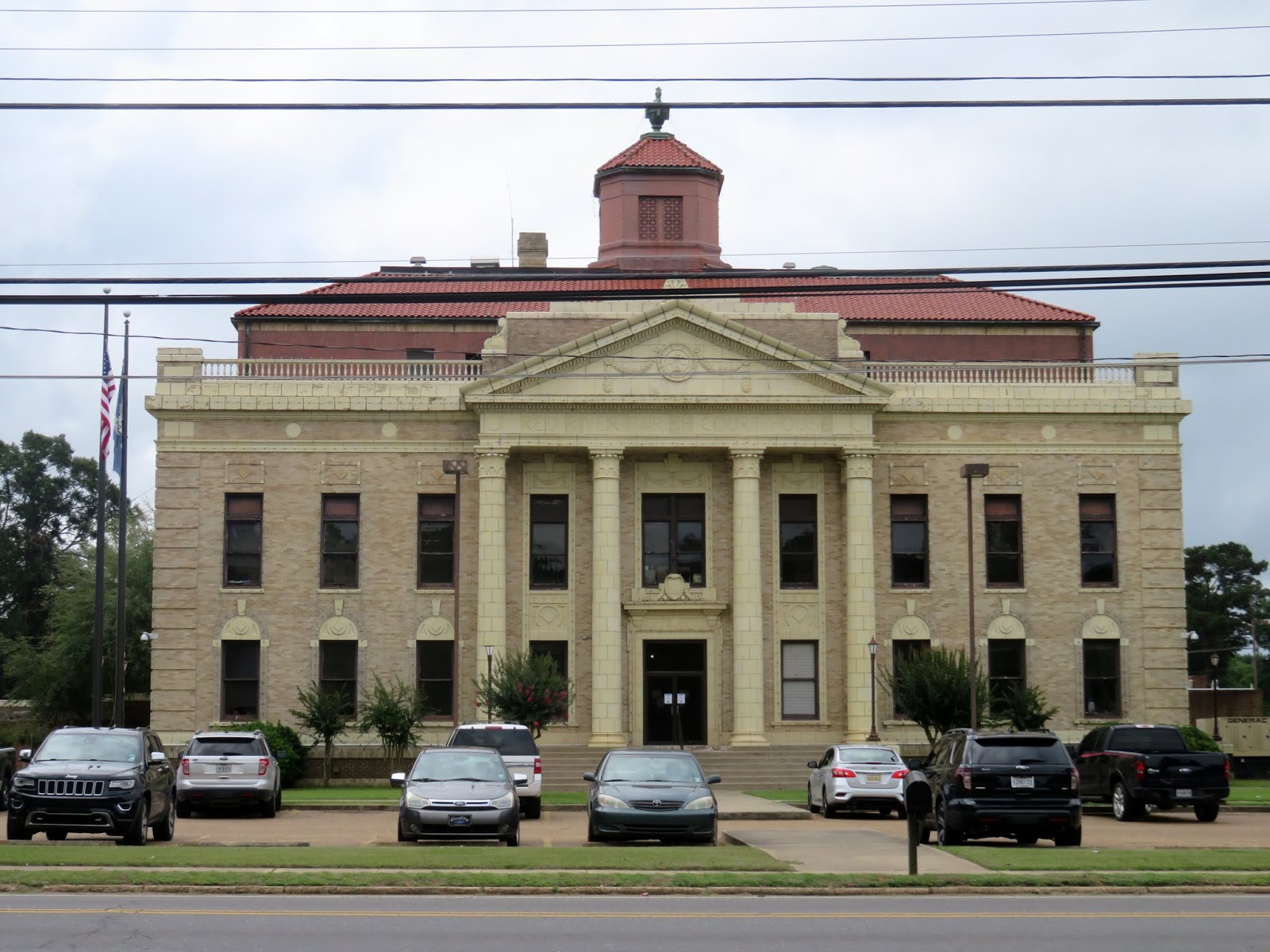
This is the Red River Parish Courthouse in Coushatta Louisiana.  It was built in 1926.  Coushatta, which is located on the Red River, is about 45 miles south of Shreveport.  Like many rural towns across America, the population is declining…from 2,299 in 2000 to an estimated 1,841 in 2016.
 
Red River Parish and the Red River Valley were areas of white vigilante and paramilitary violence after the Civil War, as insurgents tried to regain power after the South's defeat.  In 1871, during Reconstruction, the state legislature created the parish as part of their effort to develop Republican Party strength and disenfranchise former slaves. 

Formed in mid-1874 from white militias, the “White League” was formed in the Red River Valley in nearby Grant Parish.  In the summer of 1874 the White League forced 6 white Republicans from office in Coushatta and ordered them to leave the state.  League members assassinated them before they left Louisiana.  Among the men murdered were the brother and 3 brothers-in-law of state Senator Marshall Twitchell.   The White League also killed between 5 and 20 freedmen who had accompanied the Twitchell relatives and who were witnesses to the vigilante violence. 


This is the former railroad depot in Coushatta Louisiana.  Although I couldn’t determine when it was built, I did learn that it served 3 different railroads in its operating history… They were the Louisiana Railway and Navigation Co., Louisiana and Arkansas and the Kansas City Southern Railroad.  The old depot has been preserved and it’s currently being used by the Red River Council on Aging.

The Louisiana Railway and Navigation Co., (also known as the “Edenborn Line”), was a railroad that that operated from 1903 to 1934 between Shreveport and New Orleans Louisiana.  At its peak this railroad had 45 steam locomotives, 1,305 freight cars and 32 passenger cars.  It has the distinction of being the only railroad in the USA that was owned by one person…and that was Mr. Edenborn. 

  
Our next stops were in Texas along US Hwy. 84 at the home (and related depots) associated with the Texas State Railroad.  The western end of this tourist attraction is set in a park-like setting in Rusk Texas.  We thought that this entrance “sculpture” was quite eye-catching and creative.


The Rusk Texas Depot for the Texas State Railroad is a nicely done replica.  We thought that the stonework was quite eye-catching.
 
This park and the one at Palestine Texas are both associated with the Texas State Railroad.  Originally, the parks were operated by the Texas Park and Wildlife Division of state government.  But in 2007 operational control of the both parks was transferred to American Heritage Railways.  That company operates the Durango and Southern Narrow Gauge Railroad in Colorado and the Great Smoky Mountains Railroad located in Bryson City North Carolina.  Operators of the railroad have changed twice since American Heritage Railways ran the line.

 
Love the authentic look, don’t you?! 

The Texas State Railroad is a historic 25 mile long railroad between Rusk and Palestine Texas.  It was founded in 1881 by the state of Texas to haul freight.  Regular service on the line was ended in 1921.  The state leased the line to private companies until 1969 then it was turned over to the Texas Parks and Wildlife Department in 1972.


Today, vintage steam and diesel locomotives take passengers in early 1900s passenger coaches across the rails of this East Texas Piney Woods Route between the towns of Palestine and Rusk for a 50-mile round trip.  Trains usually operate on Fridays, Saturdays and Sundays on through December.

Fares depend on the day scheduled and whether or not the train is powered by diesel or steam locomotives.  Adult fares in coach are $59.95, first class are $84.95 and Presidential class fares are $99.95.  Children’s fares range from $39.95 to $59.95…coach and first class only.  Seniors fares range from $54.95 in coach up to $89.95 for Presidential class.


This is a rail side view of the replica Rusk passenger depot. 

How was the Texas State Railroad built?  In 1881 prisoners from the East Texas Penitentiary built the first 1.3 miles of railroad track.  It wasn’t until 1909 when the final ties and rails were in place, linking Rusk with Palestine.  FYI…the original purpose of the railroad was to transport raw materials for the iron smelter that was located at the Rusk Penitentiary.


This vintage baggage/Railway Express car is on display at the Rusk depot.  As it was mid-week, the depot was closed. 


A replica water tower has also been built next to the Rusk Texas State Railroad’s depot.  I’m sure it services the steam locomotives that plie this tourist railroad line. 


This is the Texas State Railroad’s Depot in Maydelle Texas.  It was really raining when Laurie took this photo!  It’s located about mid-way between the Rusk and Palestine Depots.  An old railroad turntable is located close by but it was difficult to photograph because of the rain and a lot of tall grass. 

From what I could determine, this depot was originally a house that was converted to a depot so it could serve as a movie prop.  In 1910, the steam engine pulled trains of the Texas State Railroad rolled through the piney woods between Rusk and Palestine for the very first time.  This happened because Governor Thomas Campbell had ensured that his good friend and ex-governor James Hogg’s vision for this rail line was completed.   The founders of this newly platted town between Rusk and Palestine were so grateful that they named their settlement after Governor Campbell’s daughter, Maydelle. 


This is another replica depot in a park.  It’s the Texas State Railroad’s Depot in Palestine Texas…at the western end of this historic railroad.  This is a close as we got to the depot.

The Texas State Railroad operates a variety of steam and diesel locomotives on their 25 miles of track.  The locomotives date from 1901 to 1953.  They include:

·       1901 A.L. Cooke # 316 (4-6-0 Ten Wheeler Class) (Steam)

·       1911 Baldwin Locomotive Works #500 (4-6-2 Pacific Class) (Steam)

·       1917 Baldwin Locomotive Works #28 (2-8-0 Consolidation Class) (Steam)

·       1917 Baldwin Locomotive Works #7 (2-8-2 Mikado Class) (Steam)

·       1947 Alco-GE #7 (RS2 Diesel)

·       1953 Alco-GE #8 (MRS 3 Diesel)


There were a lot of distressed old railway cars of different types on sidings in the Texas State Railroad’s rail yard.  This sleek combination coach and baggage car stood out in contrast to much of the other rolling stock.

For more information about the Texas State Railroad, you can go to http://texasstaterailroad.net/.

In addition to this reproduction depot and its railyard, Palestine Texas has a second depot and this one is an original…


This is the Palestine Texas Visitor Information Center.  It’s housed in the former Neches Texas combination passenger and freight depot that was moved to this site.  This depot was built in Neches during the late 1890s for the International – Great Northern Railroad.  Any remaining trackage that belonged to the International – Great Northern Railroad is now part of the Union Pacific system.    

For information about Palestine Texas and its tourist opportunities, go to http://www.visitpalestine.com/.

Notes:

·       Palestine Texas has 23 historical sites listed on the National Register of Historic Places.

·       The biggest employers in Palestine are the Texas Department of Criminal Justice along with 2 big Wal-Mart distribution centers.

·       Palestine was one of the East Texas towns that received much of the debris from the Space Shuttle Columbia disaster in which 7 astronauts were killed.

·       That historical plaque in front of the Visitor’s Center provides some history on Palestine’s somewhat infamous former town marshal and gunman, Christopher Columbus Rogers.  He is alleged to have killed 12 men before he was stabbed to death.  To learn more, go to https://en.wikipedia.org/wiki/Christopher_Columbus_Rogers.

Just click on any of the photos to enlarge them…

Thanks for stopping by to check out some of the sights along our route!

Take Care, Big Daddy Dave