Showing posts with label Collectibles. Show all posts

Friday, February 14, 2025

Odds and Ends Around Our Home

...taking yet another break from our October 2024 road trip blog spot 'saga'.  This time its all about 'not much', or as the title reads...just odds and ends. 


What a difference just two years make!  While the seasons are obviously not comparable/matchy-matchy, the view from our front yard tells the story.  None of the houses in the second photo existed about 2 years ago...and, while the building in the area continues, demand has dropped off so new construction has slowed as well.  


As winter's end approaches, Laurie and I are digging through drawers, closets and boxes, rediscovering 'stuff' as well as heirlooms that we'd sort of forgotten about.  One 'discovery' of note was this half-moon petit point rug.  It was made by my grandmother, Estelle Sibbald Weed, back in 1951.  It now complements an antique brass double bed that Laurie and I bought many, many years ago.


Grandma Weed also created this much larger (roughly 4' x 6') oval petit point rug that we have on the floor in the middle of our bonus room.  We have both of them in locations that keep them out of direct sunlight so they won't fade.  The larger rug has to date somewhere between 1950 and 1952.  Just another 25 years or so and both rugs will qualify as antiques... 

Petit point is a type of canvas embroidery.  These items are worked on an even-weave needlepoint canvas instead of a tightly woven fabric.  A blunt-tipped tapestry needle is used to create petit point pieces.  Petit point is more difficult/complex than needlepoint.


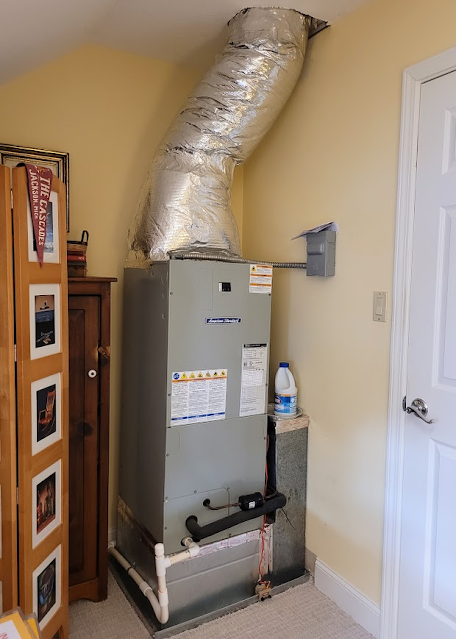
These photos show one corner of the dormer room in our home in which I pay bills, focus on my postcard and other collections, and more... I have bookcases, a nice desk and artwork on the walls.  As you can see, I've been sharing this room with this big HVAC unit.  For the last 15+ years, I've been 'hiding it' with that folding screen that I 'improved' with photos from my annual Smithsonian week by week calendars.  

FYI, until last year the room also featured ugly indoor/outdoor carpeting.  We never understood why the dormer rooms weren't carpeted like all the other rooms on the second floor of our home.  


So recently we had a closet built for the HVAC unit, using folding doors so the unit can be serviced as needed.  For those that are attentive, the unit needs to breath and the cold air return vent is in the hallway outside on the other side of the wall on the right... In any case, I now have a much nicer view as I pay the bills!


A week or two ago, Laurie and I were at Terry's home.  She is our new neighbor and she live right behind our house.  There is a narrow strip of woods and brush between our homes and it does attract critters.  We've seen Mr. Fox before, most recently trotting down the street in front of our house.  Of course, we didn't have a camera on hand at the time.  This time, Mr. Fox was foraging for mice, voles, and other rodents along the tree line in Terry's backyard...and Laurie had her new smart phone at the ready!  


Some cabinets and drawers in the kitchen were recently 'deconstructed' as regarded their contents.  We have so too much stuff, much of which we don't use.  In addition, reorganization was badly needed.  As a consequence, we loaded up that laundry basket with items we don't need or use, much of which will be donated to some deserving organization.  As for those 17 glass plates, (or are they chargers?), neighbors Sue and Steve entertain more than we do so the plates have a new home.  

What else will we discover this spring as we root through the closets, nooks and crannies in our home?  More items for charity, some throwaways and perhaps a few things to sell on "Nextdoor"...  

That's all for now.  Just click on any of the photos to enlarge them.

Thanks for stopping by for a visit!

Take Care, Big Daddy Dave

Friday, January 24, 2025

Art Museum with Focus

...returning to our October 2024 road trip, I'd left off with our visit to The Rockwell Museum in Corning New York.  As I'd mentioned previously, the Rockwell family, had contributed their extensive art collection and that was the foundation of today's artistic accumulation.  While the Rockwell family had focused on art related to the western United States, the collection is much broader than that.  However, you will note that I was drawn to the western theme as well as a few 'quirky' works of art.


At first glance, this may not strike the viewer as a work that is tied to the western USA or American Indians.  Constructed by Marie Watt, (1967 - ), it is titled "Blanket Stories: Western Door, Salt Sacks and Three Sisters".  To construct this artistic statement, a regional call for blankets went out and families across western New York State provided the necessary items.  

Watt works primarily with blankets as a material in her installations and collaborative works.  "These blankets serve as markers of collective memory and each one represents an individual story."  Marie has a Masters Degree in Fine Arts from Yale University.  She is a member of the Turtle Clan of the Seneca Nation and her father's family were ranchers in Wyoming.  For more about the artist, go to https://en.wikipedia.org/wiki/Marie_Watt.


This painting by Stephen Towns (1980 - ) is titled "Hair Lessons".  Towns uses labor as a theme, highlighting the role that African Americans have played in the economy.  His works explores their resilience, resistance and endurance.  To learn more, you can go to to https://en.wikipedia.org/wiki/Stephen_Towns.  Additional works by Towns are included later in this blog post.


This is a lithograph on paper that was created by Thomas Hart Benton. (1889 - 1975) Benton was an artist, muralist and printmaker.  Part of the Regionalist art movement, his works depicted everyday people in everyday settings.  This 10" by 14" limited edition lithograph with a certificate of authenticity can be purchased on-line for $4,400.00. 

Benton was born in Neosho Missouri.  His father was a 4-term US Congressman, and he named his son after his own great-uncle, Thomas Hart Benton, a former US Senator from Missouri.  Despite his father's wishes that his son go into politics, with his mother's support and financial backing, Benton studied art at the Art Institute of Chicago and later he continued his education in Paris.  To learn more, go to https://en.wikipedia.org/wiki/Thomas_Hart_Benton_(painter).


This painting by Olaf Wieghorst (1899 - 1988) is titled "Appaloosa".  Wieghorst is known for his portrayals of the American West.  He had an affinity for the cowboys, Native American Indians and the settlers who helped shape America's western landscape.  Olaf came to the US as a Danish teenager serving as a cabin boy on a steamship.  After living in New York for a bit, he joined the US Army, serving with the US 5th Cavalry along the US/Mexican border.  When he returned to New York he joined the Police Department's mounted division.  After some success with his artwork, he married a girl from Brooklyn and they moved to El Cajon California where they lived for the rest of their lives.  

Olaf was known as a portrait artist...but it was due to his portraits of horses.  Among others, he painted Gene Autry's Champion,, Tom Morgan's stallion and Roy Rogers' Trigger.  By the end of his long career, Olaf had sold thousands of paintings.  He became the highest paid living artist of his time.  He even appeared in 2 movies with John Wayne and he had paintings hung in the White House.

To learn more about Olaf Wieghorst just go to the website of the Olaf Wieghorst Museum.  It's located in El Cajon California.  His last home was also moved to the museum grounds.  Check it out at https://wieghorstmuseum.org/.


This painting is titled "The Gunslinger".  It is oil paint on board and it was completed by Frederic Sackrider Remington ca. 1889.  Remington is one of the premier American artist who depicted the American West in the late 1800s.  Remington was a painter, illustrator, sculptor and writer whose works focused on the cowboys, American Indians and the US Cavalry.

Early in life he struggled to find his way in life.  He wasn't a serious student but he evolved as an artist and began making a little money through his artistic efforts.  In 1866 Harper's Weekly sent Remington to Arizona to illustrate the US Army's campaign against the Apache Chief, Geronimo.  Another significant opportunity was his commission to create 83 illustrations for a book by Theodore Roosevelt.  Remington was prolific and he is highly regarded today.  Many of his paintings and sculptures have sold for hundreds of thousands and even millions of dollars.

To learn much more about Frederic Remington, a good place to start is with Wikipedia where many other sources are provided.  Website: https://en.wikipedia.org/wiki/Frederic_Remington.


This painting is titled "Sun River War Party".  It was painted by Charles Marion Russell, aka C.M. Russell in 1903.  "Kid" Russell created more than 2,000 paintings plus bronze sculptures featuring cowboys, Native Americans and landscapes set in the western United States and Alberta Canada.  He was known as "the cowboy artist" as well as a storyteller and author.  Russell became an advocate for Native Americans in the west and was instrumental in the creation of the Rocky Boy Reservation for the landless Chippewa Nation covering 171 square miles in northern Montana.

Russell's career took off when he was working as a cowboy on a ranch.  The foreman got a letter from the owner asking how the cattle had weathered the winter.  As a response, the foreman sent him a small watercolor painting Russell had completed, showing a gaunt steer being watched by wolves under a gray winter sky.  The ranch owner showed the watercolor around and even displayed it in a storefront window in Helena Montana.  After that, commissions for new works began flowing in for Russell.

The C.M. Russell Museum in Great Falls Montana features more than 2,000 of Russell's artworks, personal objects and artifacts.  Russell produced roughly 4,000 works of art including oil and watercolor paintings, drawings and sculptures in wax, clay, plaster and bronze.  To learn more about the museum, go to https://cmrussell.org/.  For more information about Russell, go to https://en.wikipedia.org/wiki/Charles_Marion_Russell.


Not all artworks are paintings or sculptures.  Some items that show a true artistic flair, were actually utilitarian or even served as deadly weapons.  The item at the top of this showcase is a ca. 1820 Pipe Tomahawk.  It features a European manufactured steel head...pipe and hatchet...attached to a carved pipestem.  They were given to Native Americans as gifts of friendship or to mark treaty signings.

The second item is a Ball-Headed War Club.  Created from hickory in the mid-1800s, these clubs were used as deadly weapons for close-in fighting by Eastern Woodlands Native American cultures.  Even after the introduction of firearms to Native Americans, many still carried these clubs.  


The central object in this showcase is a Native American's beaded jacket from roughly 1880.  Contact with Europeans led to changes in trade for Native Americans as well as life in general.  Trade goods including iron tools, cloth/textiles, firearms and beads, served as change agents to previously observed ways of life.  This particular men's jacket was made using leather, cotton, wool, glass beads and brass buttons.  

Below the jacket a Native American fringed woven sash is displayed along with 2 beaded purses.  The cane at the left has a carved hand where one would grip it.  The cane on the right is an effigy cane or walking stick.  The carved finial at the top of these canes can represent a person, animal of object.  Effigy canes were considered to symbolize age and wisdom.


This is a Native American Cradleboard or "Ga-on-seh" (Mohawk), made ca. 1865.  Eastern American Woodland Cultures (Haudenosaunee) infants were swaddled in rigid cradleboards made of wood although other Native American tribes used other materials for the same purpose.  This beautifully decorated cradleboard shows off flowers, birds and ornamental vegetation...definitely a labor of love.

To learn much more about cradleboards, including their construction and use around the world, go to https://en.wikipedia.org/wiki/Cradleboard.


This stunning sculpture is entitled "The Last Dance" and it was cast in bronze in 2012.  The artist is Michael Naranjo (b 1944) (Tewa Tribe/Santa Clara Pueblo).  Michael is blind, having lost his sight while serving with the US Military in Viet Nam.  He sculpts by touch and feel, creating forms and textures that are meant to be seen and felt.  Unlike almost all other museum displays, this sculpture is clearly signed "Please Touch".

Michael Naranjo's works are on permanent display at The Vatican and at the White House in addition to many museums.  Learn more about his work at https://en.wikipedia.org/wiki/Michael_Naranjo.  To learn more about the Santa Clara Pueblo in New Mexico, just go to to https://en.wikipedia.org/wiki/Santa_Clara_Pueblo,_New_Mexico.


Given the ornate designs and the symmetry of the ceramic pottery shown above, there is no doubt about the skill of their creators.  All of them are Acoma Pueblo items.  The first one is a bowl from ca 1920, the second one is an olla, ca 1890, and the third is another bowl ca. 1925.  

FYI, an olla is a ceramic jar, often unglazed, that is used for cooking stews or soups, for the storage of water or dry foods and even for other purposes, (if unglazed), such as irrigation of crops.  Ollas have short wide necks and wider bellies.


Laurie and I would highly recommend a visit to the Acoma Pueblo.  It's been occupied for about 2,000 years and a small number of Native Americans still live there today.  There is no running water or electricity although a road has been carved up one side of the mesa to allow supplies, tribal members...and tourists...easy access.  It is a glimpse back in time... We do have a small glazed bowl that we purchased during our visit.  Learn more at  https://en.wikipedia.org/wiki/Acoma_Pueblo and at the Pueblo's website,  https://www.puebloofacoma.org/.


This painting by Ernest Leonard Blumenschein (1874 - 1960) is titled "Jury for Trial of a Sheepherder for Murder".  Completed in 1936, the painting "illustrates the tensions between traditional Hispanic customs and the newly introduced American Legal System in New Mexico".  Viewers are in the position to see what the accused would have seen.

Blumenschein was a founding member of the Taos Society of Artists.  He's especially noted for his paintings of Native Americans, New Mexico and the American Southwest.  The style of painting of the Taos artists decisively influenced the perceptions that the wider world had of the American Southwest, and specifically of the Pueblo and Navajo Indian peoples.


Art takes many forms.  This photo was taken in 1981 and it's medium is color inkjet on paper.  It's titled "Fisherman Brooks Cambell makes Liniment - Cedar Key".  FYI, Cedar Key is a very much off the beaten track island on the upper west coast of Florida...aka "The Lost Coast".


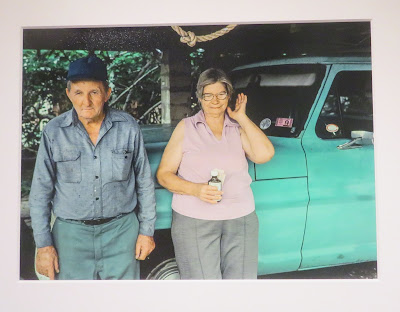
This color inkjet on paper photograph was also taken in 1981.  It shows "Sister Tommie Kaison, 108 years old, and Susanna Harteld, 110 years old, at family farm where they were born in the Florida panhandle, Two Egg, Jackson County.


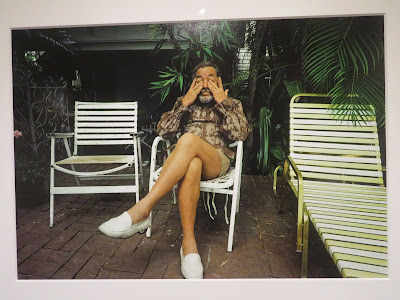
This photograph used the same medium or process as the previous two... Also from 1981, this is author and playwright "Tennessee Williams, Key West".

The photographer who created these inkjet on paper photos is Nathan Benn (b 1950).  Benn worked as a contract photographer for National Geographic from 1972 through 1991, with 300 of his photos being published by the magazine.  The film used by Benn was Kodachrome.  Photo buffs know that this color film was much appreciated for capturing rich colors and complex lighting.  In 1991, he put down his camera, becoming co-founder and President of Picture Network International, the earliest Internet digital asset management and online stock photo licensing platform.

In 1991, Benn became the co-founder and President of Picture Network International (PNI), the earliest Internet digital asset management and online stock photo licensing platform.  In 1998, Eastman Kodak purchased PNI...and later it was sold again, this time to Getty Images and Bill Gates.


This work is quite new.  Created in 2024, it is titled "Motown in Motion".  It was constructed using both natural and synthetic fabric, polyester and cotton thread, crystal glass beads plus metal and resin buttons.


This work is by the same artist as was "Motown in Motion".  In this instance, the work is titled "The Match at Paradise Park".  It was painted using acrylics and metal leaf on a panel.  

The artist who created both works, as well as the ladies in the beauty shop shown previously is Stephen Towns. (b 1980) Born in Lincolnville South Carolina, Towns was the youngest of 11 children.  He has a Bachelor of Fine Arts in Painting from the University of South Carolina.  

Towns' artistic works are on display in many museums.  Among them are the Nelson-Atkins Museum of Art in Kansas City Missouri, the Baltimore Museum of Art, the Smithsonian National Museum of African American History and Culture and, the National Portrait Gallery.

We took many other photos at the Rockwell Museum in Corning New York.  We definitely enjoyed our visit!  To learn more about this museum, just go to https://en.wikipedia.org/wiki/Rockwell_Museum, and the museum's website at https://rockwellmuseum.org/.

Just click on any of the photos to enlarge them...

Thanks for stopping by for a visit!

Take Care, Big Daddy Dave

Tuesday, January 14, 2025

Wellsboro Pennsylvania

...continuing with our October road trip through parts of Tennessee, Kentucky, Ohio, West Virginia, Pennsylvania, New York and Virginia.  Our next stop was Wellsboro Pennsylvania.  It had been highly touted in the on-line 'travel-verse' as one of the best small towns to visit in the state. 


The Penn-Wells Hotel opened for business in 1870, although it was initially knows as the Cone House after the owner's name.  A.P. Cone actually built his hotel on the site of a previous hotel that had burned down in 1866.  Next it became the "Holiday Inn" as it was owned and operated by a fellow named B.B. Holiday.  Then it became the Parkhurst House and finally Coles House.  A fire in 1906 destroyed the 3rd and 4th floors.  

The hotel was reborn as the Penn-Wells in the mid-1920s as the area welcomed an increasing number of leisure travelers.  Elements of the structure from 1869 have been preserved and the old time elegance of the interior includes 1920s era finishings and decor.  Note the American flag in the second photo above.  It was created for a Corning Glass Works Christmas party in 1946 with the end of WWII.  It's made up with 1,438 glass Christmas ornaments.  To learn more about the Penn-Wells Hotel and it's sister Lodge, go to https://www.pennwells.com/.


This two-story red brick building in downtown was constructed in 1880.  It is part of the Wellsboro Historic District as list on the National Register of Historic Places.  The Historic District covers 360-acres and it includes 531 contributing buildings, 3 contributing sites and 4 contributing objects.  The properties include commercial structures, churches, residential areas, a park and 2 historic cemeteries.  As happens all to frequently, the paper work that was submitted to qualify the area for the National Register has never been input into the tracking NRHP system so detail is hard to come by...

Historically, in the early 1900s, Wellsboro was a shipping point and trade center for a large area.  It had fruit evaporators, flour and woolen mills, a milk-condensing plant, marble works, saw mills, a foundry, machine shops and manufacturing companies producing cut glass, chemicals, rugs, bolts, cigars, carriages and furniture.  In 1900, there were 2,945 residents and in 1910 there were 3,183.  Today the town is home to about 3,458 people.

Note: The biggest attraction in the area is the Grand Canyon of Pennsylvania.  Officially Pine Creek Gorge is a 47 mile long gorge carved into the Allegheny Plateau by Pine Creek.  It's deepest point is 1,440 feet from the rim and the rim to rim distance is about 4,000 feet.  To learn more, just go to http://en.wikipedia.org/wiki/Pine_Creek_Gorge.  We skipped it due to my Afib issues and the walking entailed...


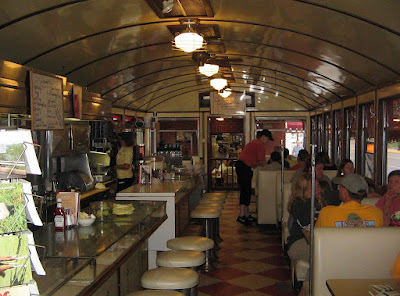
The Wellsboro Diner remains unchanged from the time it opened in April of 1939 at the town's busiest intersection.  This is a Sterling Diner (#388 - eighth one built in 1938 by J.D. Judkins Co. from Massachusetts.  It was originally named Schanacker's Diner.  I borrowed the interior photo from the Internet.  Located at 19 Main Street, the diner has a stainless steel exterior, a low-arched roof and pale green porcelain walls.  The owners changed the diner's name to Wellsboro Diner in the 1960s.  It wasn't time to eat yet, so we didn't sample their diner fare... The Diner is on Facebook at https://www.facebook.com/p/Wellsboro-Diner-100089417522142/.


I didn't find much information about this handsome United Methodist Church at 36 Main Street in Wellsboro.  The Gothic Revival style structure replaced an older Methodist Church in 1905 at the same location.  The previous building had been deemed unsafe for use in 1900.   The entrance to the church features a lintel stone from the Old Rectory in Epworth, Lincolnshire England...the original home of the Wesley family.


As in Ridgway Pennsylvania, Laurie was a bit disappointed with the number and quality of shopping opportunities in Wellsboro.  Still, she managed to find a couple of promising shops to peruse.  This Victorian style home at 15 Main Street offers two floors of antiques, collectables, gifts and home decor possibilities.  Learn more at https://www.facebook.com/p/Karens-Country-Store-100050564600457/.


When Wellsboro's Arcadia Theatre opened in December of 1921, it had one screen and it could seat 900 patrons.  The first film was of course a silent movie entitled "The Old Nest".  Having been built to show silent films, the theatre was equipped to provide the musical equipment needed...an organ, a piano and even an orchestra box.  In 1929, the Arcadia became one of the first theater in the northern states to start showing "talkies".

In 1987, the Wellsboro Hotel Company, owner of the Penn-Wells Hotel and Lodge, purchased the theatre.  With the success of television, the theatre's attendance and it's condition declined. However, in 1996, the theatre was completely renovated.  In March of 1997, it reopened as a state of the art 4 screen cinema...while preserving that classic old-time theatre feeling.  Special features now include "Dinner and a Movie" and live theatrical shows have been added and the theatre is prospering... Learn more at https://arcadiawellsboro.com/.


The Tioga County Courthouse, or at least the core building, was completed in 1835.  The architectural embellishments evident today came along much later.  For nearly a century, this courthouse was a trim but modest Federal-style 'block' built with dressed local sandstone.  By the 1920s local politicians decided that they wanted a more distinctive structure to represent the county.  Consequently, a Scranton Pennsylvania based architect replaced the two-over-two windows with nine-over nine windows.  He also added a rear wing, added a Federal-style entrance with the fan-light window and he erected the Corinthian portico with those impressive columns.  Further expansions have added to the original structure as the county's needs increased.


This red brick building at 114 Main Street is the former Tioga County Sheriff's residence.  It was built in 1860 at a cost of $10,000.  Later, until 1985, it served as the County Jail.  The structure is now the home of "Develop Tioga", "Wellsboro Chamber of Commerce", and "Growth Resources of Wellsboro".  Unfortunately I didn't capture a picture of the elm tree in at the front of the building.  It is one of the largest in existence and has been growing since sometime in the 1700s.


This is Wellsboro's "Green Free Library".  As you can see, it is not your typical small town (or large town) library!  The library was the former home of a wealthy lumber baron and banker.  It was built in 1855.  The home was remodeled by the owner's daughter in 1898 and it was named "Chester Place".  The woodwork is top notch.  Note the classic grandfather clock in the corner.  The former home also features a marble fireplace and a Tiffany window.

In 1910, citizens of Wellsboro organized a group to raise money to open a public library.  In 1911, Charles S. Green, a wealthy local lumberman bequeathed $50,000 for the incorporation of a "Green Free Library" in Wellsboro.  The owner and her heirs donated the home to the Green Free Library in 1916.  After some remodeling, the Green Free Library moved from its temporary location in a vacant storefront to "Chester Place", which opened in 1917.  Learn more at https://greenfreelibrary.org/.


The Jesse Robinson House or Manor at 141 Main Street in Wellsboro is a three-story Queen Anne style home that was built in 1888.  It is listed on the National Register of Historic Places.  This 5,342 square foot home, located on a half acre of land features stained glass windows and two prominent balconies.  In the past it has served as a hospital as well as home for several owners.  Currently it serves as a residence and dentist office.


This eye-catching Italianate home at 140 Main Street in Wellsboro was built ca 1850.  It's known as the "Lincoln Door House".  That red front door of the residence is purported to have been a gift from Abraham Lincoln to Dr. and Mrs. J.H. Shearer when they purchased the home in 1858.  Allegedly the door came from a building in Springfield Illinois.  It is well documented that the Shearers were close friends with Lincoln when they lived in Springfield.  While no one has been able to document the door's origins, it certainly may be a true story...


Laurie would have loved to browse through this shop at 6 East Avenue in Wellsboro!  She's always been interested in the possibilities of the supernatural.  Unfortunately, "Enchanted Hollow" was closed when we stopped by. (Probably fortunate for my wallet!) In any case, Enchanted Hollow sells, crystals, oils, incense or witch balls and they say that they have "your Faery, Witchy and Angel needs all covered".  You can check this store out at http://www.enchanted-hollow.com/.


As we rolled east out of Wellsboro toward Mansfield Pennsylvania, Laurie got lucky when we spotted The Farmer's Daughters Antiques and Gifts shop along US Hwy 6.  They offer lodge and cabin decor, antiques, re-purposed furniture, unique lighting and (unfortunately for me) candles...as well as a year-round Christmas room.  After helping the local economy at Farmer's Daughters, we headed down our final stretch of highway to our overnight stay in Mansfield.  For more about this shop, go to https://www.thefarmersdaughtersshop.com/ 

Just click on any of the photos to enlarge them...

Thanks for stopping by for a visit!

Take Care, Big Daddy Dave

Friday, December 6, 2024

A Sunday in October - Marietta Ohio

It was a Sunday in October and we were on our road trip from eastern Tennessee to western Tennessee, across Kentucky from west to east, and then along the Ohio River to Marietta Ohio.  What to do on a Sunday?  Other than big box stores and chains, most smaller retailers tend to close on Sundays.  Some local attractions close as well.  A bit of research and I knew what our first stop after our 'yummy' breakfast at the Hampton would be.


Fortunately for me...and for Laurie...the Antique Mall of Marietta at 135 2nd Street was open for business!


This antique mall...made up of individual booths who lease the space...is huge and it was loaded with all kinds of antique, vintage and not-so-vintage items for us to browse through.  I'm pretty sure that we made a purchase or two...but I'm not sure what they might have been.  Learn more about this antique mall at https://www.facebook.com/AntiqueMallofMarietta/.


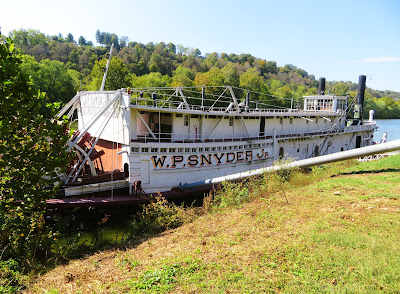
Our next stop was at the Ohio River Museum with the W.P. Snyder Jr. Towboat.  The museum is located at 601 Front Street in Marietta along the Muskingum River...a tributary of the nearby Ohio River.  We knew that it was closed but I wanted to see the old towboat and whatever else might be visible at the museum site. (The closed museum can be seen in the background of this photo as well as next 2 pictures)

Shown above is the Tell City pilothouse.  The steamboat Tell City was build in 1889.  She was named after Tell City Indiana and she carried passengers and freight on the Ohio River until she sank at Little Hocking Ohio in 1917.  The pilothouse was removed from the wreck and it served as a summer house on the front river lawn of a family in Little Hocking for many years.  Eventually, it was gifted to the Ohio Historical Society for inclusion among the historic displays at the Ohio River Museum here in Marietta.  It is the oldest surviving pilothouse from the era that Mark Twain wrote about.

I included this photo of the bicycle rack at the Ohio River Museum because I thought that the design was both creative and useful.

So why is the Ohio River Museum closed...and it apparently will be for some significant period of time.  The plan is that a new museum will be constructed on the site.  Partners in the project include several different historical groups based in Ohio.  From what I can determine, the museum has been closed since at least some time in 2022.  One article I ran across stated that the museum is scheduled to reopen in 2025.  That date is highly dubious... I didn't find any on-line updates for construction or a reopening, but perhaps I just didn't ask the right questions.


This is a restored "Shanty Boat" on display on dry land at the Ohio River Museum.  It may be the oldest and possibly the only surviving shanty boat along the Muskingum River.  Referred to as the Schoonover Shanty Boat, that family acquired the shanty boat from a family in Lowell Ohio back in 1968.  The Schoonover family used it as a cottage until it was donated to the Sons and Daughters of Pioneer Rivermen in 2010.  

It was believed that the boat was left high and dry during the 1936 Ohio River flood and that it had previously served as a fishing cottage.  Inside the refurbished shanty boat there is a small 'kitchen' area, a bit of storage, a bunk bed and other items from the 'shanty boat era'.  This shanty boat was built ca. 1920s.  These boats were small floating houses made out of salvaged materials.  They traveled the river system in the USA, allowing people to find new job opportunities by traveling from one river town to another.


This, in my opinion, is the "pièce de résistance" of the Ohio River Museum.  She is the W.P Snyder Jr., a historic towboat/pusher that is moored on the Muskingum River.  She is a National Historic Landmark and she is also the only intact, steam-driven sternwheel towboat remaining.  The towboat has a draft of only 5 feet 2 inches, she's 175 feet long and she's powered by twin compound steam engines developing 1,500 horsepower.

This towboat was originally built for the Carnegie Steel Company by Rees and Sons Company in Pittsburgh Pennsylvania.  In 1945, she was sold to the Crucible Steel Company of Pittsburgh and she was renamed the W.P. Snyder Jr. in 1945.  She towed coal on the Monongahela River until she was laid up in 1953 at Crucible Pennsylvania.  In the summer of 1955 she was given to the Ohio River Museum.


As I looked down the Muskingum River toward its juncture with the Ohio River, I noticed that a more modern form of 'shantyboat' may still survive.  Certainly floating home exist around the USA.  The Portland Oregon floating home community consists of around 1,400 dwellings, making it the largest in the country.


This is the historic Mound Cemetery in Marietta Ohio.  This historic cemetery was developed around the base of a prehistoric 'Adena' or Hopewell burial mound which is know as the "Great Mound" or "Conus".  The city's founders preserved the Great Mound from destruction by establishing the city cemetery around it in 1801.  This cemetery has the highest number of burials of American Revolutionary War officers in the USA.


As we circled the cemetery we got a good look at the one of the two platform burial mounds in the Mound Cemetery.  I was a bit taken aback by the benches situated on top of the mound.  These 2 mounds are part of an Ohio Hopewell culture mound complex known as the Marietta Earthworks.  It's been estimated that the complex was built between 100 BC and 500 AD.  When the Earthworks were originally surveyed in 1838, the complex included a large square enclosure surrounding 4 flat-topped pyramidal mounds, another smaller square and a circular enclosure with a large burial mound at its center.


A prominent land speculator named Nahum Ward founded the Unitarian Society in Marietta back in the winter of 1855.  He served as Mayor of Marietta and he was quite the socialite.  He held a reception for the Marquis de Lafayette in 1925 and in 1843, John Quincy Adams was his guest of honor.  In January of 1855 he placed a notice in the Marietta Intelligencer asking 'all friends of liberal Christianity to assemble at the Court House for the purpose of establishing a Unitarian Society in the community.  

Construction of the Unitarian Universalist Church began later that year and in June of 1857, this church was consecrated.  Mr. Ward paid $25,000 for construction of the church and, when it was complete he sold it to the congregation for one dollar.  The Gothic design of the church was based on a chapel that Ward had admired on a visit to England.


This is the former Becker Lumber and Manufacturing Building at 121 Pike Street in Marietta.  Becker Lumber started business in 1888 and in 1901 they moved to this 4-story quasi-Dutch colonial brick behemoth.  Later the company became known as Croy-Marietta Hardwoods.  The structure is 64 feet wide and 112 feet long and its listed on the National Register of Historic Places.

Today, this large structure has been repurposed into a modern apartment building providing homes for many.  It's called Marietta Mills Apartments and it still has the original drop ceilings from the roof top, original ceiling beams on the bottom floor...and all the exposed brick on the interior is original.  It houses about 50 residents in one and two bedroom apartments.


When we drove through the area where the Mound Cemetery was located, we noted a number of handsome old homes...and several of them had historical markers in front of them.  This particular home was built in 1852 for J.B. Shipman.  Then in 1877 it was purchased by Elizabeth and Marietta College Professor J.L. Mills.  Descendants of the Mills family lived in the home until 1961.  Although it doesn't seem to have endured for long, Professor Mills also established the Elizabeth College for Women in 1893.

That's all for now.  Just click on any of the photos to enlarge them...

Thanks for stopping by and spending some time sightseeing and shopping with us!

Take Care, Big Daddy Dave