Showing posts with label Trolleys. Show all posts

Friday, October 20, 2023

A Blast From the Past (Part 3) - Harold Warp's Pioneer Village

…continuing with my much abbreviated tour of Harold Warp’s Pioneer Village in Mendon Nebraska.  As different ‘chapters’ describing the exhibits at Pioneer Village unfold, keep in mind that I am only showing readers or viewers a small fraction of this crowded museum/attraction’s collection.

This photo is a perfect example of just how ‘packed’ the museum is with exhibits of varying sizes and interests.  In addition to the airplane at the center of the photo, other items include aircraft engines and another aircraft just behind the bi-plane, all hanging over firefighting equipment…with an ‘aqua car’ in the background.

The bi-plane was designed in 1927 and built in 1928.  It is a Laird “Swallow” and it was actually used by Harold Warp’s company, Flex-O-Glass.  The Swallow airplanes are thought to be the first commercially built aircraft to be offered for sale in the USA.  Utilized by Varney Air Lines based in Boise Idaho, they carried mail and some passengers.  Varney was one of the predecessor airline companies that became part of United Airlines.

If I thought that the auto industry was ‘incestuous’ with the crossover of executives and famous names from one company to another, I’ve now learned that the early airplane business wasn’t too much different.  Matt (Matty) Laird employed both Walter Beech (Beechcraft) and Lloyd Stearman (Stearman)…both of whom quit Swallow and went to work for Clyde Cessna (Cessna Aircraft).

From my research I’ve learned that Pioneer Village has several other aircraft in their inventory, not all of which are on exhibit.  That silver jet powered aircraft showing just below the Swallow is a Bell P-59B Airacomet.  This single-seat twin jet-engine fighter aircraft was designed and built during WWII and it was the first jet fighter produced in the USA.  It was underpowered and only 50 were actually produced.  Only 6 of them have survived.

Back to earth… The Trolley car above is a 4-wheel “Birney Standard Safety Car”.  It plied the trolley tracks in Fort Collins Colorado from 1919 until 1950.  Incidentally, Fort Collins was the smallest city in the USA to have electric trolley cars.  Over 6,000 of these relatively lightweight Birney Trolley cars were built and a few are in service on heritage/tourist lines. 

The first street ‘railway’ with overhead trolley power lines was built in Richmond Virginia in 1888.  The designer/builder was Frank J. Sprague, a former technical assistant to Thomas Edison.  By 1913, electric street railway companies had 41,000 miles of track in service across the country.

This modest yacht belonged to Harold Warp and, as you can see, it was based out of Chicago, the location of the family’s Flex-O-Glass factory.  The Valhalla II was commandeered by the US Government in 1942 and put to work along the Atlantic coastline, patrolling for German Submarines in World War II. 

There are photos apparently showing the boat destroying a German U-boat during the war…and signing that states that the Valhalla was one of the few privately-owned vessels that sank a U-boat during the war.   I couldn’t verify this claim as per my research…but I didn’t spend an inordinate amount of time digging into a mass of on-line information.  It would have been a remarkable achievement for such a small yacht.

Here’s a bit of whimsy… This is a folding wooden boat from the 1930s.  Folding it shortened it by about 6 feet, (assembled it measured 13 feet 5 inches), making it easier to store and transport.  It had matching transoms on both halves, which come together when latched. 

Crazy idea?!  Well, folding boats are still around, even if they aren’t in general use.  See Take Apart and Folding boats save space and are easy to transport (christinedemerchant.com).

Back to those fire engines that are on display under the airplanes… This particular horse-drawn fire engine served as engine #17 with the Chicago Illinois Fire Department.  For well over 20 years, it had been on display at the Chicago Museum of Science and Industry.  Harold Warp brought it to Pioneer Village in 1954. 

This large piece of fire-fighting apparatus was involved in several major fire fights in Chicago.  The worst of those fires was the Iroquois Theater fire in 1903.  It happened on the afternoon of December 30.  1,700 theater goers were enjoying a live matinee performance when the fire broke out in the muslin curtains on the stage.  This new theater had been billed as being “absolutely fireproof”.  602 people died and another 250 were injured.  This fire led to many reforms and improved standards…

This ungainly looking fire-fighting ‘beast’ is named “Big Red”.  Originally it was a steam powered horse-drawn vehicle.  The steam came from coal burned to produce steam which built up the pressure allowing water to be streamed on fires.  “Big Red” was procured by the Kansas City Fire Department in the 1880s.  Early in the 1900s, that big 1909 gasoline powered traction motor was ‘substituted’ for the horses.  This steam powered fire engine was used until 1925. 

By 1900, every town and city of a decent size had one or more horse-drawn steam powered pieces of fire-fighting apparatus.  Big Red was the largest size for this type of fire engine.  It was found in a barn in Cameron Missouri and it was restored to working order.  Over time, it appeared in many Nebraska parades under the auspices of the Nebraska State Fire Department.   

Back to the diversity theme offered by Pioneer Village.  In the above photo we have a large engine of some sort as well as a plethora of firearms used for hunting…and a significant number of mammalian and feathered animals that ended up as taxidermy subjects.  That’s our grandson, David III, starring at the exhibit… He’s not a hunter, that’s for sure.

This is a C.M. Russell and Company Model 10 traction engine, one of the first models that the company built ca. 1880.  This Ohio based company is best known for manufacturing farm and railroad machinery in the late 1800s and early 1900s.  Note the flared smoke stack intended to deter sparks.  This threshing machine, named the “Yellow Kid”, was used on a farm not far north of Minden and it was acquired by Pioneer Village in 1954.

By 1880, C.M. Russell and Company had 425 people working in their factory.  Among other items, they built 18,000 steam tractors and stationary engines, as well as 22,000 threshing machines.  Between 1880 and 1920, over 500,000 steam engines were built by various companies.  Power-wise, they ranged from 10 HP to 50 HP.  In addition to threshing, their primary use, some were used for planting and harvesting.  Steam threshing was a viable option for farmers until just after WWII.

Did I mention that in addition to antiques, memorabilia, and collectibles of almost every type, that Harold Warp’s Pioneer Village also included 28 buildings on its 20 acres?!  In fact, of the total, 12 are historic structures.

This is an original pioneer stockade or community ‘fort’.  It was built ca. 1869 to protect European-American settlers from attacks by regional Native American tribes who the settlers were displacing.  This is the first log cabin that was built in Webster County Nebraska.  The interior of the cabin is furnished with authentic period items and an original Pony Express mailbox is mounted on one wall.

Five families lived in this combination stockade and homestead.  When the men were out farming the fields nearby the stockade, if the women saw any Indians on the horizon, they would ring a bell in the stockade to warn the men.  Four generations of the same family farmed the Old Elm Creek Stockade Homestead and it was owned by the fourth generation of that family when it was moved to Pioneer Village.


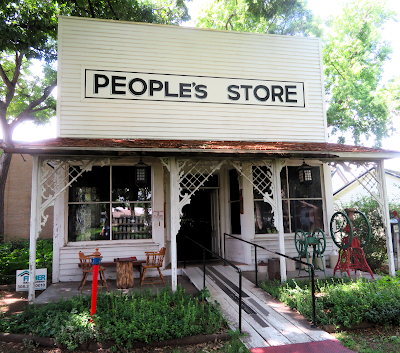
This handsome building is actually a replica of a general merchandise store that served pioneers in Stamford Nebraska.  The “Peoples Store” is loaded with a plethora of products needed or wanted by early farmers and townsfolks in the late 1880s and early 1900s.  It is stocked with everything from high button shoes and flintlock guns to calico and crocks.  Kerosene lamps are plentiful as are spices and flavorings and baskets. 

Also readily visible in the store are the original United States Post Office mailboxes from the Fort Kearney Nebraska Post Office.  Before the advent of rural free delivery of mail, everyone had to come to the post office to pick up their mail.  Small town America still maintains this method of mail ‘delivery’.

This is the former United States Land Office from Bloomington Nebraska.  It was built and opened for business on July 1, 1874.  This office served pioneers as they filed their homestead claims in south central Nebraska until it closed at the end of December, 1890. 

The old land office building was purchased by the Pioneer Village in 1952.  Each stone had to be individually numbered before the building was dismantled so it could be properly rebuilt on this site.  Today interior displays include surveyor’s equipment, early maps and old land records.  The latter collection includes John N. Warp’s original 60 acre homestead title.  That was Harold's father...

Once a homestead claim was filed, homesteaders had to 'prove up' their right of ownership.  That meant that John Warp and other homesteaders had to improve the land by planting trees and crops as well as living on the land for 5 years.  If the conditions weren't met, the homestead was forfeited.  

We took a quick look in the firehouse.  Like everywhere else a Pioneer Village, this building was full of related items collected by an obsessive collector who wanted to preserve the past, and who had the means to do so.  Included is that old Ford Model-T fire engine, ladders, a hand operated fire pump, a big selection of fire extinguishers, and more.  There even is a ‘fireman’s pole’ to access the equipment from the upper floor when an alarm is sounded.  The fire truck came from Bertrand Nebraska and it had a water pump fastened to the front of the truck's engine. 

The firehouse and all of the historic buildings are situated out around a circular green grassy area or town ‘common’ that is shaded with giant old trees.  We took some pleasure in the fact that the trees were all labeled, telling visitors what type they are.

I’ll end this portion of our visit to Pioneer Village with a photo of this authentic pioneer ‘soddy’ or sod house.  There are very good reasons why a sod house is part of the museum’s experience.  First of all, there wasn’t very much wood on the prairie and sod homes were a solution to that shortcoming.  Secondly, Harold Warp was born in a ‘soddy’ near Minden Nebraska on 12/21/1903. 

It took 11 acres of prairie sod to construct the 3 foot thick walls of this home.  Clay was used to ‘plaster’ the walls.  This replica is completely furnished…including a trundle bed.  Oh yes…that group in front of the ‘soddy’ consists of David II, my better half…Laurie, and David III.

Just click on any of the photos to enlarge them…

Thanks for stopping by for a visit!

Take Care, Big Daddy Dave 

Tuesday, October 17, 2023

A Blast from the Past (Part 2)

…continuing with the second of several recaps or overviews of the amazing and seemingly endless collection of items accumulated by Harold Warp and now on display at the Pioneer Village in Mendon Nebraska.  We spent several hours perusing…and just getting a general overview of this museum and its artifacts.

This 1903 Ford is reputed to be the world’s oldest surviving Ford production model.  This 2-cylinder car developed 8 HP and cost $850.  Interestingly, except for the engine, the design is very similar to the Cadillacs produced at the same time…the major difference being the Cadillac only had a 1-cylinder engine.

Cadillac Motors was actually formed from the remnants of the Henry Ford Company after a dispute with Ford’s investors.  He left the company with a few of his key partners in 1902 to start again.  In the first year of production, this Ford model sold 1,708 cars.

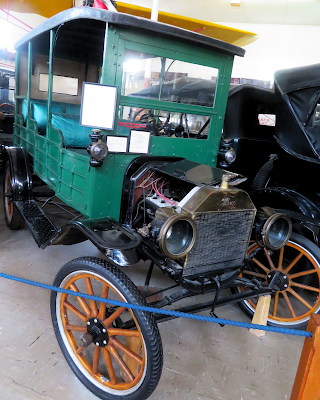
This is the second oldest Ford ‘station wagon’ known to exist.  It was built in 1915.  Beginning as early as 1910, independent manufacturers built custom bodies for installation on Model T auto frames.  They were mostly for commercial use.  This one was acquired for Pioneer Village in 1959.

This is a 2-passenger 1906 Model 19 Rambler ‘Tourabout’.  It was built in Kenosha Wisconsin by the Thomas B. Jeffery Company.  This company was in business from 1897 until 1915.  In 1916, the company was purchased by the Nash Motors Company and years later, the Nash Rambler was born.

The price of the Model 19 was $1,250 plus another $150 for the tonneau cover.  In today’s dollars, the ‘Tourabout’ would cost $48,966, not an inexpensive 2-seater automobile!  The Pioneer Village acquired it in 1967.   

This is a 1911 “Little”, which evolved into the Chevrolet brand.  Bill Durant had created General Motors when he founded Buick in 1905.  However, bankers had taken GM from Durant in 1910.  Durant paid a visit to a former employee of his, William “Wild Bill” Little.  Little was in the process of building a car for well-known race car driver, Louis Chevrolet.  This car had a ‘huge’ 6-cylinder engine.  Durant envisioned a way to get back in the auto business and perhaps regain control of GM, and he bought out Little on the spot.

Durant revisited the design of the “Little” as well as the name.  The reengineered car had a 4-cylinder engine and it was renamed after Louis Chevrolet.  Although the 6-cylinder version was a commercial flop at $3,000 per vehicle, the new “Little” Chevrolet was priced at $690 and the company sold 1,500 of them in 1912.  Durant did regain control of General Motors…and then he lost control again…but that is another story.

This is a 1935 Pierce-Arrow sedan.  Pierce-Arrow was located in Buffalo New York and it existed from 1901 until 1938.  By 1915, George N. Pierce had the reputation of building a prestige automobile.  By that time, he’d built about 12,000 autos.  They were not inexpensive!  In 1915 models ranged from $5,850 up to $7,300.  In today’s dollars, they would range from $178,247 up to $222,461…

One change that made Pierce-Arrows distinctive was the placement of the headlights.  Up until that point, headlights had been traditionally mounted next to automobile radiators.  Pierce Arrow mounted them into flared housings built into the fenders…a revolutionary change in its time.  The Great Depression was the primary cause of the company’s closing.

Note: Harold Warp and Pioneer Village doesn't recondition, refurbish and polish many of the exhibits.  They preserve them as they were when recovered and saved.

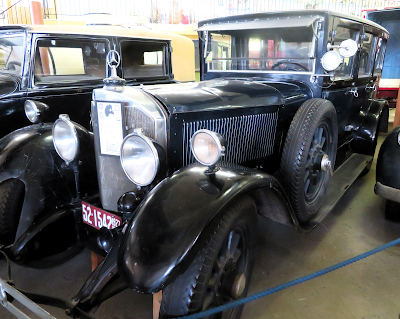
This is a 1917 Mercedes Benz Limousine.  It was acquired by Pioneer Village in 1958 from a farm in Illinois.  The auto had been stored in a shed for so long that they had to cut down some fairly mature trees to be able to transport it to Nebraska. 

Gottfried Daimler began making cars in 1886.  Karl Benz is credited as being the first man to build a successful ‘horseless carriage’ in 1885.  These 2 competitors merged in 1926, forming the Mercedes Benz Corporation. 

So neither Daimler nor Benz was married to or had a child named Mercedes… How did the brand name originate?  It turns out that Daimler’s sole distributor for his autos in France, Belgium, Austria-Hungary and the United States had a daughter named Mercedes.  In 1901, Daimler built a new 28 HP 4-cylinder model and he named it “Mercedes”.  Sales were positive and another model received the same name…and the rest as they say, is history.

This unusual looking big black car was built by The Meteor Motor Car Company in 1924.  The company was located in Piqua Ohio and from my research I’m not sure when they finally went out of business as this was a ‘specialty’ automobile builder that went through many iterations. 

The Meteor Motor Car Company was founded in 1915 but stopped making passenger autos in 1917.  Instead, the company focused on hearses and ambulances.  This one on display at Pioneer Village is a hearse.  It cost $3,150 in 1917.  

This 3 car ‘line-up’ consists of 3 automobiles that tested the limits of technology and practicality more than a century ago. 

Both Baker and Detroit Electric built autos.  The last Detroit Electric car was shipped to a customer in February of 1939…although in its final years only very small numbers of these cars were built.  Early on, Detroit Electric autos were mainly sold to women and physicians who desired the dependable and immediate start without having to hand crank the engine to start internal combustion motors. 

White Motors built 500 steam powered cars in 1903 and by 1906, they sold 1,902.  A White steamer was featured in Teddy Roosevelt’s inaugural parade and he, as the President, drove one the following year.  William Howard Taft included a White in his Presidential ‘fleet’ of cars.  While White steamers outsold Stanley Steamers, Stanley sold 200 of their cars before 1900.  A Stanley Steamer held the record speed for a mile from 1906 until 1911…covering the distance in 28.6 seconds or at 127 mph.

The Duryea Motor Wagon Company (1885 – 1917) was located in Springfield Massachusetts.  It was the first American firm to build gasoline powered automobiles.  The Franklin Automobile Company (1902 – 1934) was located in Syracuse New York.  It is important to note that before the invention of antifreeze, air-cooled engines had a huge advantage during cold weather.  They were popular with doctors who needed an all-weather auto.

OK…enough autos for now.  Back to wagons and other collectibles!

Horse-drawn United States Postal Delivery wagons were the norm, especially in rural areas for many years.  But, in 1899, an electric automobile serviced 40 mailboxes in Buffalo New York in an hour and a half.  That was half the time it would have taken a horse-drawn wagon.  The use of electric and gas-powered vehicles quickly increased when postal carriers began delivering packages as well as letters.  By 1933, only 2% of urban postal vehicles were horse-drawn.

I was unable to determine when the last horse-drawn mail route was operational.  There is a mail route that is via mule train down into the Grand Canyon.  It serves the isolated village of Supai, home of the Havasupai Native American tribe.  The Havasupai peoples have lived in the canyon for over 800 years.

In the 1800s and into the early 1900s, rural America was entertained by traveling shows.  They might include a circus, vaudeville show or similar entertainment.  Early shows moved from town to town via horse and wagon.

This is one of those ‘show wagons’.  The Bowman Show Wagon was built by J. Bowman in Wakefield Nebraska.  He built it for the express purpose of his family taking part in the opening of the Oklahoma Territory to settlers, aka the Oklahoma Land Rush.  Illness prevented the family’s participation and Bowman redirected his goals.

He decided to start a vaudeville tent show in the summer of 1900.  At times, the equivalent of a one-ring circus, he and the family continued with this endeavor until 1910.  They would be on the road from late spring until early fall and the family ‘wintered’ in Blair Nebraska.  The last show of the season was always staged in Blair.

J. Bowman was known by Native Americans as “Bowman – the showman”.  He wore long hair and he dressed, looked a lot like and acted like Buffalo Bill Cody.  His most famous performer was a boy wearing knickers who danced for him.  His name was Fred Astaire.  

This photo demonstrates both the variety and sometimes crowded juxtaposition of the items collected and displayed by Harold Warp at the Pioneer Village.  In the foreground, there is a showcase full of various old phones and that display is adjacent to an old time telephone switchboard.  The phone/switchboard display reminded me of a time when we lived in the country in southern Michigan…I was in the 5th grade…and we had a ‘party line’.  You never knew who was listening to your calls.

The Rawleigh ‘medicine’ Wagon was not an uncommon sight on rural roads across the USA between 1890 and 1920.  Another popular ‘medicine’ wagon purveyor at that time was the Watkins Man.  In 1900, has been estimated that there were as many as 30,000 horse drawn medicine wagons crisscrossing the countryside.  These company ‘agents’ are not to be confused with the more familiar ‘medicine men’ who provided entertainment and frequently sold questionable products to farm and small town families. 

These more reputable ‘door to door’ salesmen specialized in cooking flavorings/spices, home remedies, salves and livestock medicines.  As a youth, Harold Warp recalled that the family would always provide a meal for the agent and they’d also feed and water the agent’s horse. 

Guess what?!  The W.T. Rawleigh Company has been in business since 1889 and they still sell their products from their corporate offices in Florida.  Check them out at WT Rawleigh: quality vitamins and supplements, since 1889.  The Watkins Company is also still a viable functioning company, operating from Winona Minnesota since 1868.  By 1888, Watkins had 150 horse-drawn agents plying their wares in the Midwest.  Website: Watkins - Crafted In The USA Since 1868...Naturally (watkins1868.com).

As I’ve mentioned several times, the collection of artifacts at Pioneer Village is wide reaching and very diverse.  This wall mounted showcase displays various versions of old handcuffs and leg restraints.

Back in the late 1800s, guests arriving at an upscale resort via a trip on the railroad, were often greeted at the depot with a driver and a nice horse-drawn hotel transfer coach.   They and their luggage were then driven to the hotel or resort. 

I can think of one place in the United States where horse-drawn hotel transportation is still provided.  The Grand Hotel on Mackinac Island in Michigan, built in 1887, transfers their guests and their luggage from the ferry landing to the hotel using horses and upscale carriages.  There is a $12 charge round trip for each guest.  Check out this magnificent old hotel at Welcome to Grand Hotel | Mackinac Island, Michigan.

I’ll end this chapter of our visit to Nebraska’s Pioneer Village with this “Horse Car” from the Omaha Horse Railway Company.  In 1867 this was the first of many horse drawn cars or trolleys purchased for the OHRC.  The original cost was $700. 

Omaha’s first track extended 2 miles from the old Union Pacific Depot, ending at the stable that first housed 26 horses and 4 cars.  There were rail turntables at both ends of the route with turn outs along the way so the cars could pass each other as they plied their way up and down the line.  A car left each end of the route every 14 minutes and it took 28 minutes to complete the 2 mile trip.  The fare initially was 10 cents but it was later reduced to 5 cents.  The horses wore bells to warn pedestrians of their approach. 

By the time that the first steam drawn car traversed the route, there were 75 horse cars in service with 600 horses.  The line employed 255 people.  The car was used in parades from time to time and somehow it managed to dodge the junk dealers.  Harold Warp bought this first horse car for $750 in 1956, when it was 99 years old. 

Just click on any of the photos to enlarge them…

Thanks for stopping by to continue exploring this endangered historical collection of Americana!

Take Care, Big Daddy Dave

Monday, March 9, 2020

Early Railroad Postcards

Once again I decided to delve into my postcard collection and construct another historical posting to my blog site.  Since I’m a railroad ‘fan’…especially the old rolling stock…it was a natural topic for me to explore.  This is especially true when you consider the railroad industry’s impact on the growth of the United States.


The first postcard in this grouping shows a steam locomotive pulling a passenger train and crossing the bridge across the Hudson River near Mechanicsville New York.  This card was sent in 1906 to Miss Phoebe Millbank in Schenectady NY from someone with the initials H.M.F. in Mechanicsville.

Actually, it appears to me that The Hugh C. Leighton Co. Postcard Company got the spelling wrong.  Someone, perhaps their printer in Hamburg Germany, added an ‘s’ to Mechanicville NY.  I couldn’t locate any history regarding the railroad but Mechanicville was a major railyard and repair center into the 1920s.

Note:

The commercial development of US railroads began in the mid-1820s.  By 1880, the country had 17,800 freight locomotives and 22,200 passenger locomotives in service.  As the nation’s population only numbered about 50,200,000, that means that there was one locomotive in service for each 1,255 people!


This postcard, printed in Germany for A.C. Bosselman and Co. in NY City, shows a ‘new’ electric locomotive pulling passenger cars on the New York Central Railway.  It appears to have been mailed in 1909.  It was sent “From a friend” to Master Garrett Dillenback in Albany New York.

Electric trains were all about the environment…and safety.  Several cities passed laws in the early 1900s forbidding the operation of steam locomotives within city limits.  This was primarily because of severe accidents caused by terrible visibility in tunnels and rock cuts given the smoke and steam from coal fired locomotives.  New York passed such a law in 1903 and it went into effect in 1908…which ties into the date on the postcard.

Electric Locomotive #6000 shown in the postcard was built in 1904 and it was the prototype for the ALCO-GE S-Motor Class.  Believe it or not, even after being replaced by more powerful locomotives, old #6000 continued to operate, shuttling deadhead rolling stock and pulling the occasional shorter commuter train.  She actually wasn’t completely retired until the early 1970s!  To see a photo of her sitting in a field in 1912, waiting for restoration, go to https://en.wikipedia.org/wiki/New_York_Central_S-Motor#/media/File:NYC-100-front-quarter.jpg.


This postcard showing Omaha’s second Union Station, was sent to Mr. E.G. Anderson in Chicago by an M. Leonard in 1909.  I suspect that the postcard itself is a bit older as there aren’t any automobiles shown in the picture despite all the street traffic.  By 1909, cars were showing up everywhere… FYI, the passenger trains came in under the rail shed at the rear of Union Station. 
This version of Omaha’s Union Station was completed in 1899.  It was replaced by the ‘new’ depot, which is now a museum, in 1939.

Take note of that packed trolley car in front of the depot.  By 1890, the Omaha metropolitan area has more miles of trolley track than any city in the USA except Boston.  By 1910, there were 126.5 miles of track with 600 employees and 445 trolley cars in service.  In 1907, it was estimated that the trolley system carried 51 million passengers throughout the Omaha NE -Council Bluffs IA metropolitan area.


The next postcard was sent in 1908 to Mr. E.G. Anderson in Room 7, 209 Adams Street in Chicago Illinois from HJB in Davenport Iowa.  It was sent in 1909.  The card shows the Chicago, Burlington and Quincy Railroad Shops that were located in West Burlington Iowa.  Part of these maintenance and repair shops date back to 1882…and they still stand.  With over 570,000 square feet of space, as of February 2016, the buildings are mostly deserted but they are used and guarded by the Burlington, Northern and Santa Fe Railroad to store some locomotives.  Otherwise, the last 300 jobs here were transferred to other locations in 2004.

How pervasive were the railroads at their height?  A good example relates the heavily settled Midwestern Corn Belt.  Over 80 of all farms were within 5 miles of a railway.   This proximity facilitated the shipment of grain, hogs and cattle to national and international markets.  Actually, only the agricultural sector of the economy employed more people than the railroads did…


In our current environment with instant communications, social media and smart phones, it’s easy to forget what communications were like in the ‘old days’.  In effect, postcards were the e-mails or more appropriately ‘Twitter’ messages in the late 1800s and early 1900s.  This postcard was mailed on July 12, 1909 to Mr. E. G. Anderson on Park Avenue in Chicago. (Apparently he was no longer renting a room on Adams Street)

In any case, was apparently sent by Mr. Anderson’s father as the message begins with “Dear Children”.  It seems like mother got their letter and was expecting a visit from the children…so much so that father went down to the Rockford Railway station to meet the “Q” train from Chicago.  Alas, no family disembarked…

The card itself shows the Chicago, Milwaukee and St. Paul railway bridge over the Rock River at Janesville Wisconsin.  This bridge was originally constructed in 1896 and then it was widened in 1908 to accommodate 2 tracks.  It’s apparently still in use as I found several photos of it on line.


This card was sent by one humorous fellow in Davenport Iowa to his friend Mr. Eric Anderson c/o the CB and Q (Chicago, Burlington and Quincy Railroad) Tel Offices at Adams and Franklin Street in Chicago Illinois.  I’m guessing that although this postcard was mailed in 1911, it’s the same ‘Anderson’ as previously noted via the preceding 3 postcards…  In any case, his friend tells him to “Stick to your word and study ‘wire work’.  You will never regret it.  There is a good future for ‘wire chiefs’ ahead”. 

I did have to determine what a ‘wire chief’ was back in the day.  Apparently, they were the ultimate decision-maker in assigning emergency tasks to linemen, installers, signalmen and splicers to remedy problems and restore services.

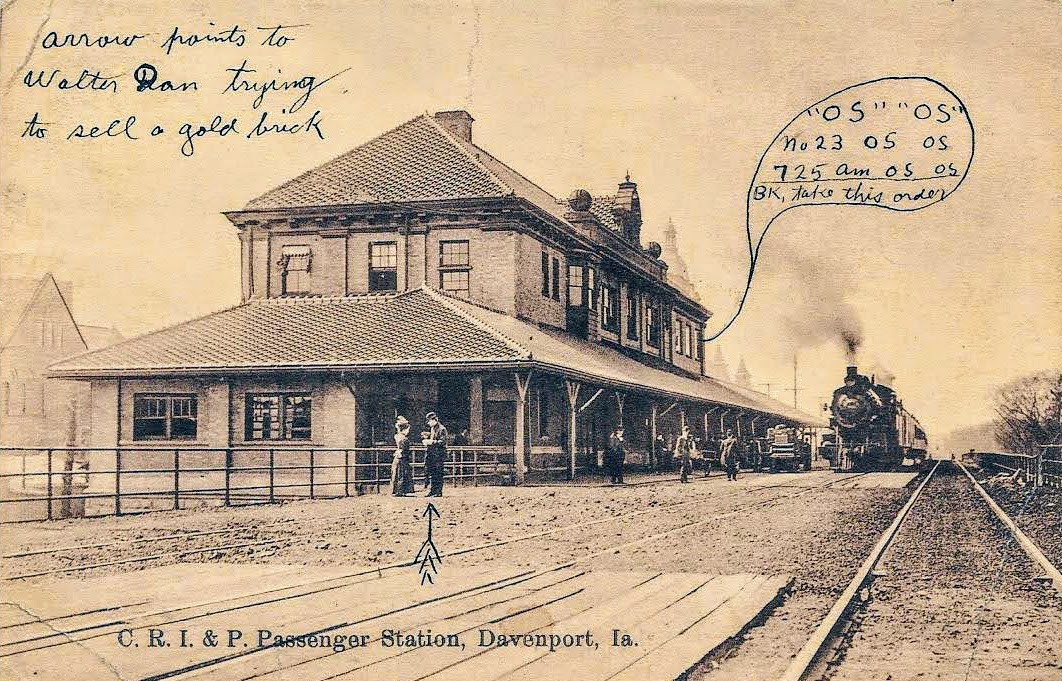
The Chicago, Rock Island and Pacific Passenger Station shown on the postcard is apparently long gone.  A parking lot has replaced it and apparently only one passes this spot today… If you can’t read our humorous senders notes on the front of the car, he states that the arrow (below the 2 people) “points to Walter Dan trying to sell a gold brick”.


My postcard saga with Eric Anderson continues!  At this point, June of 1914, he’s living at 1928 Park Avenue in Chicago.  Eric’s life is apparently moving forward as the card was sent to him from Harrisburg Pennsylvania, ‘With Love” by Ruth.  Her handwriting isn’t the best, and she’s had a hard time sleeping on the train.  Apparently she was on her way to Philadelphia and she sent this card at a stop along the way.

The postcard shows the Pennsylvania Railroad’s Rockville Bridge…the ‘longest stone bridge in the world’, at Harrisburg.  This bridge, which crosses the Susquehanna River about 5 miles north of town, was completed in 1902.  It still is the longest stone masonry arch railroad viaduct in the world.  Laurie and I have seen this impressive structure!  It has forty-eight 70 foot long spans and is 3,820 feet long.


When I purchased these postcards several years ago, I had 2 objectives.  They had to be old and they still had to have stamps on them.  I never realized until now that I was basically tracking Eric Anderson’s life for over 10 years!
 
This card was mailed on April 9, 1919.  Eric had moved again...  This time he was living at 1930 Washington Boulevard in Chicago.  Had he moved up in the world?  I’ll never know… In any case, this postcard was ‘long distance’ compared to the previous cards.  It was sent from Long Beach California from someone (can’t read the writing) who lived in Pasadena.  It reads “Greetings from this land of sunshine, flowers and beauty”.

The picture on the postcard shows the California Limited on the Santa Fe Railroad going up the Cajon Pass near Riverside California.  Even though it was a passenger train, it took 2 locomotives to get the job done.  The Cajon pass is a 3,777 foot high mountain pass between the San Bernardino Mountains and the San Gabriel Mountains in Southern California.  The rail line was built through the pass in the early 1880s.

The California Limited, advertised as the “Finest Train West of Chicago”, made its first run between Chicago Illinois and Los Angles California in November of 1892.  This run and its title train were withdrawn from service in June of 1954.  The California Limited featured “Fred Harvey Company” meal service and later trains offered air conditioning, a barber, beautician, clothing press and even a shower bath.


My last postcard for this posting 1) isn’t to or from Eric Anderson, and 2) it is relatively ‘new’, having been mailed to Mrs. Tuple in Reedsburg Wisconsin on Route 1 in September of 1954.  Pictured are the Vista Dome Twin Zephyrs that used to make the run between St. Paul/Minneapolis Minnesota and Chicago Illinois two times each day.  The Burlington Railroad operated a large number of distinctive, articulated stainless steel streamlined passenger trains that were known as the Zephyrs.  These trains were the most famous and largest fleet of streamliners in the USA.  The first of these trains, the Burlington Zephyr, made a famous ‘dawn to dusk’ run from Denver Colorado to Chicago IL in May of 1934.

In 1947 the Burlington replaced the old Zephyrs with these new dome-car trains.  Each train consisted of a baggage-club-lounge car, 4 dome coaches, a diner and a dome-parlor-observation car.  The latter included a private drawing room with 5 seats.  The dome coaches seated 54 people on the main level and 24 in the dome.

The Burlington Zephyr Chicago – Minneapolis route was canceled in 1971 with the advent of Amtrak.  Even with 9 stops between Chicago and Minneapolis, during the 1930 and into the 1950s, these trains made the trip in about 6 hours and 40 minutes.  Today, using the Interstate highways, the drive will take 6 hours and 10 minutes…without stops.  To learn more about the Zephyr train phenomena and to learn where you can see one on exhibit, go to https://en.wikipedia.org/wiki/Pioneer_Zephyr.

The railroads helped build America, moving untold quantities of freight and millions of passengers over the years.  In 1900, the United States had a population of 76,200,000 and about 225,000 miles of track in operation.  As of 2014, we have about 332,600,000 million people and about 161,000 miles of track remaining including sidings, freight yards and other miscellaneous trackage.  About 134,000 miles of ‘route’ trackage still remains in service…but the population has increased by more than 400%.

Just click on any of the photos to enlarge them…

Thanks for stopping by for a visit!

Take Care, Big Daddy Dave 

Monday, April 1, 2019

A Plethora of Trains and Trolleys!


…continuing with the 19th day of our August 2018 3-week exploration of parts of the northeastern USA.

If you like railroads, trains or trolleys, this long (very long) post should satisfy your interest and perhaps provide you with a destination to visit on your next vacation!


This is “Steamtown”, a National Historic Site in Scranton Pennsylvania that operates under the aegis of the U.S. National Park Service.  This industrial heritage site is dedicated to the role that steam railroads…and the people who worked in the industry…played in America’s Industrial Revolution.

Steamtown occupies around 62 acres of the Scranton railroad yard of the Delaware, Lackawanna and Western Railroad.  While there are diesel locomotives on display, the heart of the collection is a large grouping of standard gauge steam locomotives and related rolling stock. 

What follows is a fairly lengthy posting featuring a lot of rail related photos!


This big steam locomotive is situated just outside the museum structure adjacent to the parking lot of the Steamtown Historic Site.  Locomotive 2124 was built as #2044 in the Reading Shops for the Reading Railroad in 1924…and then was rebuilt in 1947 and was renumbered 2124.  For most of this locomotive’s working life, it was used to haul coal trains before being retired in 1956.  At one point in 1959, it was brought back into service to pull a series of rail fan excursions.  Final retirement for this beauty was in 1963.


Reading Railroad Diesel Locomotive #903 is also on display in Steamtown’s parking area.  It was one of the first General Motors Electromotive Division FP7s ordered by Reading in early 1950 to replace their passenger steam locomotives.  Number 903 is currently owned by the Philadelphia Chapter of the National Railway Historical Society.


I have no idea about the history of this attractive locomotive that is also on display near the Steamtown’s parking area.
 
This is a good time for a little background on Steamtown’s collection of locomotives and rolling stock.

The majority of the steam locomotives, rolling stock and other railroad equipment were originally collected by F. Nelson Blount, owner of Blount Fine Foods, a large seafood and soup processer (Panera Bread and Legal Seafood among others).  Originally his collection was exhibited in Bellows Falls Vermont but in 1984 it was moved to Scranton.  

Steamtown and the upscale Radisson Hotel now occupying Scranton’s former Lackawanna Depot, were intended to help revive the area’s economy.  The need for improving the museum’s financial stability combined with the collection’s historical significance led to the acquisition of the site by the National Park Service in 1995.   


Not all of the locomotives or rolling stock at Steamtown are in pristine condition.  This is Union Pacific Locomotive #4012, nicknamed “Big Boy”.  This 4-8-8-4 (wheel configuration) locomotive was built by the American Locomotive Company in 1941.  It is among the largest steam locomotives ever built.  This articulated locomotive weighs 625 tons.  It worked for 21 years hauling freight between Cheyenne Wyoming and Ogden Utah, logging over 1,000,000 miles before it was retired in 1962. 

Unfortunately the Steamtown’s turntable and roundhouse are too small to handle the size and weight of #4012 and it has remained outdoors since it arrived in Scranton.  While it is possible that this locomotive could be restored to working order, it’s unlikely that the track, switches, culverts, trestles, bridges, etc. could handle her great weight.  As a consequence, she remains on static outdoor display…


Steamtown’s Museum is built around a working turntable and a roundhouse.  However, they are mostly replicas reconstructed from the remains of a 1932 structure.  Some original outbuildings were built between 1899 and 1902.
 
The visitor center, the theater and the technology and history museums were built in the style and on the footprints of the missing portions of the original roundhouse.  Exhibits focus on the history and technology of steam railroads, particularly the Delaware, Lackawanna and Western Railroad.  Parts of the museum cover life on the railroad as well as business, labor and governmental relationships.  There is a film that is shown regularly throughout the day.


This is Illinois Central Locomotive #790.  It is the only Illinois Central Railroad 2-8-0 Consolidation type of its class to survive into the diesel age of locomotion.  Built in 1903 by the American Locomotive Company, it was originally owned by Chicago Union Transfer Railway.  Illinois Central bought it in 1904.  Illinois Central, which dated back to 1851, operated over 4,200 miles of track between Chicago Illinois and New Orleans Louisiana.  This particular locomotive pulled heavy freight trains in Tennessee. 

Locomotive #790 was pulled from storage in 1958 to assist Illinois Central trains through floodwaters…as the diesel/electrics would short out in the water.  In 1965, it was once again used for flood duty…at the Clinton Iowa Corn Processing Company, where “it plowed through overflow from the Mississippi River.


This is a view of some of the railroad equipment on display in front of a few of the bays of the roundhouse.  This is a big museum!


Believe it or not, this diesel locomotive is 84 years old.  Delaware-Lackawanna and Western locomotive #426 was a pre-production model for the Electro-Motive Corporation’s SC product line and it was built in February of 1935. 


Trap rock is used on various construction projects, including road paving, building foundations and railroad ballast.  In Connecticut, the New Haven Trap Rock Company was the primary customer of the Branford Steam Railroad. 

At the height of steam operations at the 300 acre complex, a set of 4 – 6 small 15 ton 0-4-0 saddletank locomotives were used to move the loaded gondola cars around and 2 heavier 40 ton locomotives moved the product down the 6.2 miles of track to either the port or the interchange with the New Haven Railroad.  


The E.J. Lavino and Company 0-6-0 locomotive was built by the American Locomotive Company in 1927 as Poland Springs Railroad #2.  Yes, this locomotive was scheduled for delivery to Poland Springs, the bottled water company located in Maine.  Apparently it was never delivered to Poland Springs but it is known to have been sold to the E.J. Lavino Steel Company at Sheridan Pennsylvania in 1949.  

Note
  • Poland Springs in Maine were first exploited for bottled water back in 1845!  Now owned by the Nestle Company, it is one of the largest purveyor of water in the world and the company draws its water from several sources in Maine.
  • Currently there is an ongoing lawsuit against Nestle claiming that the company has defrauded consumers by filling bottles of its Poland Spring water with ordinary groundwater.

This is just one of the many pieces of railroad equipment on display.  A ‘hot box’ is the term used when an axle bearing overheats on a piece of railway rolling stock.  Before the mid-twentieth century, axle bearings were housed in a box that used oil-soaked rags or cotton (‘packing’) to reduce friction of the axle against the truck (wheel) frame.  If the bearings overheated, fire could threaten to destroy the entire rail car…and the train itself if not uncoupled in a timely fashion from the car that was on fire.  Derailment and a wreck was also possible…

It was necessary to constantly inspect trains as they rolled by.  If the railroad worker spotted smoke, sparks or fire, the train would have to make an emergency stop.  The ‘hot box’ would then be doused with water from the tank and the box would have to be repacked with lubricated materials.


Other exhibits featured life size figures of people using or working for the railroads.  These included porters, ticket window attendants, engineers, passengers, immigrants, conductors, firemen and others. 

Firemen on steam trains were responsible for tending the fire that ran the boiler for powering the steam engine.  It was a hard demanding job involving constant shoveling of coal into the boiler’s firebox. 

Notes:

·       Vladimir Lenin escaped to Finland in 1917 by posing as a fireman on a steam locomotive.  The engineer later recalled that Lenin shoveled with gusto as he fed the engine…making the train run fast!

·       Simeon T. Webb was the fireman on the Cannonball Express when it was destroyed in the legendary wreck that killed engineer Casey Jones.  At the last minute, Jones told Simeon to jump.  He did and survived to become the primary source for information related to the wreck.

·       Kentucky Fried Chicken founder Colonel Sanders worked as a fireman when he was 16 or 17.

·       Martin Luther King Sr. worked as a fireman on the Atlanta Railroad when he was 14 years old. 


For those young folks out there, before we had email, tweets, texts, etc. people actually communicated via letters and postcards.  Most mail, newspapers, magazines and packages moved around the nation via the nation’s railroads.  The Railway Mail Service was very important from the 1890s until the 1960s.
This beautiful Louisville and Nashville Railroad Railway Post Office (RPO) car was built in 1914.  It was restored at the Steamtown National Historic Site in 1999. 

At the height of their use, RPO cars were used on more than 9,000 routes and on more than 200,000 miles of track in North America.  Most routes were eliminated during the 1960s but the last RPO route between New York City and Washington D.C. lasted until the end of June in 1977.  The U.S. Mail business was important for the railroads as it was the key money maker on passenger service routes.  Cancellation of the ‘rail mail’ doomed remaining passenger routes…  


This is the dining room inside Erie Business Car #3.  This car was built by the Pullman Company in 1929.  It has 2 staterooms, 2 bedrooms and a room for the porter.  Erie Car #3 was the private ‘land yacht’ of the Assistant Vice President and General Manager of the Eastern District for the Erie Railroad for his business travels.  At its biggest, the Erie Railroad had 2,316 miles of track in the northeastern USA and into the Midwest as well.  


Steam Crane #5 is on display with CNJ Idler Gondola #92082.  This steam crane was built for the Central Railroad of New Jersey by the Bucyrus Company in Bucyrus Ohio in 1918.  The crane (derrick) has a 150 ton lifting capability.  This crane was designed solely to maintain the railway, removing wrecks and to lay, replace and resurface the tracks.  The crane could move itself and it’s Idler for short distances but it was usually pulled by a locomotive. 


This is Grand Trunk Western’s former steam locomotive #6039.  It appears to be stripped down to the metal for repainting.  This 4-8-2 Mountain Locomotive was built by the Baltimore Locomotive Works in 1925.  In the 1950s #6039 was leased to Central Vermont Railroad and it was one of the last steam locomotives employed in common carrier business in that state.

In turn, Grand Trunk Western (controlled by Grand Trunk Railroad of Canada) was one of the last U.S. railroads us use steam locomotives.  Its last scheduled steam train in the USA was on March 27, 1960, leaving from Detroit and terminating in Durand Michigan.  3,600 passengers bought tickets and they had to run 2 separate trains…


This is Nickel Plate Road Steam Locomotive #759.  This 2-8-4 “Berkshire” type locomotive was built in 1944 by the Lima Locomotive Works in Lima Ohio.  FYI, the Nickel Plate Road is the commonly used name for the New York, Chicago and St. Louis Railroad. 

Locomotive #759 was built as a fast freight locomotive and she wasn’t retired until 1959.  In 1965 she was added to the Steamtown collection.  In 1968, she was restored to operating condition for use in hauling the Golden Spike Centennial Limited, a special commemorative train that celebrated the 100 year anniversary of the completion of the Transcontinental Railroad. 

At over 100 feet long Locomotive #759 is the largest locomotive in the Steamtown Museum’s roundhouse, with only a foot or two clearance at either end.  This is also the largest non-articulated locomotive at the Museum…


Locomotive #26 is a 0-6-0 type steam locomotive that was built in 1929 by the Baldwin Locomotive Works.  For its first 19 years in service, #26 worked at the Baldwin Locomotive Works in Eddystone Pennsylvania.  Painted with Baldwin’s standard olive green with aluminum trim, she hauled raw materials and completed locomotives around the plant.
 
Following WWII, #26 went to work for the Jackson Iron and Steel Company in Jackson Ohio.  She wasn’t actually retired until the 1970s.  Following the opening of Steamtown in Scranton in 1995, #26 was the primary power for the Museum’s Scranton Limited Trains.  After a complete overhaul completed in 2016, she returned to duty at Steamtown.


A very knowledgeable guide took a group of us on a tour of the roundhouse area…focusing on reconditioning efforts on locomotives and rolling stock and giving us an idea of the complexity involved.  The big issue in maintaining steam locomotives is all about the boilers.  Another issue is that people who work on boilers are few in this age of gas, diesel and electric engines.  Federal requirements and inspections are very demanding… Then there is the cost issue.  


This cutaway display showing the interior workings of a steam locomotive is color coded to assist the docent or park ranger with his or her explanation of how steam locomotives actually work…  


The 3 photos above are intended to provide readers with a vague idea of the size and complexity of the machine/repair/refurbishing shops at Steamtown.  The work is a slow process as neither money nor available skilled labor are abundant for the work.   All of this equipment is beyond my comprehension as I have a hard time hanging a picture on the wall…


Neither human skeleton nor a steam locomotive skeleton are things of beauty unless you’re an anthropologist or an engineer.  In any case, this is the bare bones of Boston and Maine Locomotive #3713.  She is known as The Constitution.  She is a 4-6-2 Heavy Pacific type locomotive that was built in 1934.  She is a being rebuilt to working condition in a partnership with the National Park Service and the Lackawanna and Wyoming Valley Railway Historical Society. 

The Constitution was retired in 1958.  Designed with 80 inch drivers, a large firebox, and massive boiler, P-4 Heavy Pacific locomotives could easily cruise at 70 miles per hour, carrying enough coal to pull a 14-car train for about 250 miles and enough water to last about 125 miles. 


This is New York, Chicago and St. Louis Railroad (Nickel Plate Road) diesel locomotive #514.  She was built by the Electro-Motive Division of General Motors Corporation in La Grange Illinois in 1958.  The Nickel Plate Road was one of the last major steam railroads to switch to the new diesel-electric locomotives.

Steamtown took possession of #514 in 1985, as part of a trade which gave the Virginia Museum of Transportation clear title to an A-class steam locomotive.  Today #514, with its original Nickle Plate colors, is used in the Steamtown rail yards for switching and as a back-up for visitor’s train rides while steam locomotives are undergoing maintenance and repair. 


There are a lot of locomotives and rolling stock at Steamtown that are in less than pristine condition.  It’s all about money and priorities but for railroad buffs, it’s also a bit depressing.  Of course, rust and decay is usually better than being cut up for scrap metal!

This rather decrepit semi-streamlined steam locomotive off at the back of the rail yard was built by the Canadian Pacific Railway in 1936.  Locomotive #2929 is a rare 4-4-4 “Jubilee” model.  In the USA, it’s referred to as the “Reading” type.  This class of locomotive was the last North American steam locomotives specifically built to win passengers back to the railways.  These engines were completely withdrawn from service by 1961.  

To see a photo of what this locomotive looked like back in 1970, just go to https://www.classicstreamliners.com/lo-cpr-f1a.html.  


Rahway Valley Railroad Locomotive #15 sits out behind Steamtown’s roundhouse.  It was built in 1916 by the Baldwin Locomotive Works as the Oneida and Western Railroad’s #20.  Rahway Valley bought it in 1937 and it last was in service for that railroad in 1953.  F. Nelson Blount acquired it in 1959 and restored it to operate at his Steamtown USA.  Later it was featured in the 1963 movie, “The Cardinal” which was nominated for 6 Academy Awards.  Eventually it became Green Mountain Railroad Locomotive #15 and it continued to operate until August of 1973 when a boiler tube blew out and injured a railway worker. 


The railyard with its ‘tired’ passenger coaches and a lot of other rolling stock along with the Steamtown National Historic Site are all included in the Delaware, Lackawanna and Western Railroad Yard-Dickson Manufacturing Co. National Historic District.  The Scranton Army Ammunition Plant is part of the Historic District. 

The Dickson Manufacturing Company actually built steam locomotives.  It was founded in Scranton in 1856.  In 1901, the locomotive division was merged with 7 others to form the American Locomotive Company. (ALCO)  ALCO ceased locomotive production at the Dickson Works in 1909.  Only one locomotive made by Dickson prior to its merger into ALCO exists today.  Its #1005, an o-6-2 that was built in 1898.  It’s owned by Enterprise Plantation in Louisiana. 

The Scranton Army Ammunition Plant is an active US Army facility that manufactures 105 mm and 155 mm-diameter projectile bodies.  The Army Ammunition Plant was established in 1951 and it occupies a building that was built as a steam locomotive production and repair facility in 1910.

The Steamtown National Historic Site is an interesting place to visit both from a train lover’s viewpoint and in an historical context.  It’s all about the early days of rail and the impact of the railroads on the development of the USA.  This attraction does not seem to be widely known but it’s big, with lots of room to look around…and it’s impressive!  Steamtown only has about 100,000 visitors a year…an average of about 276 a day.   Love trains…?  This is the Place to go! 

The Steamtown National Historic Site is located at 350 Cliff Street in Scranton Pennsylvania.  It’s important to note that admission is FREE.  The only cost visitors can incur are at the gift shop or if they purchase a rail excursion ticket.  This museum is open for 362 days a year.  Website: https://www.nps.gov/stea/index.htm.

…and that’s it for Steamtown…but wait!  See below to learn what else is located at this rail yard.


If you love anything and everything related to rails and transportation on them, Lackawanna County’s Electric City Trolley Station and Museum is located right across the parking lot from Steamtown.

This museum was created by the Lackawanna Heritage Valley Authority and Lackawanna County manages the museum.  The facility, a restored mill building from the late 1800s, is on long-term lease from the U.S. National Park Service.

Our visit to this museum was very brief!  We had no more than 25 minutes to look around before it was closed for the day.


Car #46 was built by the St. Louis Car Co. in 1907.  I think that it is very handsome indeed!  It is the sole surviving car from the first generation of cars to run on the Philadelphia and Western Railway.  This car survived because it was converted to a work car in 1928.  It was retired in 1976, but it has now been fully restored, complete with its arched leaded-glass windows.

So why is Scranton Pennsylvania referred to as the “Electric City”?  The first step in the city acquiring this nickname was when electric lights were introduced at the Dickson Locomotive Works in 1880.  The name really stuck when Scranton established the first continuously operating electrified streetcar (trolley) system in 1886.  In 1896, the various trolley companies were merged into the Scranton Railway Company.  That company operated trolleys in Scranton until 1954.


Open Trolley #651 has been recently and beautifully restored.  This 12 bench open trolley is over 37 feet long and it was built by the J.G. Brill Company in 1898.  It first served on New York City’s Third Avenue Line. 

Trolleys (aka Streetcars) really took off in the USA.  By 1895, almost 900 electric street railways and nearly 11,000 miles of track had been built in the United States.  The growth of streetcar systems lead to people living outside the city in ‘streetcar suburbs’, using the trolleys to commute to work.  Beyond that, the popularity of streetcars led to the rise of interurban lines…basically streetcars that operated between cities and towns.


I failed to take photo of that yellow tag/sign on the front of this trolley awaiting restoration so I can't identify it.  Still, these photos show just what kind of condition many of the museum’s trolleys were before being refurbished!  This one has a long process ahead of it…


This is former Philadelphia Rapid Transit Co. Trolley #8534.  This was the last of the 50 single-ended steel cars ordered in 1926 from the J.G. Brill Company.  The group of 50 cars were purchased in order to supplement 485 cars already owned by PRT.  It was felt that they were needed due to anticipated extra riders generated by the United States’ 1926 Sesquicentennial Celebration in Philadelphia.  These cars were phased out in 1957.


This was Philadelphia and Western Railway Company’s Car #206.  It was built by the J.G. Brill Company in 1931.  It was referred to as a “Bullet” car, named for the pointed streamlined ends.  This development was an attempt to rejuvenate the dying long distance electric railway industry.  Car #26 continued in service for many years, ending under Southeastern Pennsylvania Transportation Authority management.  Ultimately, it was converted into a “pickle car” to apply anti-icing brine onto the line’s electrified third rail.  Number 206 was finally retired in 1995.


My last photo from the trolley museum was taken outside the museum after it closed.  We didn’t really have a chance to check out the many displays in the museum that were related to trolleys and the streetcar/trolley business.

This is Philadelphia and Western Railway Company’s Car #401.  This work car was built by the St. Louis Car Company in 1907…the same time as was Car #46 as shown earlier.  Car #401 had a very long career in work service on the rail line, finally being retired by Southeastern Pennsylvania Transportation Authority in 1990. 

Timing is everything… If you’re there at the right times, visitors to the Electric City Trolley Station and Museum can board an authentic 1926 or 1932 antique trolley for a 5.5 mile trip over Roaring Brook, a mile long tunnel and along the original line all the way to the Triple-A Baseball stadium (Scranton/Wilkes-Barre RailRiders) at PNC Field.

Lackawanna County’s Electric City Trolley Station and Museum is open 362 days a year.  Admission to the museum costs $6.00 for adults, $5.00 for senior and children from 4 – 17 are $4.00.  Trolley rides are extra.  This museum is located at 300 Cliff Street in Scranton Pennsylvania.  Phone: 570-963-6590.  Website: http://www.ectma.org/museum.html

…and so ends one of the longest posts I’ve ever written!

Just click on any of the photos to enlarge them.

Thanks for stopping by for a longer than usual visit!

Take Care, Big Daddy Dave