Showing posts with label Farming. Show all posts

Tuesday, April 29, 2025

Family Visit continued...

...and the family visit continues.  Cousin Nathan, my mother's oldest brother's son, and his wife Janice recently spent a couple of days with us.  FYI, Nathan 'caught' Janice while he was serving in US military in the United Kingdom...or did Janice 'catch' Nathan?  Those Scottish women are pretty determined and very focused!  I should know given Laurie's Scottish heritage...


In my last post, we'd done a little shopping at Everhart Lumber, a furniture and decor store in Tellico Plains Tennessee.  Out next stop with any first time visitors in Tellico Plains was at the Charles Hall Museum and Heritage Center.  This photo...with a handsome fully restored 1934 Plymouth as our backdrop...was taken in Building 2 at the Museum.  From the left, Nathan, my better half Laurie and yours truly.  Janice took the photo.

Among other items, Building 2 features over 400 antique telephones, 16 old-time manual telephone switchboards, a complete local moonshine still, commemorative Harley motorcycles, antique tools, and a plethora of early Appalachian homesteading artifacts.  It also offers a shopping opportunity, "The Museum Marketplace".


Laurie took this group 'selfie' in Building 2 of the museum.  From the left, Janice, Laurie and myself.  Nathan is in the back.  Our backdrop is just a portion of the more than 800 unique telephone insulators on exhibit.

Thousands of collectors covet old or antique glass insulators.  There actually is an annual National Insulator Show.  This year it will be held in June in Marlborough Massachusetts.  

I didn't take any photos in Building 1 of the Museum.  The varied displays in Building 1 includes a wide variety of items, including 350 historic firearms, antique coins and currency, office machines, and Native American artifacts.  This building also features a shopping opportunity..."Timeless Treasures".  

The Charles Hall Museum and Heritage Center is located at 229 Cherohala Skyway (aka TN Hwy 165) in Tellico Plains Tennessee.  Admission is FREE!  The museum is open 7 days per week from March through December.  Phone: 423-253-8000.  Website: https://www.charleshallmuseum.com/.


Our next stop was at the Old Order Mennonite Community Farm Market near Tellico Plains.  The market is owned by the local Mennonite community and it's one of three such markets located within a reasonable driving distance from our home.  A wide variety of produce and other items are grown, raised or built by members of the community.  In addition to the produce (amazing!), they also sell jams, jellies, pickled just about everything, honey, molasses, baked goods, wooden tools, soap, and much more.


Laurie just had to stop at the greenhouse shown above.  This time of the year she always 'needs' more plants...especially herbs.  Tomato plants of various types are a big seller at the market.


Entrepreneurial...a good way to describe the members of this community!  Furniture is available in addition to all the other items for sale.  Oh yes, do you like to eat rabbits...or just have them around?  They are also for sale...as are rabbit hutches. 


Laurie snapped this photo of a Old Order Mennonite carriage moving along one of the roads near the store.  

Keep in mind that the store only accepts cash.  Don't expect air conditioning or fans...there is no electricity.  Hand cranked adding machines are used at checkout.  It is important that shoppers/visitors need to respect the modest dress code that is posted on site.  Also no photos of community members...


This is truly an old-time bucolic scene.  It's the peaceful looking valley just below the store where the people live and work.  The Old Order Mennonite Market near Tellico Plains Tennessee is located at 1472 Fairview Road.

We loaded up at the market.  Heirloom tomatoes, pickled beets, fresh bread, jalapeno cheese rolls and Laurie's favorite granola mix...2 big bags of it!  To see photos of the market, go to the following post on Facebook: https://www.facebook.com/amishmennonitetn/posts/the-tellico-community-farm-market-in-tellico-plains-tennessee-is-such-a-pretty-p/479923548199930.  If you go to https://www.visitmonroetn.com/farmers-markets, you can view a calendar that projects what produce you can expect to find at the market on a month to month and week to week basis.


When we got home, the exhausted shoppers took a break on our screened porch overlooking the patch of wooded common ground behind our home.  Photo by Nathan as were most of the others in this posting.


Nathan had very fond memories of my mother, his Aunt Beth.  We gifted he and Janice with a couple of my mother's woven wall hangings or couch blankets as well as this ceramic/pottery bust of Grandma Estelle Sibbald Weed.  My mother did an excellent job of capturing my grandmother's features.


This final photo was taken by guess who?  Nathan at least warned me that he was taking a photo so although I'm giving him that 'walleye look', at least I'm not frowning.  Here I am in our bonus room at action central.  Computer, printer, TV, Radio/CD player and lots of family artifacts...what more could a fellow want?!

Just click on any of the photos to enlarge them...

Thanks for stopping by for a visit!

Take Care, Big Daddy Dave

Tuesday, October 22, 2024

Found - Family

Both Laurie and I are interested in our family histories and we've gathered a plethora of family related items, articles and documents over the past few years.  In addition, off and on we have subscribed to and participated in both the Ancestry.com as well as 23andme.com on-line sites.  While it is interesting to learn that our genetic roots lead back to Scotland, England, Germany, Ireland, Sweden...and most recently Iceland in my case, the real payoff takes place when you discover family and begin communicating with them...    

What better way for us to start a 13 day road trip than to actually visit 'found family', in this case via 23andMe... So off we headed to western Tennessee to meet Laurie's 'found' cousin, Meggen, and her family!


This is Meggen's family's home which is just a bit south of Paris Tennessee.  The family lives out in the country on a nice piece of property.    


I took this photo of Laurie and Meggen shortly after we arrived.  Meggen had just gotten home from work and apparently Belle (the pointer) was really happy to see her.  


Meggen and her husband Bradley have a lot of critters...and both Laurie and I love critters.  Tucker aka "Tuck" is more or less the 'house dog' and his favorite place for cuddles is in Bradley's lap.


This is Bravo.  Despite the presence of so many canines, he is about as 'chill' as a cat can be.  Its like he owns the place!


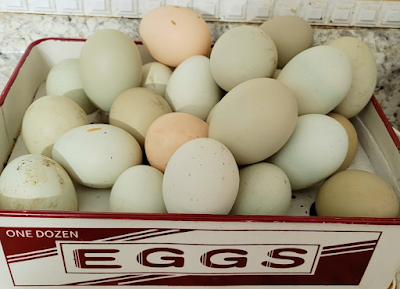
Meggen and Bradley's farm includes a flock of chickens and one very busy rooster.  Laurie has always wanted chickens but 'sadly' our POA doesn't allow for farm animals.  We both do love fresh eggs and Meggen told Laurie that almost all of her chickens lay eggs with a greenish tint.  FYI, Laurie almost never buys white eggs...


Meggen and Bradley live on a nice parcel of land...wooded acreage with plenty of pasture land and privacy.


Lots of dogs!  This is Gabby and he is an old boy.  When Meggen and Bradley bought the farm, Gabby had been living there for quite a while...so he actually came with the farm.


While both Bradley and Meggen also work elsewhere, he in manufacturing and she in health care, they raise Katahdin sheep on their farm!  Neither Laurie or myself had ever heard of this breed.  This breed was developed by a breeder in Maine...so it is an American breed.  They are a cross-breed involving African Hair Sheep with various meat breeds, principally the Suffolk.  


The Katahdin breed are easy-care sheep.  In addition, they are resistant to many common parasites.  They grow a hair coat with little wool which molts naturally in the spring...no sheering needed.  Meggen and Bradley raise them for their high quality meat, selling off all of their lambs every year.  Meggen does have 4 sheep that have been given names...and those will not be sold!

Note the large black and white sheep in the middle of this photo.  It's the ram in the middle of his 'ladies'.  He is a Dorper ram...the Dorper being a South African breed that was created by the South African government to breed a meat sheep suitable to the more arid regions of that country.  While his 
'harem' of Katahdin ladies average 145 lbs., Dorper rams can weigh 230 lbs.


When raising sheep, goats or other small farm animals, coyotes abound in Tennessee so its a good idea to provide them with a protector.  In this case he is a Great Pyrenees whose name is Buck.  Buck does like a bit of human attention, especially if one of us would pick the burrs off his coat, but he is not a house dog...not his thing.


When owning a farm with critters to care for, an ATV is pretty much a necessity!  Meggen and Bradley rode down from the house to check out their flock of sheep.  They drove the ATV and we rode down to the pasture on a golf cart. 

After visiting the family at the farm, we headed into Paris Tennessee for a family dinner and gathering...


We got together with everyone at Moustos Pasta and Grill.  This restaurant is family owned and has been in business for over a decade.  With over 1,400 reviews on TripAdvisor, the restaurant has a 4.6 out of 5 rating.  As the focus was on meeting 'found family' I didn't take photos of the food, however both the food and service were very nice.  This restaurant has 2 locations in the area now, with another one opening soon.  Website: https://www.moustospastagrill.com/.  Unfortunately, this restaurant's website doesn't feature a menu which is a bit strange.   


Our family gathering included Meggen's son Collin, his wife Jordan, Meggen's mother Alice, then my better half Laurie, Meggen's son Alex at the head of the table, then Bradley and Meggen, then their son Sam...and at the end of the table their son Isaac with his girlfriend Kimora.


One final photo from our visit with Laurie's found family.  Laurie is at the left, then Meggen, and then Meggen's mother Alice.  Alice's mother was Laurie's grandmother's older sister on the paternal side of Laurie's heritage.

It was great meeting everyone and we loved the farm visit with all the critters.  The family has an open invitation to come and visit us at the eastern end of Tennessee!

Just click on any of the photos to enlarge them...

Thanks for stopping by for our family gathering!

Take Care, Big Daddy Dave and Laurie

Tuesday, April 2, 2024

Chesapeake Bay Maritime Museum #2

…continuing with our late September exploration of the Chesapeake Bay Maritime Museum in St. Michaels Maryland back in 2023.  This is the second in a 3-part tour of the museum.

The Winnie Estelle is a ‘buy boat’ that was built in Crisfield Maryland in 1920.  She operated in the lower Chesapeake Bay for over 50 years, buying fish and oysters directly from regional watermen and then transporting the seafood to city markets or big seafood houses for packing.  The boat was named for the builder’s two daughters. 

In 1975 the Winnie Estelle was moved down to the Caribbean Sea to be used as a cargo carrier.  Shortly thereafter she was rebuilt for use as an island trader…carrying lumber from Honduras to Belize…and she was also used as a charter boat.  The 64 foot long Winnie Estelle was donated to the Museum in 2014.  As you can see, at the time of our visit the boat was in the boat yard being refurbished and refitted.  In the 9 years that she has called the Museum home, she has been utilized as an educational boat for school children and as well as a charter boat for guests.


The first photo shows the ‘Shipyard Building’ at the Chesapeake Bay Maritime Museum.  As mentioned in a previous post, the Museum’s working shipyard is intended to preserve the tradition of the working waterfront and to insure that the skills and techniques of early shipbuilders are maintained.  Shipyard staff interact with, visitors answering questions and explaining what they are doing.  In addition, apprentices are trained in the skills required for wooden boat building.

The boat shown above in the shipyard building is named Mr. Dickie. This boat with a scaled down (36 foot) ‘buy boat’ look, is actually new construction.  Work began in 2022 and it was completed the month after our visit.  It was built with heart pine, white oak, Atlantic cedar and western red cedar.  The owner had started building Mr. Dickie at his home in Virginia but when he decided that he needed help he turned the project over to the Museum’s shipyard staff.

The Chesapeake Bay Maritime Museum has an impressive collection of large and small watercraft.  The Museum’s new welcome center (which opened in December of 2023) is currently featuring a long-term exhibition called “Water Lines: Chesapeake Watercraft Traditions’. 

I took this photo of the recreational sailboat Fly when we toured the “At Play on the Bay” exhibit adjacent to the Hooper Strait Lighthouse.  In addition to small sailboats like this, visitors could view an early 20th century canoe campsite, a boathouse, a 30 foot long Owens cruiser, a 1950’s tackle shop and a yacht club lounge.

This little sailboat was also found in the “At Play on the Bay” exhibit.  In 1932 Maria Wheeler asked a boat builder named C. Lowndes Johnson to design a sailboat that her sons could easily launch and sail on Chesapeake Bay.  The result was the ‘Comet’, an American sailing dinghy.  While the design has evolved and many are now built with fiberglass, this design has endured.  Over 4,100 sailboats based on the original ‘Comet’ design have been built.

At Play on the Bay examines the dramatic changes for Chesapeake Bay over the last century.  It started as a waterway for transportation, to a place to work in the fisheries and on to a place where so many come to play.  Historical moments are explored and the beginnings of tourism is examined, as is the role of sailboat racing and cruising.  Exhibits also include the founding of African American resorts as well as the mass production and marketing of motorboats.

We visited the Chesapeake Bay Maritime Museum during the ‘shoulder season’ but we did observe that some of the smaller watercraft from the Museum’s fleet were in use taking visitors on tours.  Reservations were required.  Looked like fun though…

The Museum is located on Navy Point in St. Michaels Harbor.  It first was opened in 1965.  When you consider that this area was once a jumbled collection of docks, workboats and seafood packing houses, you have to hand it to the visionaries who conceived of the Museum.


We found the exhibit focused on Chesapeake Bay’s Oyster industry to be quite compelling.  Looking at all those oyster tins, it’s hard to imagine just how many packing houses were operating at the peak of the industry. 

In the early 1600s, Capt. John Smith described oysters lying “as thick as stones”.  They were so abundant that their reefs neared the water’s surface, sometimes becoming navigational hazards.  Most oysters in the early days of the industry were ‘hand-tonged’ by watermen in small boats.  Then dredges imported from New England appeared, bringing about the “Oyster Wars”, a violent struggle between traditional harvesting and the dredgers. 

At the end of the 1800s, it is estimated that over 15,000,000 bushels of oysters were being harvested each year, just from the Maryland portion of the Bay.  Today’s harvests are about 1% of that total!

This photo of oyster-shuckers posing on an oyster shell midden was taken near a Crisfield Maryland packing facility ca. 1891.  It had to be tough work…monotonous too!  Injuries had to be common.  I can’t imagine just how many people were involved in the packing business.  In Baltimore alone, the center of the industry, close to 30,000 people were employed.  During that period as much at 160 million pounds of oyster meat was harvested every year.  An oyster cost just about a penny at retail…or the equivalent of 25 cents each today.  Oysters were on everyone’s menu.  It’s estimated that each resident of New York City ate around 600 oysters a year.  Today, the average American eats about 3 a year...

This boat, or actually a two-sail bateau, is 52 feet long.  The E.C. Collier was built in Maryland in 1910 and she is one of the 35 or so surviving traditional Chesapeake Bay ‘skipjacks’.  She belongs to the group comprising the last commercial sailing fleet in the USA.  The Collier was built mostly from Eastern Shore loblolly pine and white oak.  After 80 years on the water and with the oyster industry in steep decline, she retired from dredging and spent most of her time at a dock on Tilghman Island.  She was fully retired in 1985.  The E.C. Collier was donated to the Museum in 1988 and she is on permanent display.

I took this photo of Bonnie and Laurie on the E.C. Collier as they explored the working world of the Chesapeake Bay watermen.  The exhibit includes everything from harvesting equipment to an examination of the “Oyster Wars”.  The overall theme is about how the Bay’s oyster fishery shaped the area’s history, culture and landscape. 

Note: Did you know?

         ·         Oysters purify the water as they filter it for their food.  A single adult oyster can filter as much as 50 gallons of water each day.

         ·         Sediment and nitrogen cause problems in the Bay.  Oysters filter these pollutants by consuming them or shaping them into small packets which are deposited on the bottom where they aren’t harmful.

         ·         At one time the oysters in Chesapeake Bay could filter the equivalent of all the water in the Bay (19 trillion gallons) in a single week.  Today it would take the remaining oysters a year to filter this much water...

One more boat… This 41 foot long ‘dovetail boat’ was built in 1834 at Bishops Head Maryland.  She is named the Dorothy Lee.  She was built for oyster tonging as well as for trot-lining for crabs.  Her long narrow hull and light displacement made it a fast workboat.  These boats were equipped with gasoline engines and they have a stern the looks more like a motor racer.  The watermen really appreciated the speed these boats provided.

This photo is titled “Tonging Skiff Gypsy Girl 7”.  It was taken by Robert de Gast and it is on exhibit at the Chesapeake Bay Maritime Museum.  This 1969 photo shows Tilghman Island waterman Ben Gowe carefully following the Maryland state icebreaker leading him back to a safe harbor after a day ‘tonging’ oysters during a cold snap.  It was a hard way to make a living!  During icy winters, the state deploys small icebreakers to help watermen return to port.  The photo was taken in preparation of a book entitled “The Oystermen of the Chesapeake”. 

In the early days fleet of locally made log canoes would venture into the Bay for a day of tonging.  Commercial hand tonging has been largely replaced by more efficient means of harvesting.  However, recreational tonging remains an ideal way to gather enough fresh oysters for a family or for a party.  All you need is a small boat, tongs and the location of an oyster bar or reef.  Both Virginia and Maryland have an open season for recreational oystering.  No license is required but the legal harvesting methods are via use of tongs or by gathering by hand from open rocks.  Maryland allows residents to gather 100 oysters per day and Virginia permits a daily catch of a bushel.

One more tour of a mixture of varied exhibits and themes explored during our visit to the Chesapeake Bay Maritime Museum will follow…

Just click on any of the photos to enlarge them.

Thanks for stopping by for a visit!

Take Care, Big Daddy Dave

Friday, October 27, 2023

A Blast from the Past (#5): Harold Warp’s Pioneer Village

…and our visit to the Pioneer Village in Minden Nebraska continues.  So many buildings crammed with antiques and collectibles and I was getting generally tuckered out!  What didn’t Harold Warp collect for his museum?  He was focused on many items but whimsy pops up here and there as well.

By this point, I’m not 100% sure that I’m correct as regards which items were displayed in which building.  Both Laurie and I were taking photos.  Hopefully I got it right!

Where next?  This is Pioneer Village Building #15 which features antique tractors and trucks.  It is home to 100 early farm tractors and other items, including Dave Buick’s first gasoline engine.

This is a 1919 Ford Model-T Knickerbocker Forma Tractor.  This ‘make do with what you have’ tractor was invented by Walter Guilder from Ohio.  An engineer, Guilder owned an 80 acre farm that his brother worked for the family.  Walter had noticed all kinds of truck modifications of Model-T Fords, so when looking at buying a ‘real’ tractor ($1,200), he decided that if they could be made into trucks, why not a serviceable tractor.

A negative article on these types of conversions in “Gas Review Magazine” stated “You can’t make a real tractor out an automobile any easier than you can make a draft horse out of a jack rabbit”.  In 1916, Guilder signed an agreement with the Knickerbocker Motors Company in Poughkeepsie New York, to manufacture the necessary part for the conversion kit.  The idea was that farmers could ‘easily’ change over their family’s Model-T to a tractor for work on the farm over the weekend, and then change it back to take the family to church on Sunday.

These kits sold well enough that Sears, Roebuck and Company as well as Montgomery Ward and Company, (my former employer), included them in their respective catalogs.  Prices seemed to have ranged from $178 to about $300 although some other complementary devices were also offered.  They included a better engine cooling system for the autos used for this purpose.  Many conversions using similar kits were used with various auto brands throughout the 1920s and 1930s.

This eye-catching tractor is a light-weight OilPull Tractor that was made by the Advance-Rumely Thresher Company in LaPorte Indiana.  The company built these 15 to 25 HP tractors from 1924 through 1926.  They were described as ‘being adapted to lighter power requirements on the farm’ and as being ‘compact in construction.

The Advance-Rumely Company was a pioneering manufacturer of threshing machines, large tractors and other agricultural equipment.  The company was founded in 1853 with threshers as their primary product.  Later, they moved on to tractors and steam engine manufacturing.  In 1931, the Allis-Chalmers Manufacturing Company purchased Advance-Rumley.

The collection of a mind boggling list of items continues.  This photo shows a line of antique trucks…but against the opposite wall there is a long line of lawn mowers.  What didn't Harold Warp collect?!

Now on to a couple of those early trucks…

This awkward looking vehicle is a 1908 Randolph Power Wagon.  It and other early trucks were ‘inspired’ by the introduction of an earlier ‘power wagon’ that was introduced by the Grabowsky Wagon Co., aka the Grabowsky Motor Co.  That company was founded in 1900. 

The advertising for Grabowsky’s Power Wagon claimed that it could ‘do the work of 3 or more horse-drawn wagons’.  Other companies, such as Randolph (shown above), Reo and Mack soon jumped on the bandwagon.  This particular truck was purchased by a publisher in Chicago to deliver his newspapers.  Despite this purchase, horse-drawn wagons still delivered newspapers well into the 1920s.

When William (Bill) Durant put together the General Motors Company in 1908, it was done through the purchase of existing manufacturers.  The Randolph Company was one of the companies folded into GMC.  Consequently, the Randolph Power Wagon was the first GMC truck, with the Randolph name being by the company in 1913.

With that gigantic bulbous hood, this 1913 7.5 ton Mack truck is an ungainly looking ‘beast’.  Back in the 1910s and 1920s Mack trucks were considered to be the most rugged on the road.  The company stuck with a chain drive instead of a shaft drive which other truck makers had adopted.  Mack trucks also utilized solid rubber wheels vs. the pneumatic wheels used by other manufacturers.  Trucks like this one were primarily used to deliver coal to homes and businesses in the cities.

Mack Trucks, Inc. not only build trucks but also buses and trolley buses.  The company was founded in 1900 in Brooklyn New York as the Mack Brothers Company…and eventually all 4 Mack brothers were involved in the business.  The company built its first truck in 1905.  Originally, their vehicles were called “Manhattan” trucks, etc. but in 1910 they switched to “Mack”.   Today, Mack Trucks is a subsidiary of AB Volvo...

This rather primitive looking truck was built by the Republic Motor Truck Company in 1920.  It was acquired by Harold Warp for Pioneer Village in 1954.  It had a cargo capacity of 4 tons…had a 4 speed transmission, ‘4-wheel’ brakes and a handbrake.  Its 6 cylinder motor produced 36 HP.  An ad for Republic Trucks stated that “Standard equipment includes a speedometer, ammeter, air cleaner, gasoline strainer, electric head and tail lamps, a front bumper, radiator guard, front fenders and a horn”.  What a great deal!

The Republic Motor Truck Company was based in Alma Michigan and they built commercial trucks from 1913 until 1929.  By 1918, it was the maker of 1 out of every 9 trucks on the road in the USA.  During WWI, Republic was one of the major suppliers of “Liberty trucks” used by American troops during the war.  Over 3,000 dealers served the company in the USA and there were additional Republic dealers in at least 56 foreign countries and colonies. 

At the end of WWI, Republic had an annual production capacity of 30,000 trucks a year.  The bad news was that a postwar depression plus the return of thousands of Liberty trucks to the United States, combined to bring about a major decline in demand for new trucks.  The company closed in 1929.

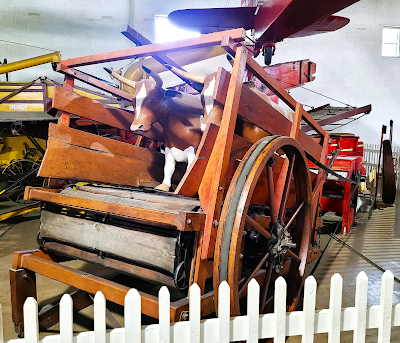
Laurie took this photo of an old-time threshing machine that is on display in Building #14, the Antique Farm Machinery Building.  In this case an ox is providing the power for the machine.  Most animal driven threshers were powered by horses.  Before such machines were developed, it was all about hand threshing, a very labor intense function.  About 25% of total farm labor prior to animal driven and motor driven threshing, was taken up by this activity.  The first threshing machine was invented ca. 1786 by a Scottish engineer named Andrew Meikle.

Building #14 is 265 feet long and it shows the equipment that was part of the evolution, of cultivating, seeding, harvesting and threshing crops.  This has to be a must stop for anyone who is involved in or was involved in farming. 


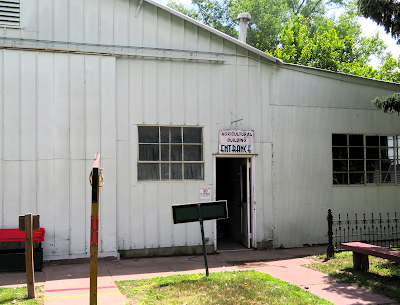
Building #20 has a rather inauspicious entrance.  Once again, never judge a book by its cover.  This is the Agricultural and Steam Tractor Building.  This 2-story structure contains more than 500 agricultural tools and implements…all of which contributed to America’s enormous farm economy.  The second photo is intended to give viewers an idea of the size and scope of this collection.

Important Note: Given the exhaustive collection of just about anything from America’s past, one item in the second photo deserves special note!  That would be the church pew or railway style waiting room bench in front of the faux horse.  Pioneer Village must have sewed up the market for benches like this.  They are everywhere almost every building and, for some of us, they are truly important if we have any hope of touring all or most of the village.

This is a 1917 Aultman-Taylor steam tractor.  It is the largest of the 3 sizes the company offered, producing between 30 and 60 HP depending on the application.  In 1955, it took 2.5 days for this tractor to cover the 50 miles between the farm where it came from and Pioneer Village.

The Aultman-Taylor Machinery Company of Mansfield Ohio began with the C. Aultman Co. that was founded in 1859.  The company built steam engines and threshing machines and it wasn’t until ca. 1910 that the company began building steam tractors.  The company was taken over by the Advance-Rumely Thresher Company of LaPorte Indiana in 1924

This is another Advance-Rumely Tractor.  In this case its a 1918 Advance-Rumely Oil Pull Tractor.  It is equipped with a 2 cylinder engine that developed between 20 and 40 HP.  I noted a ‘slick’ marketing advertisement posted by this tractor.  It was taken from a 1907 copy of “The Threshermen’s Review”.  The snazzy byline reads “Why are Rumely goods selling so well?  Because it pays to have them.”  Wow, how advertising has changed over the years!  The Rumely Oil Pull was a line of farm tractors developed by the company starting in 1909, which was sold from 1910 to 1930.

The Advance-Rumely Company of LaPorte Indiana was was best known for its threshing machines and big tractors.  Of interest to me was the Oil Turn line of tractors.  To start one, the farmer/operator had to step out of the cab onto that large iron rear wheel, then climb onto the flywheel and use his bodyweight to get it turning.  Then he’d have to quickly get back in the cab to adjust the choke to keep the engine turning.  Talk about dangerous and sometimes frustrating work!

Hundreds of these old steam powered tractors have been saved, rebuilt and shown at fairs and tractor shows.  Watching a 10 to 20 ton tractor belching smoke and clanking along is still possible.  Check out the National Threshing Association’s annual show in Fulton County Ohio.  The next show/exhibit will be in June of 2024.  Website: National Threshers Association, Annual Steam Traction Engine Show.


Thankfully, this building was small and touring it was easy!  This is the former Pony Express Black Hills relay station.  Originally called the “Pumpkinseed Relay Station”, it was moved to Pioneer Village from Bridgeport Nebraska.  Harold Warp only paid $100 for it.  The Pony Express route covered 1,966 miles and the riders could complete the trip in just 10 days!  The Pony Express only operated from April of 1860 until October of 1861, when it was supplanted by the completion of the coast-to-coast telegraph system.  Nebraska had 565 miles of the Pony Express’s route along with 38 relay stations.

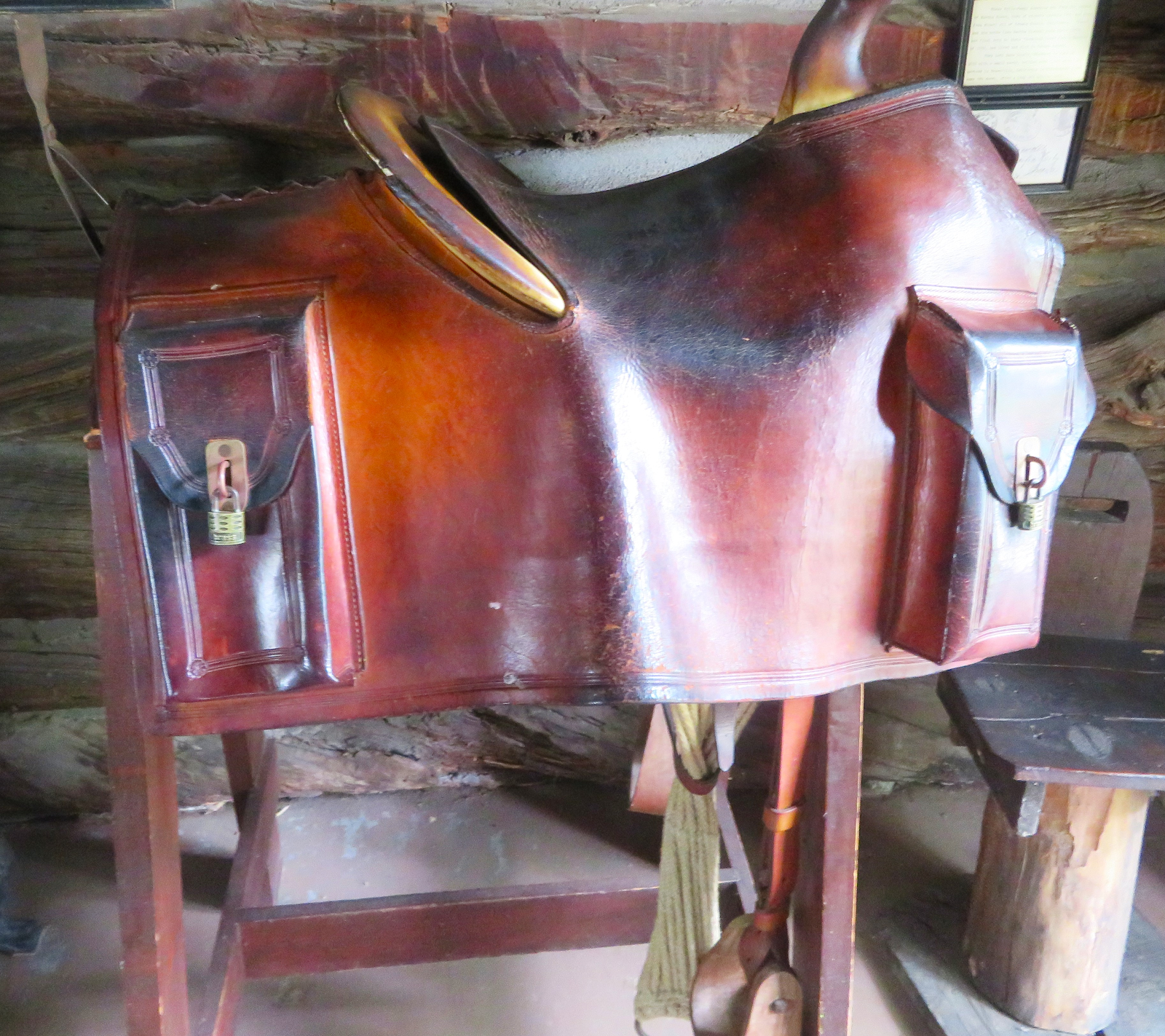
This is a replica of a Pony Express saddle and Mochila.  It was crafted in 1961 based on the schematic for the original saddles.  The saddle itself was built to minimize weight so it wasn’t the most comfortable for the riders.  The riders themselves couldn’t weigh more than 125 pounds!  The Mochila fit over the saddle and it could quickly be transferred from horse to horse as needed.   

To emphasize just how expansive Pioneer Village is, there are 26 buildings plus a bandstand.  The Household Appliance Building shown above is one of those that we skipped because we were overwhelmed and tired.  Plus we had a significant drive ahead of us back to the family home in Omaha.

The Home Appliance Building (#24) features the evolution of washing machines, stoves, refrigerators, bathtubs, and much more.  The Valentine Diner was closed during our visit and the Steam Powered Merry-Go-Round was under repair.  But we also skipped: the Country School (#7); the China House with china, pottery, cut glass, etc. (#9); the Blacksmith Shop (#21); the Pony Express Barn (#22), and; the Horse Barn (#12).

We did visit one more building and then we discovered that there was yet another portion of the main building that we hadn’t seen.  Those last stops, plus a couple of interesting ‘collectibles’ that I’d missed in previous posts, will be included in the final edition of our family adventure.

Just click on any of the preceding photos to enlarge them…

Thanks for stopping by for a visit! 

Take Care, Big Daddy Dave