Showing posts with label Louisiana. Show all posts

Wednesday, January 15, 2020

Out and About Town – Late Afternoon Break


Continuing with our family visits to St. Louis Missouri and Omaha Nebraska during the week of Thanksgiving…

In this instance we were out and about in Omaha and we decided to stop in at a local watering hole for a snack and an adult beverage.


This is Firebirds Wood Fired Grill.  Laurie and I hadn’t eaten here for at least 3 years. 

Firebirds started out in 2000 as a steakhouse in Charlotte NC.  It has a real wood-grill and it specializes in steaks and seafood but there are a number of other items on the menu.  They are open for lunch and dinner…


The dining area at Firebirds is warm, with mellow lighting combined with wood and lots of stone. 

The parent company has about 50 Firebirds location scattered across 19 states.  They are all company owned.


But…we weren’t planning on going to the dining room!  Instead we were focused on happy hour in the bar area.  Happy hour at the “Firebar” is a ‘happy time’ for saving a couple of bucks.  Amy and Emmett Lee are at the bar waiting for a snack and their beverages.

Their special martinis are $6.00 vs. $11.00, seasonal craft cocktails are $7.00 vs. $11.00, select glasses of wine are $5.00, well drinks are $5.00 and all draft beers are $2.00 off. 

How about that 'FIREBAR'!  Very eye-catching.  The backbar features a colorful display of bottles, all back-lit and tiered…creating a ‘waterfall’ of color for the bars patrons. 


One of our appetizers was this giant Bavarian Pretzel with beer cheese. ($5.00 Happy Hour/Normally $8.00) The big German-style soft pretzel was very nice, especially when paired with Samuel Adams beer cheese fondue and horseradish mustard.


I was in the mood for some beef so for another appetizer, I ordered the Beef Sliders. ($5.00 Happy Hour/$8.00 Normally) The three USDA Choice mini burgers normally come with Tillamook cheddar cheese, sautéed onions, yellow mustard and pickles.  Not being a big fan of onions, I left them off this trio.

OK…To quote from Firebird’s website, “…Firebirds’ chef-prepared, made-to-order bar fare upholds the same standard of quality you’ll enjoy in every bite of steak or morsel of lobster in our dining room”.  Well…so much for commitment!  These sliders were overcooked, hard and dry with very little flavor.  Even at $5.00 they weren’t worth the money!


The final appetizer was the Fired-Up Shrimp. ($7.00 Happy Hour/$10.00 Normally.  These flash fried shrimp were coated and flash fried and then they were served with a spicy Sriracha sauce.  These spicy shrimp were pretty average and they could have used a little more spicy sauce.

As per Forbes Magazine, Firebirds Wood Fired Grill was named as one of the USA’s top 50 emerging restaurant chains by a leading industry trade magazine.  New management/ownership is planning to expand this chain.  Please fix the sliders first…!

Firebirds Wood Fired Grill in Omaha Nebraska is located at 17415 Chicago Street.  Phone: 402-359-1340.  The Website for this specific store is at: https://omaha.firebirdsrestaurants.com/.

Just click on any of the photos to enlarge them…

Thanks for stopping by for a visit!

Take Care, Big Daddy Dave

Wednesday, August 2, 2017

West Across Louisiana into Texas

On our recent trip, after leaving Natchez Mississippi we headed west along US Hwy. 84 across the middle of Louisiana and on into east Texas.  As we had a long day of driving ahead of us, I didn’t stop and take too many photos of historic sites along the way… I did manage to take a couple of photos in Louisiana before we crossed the Sabine River into Texas.


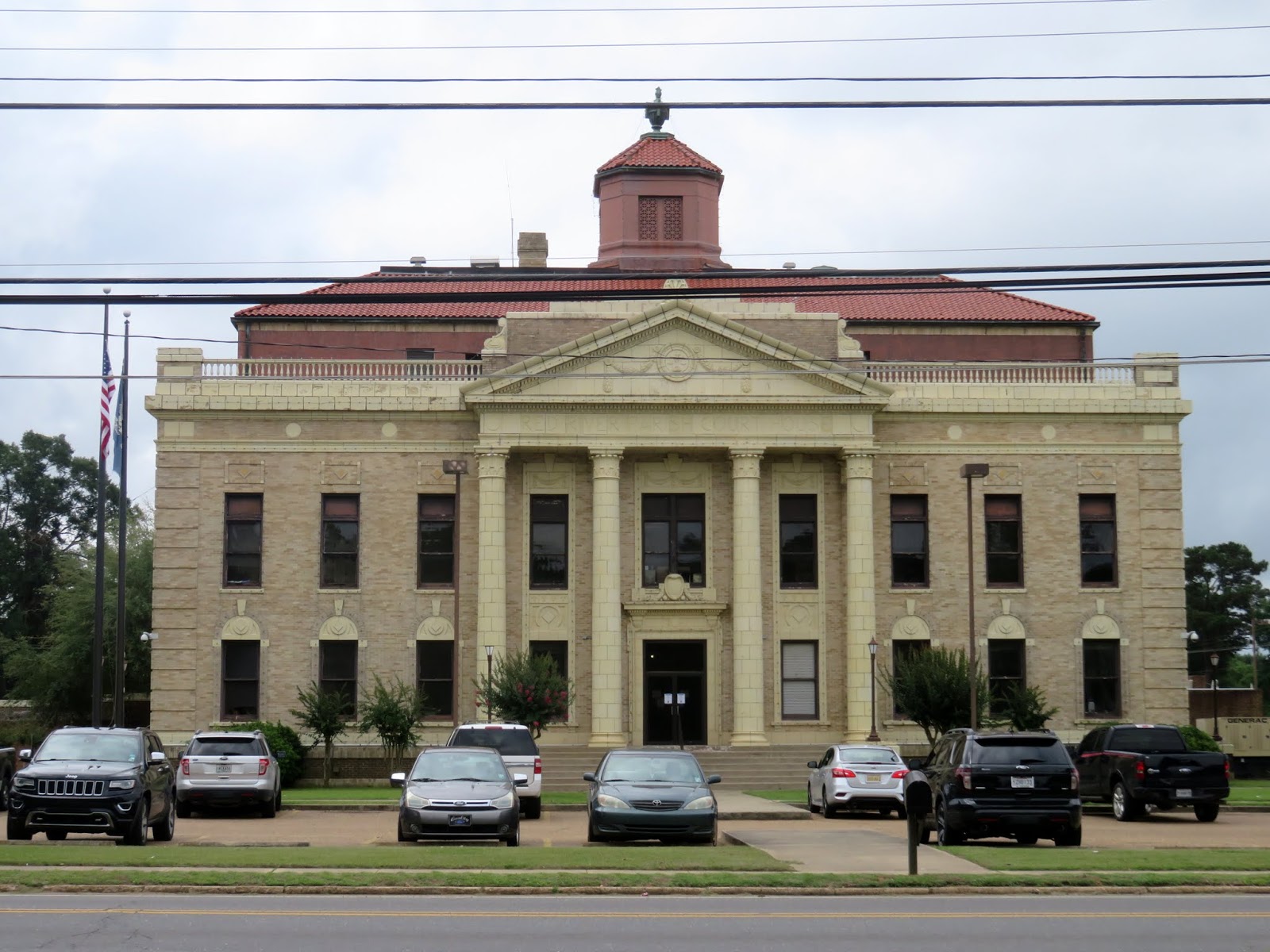
This is the Red River Parish Courthouse in Coushatta Louisiana.  It was built in 1926.  Coushatta, which is located on the Red River, is about 45 miles south of Shreveport.  Like many rural towns across America, the population is declining…from 2,299 in 2000 to an estimated 1,841 in 2016.
 
Red River Parish and the Red River Valley were areas of white vigilante and paramilitary violence after the Civil War, as insurgents tried to regain power after the South's defeat.  In 1871, during Reconstruction, the state legislature created the parish as part of their effort to develop Republican Party strength and disenfranchise former slaves. 

Formed in mid-1874 from white militias, the “White League” was formed in the Red River Valley in nearby Grant Parish.  In the summer of 1874 the White League forced 6 white Republicans from office in Coushatta and ordered them to leave the state.  League members assassinated them before they left Louisiana.  Among the men murdered were the brother and 3 brothers-in-law of state Senator Marshall Twitchell.   The White League also killed between 5 and 20 freedmen who had accompanied the Twitchell relatives and who were witnesses to the vigilante violence. 


This is the former railroad depot in Coushatta Louisiana.  Although I couldn’t determine when it was built, I did learn that it served 3 different railroads in its operating history… They were the Louisiana Railway and Navigation Co., Louisiana and Arkansas and the Kansas City Southern Railroad.  The old depot has been preserved and it’s currently being used by the Red River Council on Aging.

The Louisiana Railway and Navigation Co., (also known as the “Edenborn Line”), was a railroad that that operated from 1903 to 1934 between Shreveport and New Orleans Louisiana.  At its peak this railroad had 45 steam locomotives, 1,305 freight cars and 32 passenger cars.  It has the distinction of being the only railroad in the USA that was owned by one person…and that was Mr. Edenborn. 

  
Our next stops were in Texas along US Hwy. 84 at the home (and related depots) associated with the Texas State Railroad.  The western end of this tourist attraction is set in a park-like setting in Rusk Texas.  We thought that this entrance “sculpture” was quite eye-catching and creative.


The Rusk Texas Depot for the Texas State Railroad is a nicely done replica.  We thought that the stonework was quite eye-catching.
 
This park and the one at Palestine Texas are both associated with the Texas State Railroad.  Originally, the parks were operated by the Texas Park and Wildlife Division of state government.  But in 2007 operational control of the both parks was transferred to American Heritage Railways.  That company operates the Durango and Southern Narrow Gauge Railroad in Colorado and the Great Smoky Mountains Railroad located in Bryson City North Carolina.  Operators of the railroad have changed twice since American Heritage Railways ran the line.

 
Love the authentic look, don’t you?! 

The Texas State Railroad is a historic 25 mile long railroad between Rusk and Palestine Texas.  It was founded in 1881 by the state of Texas to haul freight.  Regular service on the line was ended in 1921.  The state leased the line to private companies until 1969 then it was turned over to the Texas Parks and Wildlife Department in 1972.


Today, vintage steam and diesel locomotives take passengers in early 1900s passenger coaches across the rails of this East Texas Piney Woods Route between the towns of Palestine and Rusk for a 50-mile round trip.  Trains usually operate on Fridays, Saturdays and Sundays on through December.

Fares depend on the day scheduled and whether or not the train is powered by diesel or steam locomotives.  Adult fares in coach are $59.95, first class are $84.95 and Presidential class fares are $99.95.  Children’s fares range from $39.95 to $59.95…coach and first class only.  Seniors fares range from $54.95 in coach up to $89.95 for Presidential class.


This is a rail side view of the replica Rusk passenger depot. 

How was the Texas State Railroad built?  In 1881 prisoners from the East Texas Penitentiary built the first 1.3 miles of railroad track.  It wasn’t until 1909 when the final ties and rails were in place, linking Rusk with Palestine.  FYI…the original purpose of the railroad was to transport raw materials for the iron smelter that was located at the Rusk Penitentiary.


This vintage baggage/Railway Express car is on display at the Rusk depot.  As it was mid-week, the depot was closed. 


A replica water tower has also been built next to the Rusk Texas State Railroad’s depot.  I’m sure it services the steam locomotives that plie this tourist railroad line. 


This is the Texas State Railroad’s Depot in Maydelle Texas.  It was really raining when Laurie took this photo!  It’s located about mid-way between the Rusk and Palestine Depots.  An old railroad turntable is located close by but it was difficult to photograph because of the rain and a lot of tall grass. 

From what I could determine, this depot was originally a house that was converted to a depot so it could serve as a movie prop.  In 1910, the steam engine pulled trains of the Texas State Railroad rolled through the piney woods between Rusk and Palestine for the very first time.  This happened because Governor Thomas Campbell had ensured that his good friend and ex-governor James Hogg’s vision for this rail line was completed.   The founders of this newly platted town between Rusk and Palestine were so grateful that they named their settlement after Governor Campbell’s daughter, Maydelle. 


This is another replica depot in a park.  It’s the Texas State Railroad’s Depot in Palestine Texas…at the western end of this historic railroad.  This is a close as we got to the depot.

The Texas State Railroad operates a variety of steam and diesel locomotives on their 25 miles of track.  The locomotives date from 1901 to 1953.  They include:

·       1901 A.L. Cooke # 316 (4-6-0 Ten Wheeler Class) (Steam)

·       1911 Baldwin Locomotive Works #500 (4-6-2 Pacific Class) (Steam)

·       1917 Baldwin Locomotive Works #28 (2-8-0 Consolidation Class) (Steam)

·       1917 Baldwin Locomotive Works #7 (2-8-2 Mikado Class) (Steam)

·       1947 Alco-GE #7 (RS2 Diesel)

·       1953 Alco-GE #8 (MRS 3 Diesel)


There were a lot of distressed old railway cars of different types on sidings in the Texas State Railroad’s rail yard.  This sleek combination coach and baggage car stood out in contrast to much of the other rolling stock.

For more information about the Texas State Railroad, you can go to http://texasstaterailroad.net/.

In addition to this reproduction depot and its railyard, Palestine Texas has a second depot and this one is an original…


This is the Palestine Texas Visitor Information Center.  It’s housed in the former Neches Texas combination passenger and freight depot that was moved to this site.  This depot was built in Neches during the late 1890s for the International – Great Northern Railroad.  Any remaining trackage that belonged to the International – Great Northern Railroad is now part of the Union Pacific system.    

For information about Palestine Texas and its tourist opportunities, go to http://www.visitpalestine.com/.

Notes:

·       Palestine Texas has 23 historical sites listed on the National Register of Historic Places.

·       The biggest employers in Palestine are the Texas Department of Criminal Justice along with 2 big Wal-Mart distribution centers.

·       Palestine was one of the East Texas towns that received much of the debris from the Space Shuttle Columbia disaster in which 7 astronauts were killed.

·       That historical plaque in front of the Visitor’s Center provides some history on Palestine’s somewhat infamous former town marshal and gunman, Christopher Columbus Rogers.  He is alleged to have killed 12 men before he was stabbed to death.  To learn more, go to https://en.wikipedia.org/wiki/Christopher_Columbus_Rogers.

Just click on any of the photos to enlarge them…

Thanks for stopping by to check out some of the sights along our route!

Take Care, Big Daddy Dave


Monday, April 11, 2016

A Party Appetizer plus Eggs My Way!

Anyone who reads my blog knows that food is a major focus… While it’s not all that important to Laurie, I am an admitted “foodaholic”.  As such it was hard for me to drop 45 + pounds to get down to my current fighting weight.  Nevertheless, with a low carb diet and exercise at the local wellness center, I accomplished that feat.  Another factor is that I don’t sit and watch much TV…which I’ve observed leads to my becoming restless and then looking for something to eat!

Still, I do love good food and I go on periods of splurging on carbs and sweets.  A 5 pound bump in the wrong direction and I rein it in again!

The first food item…a very rich but tasty appetizer…was Laurie’s Louisiana themed creation for a recent wine tasting/social/eating party that was held at Big Dude and Bev’s home here in East Tennessee. Big Dude’s blog site is found at http://bigdudesramblings.blogspot.com.


This was Laurie’s Warm Shrimp Gumbo Dip.  Everyone agreed that this was a big winner!  Although this serves up to 16 people, and there were only 10 of us at the party, very little made it home with us.  Everybody requested the recipe too… Here it is:
Warm Shrimp Gumbo Dip
Ingredients
·       ½ stick of unsalted butter
·       ½ pint of small cherry tomatoes cut into 4 slices each
·       4 celery ribs – diced
·       12 green onions – diced (used tender green portion only)
·       2 garlic cloves – minced
·       3 teaspoons of Cajun seasoning
·       1 teaspoon of crushed red peppers
·       3 lbs. of large shrimp, peeled, deveined and each cut into 4 bite size pieces
·       16 oz. of cream cheese
·       1 cup of grated Parmesan Reggiano cheese

Preparation
Preheat oven to 400 degrees.  Melt butter in large skillet.  Add celery and sauté until tender…about 6 minutes.  Add onions.  When fragrant add the garlic (we used pre-minced), the cream cheese, crushed red pepper and Cajun seasoning.  Then add the shrimp, the Parmesan Reggiano cheese and tomatoes.  Mix together at a medium low heat.  Stir as needed until the cheese is melted and the ingredients are blended evenly throughout.
Pour or spoon the mixture into the baking dish. (We used a 9” x 13” glass baking dish) Bake for 40 – 45 minutes or until bubbly and lightly browned on top. Ovens may vary...it may take 50 to 55 minutes... just keep checking.

Serve with toasted baguette slices.  We found ours at our local Fresh Market in the fresh bread area…

Enjoy! 

Now onto a series of relatively carb free breakfasts that I prepared for myself… 


I took advantage of a bit of leftover gumbo that our friend Martha made for the Louisiana based food and wine tasting party.  It was another big hit at the party.  I’d eaten 3 helpings that night!

In any case, I took the leftover gumbo, heated it up in a frying pan and then covered it with a couple of easy over fried eggs.  I added Tabasco after taking the photo…and the spicy creamy yolks blended in with the gumbo very nicely.  Good breakfast!


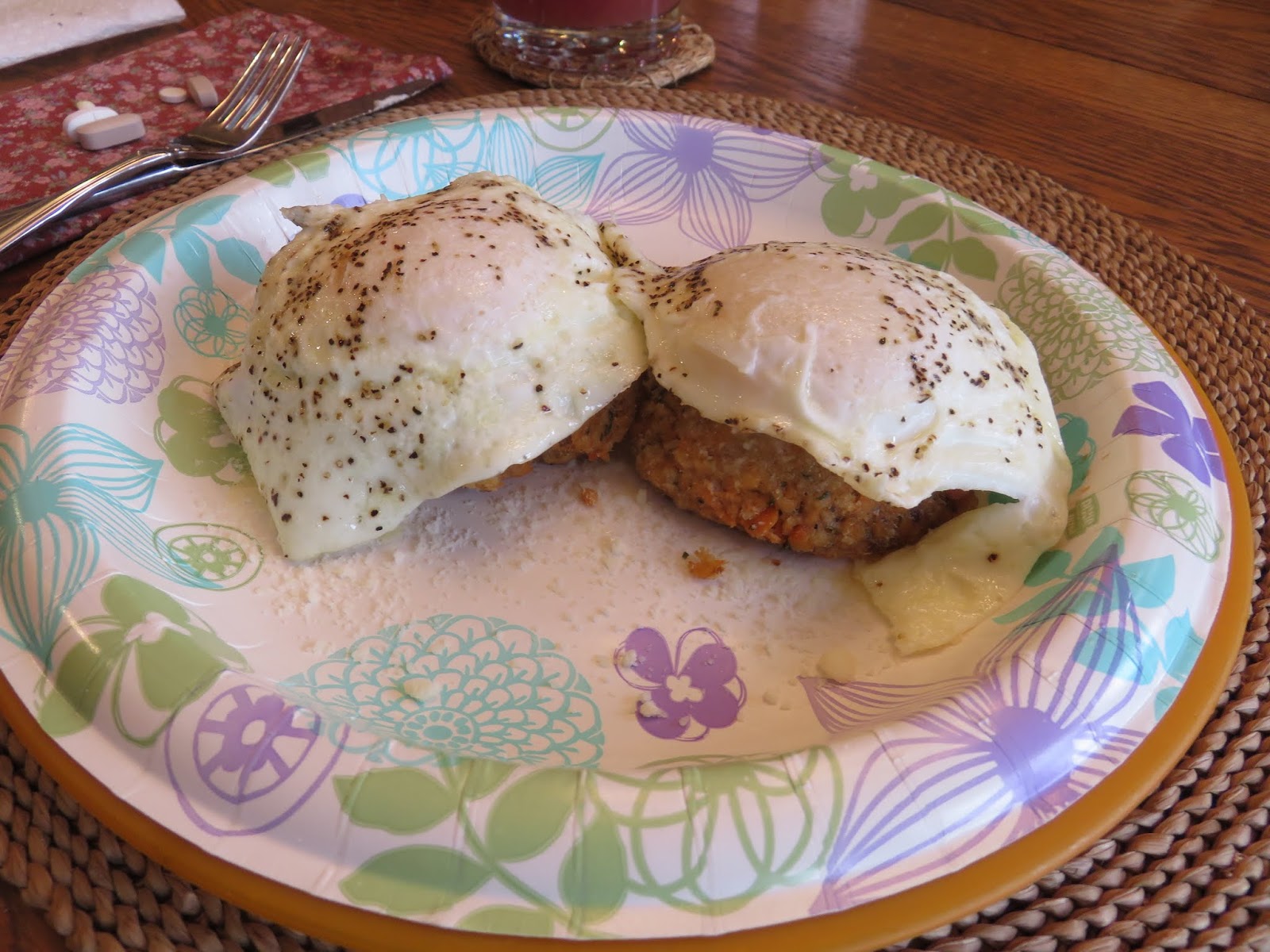
Then there was a subsequent breakfast…2 easy over eggs on 2 leftover salmon patties.  This started a fish related theme for my breakfast!


A few days later, I took these 2 halibut filets and heated them in a frying pan with some grated parmesan on top…


I plated the heated and browned filets on a paper plate.  The cheese hadn’t melted quite as much as I’d liked but that minor problem was soon solved.


Just cover the filets and cheese with 2 over-easy eggs!  This was a very satisfying breakfast…after I added my Tabasco...


Too much parmesan?  Not in my book!  These were leftover Tilapia filets from our recent dinner at Z Fish House in Loudon Tennessee.  They serve so much food for a very reasonable price that it’s a challenge for anyone to finish their dinner…hence leftovers! 


And of course, after those Tilapia filets were heated up, I topped them with my usual 2 easy-over fried eggs.  Excellent!  The next time we go to Z Fish House, I’ll have to bring home one of their giant fried catfish filets for breakfast…

Well, now that I’ve worked up an appetite, I need to go and find something useful to do that keeps me away from the kitchen! 

Just click on any of the photos to enlarge them…

Thanks for stopping by to see what’s cooking!


Take Care, Big Daddy Dave

Friday, March 13, 2015

Headed North Up the Mississippi River Delta

After driving all the way down to Venice Louisiana…and the end of the road on the Mississippi River’s delta…then enjoying a good lunch, it was time to head back up the delta along the river.


As we drove north, we came across this structure at Plaquemines Bend on the Mississippi River.  This is what remains of Fort Jackson, the largest of 3 forts that were built along the lower reaches of the river to protect the port of New Orleans.  This property is owned by Plaquemines Parish and it’s located near the town of Triumph Louisiana. 


This is the main entrance to the Fort…complete with a bridge across a dry moat!  We didn’t have much time to look around as the Parish employee who was watching over the fort was just about ready to close up for the day.

Fort Jackson is located about 70 miles south of New Orleans on the western bank of the Mississippi.  The older Fort St. Philip is located opposite of Fort Jackson on the eastern bank.  This fort was constructed after the War of 1812, actually between 1822 and 1832, on the advice of Andrew Jackson.  The fort was named after him…  A third fort, Fort Bourbon was also located nearby but that site is now underwater.


The fort was garrisoned by a small force until 1842, when it was declared a military reservation by executive order of President John Tyler and the state took control.  With the coming of the Mexican War in 1846, Governor Isaac Johnson of Louisiana ceded the land to the National Government.  However these defenses were not needed during that War.  Both Fort Jackson and Fort St. Phillip remained garrisoned with just a few soldiers until seized by the State of Louisiana on January 8, 1861 when the state joined the Confederate States of America.

After the Civil War the forts at Plaquemines Bend were an on-again off-again matter.  Fort Jackson was used as a prison and later as a minor training base.  Gradually, much of the reservation was abandoned.  During the Spanish-American War in 1898, the Fort was repaired and modernized and two large coastal guns were installed.  During World War I (1917-1918), the Fort was again used as training base. After the war, both Forts Jackson and St. Phillip were declared surplus property and eventually sold.


Plaquemines Parish put a lot of resources into the revitalization of Fort Jackson after a local resident bought the property and deeded it to the Parish.  The goal was to transform the abandoned Fort and its 82 acre reservation, into an historical mecca for tourists and recreational center.

A levee was built to ring the Fort and protect it against high waters of the Mississippi River, then an automatic pumping station was installed which drained the water.  The property had become a jungle with mud-filled tunnels infested with snakes.  Mountains of slush were removed, the area cleared and an access road was built to the Fort and a parking area was added.  The brick walls were repaired or replaced, guns and gun replacements were refurbished and the moats and drains were opened.   

In addition, two multicolored fountains were installed on the turrets in the Spanish-American disappearing gun placements, a subsurface lighting system installed, a water system built, and wrought iron picket guards erected on top of the wall of the Fort to protect the tourists.  Identifying markers were installed so tourists could learn about the facility and a permanent relic and souvenir exhibit was established. 

Unfortunately, despite all of the effort and good intentions, along came Hurricane Katrina's storm surge in 2005.   Between Katrina and Hurricane Rita the following month, much of the fort sat under water for up to six weeks.  Many of the historic exhibits in the fort were destroyed, and the fort itself suffered structural damage. 


This is a view of the Mississippi River from the fort’s ramparts… I used my imagination to envision the Civil War Battle of Forts Jackson and St. Philip from April 16 to April 28, 1862.  The Confederate-controlled fort was besieged for 12 days by the fleet of U.S. Navy Flag Officer David Farragut. Fort Jackson fell on April 28 after the Union fleet bombarded it and then sailed past its guns, losing only one ship.  Combined casualties totaled about 1,000.  Following the engagement and its surrender, Fort Jackson was used as a Union prison.

To learn more about this key battle for the control of the lower Mississippi River, just go to http://en.wikipedia.org/wiki/Battle_of_Forts_Jackson_and_St._Philip.

We wish we’d had a little more time to explore the Fort as there is a haunting beauty about the place.  Despite the hurricane damage, this is an interesting historical site.


Three or four days earlier I’d seen this ship, UBC’s bulk carrier “Baton Rouge and its crew of 30 headed upriver just below New Orleans.  In this photo the ship is anchored downriver from my earlier sighting.  As of this writing, the ship was moving east in the Gulf along the north coast of the Yucatan Peninsula of Mexico.  It appeared to have just departed from the port of Merida. 


Dawn took this photo of my better half…Laurie…and me on the Mississippi river levee adjacent to Fort Jackson.  There were several ships anchored along the river nearby. 


This ship was also anchored in the river...probably waiting clearance to proceed upriver.  It’s the “E R Haden”.  She flies the Turkish flag and she’s based in Istanbul.   When I wrote this blog posting, this bulk carrier had recently departed from the Chinese port of Tianjin (formerly Tientsin) and was entering the Yellow Sea.


SAM Shipping’s vessel, “SAM Phoenix”, was headed downriver to the Gulf of Mexico.  This ship is owned by a Swiss consortium, (Shipping Asset Management), and she’s ‘flagged’ in Hong Kong.  It is one of SAM Shipping’s 9 vessels and she is basically a grain carrier. 


Laurie took this photo of Dawn Marie and me… Dawn was cold so she brought her car blanket with her to keep warm on this chilly and breezy day.  At least we had lots of sunshine!


The 2 photos above were taken by Laurie as we crossed the Empire High Rise Bridge near the town of Empire Louisiana.  Empire, combined with Venice, comprise the third biggest seafood port in the United States by weight.  Some two thousand boats home port from this port.  Species landed include oysters, shrimp, menhaden, and other types of fin fish.


Borrowed from Wikipedia, this photo shows Highway 23 following Katrina and the accompanying storm surge.  Much of the fleet that wasn’t sunk was dumped on or against the roadway.  Another disaster struck this area during the BP oil spill.  Seafood landings came to a halt.  Oyster fishing did not resume for an entire year.


I was a little frustrated by the time that we managed to fight the commuter traffic and board this ferry across the Mississippi at Terrytown Louisiana.  My goal had been to take the ferry across the river much further south at West Pointe a la Hache but that crossing was closed for maintenance. 

I like to seek out and take ferry boats but it was almost dark when we boarded and there was no way to get out of the car on the jammed deck.  I’m guessing that the closed ferry further south had forced everyone to use this option… Actually we were one of the last 2 or 3 cars allowed on the ferry boat for this crossing.

That’s about it for now… Just click on any of the photos to enlarge them.

Thanks for stopping by and helping us explore the Mississippi River delta!

Take Care, Big Daddy Dave