Showing posts with label Montgomery Ward. Show all posts

Tuesday, June 3, 2025

No Post Week! (Almost...)

We're so tied up this week with the pending neighborhood garage sale that this will be the closest thing to a blog posting I'll even attempt.  Seventeen houses in the immediate area are all having garage sales on Friday and Saturday from 8 AM until 2 PM.   


We are still digging for other items to sell and we seem to be constantly reorganizing our garage sale offerings... We did sell one set of ladies golf clubs already.


Laurie caught 'some old guy' in this photo of one side of our garage.  We have signs on all the upper shelves stating that nothing on those shelves is for sale.  We've also covered our yard tools...rakes, shovels, etc. as they aren't for sale either.  I did sell a sledge hammer and an axe to one of folks from the crew that washes our windows a couple times a year.


This is a view of the other side of the garage.  Note the hanging items on the wall plus all the fishing rods and reels along the wall.  More golf clubs too.  That couch/love seat at the left by the garage door was sold today and it's gone.


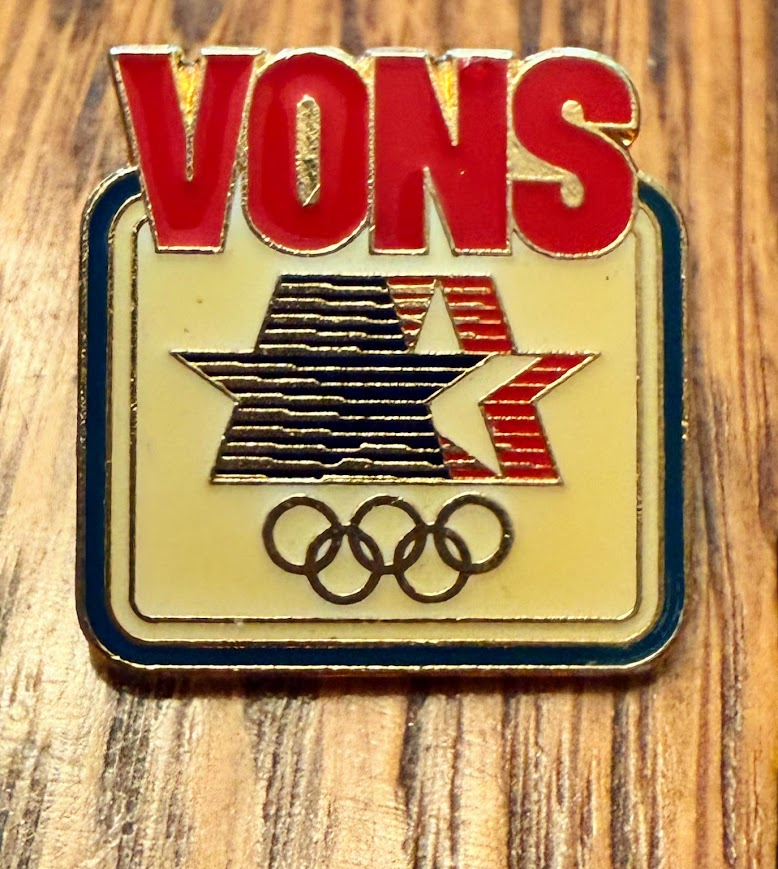
I am selling a bunch of 'collectables' including some Olympic Games vendor's pins... This is a Vons Grocery Store pin from 1984.  I have lots of them from Atlanta and even a couple from Barcelona.  In addition, since I spent my career in retail security and loss prevention I have over 100 security badges bagged for sale.  Who knows?  I might sell a few of them.  Also on sale are 3 Montgomery Ward collectable trucks in their original boxes...


We did manage to sell a set of Mikasa China on-line and we just pulled a scattering of these Czechoslovakian plates and serving pieces out of storage, even matching boiled egg cups.  My mother inherited them from my great aunt Elsie ca. 1951 or so.  Someone might buy them... If not we'll find a home for them in a thrift store.


This rain-style shower head came with the house when we bought it.  It's been in the garage ever since... It will sell or it will become recycled metal!  We are running out of things to put out for the sale.


We have sold a number of furniture items in addition to that love seat previously mentioned.  This antique table came from my mother's house where it served her well for years.  We also sold a buffet, a baker's table with an attached hutch and 2 rocking chairs.  Basically the big stuff is gone and the sale doesn't start until this coming Thursday.


The weather forecast for the sale is that there is a 40% rain on the first day and 60% chance of rain on Saturday.  Whatever will be, will be!

All I know for sure is that this will be our first and last garage sale!  We are looking forward to 'just chillin' with a beverage on our screened porch after the madness we're expecting to take over the neighborhood.

Thanks for stopping by for a visit!  I'll be back with a new post on 6/10.

Take Care, Big Daddy Dave and Laurie

Tuesday, March 18, 2025

Through the Forest to Luray Virginia

...continuing with our September/October 2024 road trip...the final phase of which was working our way south through Virginia toward our home in East Tennessee.  After our brief stop in Edinburg, we head south and east on back roads toward Luray Virginia. 


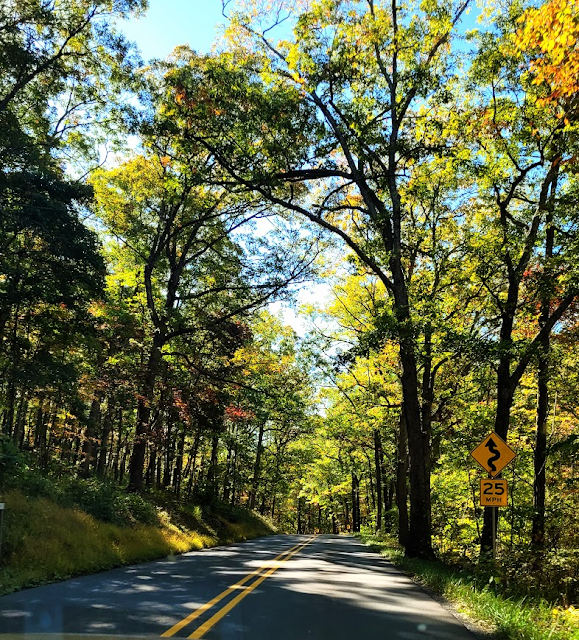
Following VA Hwy 675, we wandered through a narrow portion of the George Washington National Forest.  This particular National Forest covers 1,064,176 acres, about 33,600 acres of which are located in Page and Warren Counties that we were passing through. 

Administratively, the George Washington and Jefferson National Forests are managed as one unit.  Between the 2, a total of 2,800 square miles of land is protected.  Almost 140,000 acres of the National Forest have been designated at "wilderness areas"...no vehicles and no development allowed.

Note: These two National Forests cover an area larger than the State of Delaware.


This is a great example of our favorite style of highway driving!  Peaceful and almost no traffic... We wandered through the woods across the ridge that is part of this portion of the George Washington National Forest.


This view was one of our 'rewards' from following this byway from Interstate I-81 toward Luray.  That's the part of the Blue Ridge Mountains, itself a portion of the 2,000 mile long Appalachian Mountain chain.  I'm guessing that those little red flags will be replaced by guardrails.  


Once we reached Luray Virginia, our goal was the Luray Caverns attraction.  The fact is that we've done a lot of cave walking over the years and at my age and stage, there is no way that I could tour a cave.  But, the fact is that Luray Caverns is much more that an interesting big cave complex.  

I had called ahead and talked to the front office at Luray Caverns.  I told them that I was unable to tour the caves but that I sure would like to visit the remainder of the attraction.  Was there a way we could do that without fronting $64.00 for Cavern tickets?  I was told that all we had to do was to tell the admissions that we could visit the rest of the attraction without paying...and if there was a problem, just have them call the office.  Now this was a deal!

So, other than the caverns, (obviously the main attraction), there are 4 other attractions at Luray Caverns.  There is a Rope Adventure Park (not for us), The Garden Maze (not for us), Car and Carriage Museum (yea!), Shenandoah History Village (yea) and, there also is a toy museum. (ok) Plenty to see and do!


The toy collection or museum at Luray Caverns isn't hyped as much as the other attractions but Laurie and I both enjoyed wandering down "memory lane".  This large model railway display occupies the center of the space.  


Laurie took this photo of the railway bridge over the canyon.  If you look closely, you can see the images of a couple of toy airplanes hanging from the ceiling as well as a carousel horse behind the railway display's church steeple. 


I've always been fascinated by miniatures and love the close-up detail one can create.  I do remember when Trailways and Greyhound buses looked like the one in this photo...and love that Ford 'ragtop'! 


Being from the Midwest, we never saw electric power locomotives like this one.  I still prefer the look of, if not the smoke from, old time coal burning locomotives.


This is one of the few photos we took of toys that weren't part of the train exhibit.  Its the only one that I liked.  While a variety of "Rocket Racer" cars were produced and can be bought on the Internet, this is one of the truly rare ones.  From the 1930s, this is a rare Marx Rocket Racer Tin Lithograph Wind Up Toy.  It is roughly 18" long.  I found one on sale on eBay that isn't as pristine as this one is.  Asking price $499.95.

If you are over 55 years old, you should remember Marx toys.  Louis Marx and Company was in business from 1919 until 1980.  Toys that the company produced included tin toys of many types, toy soldiers, toy guns, action figures, dolls, toy cars and model trains.  Rock'em Sock'em Robots and Big Wheels tricycles were Marx products.  Marx's larger and costlier toys were staple items for catalog and departments store retailers, including J.C. Penney, Sears and Montgomery Ward. (The latter company being one of my key career stops)


These last two photos in this blog post are indeed children's toys, but they also lead into future posts from Luray Caverns.  Note that these are technically 'wheeled vehicles'.

Reading the plaque at this angle is challenging, so I'll do it for you.  This elaborate child's goat cart...powered by two 'billy' goats...was built in 1905 at the J. W. Clinedirst Factory in New Market Virginia.  Why was it so fancy?  Simple answer...it was built for the factory owner's grandchildren.  Looking on-line, no actual goat powered carts are shown that even approximate the look of this luxury toy.


Technically, this isn't a child's toy but rather a toy or prop designed to entertain children.  This horse tricycle was built sometime in the mid-1920s or 1930s for clowns to use in a circus.  It moved by pumping the handlebars up and down and as it moved, it 'rocked' like a child's rocking horse.

Do you remember the excitement when the traveling circus came to town?  Laurie and I remember the colorful and very impressive Ringling Bros. and Barnum and Baily Circus train passing through Des Plaines Illinois.  On one occasion Laurie visited the site of the fair near O'Hare Airport in Chicago... Her mission was to collect animal 'poop' from the elephants, horses and tigers that she could use to fertilize her flower beds.  It was free!  

The Ringling Bros. and Barnum & Bailey Circus, the largest circus in the USA, closed its traditional big top in 2017.  New types of entertainment including video games as well as animal welfare campaigns significantly contributed to the demise of most traveling circuses.  In 1905, there were 46 traveling circuses in the USA and by 1937 there were about 300 traveling circuses or shows of varying sizes.  Today there are just a handful of relatively small traveling circuses, many of which don't feature 'wild' animals. 

Just click on any of the photos to enlarge them...

Thanks for stopping by for a visit!

Take Care, Big Daddy Dave

Tuesday, November 19, 2024

Maysville Kentucky - Continued

Continuing with our October road trip with more sights and history from Maysville Kentucky.  This city is loaded with historic structure and my camera was at the ready as we wandered...or shopped...through town.


This is the Russell Theater.  Located at 9 East 3rd Street, it was completed by Col. J. Russell Barbour in 1930.  Construction costs totaled $125,000 and the first movie shown was "Whoopee!" starring Eddie Cantor.  The site occupied by the theater was previously home for wholesale grocery warehousing.  The exterior architectural style is Spanish-Moorish Revival.  Constructed as a movie theater, Col. Russell did provide dressing rooms for live performers as well as an orchestra pit.  

In 1935 another company took over the theater.  In 1953, the Russell Theater was the site of the world premier of "The Stars Are Singing", starring Rosemary Clooney.  In the early 1970s another group took over the theater and they operated it until 1983.  For a number of years it served as a restaurant, a used furniture store and a used clothing store before it closed.  After it was abandoned, high winds ripped off a section of the roof.  Since repairs weren't immediate the interior plaster work was extensively damaged.  Restoration is underway, tours are offered and the theater is open for movies on weekends from May through October.

Note: Rosemary Clooney was raised in nearby Augusta Kentucky and her nephew George Clooney grew up there.  A mural of Rosemary Clooney is featured on Maysville's flood wall.


This is a miniature model of what the interior of the Russell Theater looked like originally.  It was what was termed as an 'atmospheric' theater.  Atmospheric theaters were a movie palace design that was popular in the late 1920s.  They were meant to evoke a feeling of a time and place for theater goers, using architectural elements, ornamentation and projectors.  

The Russell auditorium was decorated as a Mediterranean garden with Lombardy poplars and literary busts set in wall niches.  At the end of the movie, a rainbow would appear over the stage.  The renovation continues... To learn more just go to https://www.russelltheatre.org/.


I've included these photos just to contrast Maysville's 2nd Street as it appears now as compared to a photo/postcard from ca. 1900.  I'm basing that early date on that very primitive automobile shown on the postcard.  Note the trolley tracks and the matching electrical power line right above them.  I'm guessing that the street was paved with bricks but its hard to be certain based on the picture.


Part of the Maysville Downtown Historic District, this is the Nelson Building.  It consists of two storefronts sharing a 'party wall', thereby creating 2 major bays.  The upper floors would have once been professional office space or apartments.  The huge Roman arched windows and the belt courses of stone indicate a Richardson-Romanesque influence.

One store front, at 9 West 2nd Street, is occupied by the Sprinkles and Hope Bakery and Deli, which trains and employs people with disabilities.  The bakery/deli offers cupcakes, cookies, breakfast sandwiches, salads and ice cream.  At 11 West 2nd Street, that second storefront, based on recent information on the Internet, one can imbibe at Kenton - "Stores with a Spirit".  They offer books, an art gallery, coffees, liquor and an interesting menu for its guests.


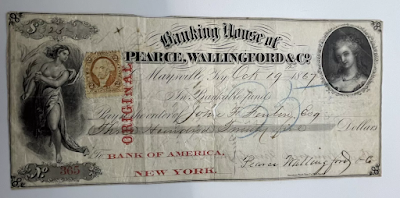
This handsome 3 story structure at 38 West 2nd Street in Maysville began life in 1871 as the Pierce and Wallingford Bank.  I was unable to learn anything about the bank company but I did find this company bank check for sale on eBay. (Asking price - $398.98!) Given the date on the check, (1867), its a fair guess that the bank was operating somewhere else before it opened its doors in Maysville.  The building is now known as the Hay House and it's a gift shop that specializes in greeting cards, gift wrap, ornaments and a variety of gifts for any occasion.  

The Maysville Downtown Historic District is about 4.5 blocks long and 2 to 2.5 blocks wide.  When the National Register for Historic Places application was completed in 1982, the area contained 155 buildings, a cemetery and a sculpture.  62% of the structures were commercial and 28% were residential.  The other 10% of the historic district included 5 churches, 2 theaters, a high school complex, a library, a museum and 5 governmental buildings.  87% of the buildings were built before 1930 and 92% were brick.  The first floor occupancy rate was 98%.


This is the Cox Building.  It's located at 2 East 3rd Street in Maysville.  I borrowed this photo of the building from the Internet as it was so much better than the picture I took... Construction of this Richardson-Romanesque style building began in 1886 and it was completed in 1887.  The tower at the corner, the large dormer-type windows on the 4th floor, the distinctive chimneys, curved windows and that big circular stained glass window, all combine to grab one's attention.  

The building was designed to accommodate 3 large storefronts on the ground floor with appropriate storage space for the stores on the second floor.  Up to 9 tenants could occupy the upscale professional office space on the rest of the second floor.  Originally the Cox Building was a 5 story structure.  The upper 3 stories were explicitly designed for use as a Masonic Temple, specifically for the York Rite "Knights Templar".

In 2010 the roof of the building, as well as the 4th and 5th floors were destroyed by a fire.  The city has worked to restore the structure to its original grandeur...bringing it back to life.  It was rededicated in 2012.  Currently it provides space for special events and offers tours to visitors.  Occupants include the Maysville-Mason County Convention and Visitors Bureau, the Ohio River Valley Artist Guild, the Masonic Lodge, the Downing Music Academy and the Maysville Community and Technical College Culinary Institute with its bakery and cafe.


Perhaps the most unusual building on Market Street is the former IOOF lodge.  Located at 221 Market Street, the building's attention grabbing polychrome Venetian Gothic ornamentation dates back to 1914.  The building appeared to be unoccupied during our visit to Maysville. 

FYI, I.O.O.F stands for the Independent Order of the Odd Fellows.  This fraternal organization promotes friendship, love and truth as guidelines for daily lives and they are involved in various activities, functions and charitable events that support their goals.

Note: See the person about to enter the building at the left of the old I.O.O.F. structure.  That spelled 'trouble' for me...


Laurie just had to explore "Elementz", a small boutique gift shop at 225 Market Street featuring 'upscale gifts for you and your family'.  Maysville and Kentucky crafted items are a primary focus with items available for babies, kids, teens, women, men, pets and the home.  Laurie scored with the purchase of 2 Christmas Holiday swags.  The good news for me was that she got them for 30% off the normal price... Elementz can be found on Facebook at https://www.facebook.com/elementzonmarket/.

As I was researching other buildings and historical structures in Maysville, I 
came across this blast from my past...sort of...because while I may be 'older', I'm not this old.


As I was researching other buildings and historical structures in Maysville, I 
came across this blast from my past...sort of...because while I may be 'older', I'm not this old.  As I wandered around Maysville, I don't know how I missed this building with its symbolic "The Spirit of Progress" figure at its decorative center peak.  This was retail giant Montgomery Ward's quality symbol and I spent a good deal of my work life with this company.  The building was constructed in 1928 as a Montgomery Ward department store.  It has been renovated and as best as I could determine, it's been serving as a conference center.


These are photos of the Simon Kenton Memorial Bridge.  It spans the Ohio River between Maysville Kentucky and Aberdeen Ohio.  This suspension bridge was built in 1931 to carry US Hwy 62 across the river.  At that time it was the only bridge spanning the Ohio River between Portsmouth and Silver Grove Kentucky, a distance of 110 miles.

The official opening of the bridge was on November 25, 1931.  As was the custom of the time, caravans of auto club members from across the state traveled to the event.  It was declared a holiday in Maysville.  Lights were strung across the bridge and a grandstand was built for the dedication ceremonies.  Several thousand people attended the event.

This is one of the few surviving historic suspension bridges on the Ohio River.  The steel "X" pattern steel towers are a special feature.  The main span of the bridge is 1,060 feet long and the total length of the bridge is 1,991 feet.  Tolls were collected for passage over the bridge until 1945...when there was another celebration.


This is the William H. Harsha Bridge and its located just a couple of miles downriver from the Simon Kenton Memorial Bridge.  This new cable-stayed bridge opened in 2000 and it handles a lot of the traffic that would have used the old bridge.  Noisy truck traffic can now bypass downtown Maysville and less traffic on the old bridge will expand its life expectancy.  Since its opened for traffic, the old bridge has been closed a couple of times with significant repairs and upgrades taking place.

The new Maysville (William H. Harsha) Bridge has a main span of 1,050 feet and a total length of 2,100 feet.  Each of its towers consists of battered reinforced concrete cellular shafts.  The deck of the bridge is 60 feet wide.


With the construction of the flood walls, the old Louisville and Nashville Railway depot was moved about a quarter mile south from its original location and this new depot was constructed in its place.  As the article notes, the old depot was repurposed by the city for offices and the fire department. 


This is the old Chesapeake and Ohio Depot in Maysville Kentucky.  This Georgian-style depot was built ca. 1918.  The first photo was borrowed from the Internet as it shows the front of the depot.  The depot is one of the few buildings near downtown Maysville that doesn't sit behind the floodwall.  Of course, neither do CSX Transportation's double tracks.  

Amtrak refurbished the old depot.  It had closed in 1968 and it was rebuilt in 1971.  The depot is located at the corner of West Front Street and Rosemary Clooney Street.  It now services Amtrak's Cardinal trains 50 and 51 with service on Wednesday, Friday and Sunday.  The depot lacks a station agent or station services but it does have a waiting area that is furnished with traditional wooden benches.  In 2023, the depot served 2,111 travelers.

Just click on any of the photos to enlarge them...

Thanks for stopping by for a visit!

Take Care, Big Daddy Dave

Friday, April 5, 2024

Chesapeake Bay Maritime Museum #3

…continuing with our tour of the Chesapeake Bay Maritime Museum which is located in St. Michaels Maryland.  We were nearing the end of our family trip to explore part of the Delmarva Peninsula.

This final post about our visit to the Museum will look at a variety of exhibits…in no particular order.


The first photo shows a punt that's equipped with a punt gun… These were tools used in the commercial waterfowl hunting trade.  Restaurants in the big cities not only craved oysters by the bushel, but also a steady supply of waterfowl for their clientele.  The Chesapeake Bay area is a critical and massive stopover for migrating ducks, geese, etc.

Punts are small flat-bottomed boats with a square bow.  They are used in smaller rivers and in shallow bodies of water.  They’re propelled by pushing with a pole on the river bed.  Punt guns are oversized smoothbore percussion guns that are far too big to fire from the shoulder so they’re mounted at the front of the punt and could be aimed by the shooter.  Guns like this were charged with huge amounts of gun powder and shot…and then were aimed at a flock of water birds.  When fired, a hundred or more ducks could be harvested, just from one shot.

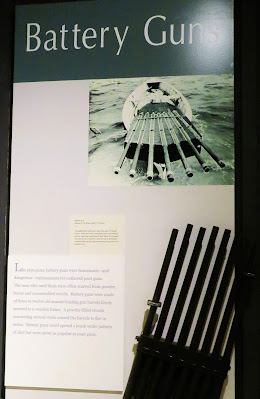
The second photo is one of the results of punt guns being outlawed.  To work around their inability to employ punt guns, market hunters built ‘battery guns’.  Basically they consisted of 3 – 12 old muzzle loaders secured to a wooden frame.  A powder filled ‘trench’ connected to vents caused the barrels to fire in a series. With the spread of gun barrels, they covered a wider area with shot pellets.  However they were dangerous to operate…

In any case, the use of punt guns or battery guns severely depleted the number of wild waterfowl and by the 1860s most states had banned the practice.  The Lacey Act of 1900 banned the transport of wild game across state lines.  Then a series of Federal laws in 1918 outlawed market hunting altogether.

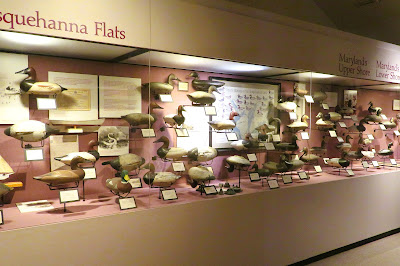
The Chesapeake Bay Maritime Museum has an impressive collection of artifacts related to water fowl hunting as a pastime and occupation.  As shown above this collection includes firearms and gunning skiffs but in addition there is a sizable collection of decoys…backed up by sinkboxes, tools and clothing.

The Museum’s large decoy collection includes working goose, duck, swan, and shorebird decoys made by more than 70 regional makers…many of them rather famous for their skills.  This display is part of the Museum’s long term exhibition “Stories from the Shoreline”.

Note: Not being a hunter I had to look up the term ‘sinkbox’.  It is a hunting blind consisting of a weighted, partially submerged enclosure that can hold one or more hunters.  Sinkboxes are suspended from a floating platform and are placed in calm water so the hunter can wait for his opportunity with the waterline roughly at shoulder height.  Since the early 1900s, sinkboxes have been illegal in the USA


The first photo shows the “model shop” at the Museum.  The volunteer Maritime Model Guild supports the Museum’s curatorial needs with exhibition models and building kits that are available at the Museum Store.  The Guild also offers classes for building models from scratch.  The Model Guild also hosts radio-controlled skipjack sailing races.  The Museum’s extensive ship model collection numbers more than 300 vessels.

I suspect that this handsome and detailed model of the “Peggy Stewart” was made by a member of the Model Guild.  The original “Peggy Stewart” was a Maryland cargo vessel that, with its cargo of tea, was burned in Annapolis Maryland on October 19, 1774.  It’s destruction was as a punishment for attempting to get around the boycott on tea imports that had been imposed in retaliation for the British occupation of Boston following that city’s “Tea Party”.  The burning of the “Peggy Stewart” in known as the “Annapolis Tea Party”.

Note: Incidentally, the most important cargo aboard the “Peggy Stewart” was removed from the ship before she was burned.  That cargo consisted of 53 ‘indentured’ servants.


The first photo shows the tugboat “El Toro” after it had been acquired by the Chesapeake and Ohio Railroad and it had been renamed “Chessie”…and later “W.J. Harahan”.  The “El Toro” was built in 1928 and spent many years of her life moving railroad car barges across Chesapeake Bay. 

The second photo shows the 12 foot high compound 2-cylinder steam engine the tug boat was equipped with.  This engine produced 700 horsepower…just a fraction of the power needed for today’s tugboats.  As I’d mentioned, the Museum covers a wide variety of Chesapeake Bay endeavors…

…and the variety of displays at the Museum continues.  In this case it includes a collection of about 1500 historic and contemporary paintings, prints and other artwork.  Works by regional artists as well as contemporary artists are featured along with posters, print advertisements and detailed drawings.

I failed to note the photographic artist who took this eye-catching aerial photo of a creek or small river where it emptied into part of Chesapeake Bay.  Nevertheless, I’d love to have the original of this photo on my wall at home!  Nature's designs are endless...

I do love ship paintings…and this one is no exception.  This is a painting depicting the pungy “Geneva A. Kirwan” sailing along the Bay.  This vessel was built in Madison Maryland in 1882.  The painting was completed in 1933 by Louis Feuchter.  Feuchter was born in 1885 and died in 1957.  He was known for his maritime paintings and he was quite prolific. 

Many of Feuchter’s paintings can be purchased for less than $1,000 with many in the $500 range.  The highest price for one of his paintings was for a painting of the “Pungy Amanda F. Lewis”, which sold for $4,312. 

Note: Yes…I did have to look up the ship style referred to as a ‘pungy’.  Basically, a pungy is a two-masted schooner that was used for oyster dredging in Chesapeake Bay.


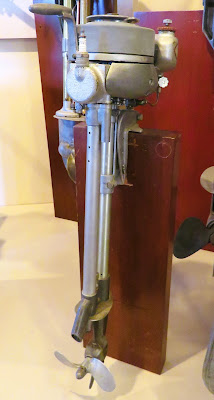
The “Stories from the Shoreline” exhibit also addresses the mass production and marketing of motorboats.  This modest display of outboard motors caught my eye as I’m always looking for items that tie back to my former ‘work life’ in some way. 

In this case, that small outboard motor to the left center of the photo did tie back to a former employer.  The close-up photo of the top of that little 7.5 HP “Sea King” outboard motor shows that it was manufactured for and sold by Montgomery Ward.  The company sold Sea King outboard motors from 1933 until 1986. (I didn’t join the company until 1987)

Primary manufacturers of a variety of Sea King outboard motors included Gale, Clinton and Chrysler Marine.  Some discontinued Lockwood (Evinrude/Outboard Motors Corporation) motors were also relabeled Sea King.  The same thing happened with some Thor outboards.  Apparently old/antique Sea King outboard motors are quite collectable with a number of them for sale on-line.  Another company advertises that they have replacement parts available.

This rather worn vessel is a five-log Tilghman Canoe.  It is the last of the 68 built by Robert Lambdin of St. Michaels Maryland.  These canoes were used in the fisheries industry along the bay.  This one was built in 1893 and it cost $212.57 at the time.  In 1910 this ‘canoe’ was converted to a powerboat by removing the centerboard and adding a propeller shaft.  It had been abandoned along the shore of Chesapeake Bay for several years before it was rescued and stabilized for the Museum.

…continuing with my boating or boat theme.  This is the “Bessie Lee”, a 20 foot long Seaside Bateau that is located in the Small Boat Shed at the Museum.  This is a two-sail periauger rig or “cat-yawl”.  In broad terms, a periauger or peroque is a shallow draft, often flat-bottomed 2-masted sailing vessel which also carried oars for rowing.  These vessels were often created by digging out a log, splitting it longitudinally and then adding at least one keel plank between the halves. 

Only small vessels with a shallow draft could enter many of the inlets around the bay.  But these bateaus were used by local merchants as well as blockade runners during the Revolutionary War.  A family’s boat ca. 1850s may have looked like this.  Bateaus did come in varying sizes depending on their planned use.

This is a Smith Island Power Crabbing Skiff.  Smith Island watermen used similar boats to sail to their crabbing grounds where they caught soft crabs using a dip net.  Originally these were sailing skiffs but engine-powered boats like this began being used ca. 1907.  Sailing skiffs continued to be used in the commercial crab fishery until WWII. 

After retirement from the fishery business, this skiff was used for pleasure.  She was found stored in a Pennsylvania barn but she has been restored to her original configuration and paint colors.  She was built ca 1925.

This early cabin cruiser was built in 1926 by the Mathews Company in Port Clinton Ohio.  The original owner spotted it on display at the Maryland Yacht Club in Baltimore and he paid $6,500 for it…a lot of money back in 1926.  Named the “Isabel”, she was a ‘show boat’ so it came equipped with anchors, life rings, monogrammed china, linen and silver.  Some of those artifacts are also on display at the museum. 

The family of the original owner spent almost 70 summers cruising the Chesapeake Bay on “Isabel”.  Her heirs were among the founders of the Classic Yacht Club of America and they participated in numerous rendezvous, parades and cruises.  With the exception of a new diesel engine, the boat retains most of its original equipment and fittings.  In 1995 the family donated this classic 38 foot cruiser to the Chesapeake Bay Maritime Museum


I’ll end our tour of the Museum with a photo of a more traditional Chesapeake Bay boat.  The 51 foot long “Old Point” was built in 1909.  The builder used 7 pine logs pinned together and then hewn to shape to construct this vessel.  She is a good example of the fleet of boats operating out of Hampton Virginia from the 1910s through the 1960s that were designed to dredge crabs during the winter. 

From December through March, captains and crews lived on their boats so they could leave every morning and dredge for crabs all day.  In the summer and fall, “Old Point” would carry fish and oysters to packing houses or to market.  The former owner of “Old Point”, Captain Ernest Bradshaw, had to transition throughout the year…from fish, to oysters and to crabs.  Part of the Museum’s ‘floating fleet’, “Old Point” was donated to the Museum by Mr. and Mrs. Richard C. DuPont back in 1984.

And so ends our tour of the Chesapeake Bay Maritime Museum.  To learn more about the museum, its exhibits, waterborne tours, hours of operation and entry fees, just go to Chesapeake Bay Maritime Museum | Home Page (cbmm.org).  We certainly enjoyed our experience at the Museum!

Just click on any of the photos to enlarge them…

Thanks for stopping by for a visit!

Take Care, Big Daddy Dave