…and continuing
with our exploration of Mystic Seaport Museum in Mystic Connecticut.
This is
the 40 foot fishing boat Florence. She was built along the Mystic River back in
1926. Engines powered fishing boats from
the first decade of the 1900s. The Florence is a ‘western rig dragger’, a
type of fishing boat that drags a conical net across the bottom to gather
fish. In the summers, draggers were used
to catch sword fish. She is the only
existing fishing vessel of this type in a museum collection.
The first
engine for Florence was a 65
horsepower 6-cylinder model by Lathrop, a company that was also situated on the
river. Florence was acquired by the Museum in 1982. She had been completely restored to her
original configuration, both inside and out.
From what I could determine, she is currently being used to carry
students out to Fishers Island Sound to collect marine biology specimens.
Being a
landlubber myself, I tend to think of a blacksmith shop as a place where they make
horseshoes, some decorative items and basic tools. However, I never considered their value as
regards ships and smaller vessels.
This “Shipsmith
Shop” was built by James Driggs on a wharf in New Bedford Massachusetts. It is the only remaining facility of its
type, specifically focused on the whaling industry that has survived from the
1800s. Driggs, with his grandson’s help,
replaced his larger building with this one in 1885. The whaling industry was already starting to
collapse…
During
our visit, the blacksmith/’shipsmith’ appeared to be training someone else in
the business. Products provided for the
whaling ships included harpoons, cutting irons, and ships fittings.
The
Shipsmith was sold to A.J. Peters ca. 1902.
It continued in business for many years despite the fact that only a
handful of whaleships remained. The shop
actually expanded in order to allow the Peters family to expand into more
familiar blacksmithing operations. The
shop was still in business until 3 years after the whaling ship, Charles W. Morgan was retired in 1921.
Merrill’s
Wharf and Peters “Shipsmithy” in New Bedford were the last outpost of American
whaling. C.E. Peters was probably the
last ‘whalecraft’ manufacturer in the USA.
FYI…the whaler John R. Mantra
made the last American whaling voyage, departing from New Bedford in 1927.
Note:
·
The most
significant invention impacting the success of the whaling trade was the
invention of a “Single Fluke Temple Toggle Harpoon”. It worked much like a toggle bolt works,
opening after penetrating the wall or whale, and securing it firmly. It was invented ca. 1845 by African American
blacksmith, Lewis Temple. His son, Lewis
Temple Jr. worked for James Driggs at his shipsmithy.
The ships
chandlery was the ‘general store’, both retail and wholesale, for ships and
crew. Like any good merchant, a
successful chandler knew what was needed locally, whether for whaling,
shipping, fishing or ship building, and he insured that he could meet those
needs.
Ships
provisions were the responsibility of a shipping agent, a person who was hired
by the ship owners to manage supplies and equipment. He also saw to necessary repairs, freight,
towage and the hiring of officers and crew members. Sometimes, the chandler himself served as a
shipping agent.
Of
course, back in the early days of shipping and whaling, a lack of refrigeration
restricted what items could be brought on board for long voyages. However, chandlers provided salted fish and
meat, hardtack, molasses, potatoes, onions and other winter vegetables as well
as spices, flour, rum and tobacco.
Sailors bought clothing, boots and blankets. The ships themselves required navigational
instruments, lanterns, buoys, logs, inkstands, needles, beeswax, canvas, marine
hardware, paints, oils and caulking compounds.
The Ship
Chandlery at Mystic Seaport displays many objects from the collection that
would have been available in such a ships store in the 1800s. You can see anchor balls, lights, bomb lance
guns, hoops, caulking irons, lamps, chests, biscuits/hardtack, rope and ships
wheels… Chandleries were truly general stores for the sea!
The Charles W. Morgan is the last remaining
ship from an American whaling fleet that sailed for more than 200 years and
which numbered more than 2,700 vessels.
The Morgan was built and
launched at New Bedford Massachusetts in 1841.
As such, this 177 year old ship is now America’s oldest commercial ship
still afloat. FYI…only “Old Ironsides”, the USS Constitution is older.
In 1966, she was designated as a National Historic Landmark.
The Morgan is 113 feet long and she usually
sailed with an international crew of 35 from around the world, over 1,000 in
total. She embarked on 37 whaling
voyages, most of them lasting 3 or more years.
Between 1888 and 1904, she called San Francisco her home port. She was built for durability, not speed, and
she roamed all over the world in pursuit of whales. The Morgan
is known as a ‘lucky ship’. She safely
navigated ice fields and flows, survived hostile cannibals, endless storms and
several passages around Cape Horn. After
80 years of whaling, Morgan ended her
quest in 1921.
The Charles W. Morgan made her 38th
voyage in the summer of 2014. Following
a 5-year restoration project, the Mystic Seaport Museum took her back to
sea. She visited her original home port
of New Bedford, as well as Newport Rhode Island, Boston Massachusetts and New
London Connecticut. Her mission was to
raise awareness of America’s maritime heritage and to focus attention on issues
of oceanic conservation.
This
photo of the Charles W. Morgan’s deck
shows 2 huge ‘try pots’. Early in the
whaling industry, oil was rendered from blubber in try pots onshore. Later on, whaling ships frequently featured a
‘trywork’, a brick furnace and a set of pots built into the deck. This feature allowed whaling ships to stay at
sea hunting for whales longer, boiling out their oil as they were
harpooned. This technological advance
enabled the success of the Yankee whaling industry.
The deck
of the Morgan is 106 feet long and
her beam measures 27 feet, 9 inches.
Fully rigged she carries 7,134 feet of sail. The ship was featured in 3 early films, ‘Miss
Petticoats’ (1916), ‘Down to the Sea in Ships’ (1921) and ‘Java Head’
(1923). When her career ended in 1921,
the Morgan was preserved by Whaling
Enshrined, Inc. and she was exhibited in South Dartmouth Massachusetts. In 1941, she came to Mystic Seaport and to
this day, she continues to dominate the waterfront here…
Note:
·
Over her
80 years of whaling, the Charles W.
Morgan brought back 54,483 barrels of whale oil and 152,934 pounds of whale
bone (baleen).
This is
the inside of Mystic Seaport’s cooperage.
This was a shop that built round wooden containers (barrels or
casks). These containers were essential
at sea and ashore, used to store many products.
Aboard ship, they contained provisions and on fishing and whaling
vessels, they contained the catch from the sea.
A cooper
was a regular member of a whaleship’s crew.
He was expected to assemble pre-made casks as needed to hold the whale
oil. Not only was he responsible for
insuring the casks were leak-proof, he was also in charge of the accuracy of
measure held in them…
Coopers
made both ‘tight’ and ‘slack’ casks/barrels.
Tight casks were used for spirits (such as rum), molasses, whale oil,
etc. Slack casks were used for flour,
potatoes, apples, dishes or anything that wasn’t liquid that needed to be
transported.
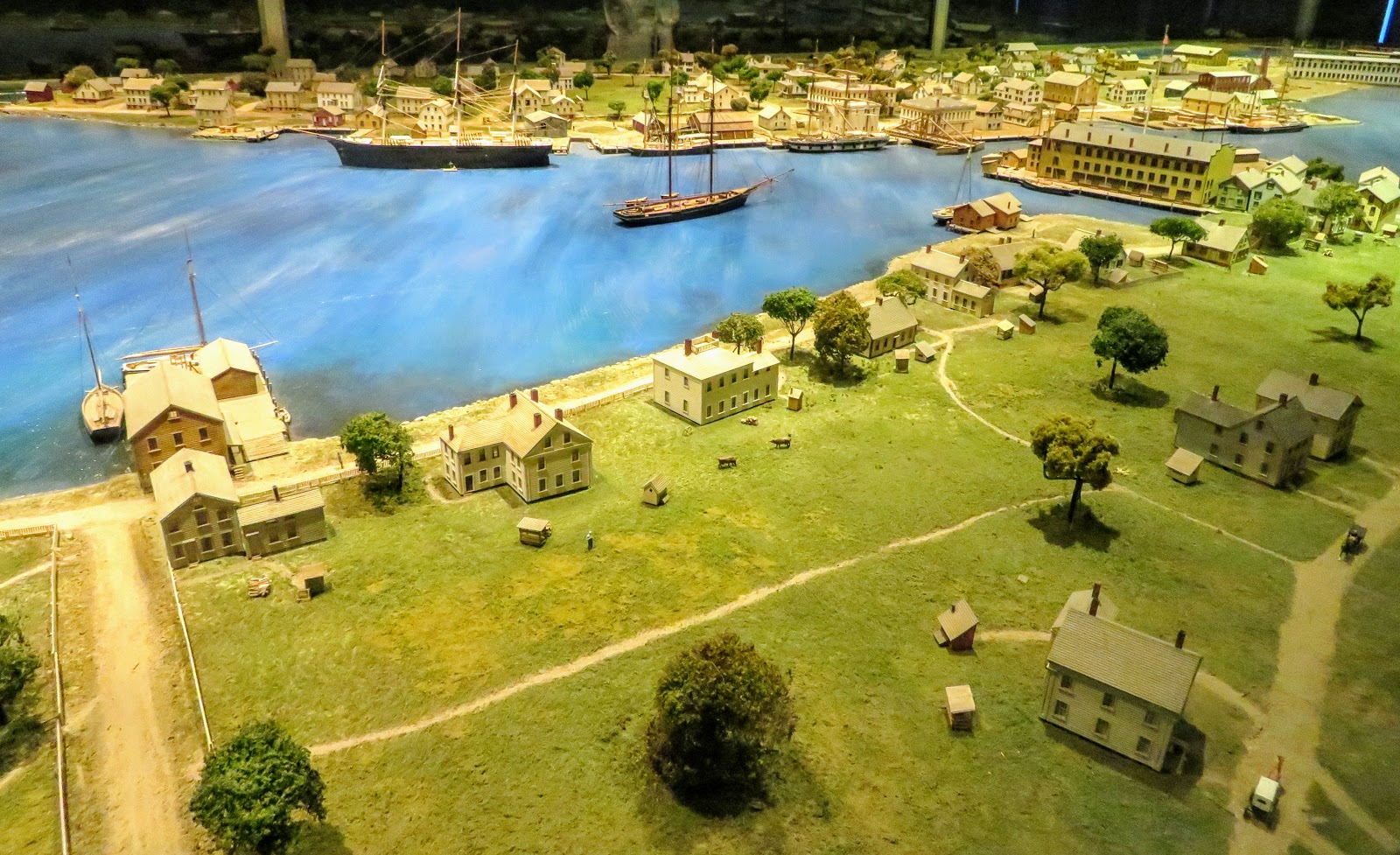
One
building at Mystic Seaport contained this exhibit showing the Mystic River area
as it appeared ca. 1870. The 12 foot by
40 foot diorama is scaled to 3/32 of an inch equals 1 foot. Providing visitors with a look back in
history, the display features more than 250 detailed homes, shops, barns and
lofts, plus 5 local shipyards.
This
General Store/Grocery Store was originally built in 1850 as a home near
Pawcatuck Connecticut. It was given to
the museum in 1954. The exhibit inside
is the result of a retired local merchant who personally stocked the shelves
with his own collection of historic items.
Note the youngsters listening to the docent explaining the wares on
display.
This is
the Wood Carver’s Shop at Mystic Seaport.
The age of sail was marked and celebrated with ship’s figureheads and
other ornate decorative carvings. All
too frequently, these old carvings are all that remains of many vessels from
the 1800s. The Mystic Seaport Ship
Carver exhibit portrays the shop of a skilled independent tradesman and his
staff.
Carvers
such as this artist worked to carve ship’s nameboards, trailboards, figureheads
and sternboards for boats. They also
carved shop signs, tobacconists’ figures, ornate fencing and a variety of
decorations intended for the home.
Carvings
on a ship were intended to show pride to catch the attention of the
public. Commercial vessels were required
to have a name and that was a big part of the carver’s business. Choosing a name that the shippers would
remember with a memorable figurehead was important to ship owners.
Wood
carvers and the business of creating carvings for ships was rarely part of the
shipbuilder’s business. In the second
half of the 1800s when Mystic had 6 shipyards operating on the river, one local
business did most of the carvings for all the shipyards.
FYI…Mystic
Seaport’s Wood Carving Shop offers 5 day hands-on workshops teaching the
fundamentals of the art. The next
workshop is scheduled for January 2019.
I’d love
to have a carving like this depiction of a Tobacco Store Indian. I have no idea what a new full size carving
like this would cost but I did discover a website offering a wide variety of
antique wood and metal figures like this.
Prices for wood figurines roughly range from $40,000 to $80,000. One of the most expensive Indian wood
figurines pictured on this site originally cost $175.00 back in 1875! In the market? Check out what’s available at http://www.cigarstoreindians.com/.
The
family of William Hall Sr., a New York import merchant made their home in this
coastal farmhouse in the 1830s. The home
was originally located in Saybrook Connecticut, close to the ferry crossing at
the mouth of the Connecticut River. It
was purchased in 1833 from the estate of Samuel Buckingham.
In 1951,
the construction of a new highway bridge across the river meant that this home
might be razed. Mystic Seaport decided
to save it and it was shipped to its current location via barge.
The
current exhibit in the home is entitled “Voyaging in the Wake of the
Whalers”. It’s an exploration of
America’s historic as well as current relationship with whales and
whaling. It’s all about stories about
the people, places, ships and whales that impacted and were impacted by whaling
since the Charles W. Morgan was built
in 1841.
Several
buildings contain sea and whale hunting exhibits. I love quality ship models and these three
were among those on display. I failed to
capture the names of the first two ships…the first one is a warship…but the
third one is a model of the freighter City
of New York. Many actual ships were
named City of New York or New York City.
Some of
the displays focused on whale based products and that included these
corsets. Baleen from whales was the
equivalent of plastics today. It is a
strong and flexible product. Baleen,
commonly called whalebone, was used as corset stays, in crinoline petticoats,
back-scratchers, umbrella handles, false teeth, chess pieces, collar stays,
toys, walking stick handles, buggy whips and piano keys.
Whales
were primarily hunted for their oil.
Boiled out of the blubber, which can be as much as 11 inches thick, it
was widely used in oil lamps and for lubricating machinery. It was also used in soaps, paint, varnish,
textiles and rope. “Spermaceti” from
Sperm Whales was highly valued to create high quality candles and perfumes…
Of
course, whales were and still are hunted for their blubber as food…these days mostly
by native peoples in the artic. Even
whale tendons were put to use, sometimes as strings on tennis racquets. Another use was as a key ingredient in margarine
and cooking oils. Whatever remained was
used as fertilizer or in animal feed.
Note:
·
As a
material for its many human uses, baleen is usually called whalebone. However it is not really whalebone. Baleen is a filter-feeder system in the
mouths of baleen whales. It resembles
bristles and it’s made from keratin, the same substance found in human hair and
nails.
Other
uses derived from whale hunting include various art forms. In their down time, sailors would carve
scenes on whale teeth. The result is
scrimshaw. A fine example is pictured
above.
The
import of new whales teeth or ivory into the United States is illegal and
without provenance showing its legal origin, it will be seized by U.S.
Customs. High quality pieces of antique whales
tooth scrimshaw by outstanding craftsmen can cost many thousands of
dollars.
This
photo shows whale’s vertebrae from 2 different types of whales. The size of these pieces is impressive. Many pieces like this were carved by sailors
too…scrimshaw can be created using bone from many animals and even baleen from
whales.
This is a
native Alaskan waterproof parka. It was
sewn together using intestines from sea-mammals. Items like this were used by native peoples
in the western arctic.
This is
another sailor’s art form. This shell
valentine from Charles W. Morgan during
the 1800s was created by a ship’s crew member.
It was presented to the museum in
1941 on the Morgan’s 100th
birthday in New Bedford Massachusetts.
At the
height of Mystic’s shipbuilding activity in the mid-1800s, the Greenmanville
Seventh Day Baptist Church was an important element of the town. It was built near its current location ca.
1851 largely with the support of local shipbuilding families. As the shipyards declined in the late 1800s,
the congregation shrunk and the church closed in 1904. After subsequently serving as a private
residence and as an apartment building, the church was acquired by Mystic
Seaport in 1955.
In these
2 posts, I’ve only just scratched the surface of the sights and history
presented at Mystic Seaport. The Museum
is home to more than 500 historic watercraft and I’ve only featured a fraction
of the 60 historic buildings on the grounds.
We didn’t check out all of the special exhibits either and we never got
around to visiting the Henry B. DuPont Preservation Shipyard where shipwrights
restore and maintain the many ships and watercraft.
The
Mystic Seaport Museum is an excellent destination for anyone interested in
American history, whaling, and our nation’s seafaring past. Admission is $28.95 for adults, $26.95 for
seniors and $18.95 for youth between 4 and 14 years of age. Mystic Seaport is open daily from 9 AM until 5
PM. It is located at 75 Greenmanville
Avenue in Mystic Connecticut. Phone:
860-572-0711. Website: https://mysticseaport.org.
Just
click on any of the photos to enlarge them…
Thanks
for stopping by and sharing our tour with us!
Take
Care, Big Daddy Dave