My final
post on our visit to the Shelburne Museum near Burlington Vermont is focused on
transportation related exhibits. There
was more than enough to look at that fit this category…
Of
course, this isn’t an antique. There is
a lot of walking around Shelburne in order to cover its 45 acres and 39
different building with over 100,000 artifacts on exhibit. For those who might have a hard time walking
the entire facility or who just get tired, from May through October this
wheel-chair accessible bus circles this open air museum every 15 minutes.
To begin
this segment about our visit to Shelburne, we will start with the Horseshoe
Barn. Its exhibits are continued in the
Horseshoe Barn Annex that is directly behind this beautiful structure.
The
2-story Horseshoe Barn was built here in 1949.
It was designed like an unusual horseshoe shaped dairy barn in Georgia
Vermont. The hand-hewn beams used in its
construction came from 12 different Vermont barns. The stone came from 2 Vermont
gristmills. The structure of over 238
feet long with a 32 foot wide interior space.
The Horseshoe Barn Annex was also built on site. It was completed in 1957.
As I
stated at the beginning of this post, it’s all about transportation. The Horseshoe Barn has a large collection of
horse drawn sleighs on exhibit.
The same
is true for carriages and wagons... The variety is remarkable!
You may
not recall the history of the museum that I briefly related in my first post on
Shelburne. When Electra Havemeyer Webb
founded the Museum in 1947, her first objective was to provide a place to
preserve her family’s collection of horse-drawn carriages.
This
carriage is called a Mail Phaeton. (ca. 1882) It was built by the F.S. Brown
and Company in New York City. The Mail
Phaeton got its name from the first English mail coach built during the reign
of King George IV.
This road
coach is named ‘Liberty’. It was built
in Paris France in 1900 for James Hazen Hyde. (Heir of founder of Equitable
Life Assurance) The builder was a preeminent European coach maker,
“Million et Guiet of Paris”. In 1901,
Hazen and Alfred G. Vanderbilt set a speed record with this coach, traveling
from New York City to Philadelphia in only 19 hours and 35 minutes. In 1903, the coach was put into public
service between New York City and New Jersey.
This
‘Pony Road Coach’ named “Defiance II” was also built ca. 1900 by Million et
Guiet of Paris. A ‘pony’ coach is a
small version of a road coach. It was
designed to a pony four-in-hand team.
Points of departure, intermediate stops and destination towns are
painted on the sides of the coach. (All are New Jersey locations)
This Gypsy
Wagon or “Wardo” was built in the late 1800s.
Wagons like this were home to gypsy’s, providing a place for their
possessions as well as mobility. Note
the elegant details…beveled glass, stained glass windows, iron work and carved
wood. In the early 2000s, this
particular wagon was used as a chuck wagon for hunting.
This is a
more familiar wagon to most of us. It’s
a Conestoga wagon that was used to haul grain 60 miles from Lancaster
Pennsylvania to Philadelphia. It was
built by wagon maker A. Griffin and blacksmith/wheelwright Peter Criley in
1837. This is one of the few remaining
Conestoga wagons in existence.
The
Conestoga wagon is a heavy covered wagon that was widely used to haul freight
during the late 1700s and throughout the 1800s.
It was large enough to transport up to 6 tons of cargo. Conestoga wagons were built with an upward
curved floor to prevent its contents from tipping or shifting. Including its tongue, the average Conestoga
was 18 feet long, 11 feet high and 4 feet wide.
Note:
·
Conestoga
wagon is not a generic term for “covered wagon”. Most wagons used in America’s westward
expansion were ordinary farm wagons fitted with canvas covers. A true Conestoga wagon would have been too
heavy for use on the prairies.
This is a
conveyance you just don’t see every day.
It’s a “School Bus Sleigh” ca. 1910.
It was found in Northern Vermont.
Used to take children to their 1-room schoolhouses, it has long benches
on either side, and it’s equipped with a very small wood stove to
keep its passengers warm on the journey.
This
‘omnibus’ is named the “Barge Lady Oxford”. (1890 – 1918) It was first used to
transport tourists from the train station to the Marshfield House/Hotel north
of Boston Massachusetts. Later it was
used to carry students at St. Paul’s school in Concord New Hampshire. While these vehicles were once widely used in
New England, only 3 survive in public collections today…
If you
have cars, you must have gas stations and mechanics. If you have horses and carriages, you must
have blacksmiths and a blacksmith shop! This
1-room brick shop was built in Shelburne ca. 1800. It was moved to the Museum in 1955.
Although
blacksmiths were critical to horse, oxen or mule powered transportation, they
provided significant other value to the communities where they were
located. In addition to the shoes for
animals, the smithy also built tools, utensils, agricultural implements, architectural
hardware and vehicle parts.
Toward
the end of our long stroll through the grounds and buildings at the Shelburne
Museum, we came to this big red round barn.
This barn measures 80 feet in diameter and it was built in East
Passumpsic Vermont in 1901. It was
dismantled and moved to the museum in 1985 – 1986.
Round barns were first built by Shakers in
1826. They were designed to simplify
daily farm operations. The Round
Barn provides display space for some of the Museum’s collection of horse drawn
carriages. It also provides space for
special exhibitions and events. It can
be rented by the public for weddings, anniversaries and other private
gatherings.
By the
time we reached the Round Barn we thought that we’d seen all of the carriages
and horse drawn vehicles that the museum had on exhibit. As you can see, we were wrong.
Did you
think that food trucks were a new phenomenon? Wrong!
This Popcorn Wagon was built ca. 1880.
It would have been positioned along busy roadways, parks and at sporting
events. The steel body ensured that it
would be fireproof, a good thing considering that the popcorn was popped on 2
open-flame kerosene burners, one at either end of the wagon.
I didn’t
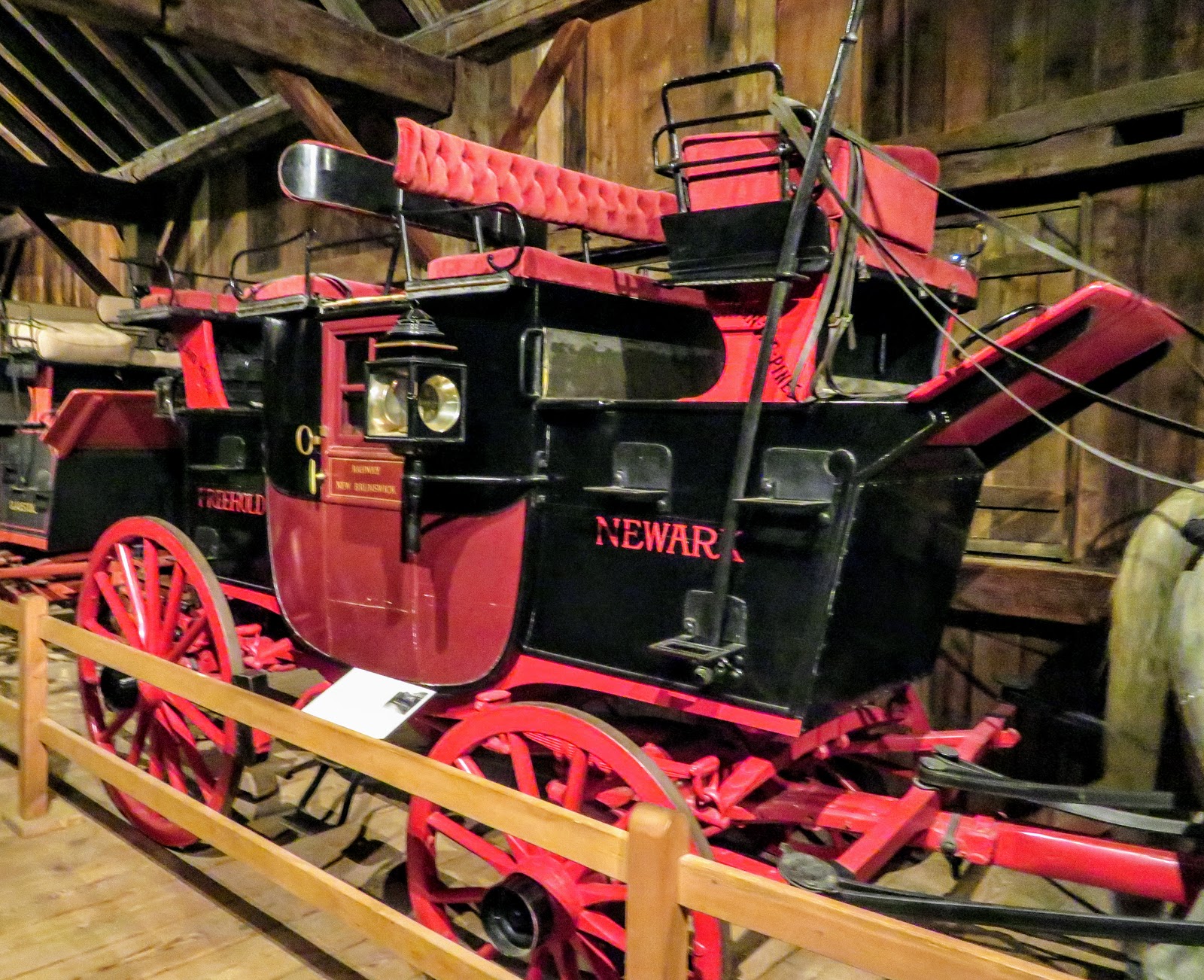
pick up any information on this handsome stagecoach named “Ipwich”. I love the look of it due to both its color
and the fact that the major cities served by the line are painted on it…
In the
1800s stage coach routes readily sprang up wherever post roads appeared. These vehicles created jobs and commerce
wherever routes were established. Livelihood
was provided for owners, drivers, ticket agents, coach manufacturers, blacksmiths,
tavern owners, stable hands and farmers who raised the horses as well as the
crops that sustained them. Regular
stagecoach runs were also an important means of communication before the
invention of the telegraph.
I wanted
to finish our tour or horse-drawn transportation before I moved on to other
means of moving people and merchandise. Many of you know that I’m partial to
railroads, locomotives, rolling stock and old railway depots…. I was happy to
see a depot as well as a protective structure covering a display of rolling
stock.
The
Museum’s Railroad Station once served as the original station for the town of
Shelburne. This shingle style depot was
designed by the same architect who designed the Vanderbilt-Webb estate on
Shelburne Farms. (A future post) The station was built in 1890 and it served
passengers of both the Central Vermont and Rutland Railroads.
Museum
founder Electra Havemeyer Webb and her family used this depot on their many
trips to and from New York City. Rail
service to the village of Shelburne was discontinued in 1953 and Electra Webb
had the station moved to its current location on Museum grounds.
Exhibits
at the depot include the stationmaster’s office, waiting rooms for men and
women, telegraphic equipment, maps, message hoops, a “high-speed delivery fork”
as well as early telephone equipment. In
addition there are historic photos, maps of Vermont and US rail routes, models
of locomotives, advertisements and timetables.
This
private rail car, the Grand Isle was
built in 1889 for Dr. William Seward Webb.
It was built by the Wagner Palace Car Company which was located in
Buffalo New York. The car was listed at
Rutland Railroad 500 Grand Isle. This
was because Webb, who’d been trained as a physician, had been persuaded to quit
medicine and join the family business by his father-in-law…William Henry
Vanderbilt.
As
President of the Wagner Palace Car Company and then the Rutland Railroad, Webb
lived part of the years in Shelburne…commuting back and forth to New York City
in comfort on the Grand Isle. Webb actually owned a group of rail
cars. At some point Webb presented this
coach to former Vermont Governor and President of the Vermont Central Railway,
Edward C. Smith.
This is
the sleeping car portion of the Grand
Isle. This private rail car also has
a mahogany-paneled parlor, an elegant dining room, a bathroom and of course, a
kitchen. These private luxury rail cars
were important symbols of rank for wealthy business-men in the latter part of
the 1800s. J. Watson Webb, Jr, Dr. Webb’s
grandson, personally supervised the Grand
Isle’s renovation to ensure that it would accurately reflect the day of
luxury rail travel…and to commemorate his family’s role in the railroad
industry.
Note:
·
Politician
and inventor Webster Wagner invented the sleeping car and luxury parlor
car. He also invented a railroad car
ventilating system. His company was in
constant legal battles with the Pullman Car Company. Coincidentally, Wagner was killed in a
head-on crash between 2 trains in the Bronx in 1882.
Also on
display in that protective shed is this medium-sized 4-6-0 locomotive. Locomotive 220, which was built in 1915, was
the last coal-burning steam ten-wheeler used on the Central Vermont
Railway. Because of its size, this
locomotive served double duty, pulling both freight and passenger trains. The Central Vermont Railway retired this
locomotive from service in 1956, presenting it to the Museum for
preservation.
Note:
·
Locomotive
220 became known as the “Locomotive of the Presidents” because of its use on
special trains carrying Calvin Coolidge, Herbert Hoover, Franklin D. Roosevelt
and Dwight D. Eisenhower. In 1941, #220
pulled a special train for British Prime Minister Winston Churchill during his
visit to Canada and the United States.
This
Railway Express Agency Freight Shed is a reproduction that was constructed in
1963. It was needed to protect and
exhibit equipment used by railroad workers.
It looks old and quite authentic…
Note:
·
I’m old
enough to remember the Railway Express Agency and its iconic railway related
signs. It was a national package
delivery service that operated via the railroad system from 1918 until
1975. It was much like UPS, DHL or FedEx
is today…only via the rails vs. road and air.
The Railway Express Agency was created through the forced consolidation
of existing services into a federal near-monopoly to ensure the rapid and safe
delivery of parcels, money and goods during World War I.
The
freight shed/Railway Express Agency building contains exhibits of picks,
shovels and other hand tools used by railroad workers. As the photo shows, there also is a large
collection of railroad lanterns and glass globes. Before today’s radios, railroad lanterns were
an important method of communication between conductors, brakemen, signalmen
and engineers.
Part of
this collection includes hand-powered work and inspection cars. An unusual item is the “Gertie Buck”, a
self-propelled steam powered inspection car built used on the Woodstock Railway
in eastern Vermont in the last part of the 1800s.
What the
heck! Is that a lighthouse at the far
end of this garden? What is it doing
here? Is Lake Champlain right over
there?
Not
really…but this lighthouse will lead us to the last exhibit I’ll be reviewing
at the Shelburne Museum.
The
Museum’s lighthouse was built in 1871 and it originally guided vessels past
dangerous shoals in Lake Champlain.
Visitors to the Lighthouse learn about the lake’s history and what daily
life was like on the lake in the 1800s.
This lighthouse was originally situated on the lake’s Colchester Reef,
actually 3 reefs between New York and Vermont.
It was the home and workplace for 11 different lighthouse keepers and
their families. In 1952, the abandoned
lighthouse was dismantled and re-constructed at the Museum.
For those
not familiar with Lake Champlain, it’s a natural freshwater lake that stretches
for 107 miles primarily between the US States of Vermont and New York, although
the northern portion of the lake lies across the Canada-U.S. border in the
province of Quebec. The lake is only 14
miles across at its widest point and it has an average depth of 64 feet.
(Deepest point 400 feet)
If there
is a lighthouse, there just has to be a ship!
This is the steamboat Ticonderoga
peeking over the hill and framed by the forest behind it… It certainly has to grab
visitor’s attention… It certainly caught my eye! This restored 220 foot long steamboat is a
National Historic Landmark and it is the last walking beam side-wheel passenger
steamer in existence.
The
Ticonderoga is no less impressive when viewing her from the stern. Actually built in Shelburne in 1906, this
beautiful ship operated as a day boat on Lake Champlain. She served ports along the New York and
Vermont shores until 1953. Amazingly, in
1955 Ticonderoga was moved 2 miles overland to Shelburne Museum. What a challenge that must have been!
Lake
Champlain was named after the famous French Explorer, Samuel de Champlain. During his explorations he arrived at the
lake in July of 1609.
Today the
ports around the lake are primarily used by small craft, ferries and lake-cruise
ships but back in the 1700s and 1800s, the ports and the lake were of
substantial commercial and military importance.
In the early 1800s, the Champlain Canal was constructed. It connected Lake Champlain to the Hudson
River system to the south, allowing north-south commercial traffic from New
York City to Montreal and Atlantic Canada.
The canal officially opened in 1823.
It was immediately a financial success.
It carried substantial commercial traffic until the 1970s.
As she is
displayed today, the Ticonderoga provides a picture of life on board her in
1923. Visitors are able to explore the
ship’s 4 decks, look at its engine, and then check out the pilot house, galley
and crew’s quarters.
This is
the inside passenger area on one side of the main deck. Note the carved and varnished woodwork and gilded
ceilings along with some original deck chairs.
The
Ticonderoga was never intended as an overnight boat but passengers could book
one of five suites on the ship to coincide with their arrival by train the
evening before the ship was scheduled to depart. That would save them from having to wake up
in a hotel or inn in time to board the ship for its 6 AM departure.
This
luxury suite is set up to show what it was like in 1923. At $3.00 per night, it was the most expensive
suite of the 5 on board. The least
expensive suite was $1.50 a night.
Both crew
and passengers had to eat. This is the
galley where the food was prepared. It’s
located on the Engine Deck. Other key
rooms or areas on the Engine Deck include the Lazerette (ship’s storage), the
Dynamo Room, Pump Room, Boiler Room, Power Steering and Blower Room and Crew’s
Quarters.
While the
Captain and other ranking crew members had cabins on upper decks, most of the crew
slept on the Engine Deck. This included
deckhands, firemen and the like. The
crew included the Captain, pilots, mate, deckhands, engineers, firemen, a
purser, stewardess, freight clerk, bartender, hall boys, cook, waiters,
scullion and mess boys.
The
Ticonderoga had a displacement of 892 tons.
Her vertical beam steam engine was constructed by the Fletcher Engine
Company of Hoboken New Jersey. It was
powered by 2 coal-fired boilers manned by 2 firemen who kept those boilers
stoked. The ship could achieve a maximum
speed of 17 miles per hour or about 15 knots.
On this particular
trip, the Ticonderoga was transporting a passenger’s 1925 Durant Five Passenger
Touring Car. This type of car was
typical of those used by adventurous travelers who took road trips in the
mid-1920s. This model Durant cost
$830.00 in 1925.
I like this
view of the upper deck and wheel house.
Initially,
Ticonderoga served a north-south route Lake Champlain. She would dock at Westport New York where she
would meet the New York City evening train.
The next morning she would carry travelers and freight north toe St.
Albans Vermont.
During both World Wars,
Ticonderoga transported US troops between Plattsburgh New York and Burlington
Vermont. Other routes and a short stint
as a floating casino followed. When
modern ferries made her obsolete, Ticonderoga continued as an excursion boat,
ending in 1950.
Ahh… I
see that Laurie is ready for the cruise on Lake Champlain. It was hard telling her that we were in ‘dry
dock’!
I’m not
sure whether I like this photo best or the one at the beginning where I saw Ticonderoga over the hill…
The
Shelburne Museum tried to continue to operate the ship for a short time…but a
lack of available properly trained personnel ended that effort. In 1954, it was decided to move the
Ticonderoga 2 miles overland to the Museum grounds. At the end of summer season, the boat was
floated into a newly dug, water-filled basin on Shelburne Bay. She was then floated over a railroad carriage
resting on specially laid tracks.
When the
water was pumped out of the basin, the Ticonderoga settled onto the railway
carriage. During the winter of 1955, the
ship was hauled across highways, over a swamp, through woods and fields and then
across the Rutland Railway’s tracks to reach her permanent home at the Museum.
…and so
ends our adventures at Shelburne Museum.
I only covered what we considered the most interesting exhibits of the
places we visited. We skipped a couple
buildings altogether as we were getting tired.
In my 3 posts about this Museum, I didn’t cover anything about the
following: Artisans Shop/Diamond Barn; the Carousel; the large Circus Building;
Dutton House and Tavern; Jail; Meeting House; Pizzagalli Center for Art and
Education; Pleissner Gallery; Prentiss Home; Print Shop; School House;
Smokehouse; Stencil House; Sawmill; Stone Cottage; Weaving Shop or the Settler’s
House and Barn.
It would
be very easy to spend 2 full days at Shelburne Museum… We would highly
recommend this fabulous collection for its variety and many collections. There is something for everyone! Check out the Shelburne Museum for
yourself. Website: https://shelburnemuseum.org/visit/. Adult tickets for a 2-day admission are $25
but only $23 for seniors. Active
military are free…
Just
click on any of the photos to enlarge them…
Thanks
for persisting and following along with us on our tour!
Take
Care, Big Daddy Dave