Friday, August 11, 2023

A Bit of Brew…and Family Too!

…continuing with our early summer family visit to the St. Louis Missouri area.  Following our exploration of Ste. Genevieve Missouri, we headed out to a local winery for adult libations and a snack…

Crown Valley Winery’s mailing address is Ste. Genevieve although this expansive facility is 25 miles and about 35 minutes from the town.  Crown Valley is not only a winery, but also a brewery and a distillery. 


The winery not only offers wine tastings, but also a fair quantity of miscellaneous merchandise.  In addition to the obligatory t-shirts, mugs and hats, visitors can purchase non-alcoholic beverages, fruit ciders and a wide variety of craft beer…

This is Crown Winery’s vat/distillery room.  It is large, spotless and impressive… Actually, the winery with its various customer snacking and relaxing areas plus a number of event spaces, is very large indeed.

The interior of the winery goes on and on with tables and chairs everywhere and a second bar in the back adjacent to the veranda.  What stunned me was just how empty the place was.  There were just a handful of customers in the late afternoon.

Of course, it is obvious from their website that this is an event center too and that may be their primary business.  Crown Winery is only open Friday and Saturday from 11 AM until 8 PM and on Sunday from 11 AM until 6 PM.


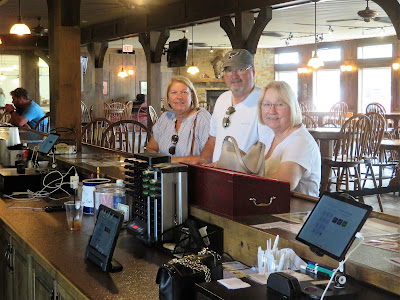
I took these photos of Laurie and Bill and then Bonnie, Bill, and Laurie at the bar.  Wine tastings at Crown Valley are $8.00 per person.  Tastings include 5 wines samples and you get to keep the souvenir wine glass.

Laurie and Bonnie had a beer while Bill ordered a flight of different beers to sample a variety of the available brews… Beer flights include 4 choices from a list of beers and hard ciders…cost $8.00.  Since I just don’t imbibe much anymore and I was driving, I abstained and had a Coke Zero.

While no one sampled the Raspberry Milkshake Ale or the Mango Milkshake IPA, to me they sound ‘gag-worthy’, but if they didn’t sell, no one would brew them.  Maybe a different name… The alcohol content of some craft beers certainly could surprise the amateur beer lover.  A couple of those Gunslinger 2X IPA’s at 9% alcohol could really sneak up on you.


Laurie took this photo of Bill, yours truly and Bonnie sitting out on the covered veranda.  The view was decent…but in my opinion, the view was offset by the lack of food options.  They were very limited and just not enticing.  A charcuterie ‘tray’ was available but it was in a ‘self-serve refrigerator’, it was overpriced for what you got…and it wasn’t very good.

I do have to give a high grade/positive feedback on the Blackberry Hard Cider.  It was very refreshing and we actually bought 2 6-packs to take back to Tennessee with us…

To learn more about Crown Valley Winery and the possibilities/services they offer, go to Home | Crown Valley Winery.


Next on our agenda, we headed for a casual dinner in a restaurant a bit closer to St. Louis in Festus Missouri.  That’s where we met up with Bonnie and Bill’s daughter Kasey, her husband Kevin and their family.

Main and Mill Brewing Company was the perfect environment for our gathering.  Kasey is in the medical field and she had yet another exhausting day.  The little ones were a bit stoked up so a relaxed and informal setting like this was perfect for the group.

Here are a few family photos…

At the left is Charlie Kate and at the right is Elliot Jane…8 and 6 years old respectively.  Charlie Kate is our rabid hockey star and Elliot Jane just loves being a little girl…


We were happy that the two driving age teenage daughters also joined us for dinner.  Both of them are great students, with Avery (first photo) being an avid and skilled catcher on a softball team and Delany excelling in volleyball.

With 4 kids in the house, 2 of which are so young and full of themselves, Kevin and Kasey are always on the run.  The good news is that with both of the teens able to drive, they now drive to their own sporting and social events.

As if Kasey wasn’t already tired… Charlie and Elliot were all over her, giving her more love than she needed at that moment.  Those 2 girls are always in motion…

Back to the restaurant.  For a change, I didn’t take photos of the food, which included Saigon Crab Rangoon, Hot Wings, Catfish Bites, Fish and Chips, Tacos and more.  While Main and Mill Brewery’s food wasn’t exceptional, it was quite competent…but the menu was generally typical of a local brew pub.  I did note that they offer at Buffalo Chicken Ravioli…and a Burger called “The Ghost”, which featured serrano, ghost and caramelized red peppers.

If you are anywhere near Festus, check out Main and Mill Brewery at 240 Main Street.  This family owned brewery and restaurant is closed on Mondays but they are open for lunch and dinner the rest of the week.  Check out the menu and their brews at Main & Mill Brewing Company (mainandmill.com).

Just click on any of the photos to enlarge them…

Thanks for stopping by for a visit!

Take Care, Big Daddy Dave

Tuesday, August 8, 2023

Exploring Ste. Genevieve Missouri (2)

…continuing with our trip to visit family in the St. Louis Missouri area and our tour of historic Ste. Genevieve.  This town of about 5,000 residents is named for Saint Genevieve, the patron saint of Paris France.  Genevieve, who lived in the 5th century AD, was most revered for leading a ‘prayer marathon’ that is said to have saved Paris by diverting Attila’s Huns away from the city.

At the time of European settlement at Ste. Genevieve, no American Indian tribes lived in this area on the west bank of the Mississippi River.  The closest Indian village on this side of the river was 100 miles away.  Most of the initial European settlers were of French-Canadian descent.

More historic structures and a variety of shopping opportunities coming up below…

This is the Rene LeMeilleur House at 101 South Main Street.  This Anglo-American timber-framed building was built in 1820.  Basically this house shows the transition from French vernacular design elements combining with British-American construction techniques.  The house and front gallery rests on a limestone rubble foundation.

Rene LeMeilleur died shortly after the home’s completion.  It then passed onto his mother-in-law, Catherine Bolduc, the widow of Etienne Bolduc.  Later it was acquired by Jean Babtiste Valle who gave the home to the Sisters of Loretto in 1837.  They occupied it for many years. 

Founded in Kentucky in 1812, this Catholic organization currently has communities in 16 states across the USA as well as in Bolivia, Chile, Peru, Ghana, Pakistan and China.  Over the years, the Sisters earned a reputation for educational innovation as well as racial and religious tolerance

Located next to the LeMeilleur house, this is the Louis Bolduc House.  This is the first historic structure in Ste. Genevieve to be authentically restored back to the way it was when it was completed in the 1790s.  It is a prime example of traditional French Colonial architecture from that period.  The walls of the house were constructed with heavy oak timbers set about 6 inches apart and then infilled with a mixture of mud, straw and horsehair.  This mixture, called ‘bousillage’, hardens to a cement like texture.

This property was owned by Bolduc family descendants until the 1940s.  It’s been furnished with pieces that were typical of the 1790s and, along with the adjacent LeMeilleur house, it is a National Historic Landmark and it now serves as a historic house museum.  The National Society of The Colonial Dames of America (Missouri), owns and operates the museum.  Tours are available with an emphasis on French and Spanish culture, influence and architecture.  To learn more about this multi-unit museum, just go to Home | My Site (frenchcolonialamerica.org).

The Beauvais-Linden House at 116 South Main Street features educational French Colonial activities for kids, as well as adults.  They can experience traditional crafts and skills by “shopping” in the vintage store.  They can learn about history and language in a school room from the 1700s.  Souvenirs are also available for purchase.

The Beauvais-Linden House was built ca. 1820.  The 2 rooms on the north side of the house constitute the original vertical log structure while the rest of the first floor and the second story were added over the years.  As you can see from the photo above, the docent for the Linden house was imparting information about historic Ste. Genevieve to Laurie, Bonnie and Bill.  To learn more about the learning possibilities, you can just go to: https://visitstegen.com/2020/02/hands-on-history-at-the-linden-house/.

History Lesson: The Ste. Genevieve Race Riot of 1930

Balancing our history requires an even hand.  As most people know, there are plenty of not so outstanding bits and blots of US history to contemplate.

In 1930, Ste. Genevieve had a population of about 2700 residents.  About 170 of them were African Americans and the remainder were European Americans.  Another 170 African Americans lived outside the town in the county…closed to work sites.

The riot was a 4 day event, long shrouded in secrecy.  Vigilantes drove away most of the town’s black residents, many of whom were recent arrivals that had been recruited to work in the local lime kilns and stone quarries.  State Police were called in twice to the little town, reportedly to prevent a triple lynching.  Threatened with lynching’s, all of the black population, except for 2 families, left the area.

This is the Jean Baptiste Bossier House. (1783 – 1842) Speculation is that when both his father and his mother died in Louisiana, he moved to the new American Missouri where members of his mother’s family (Beauvais) were already established.  He built the first section of this house in 1811.  Built in 3 stages, the Bossier home has a long history of family life and shopkeeping.

The initial part of the home now serves as the Spice and Reception area for the Quintessential Rivertown Spice and Tea Company.  This store features organic, wild crafted and kosher spices as well as roots and barks that will take customers back to the past.  In addition, there is a tearoom and tasting area…with 18 or more different varieties of tea to sample. Of course, there also is a gift shop.  Website: Home | Quintessential Rivertown Spice & Tea (qrstea.net).

More shopping can be found in the relatively ‘new’ Kempff building at 234 Market Street.  Francis Anthony Kempff (1827 – 1870) built this commercial structure with its dual storefronts in 1851.  Today, this building, the oldest commercial building on Market Street, is a shopping opportunity...

Harold’s Famous Bee Company, which is owned by two “patented beekeepers”, now occupies both storefronts of this 172 year old building.  They formulate products using ingredients harvested from honey bees, making ‘healthy products to help people while maintaining environmental responsibility.”  They also make mead for those who imbibe in this honey based alcoholic beverage.

In addition to honey-tasting, their flagship product is “Harold’s Famous Bee Cream”, a patented formulation that uses the healthy benefits of honey bee venom to soothe joints, muscles and dry, rough skin.  We didn’t buy any cream but you can check it out at Harold's Famous Bee Co. | Just Two Patented Beekeepers With The Sweetest Bar in Missouri (haroldsfamous.com).


Another sweet shopping opportunity is right next door to Harold’s Famous Bee Company.  The Sweet Things Sweet Shop is based in the P.U. Jaccard Building at 242 Market Street.  This small but ‘sweet’ looking building was built ca. 1860 and it served as a jewelry store.  P.U. Jaccard was a watch-maker and jeweler, a member of the well-known Jaccard family of jewelers from St. Louis Missouri.  The family name is still active in the jewelry business.

The Sweet Things Sweet Shop is chock full of all types of candies, from old favorites to new and popular confections.  They feature chocolates, lollipops, licorice, jawbreakers…and even something called “Crickets”, which are sour cream and onion flavored.  Argggg!  Different strokes for different folks… Just to round things out, this store also features books and toys for children.  Learn more at Sweet Things - Ste. Genevieve, MO Candy, Toys, Books, & More | World's Okayest Candy Store (square.site).

We really liked the look of the Marie Hubardeau LaPorte House at 248 Market Street.  This timber framed house was built ca. 1830 with parts of it possibly completed sometime in the 1790s.  It is a good example of prominent members of the French community embracing the Anglo-American building traditions.

Today, “Ms. Bette’s Place” is available as a short term rental.  Reportedly the décor is French country.  It features 3 bedrooms, a living room, kitchen and a bathroom.  The location is perfect for those that want to savor Ste. Genevieve’s history, its shops and other attractions.  I checked it out.  Four adult guests for 2 nights with fees included would pay $736.72 with fees and taxes.  That’s $184.18 per night per couple…about the cost of a room at a mid-range hotel chain.  Check it out at Ms. Bette’s Place (City) – Visit Ste Gen.

This building is clearly marked as “The Old Brick House”.  While the sign on the building proclaims that it was built in 1785, I’ll go with the National Register of Historic Places that reports that it was built ca. 1804.  The original owner was John Price, who ran a ferry across the Mississippi River between Ste. Genevieve Missouri and Kaskakia Illinois.  A ferry still operates on the same route, however the original village of Kaskaskia is under the river.

Local legends abound as regards this former home.  One is that that bricks used to build it were hand-made in France and imported to North America.  It is said that at one time the building was used as a courthouse and a school as well.  A fur trading post was later built in the back and the cellar served as the quarters for the slaves.

Today The Old Brick House is a restaurant.  It’s open 7 days a week for lunch and dinner…and for breakfast as well, Mondays through Fridays.  Learn more at OLD BRICK HOUSE, Sainte Genevieve - Restaurant Reviews, Photos & Phone Number - Tripadvisor.

I couldn’t resist interrupting my photo exploration of Ste. Genevieve's historical buildings when I spotted this old Nash Metropolitan parked near The Old Brick House.  These American automobiles were assembled in England and marketed mostly in the USA from 1953 until 1961. 

This car was designed in Kenosha Wisconsin.  However, Nash Automobile management decided that it wouldn’t be viable to build this car from scratch in the USA due to tooling costs.  So it was built overseas using existing mechanical components.  Britain’s Austin Motor Company was selected to build these autos.  This early ‘sub compact’ or ‘economy’ car was the first postwar American car that was marketed specifically to women.  A total of 94,986 were built before production ceased.  The vast majority of them were shipped to the USA.

Note: There is a Nash Metropolitan Club with about 2,900 members.  Check it out at Metropolitan Owners Club of North America (MOCNA) Public Group | Facebook.

The cornerstone for the Ste. Genevieve Catholic Church was laid down at the end of April in 1876 and the building was consecrated in September of 1880.  Seventy-five percent of the cost of the church was donated by Odile Pratte Valle, the widow of Felix Valle.  The parish of Ste. Genevieve was started in January 1759 by Jesuits who came from Quebec. 

The site of the present church has been used as a church since the 1790s when an old log church was moved here to higher ground.  An early stone church was consecrated here in 1837 and the current church was built around the previous stone structure.  Foundations are still visible in the basement of this church.  Commandant Francois Valle II and a few of his family members are buried below the church nave. 

As of 2013, the church served about 1,1oo families and it had about 2 dozen religious relics.  One of them belonged to Ste. Genevieve herself and it was placed around the neck of her statue inside the church.  Some of the saints’ relics were stolen from the church during the 2012 – 2013 Christmas holidays.

One last stop… More Shopping!!!


This is The Antique Mall at Ste. Genevieve Missouri.  It’s been totally remodeled and enhanced, but this antique mall is located in a century old factory building that formerly housed a washing machine factory, a toy factory and the Kisco Boiler Company.  The original idea was to save and restore the old brick structure so it could contribute to Ste. Genevieve’s unusual collection of historic structures.  The oldest section of the old factory dates back to 1903. 

October 24, 2021 was when the fate and purpose of the old factory became clear.  That was the date when the St. Mary Antique Mall, the largest such mall in the state, was destroyed by an EF-4 tornado.  What began as a temporary place for vendors from St. Mary to store their goods, ended as the new antique mall, and best yet, it’s close to the action and the visitors in downtown Ste. Genevieve.

The Ste. Genevieve Antique Mall opened for business in the summer of 2022.  It has 80 booths full of collectables, gifts, art and treasures.  Learn more at The Antique Mall Ste Genevieve | Sainte Genevieve MO | Facebook.

Just click on any of the photos to enlarge them…

Thanks for stopping by for a visit!

Take Care, Big Daddy Dave

Friday, August 4, 2023

Exploring Ste. Genevieve Missouri

After arriving in the St. Louis area for a visit with Laurie’s family, we decided to drive down to Ste. Genevieve, Missouri’s oldest permanent European settlement.  Laurie sister Bonnie and her husband Bill drove.  While they’ve visited the town or village in the not too distant past, it has been over 40 years since Laurie and I have been there.

Ste. Genevieve was founded in 1735 by French Canadian colonists and other settlers from east of the Mississippi River.  Parts of this old town are listed as the Ste. Genevieve National Registered Historic District.  In addition, as of 2020, parts of the village are home to the Ste. Genevieve National Historical Park, the 422nd unit of the National Park Service.

This former Red Wing Shoe Store on Merchant Street in Ste. Genevieve, also known as the Myers Shoe Store, is apparently no longer in business.  Despite that, given its handsome appearance, age and the name of its former occupant, I ‘had’ to include it in this post.  Love the ‘look’…I guessed that it was probably ca. 120 years old.  It has been well maintained.

After a little research, I learned that this is the Mary E. Kern Building/aka Myers Shoes.  According to what I found, this wood framed building has one of the best preserved facades of any nineteenth century commercial building in Ste. Genevieve.  I was just a little off on my estimate of its age.  Built in 1893 it is 130 years old this year...

I included the Orris Theater in this post primarily because I love the look of the old ‘downtown’ movie theaters.  The Orris is right next to the old shoe store.  Built in 1932, this old 500 seat theater ‘went dark’ at the end of August 2009.  I did note that the marquee has been restored to its original condition. 

Located at 265 Merchant Street, the Orris has served as a bar and restaurant but today it is an event and performance center.  This past July, among other events, the Orris featured tribute bands for Bob Seger, Fleetwood Mac, Styx and Def Leppard.  For more information, go to The Orris | Sainte Genevieve MO | Facebook.

This large brick home was built in 1879 by Emile P. Vogt.  Emile, of French and German heritage, was born in Ste. Genevieve in 1842 and he died there in December of 1897.  He was married in 1866 and he and his wife Mattie had 9 children.  Emile was of French and German descent.  He was a civil engineer, a Land Examiner and a Real Estate Agent.  I do know that his descendants/relatives still reside in Ste. Genevieve.

So why did I include the Red Wing Shoe Building, the Orris Theater and this home in my post about Ste. Genevieve?  It is because, as old as these buildings/homes may be, they are relatively new in the scope of the town’s history.

FYI, the Vogt House is now the location for Treasured Memories, a florist and gift shop.  To learn more just go to TREASURED MEMORIES FLORIST & GIFTS | Sainte Genevieve MO | Facebook.

This large old home now serves as the home for the Brix Urban Winery and Market.  This 3,986 square foot home/structure was built in 1908.  In 2019 it was listed for sale at a price of $399,900.  It was purchased in 2020 for only $224,900.

Thanks to my better half and her ‘smart phone’, I was able to find a list of many of the properties I photographed in Ste. Genevieve.  There are so many properties listed that it’s a bit overwhelming…


Ste. Genevieve offers an almost overwhelming plethora of old structures built after almost every historical style that existed in the early history of the USA.  One’s head can spin when trying to capture homes and commercial buildings of interest.  But, in addition, the village also offers plenty of opportunities for visitors to spend a bit of money. 

Bonnie and Bill did buy some wine and a bottle of mead from Brix Urban Winery and Market.  Brix creates their own varieties of mead and they sell ciders and fruit wines as well.  Of course, other products round out this store’s offerings.  Check it out at Order Mead Online | Historic Ste Genevieve | Brix Urban Winery and Market.

The Dr. Benjamin Shaw House or Bossier-Shaw House was built in 1819.  The front two rooms were constructed by Jean Baptiste Bossier after he acquired the property in late 1818.  Bossier, a prominent local merchant, who also served in Missouri’s first legislature, built the 20 foot by 33 foot structure for his store and office.  On the interior, silhouettes of the original counters and shelves are apparent on the painted wallboards.

In turn, Bossier sole the structure to Dr. Benjamin Shaw in 1837.  Shaw, who was a widower, remarried in 1845 and then he added a room across the back of the building as well as 2 more fireplaces in the house.

This portrait of Jean Baptiste Bossier was made by John James Audubon in April of 1821.  The portrait is owned by the Nelson-Atkins Museum in Kansas City Missouri.

This Federal style house was built in 1818 by Jacob Philipson, a Jewish merchant from Philadelphia Pennsylvania.  In 1824, it became the commercial outlet and home of Felix Valle and Odile Pratte-Valle.  The home is furnished in the style of the 1830s with many artifacts that show the American influence on the French community of Ste. Genevieve following the Louisiana Purchase, transferring the area from France to the United States.

The door on the right led to the store of Menard and Valle while the door on the left was the entrance to the Valle’s home.  The store portion is an authentically stocked mercantile from the mid-1830s.  The Felix Valle house is now part of a Missouri State Historic Site that includes the Dr. Benjamin Shaw house and one other home from that period.

The Valle family traced their history back to a French colonial officer.  They had a long connection with slavery.  Three enslaved men who worked in Felix Valle’s lead mines formed part of the “1852 Ste. Genevieve Stampede” trying to escape to Illinois.  Their efforts were in vain as the $1,600 reward offered for their return was just too tempting for some Illinois residents and they were captured.  In 1877, 3 former slaves were bequeathed $300 by Felix Valle…writing that they were ‘formerly owned by me’.

This is one of the most distinctive early nineteenth century commercial buildings in Ste. Genevieve.  The Dufor-Rozier Building at 201 Merchant Street was erected ca. 1818 by the firm of Keil, Bisch and Roberts as an office and warehouse. 

At some point after 1831, (date uncertain), the structure was purchased by French-American businessman, Henry L. Rozier Sr., as a bank building.  Rozier was an interesting character and his family was well established in the area.  General Fermin A. Rozier, Henry's father or uncle, was business partners with other French immigrants to include John James Audubon and later, Rozier’s nephew and lead firm mogul, Firmin Rene Desloge.   

Audubon and Fermin Rozier traveled to the USA and continued the partnership at Audubon’s father’s property in Pennsylvania.  Shipping goods ahead, the pair started a general store in Louisville Kentucky.  In April of 1811, Audubon sold his portion of the business to Rozier so he could continue his studies and art work.  Rozier paid Audubon $3,000 for his share. (The equivalent of almost $70,000 today) From everything that I could find, the Rozier family still has roots in Ste. Genevieve.

This is the Joseph Bogy House.  Located at 163 Merchant Street, the first portion was built in 1810 and this five-bay two-story house with the Doric columns was expanded ca. 1870.  This is yet another unusual feature of the Ste. Genevieve Historic District.  Most visitors focus on the old French Creole buildings…but in any other town, this 200+ year old house would be a ‘stand out’ historical home.

Joseph Bogy, the home’s builder, was born in Illinois in 1783 and he moved to Ste. Genevieve in 1805.  He was a member of the General Assembly of the Missouri Territory in 1816 and he was elected to the state Senate in 1822.  Joseph owned a lead mine in the area and he served as a secretary to the Spanish Governor during the Spanish occupation of the Louisiana Territory.  Joseph and his wife Marie had 11 children.  Their son, Lewis Vital Bogy, served as a United States Senator from Missouri beginning in 1873, but he died in office in 1877.

Audubon’s Hotel on North Main Street was first opened in 1904.  It was originally named the City Hotel and later it was called the Hotel Ste. Genevieve.  This centrally located hotel was fully remodeled in 2018.  Today it features a bar and restaurant as well as 7 boutique-style rooms that offer Old-World Charm.  To learn more about the Audubon Hotel, just go to Hotel Audubon (City) – Visit Ste Gen.

A little history

After the British defeated the French in the French and Indian War, in 1762 France secretly ceded the area of the west bank of the Mississippi River to Spain…which formed Louisiana, aka. New Spain.  The Spanish controlled the area for more than 40 years, often through mostly French-speaking officials.  Hence, Ste. Genevieve retained its French language, customs and character. 

Ste. Genevieve moved about 2 miles inland from its original location on the Mississippi flood plain after the great flood of 1785.  Agriculture ruled and the village sent many tons of flour each year for sale in Lower Louisiana and New Orleans.  In 1807, Frederick Bates, the Secretary of the Louisiana Territory after the USA completed the Louisiana Purchase, referred to Ste. Genevieve as “most wealthy village in the entire Louisiana Territory.


The Jean-Baptiste Valle House is a large and quite imposing example of the French “post on sill” construction.  It was built with vertical log construction on a stone foundation.  The home is about 80 feet wide across the front and almost 60 feet from front to back.  It is one of two remaining buildings from the French Colonial era in Ste. Genevieve that includes a basement for a use other than for animals and storage.  This home was built in 1794 and it was the home of the last Commandant of Ste. Genevieve.  Valle oversaw the transition from colonial town to part of the United States after the Louisiana Purchase. 

Several of Jean Baptiste Valle’s family members also served as Commandant.  That person was the civil and military leader in the town and he served as a point of contact for the local governors and everyday residents.  The first Valle to hold the position was Jean’s father Francois ca. 1780.  Jean assumed the post in 1804. 

In the 1960s, the then owners of the Jean Valle home restored the property to its pre-1850 appearance.  It served as a private home until 2010…for about 216 years! 

Today, the home and its gardens are part of the Ste. Genevieve National Historical Park and it’s open to the public when Park Rangers are available.  To learn more about this new gem in the National Park Service portfolio of attractions, go to Ste. Geneviève National Historical Park (U.S. National Park Service) (nps.gov).

I love dioramas and this is a dandy!  This diorama of Ste. Genevieve Missouri was hand-crafted by Lewis Pruneau, a master model-maker who is from the town.  We viewed this model of Ste. Genevieve in the Vistor’s Center.  Normally on display at the Beauvais-Amoureux House, where roof repairs were in process, the diorama measures 9 feet by 11 feet. 

FYI, the Beauvais-Amourex House was built in 1792 and it is part of the National Historical Park in Ste. Genevieve.  There are only 5 surviving poteaux-en-terre buildings surviving in the entire United States and 3 of them are located in Ste. Genevieve.

In this diorama the historic streetscapes were recreated to appear as they did in 1832.  The model includes the surviving historic structures and modern structures and intrusions were removed and replace by recreations of those historic structures that were lost over time…

The Visitor’s Center in Ste. Genevieve Missouri is located at 66 South Main Street.  It is open daily from 9 AM until 5 PM.  Phone: 573-880-7189.

That’s all for now.  Just click on any of the photos to enlarge them…

Thanks for stopping by for a visit!

Take Care, Big Daddy Dave

Tuesday, August 1, 2023

Family Gathering and More…

With a little help from a member of our local computer club, I have a way to work around my Google photos issue.  It involves multiple steps of copying and saving the enhanced photos through a roundabout alternative to what should be simple… In any case, for the moment I’m able to stumble along and publish twice a week.

…continuing with our June road trip to St. Louis to visit Laurie’s family.

Laurie’s niece Judy and her husband John held a family gathering at their home in the St. Louis area.  There was a good crowd but some St. Louis based family members weren’t in town or had other commitments.  The photo above is of Glenda and her daughter Judy.  Glenda is Laurie’s oldest sister.

In this photo Laurie's sister Bonnie and Bonnie's husband Bill share the spotlight with Zach, Laurie and Bonnie’s great nephew.  Zach and his family were up from Texas for a visit.

I loved this photo of Judy’s husband John with their granddaughter Gwen.  She looks so sweet doesn’t she?


This picture features Glenda’s husband Ken with his grandson Zach.  Zach is quite an entrepreneur.  He is a co-founder of Magzsports, a company that works with athletes at varied stages of their career to maximize their earning potential.  The goal is to establish them as a ‘brand’ under the new NIL rules that allow student athletes to earn money while still in school. 

NIL stands for name, image and likeness.  It represents the possibility of compensation being paid to NCAA student-athletes to promote, partner or represent brands.  This mutually beneficial relationship is built from an athlete’s reputation or fame in order to grow a business.

Laurie and I were stunned to learn just how much Zach knows about student athletes and different sports.  To learn more about his business and to view some of the athletes the company represents/promotes, just go to www.magzsports.com.

We never managed to get everyone together for a massive group photo.  If my memory serves me right, the photo is about 8 people short of the full house of family.  Sisters, in-laws, cousins, nieces, nephews, grandnieces and nephews…it was quite the mix and it was a lot of fun!

Much later in the day, Bill and Bonnie took us to the new iteration of a beloved old-time St. Louis restaurant.  It was dinner time…

This is the original Parkmoor Restaurant.  It was founded by William L. McGinley in 1931.  He had invented an aluminum tray that attached to car doors.  The key to his success in peddling these trays was via the growth of the fledgling curb service restaurant business.  He and his wife toured the USA selling their product.  They were doing well but St. Louis and the state of Missouri weren’t following the trend.  So McGinley decided to open his own curb service operation.

The Parkmoor as shown above was a real hit!  With its distinctive Tudor-style architecture, the restaurant opened in mid-July of 1931.  The local police department had to be called out to control the traffic.  Carhops in bright orange jackets and white hats weaved in and out…serving 16 cent sandwiches and 5 cent Cokes on McGinley’s aluminum trays.  The Parkmoor did so well that several locations were opened around the St. Louis area.  As dining trends changed, most of the locations were closed.

In 1969, curb service was completely eliminated and the original Tudor-style brick building was torn down in order to build this glass and stone ‘updated’ Parkmoor that could seat 165 diners.  The new Parkmoor opened that same summer.  It was designed to look like a California style coffee shop.  The color orange dominated the décor and it was equipped with a classic diner counter with swivel stools.  It’s this version of the Parkmoor that Laurie remembers from her teen years...

In time, the new and updated Parkmoor had a tough time competing with the big restaurant chains.  The restaurant continued to draw crowds…especially for weekend breakfasts, but it barely broke even.  On October 31, 1999, the restaurant closed its doors for the last time.  In 2004, the building was razed to make way for a new Walgreens...

Despite the original Parkmoor’s demise, the idea and the name have been revived.  Despite the fact that it’s no longer a drive-in restaurant, the new version of the local icon in Webster Grove Missouri is named “The Parkmoor Drive-In”.  The new owner/operator has strived to create a nostalgic, family-friendly, no-frills restaurant, one that is patterned after the one that people remember for serving classic burgers, fries and pies.  The ‘new’ Parkmoor’ had its grand opening in 2020 during the global Covid-19 pandemic.


Having never eaten at the ‘old’ or ‘oldest’ Parkmoor I can’t really compare the look or décor of the restaurant with those predecessors.  Laurie thought that it was a bit too simple and not as cozy or welcoming, even though the one she’d dined at years ago seated so many more people.  I personally thought that it was plain and simple…lacking any real character.  For me it all had to come down to the food.

Bonnie wasn’t too hungry so she just ordered a “Single Steak Burger” with French fries. ($13.00) It came on a toasted and buttered bun with American cheese, shredded lettuce, tomato, pickles, grilled onions and the restaurant’s special Parkmoor sauce.


Bill ordered the “Creole Gumbo”, a bowl of classic chicken and andouille sausage soup with onion, celery, green pepper and okra over Louisiana long-grain rice. ($11.00)

He also ordered Parkmoor’s “Fried Bologna Sandwich” with onion rings as his side dish. ($16.00) This creation is described as consisting of “pan crisped bologna sandwiched between two grilled cheese sandwiches dressed in shredded lettuce, tomato, pickles and the special sandwich spread.

I kept it simple, going with a “Bacon Double Cheeseburger” with house-made chips. ($15.00) This sandwich consisted of a double stacked steak burger with cheddar cheese, smoked bacon and Parkmoor sauce on a toasted buttered bun.  I skipped the Parkmoor sauce as it sounded too much like Thousand Island…not one of my favorites.

For her dinner, Laurie went with the Parkmoor’s most classic creation, “The King Burger” sided with French fries. ($14.50) Her sandwich, like mine, consisted of a double stacked steak burger on a toasted buttered bun, but hers included American cheese, shredded lettuce, pickles, grilled onions and that Parkmoor sauce.

As Bill, Bonnie and Laurie’s conversation, this latest iteration of The Parkmoor Drive-In lacked the charm and energy of the one that they remember.  Of course, it had been over 20 years since any of them had eaten in that version.  The food was OK but nothing to brag about.  FYI, this restaurant does serve 'adult' beverages.  Not a bad place to grab a burger… To learn more, check out the menu or to plan a visit to the Parkmoor Drive-In, just go to The Parkmoor Drive-In | American Restaurant in Webster Groves, MO.

One 'foodie' question comes to mind... What exactly is a 'steakburger' and are there any applicable standards that apply to them?  'Steakburgers' are everywhere these days...

Just click on any of the photos to enlarge them…

Thanks for stopping by for a visit!

Take Care, Big Daddy Dave