Tuesday, January 7, 2025

Headed North in Pennsylvania

This post brings us back, continuing our road trip from early October 2024.  We left the Johnstown Pennsylvania area and headed north on US Hwy 219 toward Ridgway Pennsylvania.  Along the way we hoped to discover a number of places of interest as well as some pleasant fall scenery.


At first our views of the scenery along the route were severely masked.  But the fog didn't last too long.


Ebensburg Pennsylvania isn't very far north of Johnstown but by the time we rolled through town, we had nothing but blue skies. 

The photo shown above shows the Cambria County prison/jail in Ebensburg.  Built in 1872, the Gothic Revival style sandstone building is 56 feet wide, 100 feet deep and 60 feet tall.  An additional cell block was built in 1910. The facility is surrounded by a sturdy stone wall that is 22 feet high.  When it was built, critics from nearby Johnstown ridiculed it, calling it a "Welsh castle", a putdown due to Ebensburg's Welsh roots.  Overcrowding was a big problem for many years.  As many as 123 men were confined in only 27 cells.  The new prison block added 52 more cells.  The "Old Stone Jail" was abandoned in 1997 and it served as a records center for a period of time.  

Convicted in 1884 for killing a man in Johnstown, "Smitty" Smith was set to be hung.  But after leaving a farewell letter to the warden, he escaped without a trace.  The escape was considered impossible and no trace of "Smitty" was ever found.  Early on, 11 men were hung or executed within the jail.  Citizens could buy a ticket to watch people get hung... Reports of hauntings still draw tourists to the facility and the local historical society gives tours.


The A.W. Buck House in Ebensburg was built in 1889.  It is a 'high style' Queen Anne style home.  The two-story wing with the tower was built in 1903.  The two level porch is unusual as is the 3-story 8-sided tower.  Built as a private residence, in 1923 the structure was purchased by the Roman Catholic Diocese of Altoona-Johnstown as a convent for the Sisters of St. Joseph.  In 1990 it was sold to the Cambria County Historical Society and today it serves as a museum for local history.


The original owner of the Buck House was Anicetus William Buck.  Born in 1858, he was successful in the banking business...becoming one of the youngest bank cashiers in Pennsylvania.  In the late 1880s, Buck decided that his family required a home that matched his great success and status in the county.  He chose a "catalogue house", that is he bought the blueprints and some of the key decor items from a catalogue and had everything shipped to Ebensburg to be built.  As shown above, the design and key design elements were purchased from Shoppell's Modern Houses Catalogue.  While I knew of the 'kit built' home sold by Montgomery Ward and Sears, this is a twist I was unaware of... A book was published with the illustrated designs.  No surprise, it can be found at Amazon at https://www.amazon.com/Shoppells-Modern-Houses-1887-Donald/dp/093721406X.


This imposing structure is the Cambria County Courthouse in Ebensburg Pennsylvania.  This 3 1/2 story brick building was completed in 1881.  The design...with it mansard roof...is in the Second Empire style.  A renovation in 1923 added an elevator and a glass dome which connects 3 'new' wings, now over 100 years old themselves.  Courtroom #1 is one of the largest courtrooms in the United States, with 500 seats.


As we rolled on north on US Hwy 219 from Ebensburg, the scenery, as enhanced by the fall colors, was very pleasant.  The lack of traffic also contributed to our enjoyment as we drove along...


Continuing up US Hwy 219 we drove through the little town of Burnside Pennsylvania and I stopped to take a photo of the old railway depot.  The second photo was borrowed from the Internet.  Credit to those who have put a new roof on the structure to preserve it from the elements.  It is owned by the Borough of Burnside and attempts are apparently underway to have it added to the National Register of Historic Places and to obtain funding for a complete restoration.

The rail line is referred to at the Beech Creek Extension.  It included the Canoe Creek Railroad and the Clearfield Southern Railroad and later in it's history, all of it was absorbed by the New York Central Railroad.  I couldn't find any information regarding the completion of this depot or much else either.


In the same locale, I took a photo of this old run-down but interesting house.  I'm guessing that the section at the left was an add-on at some point.  The home itself probably has some stories it could tell.  It has to have been built in the late 1800s.  FYI, the area at Burnside Pennsylvania used to sit on a seriously large coal deposit and lots of jobs at some point.  In 1880, the town had a population of 279, in 1900 there were 657 residents.  Today Burnside is home to about 189 folks.  


Additional scenes along our route north on US 219 in Pennsylvania...


Upon our arrival in Ridgway Pennsylvania, we spent a little time wandering and exploring the downtown area.  The Ridgway Historic District as listed on the National Register of Historic Places included 726 'contributing' buildings.  The District includes both the central business district and nearby residential neighborhoods.  The building shown above, with its architectural detail around the top of the structure, has to have been built ca 1900. 

Its safe to say that Ridgway PA has been the hardest town for research into the previous lives of historic structures.  The National Register has not been input with the details and the submission sheets aren't on line.  I can tell you that the Ling Ling Chinese Restaurant occupies the corner bay of the building...at 201 Main Street... 


Ridgway Pennsylvania is the county seat for Elk County.  This Second Empire Style structure was built in 1880 using native sandstone and brick and a roof of tin and slate.  The original half-ton steel bell still hangs in the bell tower of the court house.

The public square in Ridgway, where the Elk County Courthouse and the jail are located, was originally reserved for that purpose by Jacob Ridgway and James Gillis when the town site was laid out in 1833.  Ridgway, a wealthy Philadelphia shipping merchant, and Gillis, Ridgway's nephew by marriage, founded the town after Gillis convinced Ridgway that investment in the area would be very profitable.  In the early 1800s, Ridgway acquired 40,000 acres in the area...which would later become Elk County.


The Elk County Jail was yet another historic structure that I wasn't able to learn much about.  The cornerstone for the jail was laid in July of 1885, about 5 years after construction of the courthouse was completed.  The jail's architectural appearance was intended to match the courthouse.  I did find a photo of the jail from many years ago but I couldn't copy it for use in this post.  The top of the jail was much more ornate at one point in time...


These two buildings are part of Ridgway's Historic District.  The one on the left was built ca. 1883.  Named the Union Hall, it was built for Fred Schoening and James McGinnis.  Union Hall and the date are shown at the top of the structure and the original owners names are shown just below the peak.  The I.O.O.F. (Independent Order of Odd Fellows Lodge), and the Kossuth Encampment are located on the 2nd and 3rd floors. 

The Dollar General on the right has moved but for a time it was based in the Grand Central building.  It served as the John L. Larson Company building until it was purchased by three Smith brothers in 1907.  They moved their previous general store/department store to this location.  I was unable to determine when this building was completed but a good guess would be in the mid-1880s, around the time that the Union Hall next door was completed.


This imposing fortress-like structure is the Trinity United Methodist Church in Ridgway.  It's located on South Broad Street, diagonally across the street from the Elk County Jail.  The Methodist Episcopal Church preceded the United Methodist Church in both Ridgway and in this building.  The earlier church group was organized in 1833 and, as per the information near the entrance, this church was built in 1900.  After a merger of two Methodist groups in the 1930s, the United Methodist Church was born.  

As I mentioned earlier, James Gillis had convinced Jacob Ridgway that this area could become a lucrative location for a town.  Originally it was all about lumber.  Loggers could float logs down Elk Creek and the Clarion River to the Allegheny River.  It turned out that coal and natural gas were plentiful as well.  In the past, manufacturers of leather goods, iron, clay, lumber, silk goods, railroad snow plows, dynamos and machine tools were all produced in the town and its surrounding area.  Ridgway's population in 2023 was 3,938.  In 1900, there were 3,515 residents; in 1910 there were 5,408 and; in 1940 6,253 people called Ridgway home.


This handsome structure was the Elk County Bank.  The bank was originally established by a local lumber baron in August of 1864, but the bank itself was a few lots away from this location.  This building at the corner of Main and North Broad Streets replaced that earlier bank location.  It was completed in 1890 and by 1895 it touted it's own underground tunnel connecting to other businesses on Main Street.  In January of 1906, the bank's head cashier retired and he was replaced by Mr. Archie Dean Swift, Taylor Swift's great grandfather.
. 
The bank closed in 1966 and it served many purposes between that date and 2018.  These businesses included a radio station, sporting goods store, a variety of studios and even an antique store.  In 2018 The Brew Bank Brewing Company purchased and completely remodeled the building.  The 2 original vaults, the marble walls and the woodwork were all restored...maintaining the character of the original bank.

The Brew Bank Brewing Company combined a restaurant and microbrewery into a seamless operation alongside the original bank decor.  In addition, they operate the "Sleepy Man Hotel" above the brewery/restaurant.  Four rooms are available through Airbnb.  To learn more, go to https://thebrewbankco.myshopify.com/.


I do enjoy finding photos or postcards that show what a place or building looked like many years earlier.  The first photo above may show the business district of Ridgway before the big fire that occurred on September 29, 1882.  That fire destroyed the entire north side of Main Street from Mill Street to Broad Street.

As for the postcard, it shows downtown Ridgway Pennsylvania in the mid-1940s.  Cliffe's Drugs, (the white building on the postcard), was founded in the 1890s and it remained in business until the summer of 2023.

To be honest, Ridgway was a bit of a disappointment for Laurie.  On-line information suggested that it was a great place for shoppers with lots of interesting shops and galleries.  We certainly didn't find them.  I'm guessing that the declining population has impacted business... FYI, Ridgway is the home of the Ridgway Chainsaw Carving Rendezvous, the largest chainsaw carving gathering of its kind.  It's held in April each year.  For more information about the 2025 Rendezvous, go to https://www.facebook.com/ChainsawRendezvous/.


The railway station in Ridgway Pennsylvania has been completely restored and it looks great!  The station was built in 1907, the last year that the Philadelphia and Erie Railroad was in existence.  The rail line that the station is on was a part of the Pennsylvania Railroad segment that ran from Erie Pennsylvania to St. Mary's Pennsylvania.  Note the second photo ('borrowed' from the Internet).  It shows tracks on both sides of the depot.  The depot was also owned by the Alleghany and Eastern Railroad as well as the Ridgway and Clearfield Railroad.


I was able to find an old photo of the Ridgway Depot when it was a key element in the life of the town.  Ridgway first had rail service in October of 1864.  I found an historical bit of information on-line.  On July 19, 1894, it was reported that over 500 coal cars "go out of Ridgway on the Buffalo, Rochester and Pittsburgh Railroad per day".  

The Baltimore and Ohio Railroad ended passenger service in October of 1955.  Passenger service to Ridgway via the Pennsylvania Railroad (Penn Central) was discontinued in May of 1965.  Rail freight traffic continues today with the Buffalo and Pittsburgh Railroad.

This turned out to be a longer post than I expected.  Just click on any of the photos to enlarge them...

Thanks for stopping by for a visit!

Take Care, Big Daddy Dave

Friday, January 3, 2025

Out and About with Friends

Taking a break from our fall 2024 road trip, this time its all about an event followed by dining with friends.  


Our friends Sue and Steve asked us to join them for a pre-Christmas musical event in the "Old Town" area of Knoxville Tennessee.  We all decided to go somewhere for dinner after the entertainment was over.

The event was held in the old East Tennessee, Virginia and Georgia Railroad freight depot.  The preserved and repurposed depot was built in the 1880s.  Active rail tracks still pass by it on one side.


Once we entered one of the old sliding freight loading doors as shown above, we got in line for the event.  Entry was at the front left of the photo.  Abundant candles were in place in the reception area and a temporary bar had been set up for those who wished to imbibe in alcoholic or non-alcoholic beverages.  


While in the reception area, Steve took this photo of our wives in front of some of the candles and that old re-tucked 130+ year old brick wall.


Once we entered the event area of the old freight depot, we encountered lights and more lights including a plethora of candles along the wall in front of the audience.  I think that about 350 people attended this event.  Note: The candles are not real but are battery powered, but still creating the desired ambiance. 


Laurie took this nice photo of our neighbors Steve and Sue in the event hall with that bright and shiny Holiday reindeer.  


Our Candlelight Christmas Concert was a Holiday Special featuring "The Nutcracker" and other appropriate classical pieces.  The hour+ long concert featured the string quartet shown above.  The instruments included 2 violins, a viola and a double base.  The audience was very welcoming and appreciative of the performance.  More importantly, so were our wives!

The Jackson Terminal Event Center is located in the Southern Terminal and Warehouse Historic District in Knoxville Tennessee.  At 213 West Jackson Street, it's adjacent to the Jackson Avenue Warehouse District in the Old City.  To learn more about this event center, go to https://www.jacksonterminalknox.com.  

The Candlelight experience can be experienced in many venues across the USA.  To learn more and to perhaps find an upcoming event where you live, go to https://candlelightexperience.com/ or https://www.facebook.com/concertsbycandlelight/.


Following the concert in Old Town, it was time for dinner.  At the entrance to our dining destination, we were greeted by very nice, seasonally appropriate decorations.


Our restaurant of choice for the evening was Bravo! Italian Kitchen in Knoxville.  The dining area was certainly attractive... Time for a late dinner!


Laurie has decided that she likes mixed drinks involving Bourbon so she ordered the house special... It received high praise from her.


For an appetizer, we ordered the Crispy Calamari with pepperoncini, arrabbiatta sauce and lemon aioli.  ($16.99) It was very nice indeed!


Laurie had a Chopped Salad with her pasta entree. ($8.99) It included chopped greens, cucumbers, red onions, olives and feta cheese, with a red wine vinaigrette salad dressing.


For her entree, Laurie ordered the colorfully named "Pasta Woozie". ($18.99) It included grilled chicken, fresh fettuccine, house-made alfredo sauce and fresh spinach.  She really enjoyed her meal!


I just had to be different... I ordered the Spaghetti and Meatballs only without the spaghetti noodles and with marinara meat sauce instead of the usual straight up marinara sauce.  I much prefer penne pasta over spaghetti noodles.  Why?  It's simply because I'm less likely to 'wear' the sauce from noodles that are sturdier and less likely to flop around.  This entree without the modifications cost $18.99.

I was the only one in our group that was a little disappointed with their entree.  There just wasn't enough marinara meat sauce to eat with all those noodles.  I guess I'm not too traditional when it comes to Italian cuisine.  I could have asked for more meat laden marinara sauce...but I did not.  FYI, the 'Signature recipe meat sauce' was also made with ground beef and pork.  It was very nice and I liked the house-made beef and pork meatballs too.


To be quite honest, I'm not sure which of the following entrees was ordered by Sue or Steve.  I did decide that this was someone's Shrimp Alfredo...fettuccine alfredo tossed with scampi-style shrimp. ($20.99)


This is the mystery entree... Laurie took the photo of this healthy looking meal with grilled chicken, cheese, tomato, baby spinach and pineapple on a bed of risotto and drizzled with a balsamic reduction.  It isn't shown on Bravo's on-line menu.  I do know that both Sue and Steve enjoyed their meals...

As an aside, no one finished their entrees.  Between the appetizer and 2 servings of bread with a seasoned olive oil dipping sauce, I don't think that anyone managed more than half of the their main dishes.  Four to-go boxes were requested.  Laurie and I had our leftover pasta entrees for dinner the following night...and after I added more marinara meat sauce it was a very satisfactory meal.

There are only 25 Bravo Italian Kitchen locations in the USA.  The Knoxville restaurant is located at 106 Major Reynolds Place right off Kingston Highway/US Hwy 11.  They are open 7 days a week.  Phone: 865-584-5510.  Website: https://www.bravoitalian.com/locations/knoxville/.

Just click on any of the photos to enlarge them...

Thanks for stopping by to see what we've been up to recently.

Take Care, Big Daddy Dave

Tuesday, December 31, 2024

Johnstown Pennsylvania (#2)

Laurie and I are wishing that everyone has a happy and healthy New Year!🎉🎇🎊

After our drive along the highways and byways of Ohio, West Virginia and Pennsylvania, followed by our visit to the Johnstown Flood Museum, we still had a bit of time left for a little exploration.  One item of interest caught my eye as we exited the museum, so off we went...


The Johnstown railway depot at 43 Walnut Street was the second Pennsylvania Railroad station that was built in Johnstown.  By 1914 the earlier station was outdated and was overwhelmed by the passenger traffic on what was one of the busiest stops on the main line.  This new station was completed in the fall of 1916.  The depot's architect was Kenneth Murchison, and he's well known for his design of several well known depots over the course of his career.  His design of the Johnstown's depot was typical of Beaux-Arts design incorporating Neoclassical elements.


Fortunately, the former Johnstown Pennsylvania Railway Depot is partly accessible because it serves as an active Amtrak passenger destination.  We couldn't access the enormous waiting room with its original oak benches mounted on marble bases, Guastavino vaulted ceiling, marble Doric pilasters and wainscoting, terrazzo flooring, ornamental windows, and the old ticket windows.  That area of the depot...although apparently well maintained...just isn't utilized by Amtrak.  

In our imagination we could visualize this giant hall populated by a couple hundred passengers coming and going or waiting for their train to arrive.  I found photos on-line showing that someone cares about this old depot...as this waiting room was decorated for Christmas.  Based on the information I found, the depot is owned by the Johnstown Area Heritage Association.

FYI - Guastavino tiling is a patented technique for constructing robust, self-supporting arches and architectural vaults using interlocking terracotta tiles and layers of mortar to form a thin skin, with the tiles following the curve of the roof.


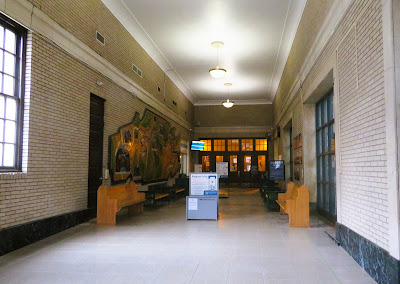
This hallway or corridor runs along one side of the waiting room.  The doors at the end of the hall lead to the boarding platform.  The ticket window, (Yes, this depot is manned!), is under that blue sign at the left near the doors.  Note the benches that now serve as the waiting room.  The depot also serves as the  Greyhound Bus station in Johnstown.


This tiled tunnel leads under the tracks and it provides access to the boarding platform for Amtrak passengers.  The setting was a little 'spooky'.  Fortunately for us, the ticket agent allowed us to access this passageway so we could go up to the boarding area...


I found this old photo on-line.  It shows Johnstown's passenger boarding platform back in 1967...just a bit decrepit but at least it was covered.


This is the Amtrak passenger boarding platform in Johnstown as it appeared in late September 2024.  Not too welcoming but at least shelter is provided for passengers waiting for their train.  There is an exterior elevator available.  The shelter is in bad shape, rusting out around the bottom in several places.


I captured this fuzzy photo from the Internet.  It shows an Amtrak train and passengers at the Johnstown passenger platform.  This once busy depot is now served by only one train a day in either direction.  The Pennsylvanian is a 444 mile daily daytime train that operates between New York City and Pittsburgh via Philadelphia and Harrisburg PA.  Traveling the entire route takes about 9 hours.  In 2023, a total of 16,449 passengers were processed through this depot.    

As the saying goes, "Hope springs eternal".  Improvements to the station platforms, tunnels and track were slated to begin in the fall of 2022.  A new heated and air-conditioned headhouse (shelter), an interior elevator, stairway, small waiting area and a platform with a snow melt system are all part of the plan.  The station itself is envisioned as a downtown anchor that would serve as a multimodal transportation center with space dedicated as a visitor's center, farmers market and retail spaces.


This is the Tribune-Democrat Building in downtown Johnstown.  This structure with its Classical Revival details was built in 1919.  The Tribune-Democrat is the result of a merger between two newspapers, the Tribune and the Democrat.  This is also the home of the Johnstown Magazine.  That 'person' by the entrance who's reading the paper is a statue of "The Working Man".  He is everyone and he represents the importance of a free press in society.


Built in 1893, only 4 years after the Johnstown flood, this is the GAR building in the center of town.  This Grand Army of the Republic chapter (US Civil War), once had over 300 member.  The Romanesque style structure features heavy stone arches and carved stone sculptures or insets with a cannon and crossed sword motif.  Currently the building is owned by a Michigan firm.  It appeared to be empty when we visited but previously it was home to a tavern and a diner.


My photo of this structure wasn't usable...so I went online and copied this one.  This was the business center of the Cambria Iron Company's empire.  It was a Johnstown Flood survivor.  The two sections, built in 1881 and in 1885 reflect changing architectural styles.  The right side is Palladian...very symmetrical, while the left side is very much a Queen Anne design.  

Before the flood destroyed much of Johnstown in 1889, the city was very much a company town.  About 7,000 men and women worked for Cambria.  Many of those workers rented one of the 700 company houses in the area.  Groceries and supplies were purchased at the company store.  Medical service could be obtained at the company-financed hospital.


I found this photo on line... I'm guessing that the air wasn't too healthy in Johnstown when Cambria's steel mills dominated the valley.  This photo shows just one of the smelters in the area.  Cambria also operated railroad shops, flour mills, several banks and newspapers.

Only those employed by the Cambria Company lived on the flats and man-made ground along the rivers.  The company built rows of two-story frame tenements close together to cut costs.  The better tenements were separate buildings, with 2 families to the house.  Cheaply made, the tenements rented for from $5.00 to $15.00 per month.  The company also owned the surrounding hills.  One hill contained limestone and another coal.  Narrow-gauge railroads ran from Cambria's mines down to the iron/steel works.


When our day was coming to an end, we decided that we didn't want to drive around trying to find a restaurant for dinner.  So, we decided to go to Chili's Grill and Bar.  I had a bad experience at a Chili's several years ago and this was our first time to give this casual style restaurant chain another chance. 

Chili's was founded in Texas back in 1975 and its now currently owned and operated by Brinker International.  Chili's serves American food, Tex-Mex cuisine and dishes influenced by Mexican cuisine.  Chili's Grill and Bar has at least 1,610 locations world-wide and they can be found in 37 nations.  About 40% (plus or minus) of the restaurants are franchised.


This was the dining room at the Johnstown Chili's Grill and Bar.  It was fairly quiet but very casual, a real positive for us after a long and busy day.


Laurie kept it simple.  She ordered a bowl of Chili's Original Chili accompanied by a house salad with dressing on the side. ($11.29) She was happy and I was able to sample her chili too.  It was very good!


For my dinner, I went for the Nashville Hot Chicken Crispers Combo. ($15.99) It included blue cheese dipping sauce for the chicken, a modest order of French fries and a cup of white mac 'n cheese.  The chicken pictured on the menu looked like strips or 'fingers' but my chicken was in chunks.  It had a little bite and it was tasty...but it certainly wasn't truly Nashville Hot.

Chili's Grill and Bar in Johnstown Pennsylvania is located at 105 Town Centre Drive.  You can learn more and check out the extensive menu at 
https://www.chilis.com/locations/us/pennsylvania/johnstown?searchResults=true.  


Once again I went online for a photo.  I wanted to show an bird's eye view of Johnstown.  Given the proximity of the rivers and the impact of heavy rains funneling down through the many hills and low mountains, floods seem almost inevitable.  Flood control river walls have been erected but despite their presence, major flooding took place again in 1977.  Of course, nothing can compare with the deluge that occurred when the dam broke.

Just click on any of the photos to enlarge them...

Thanks for stopping by for a visit!

Take Care, Big Daddy Dave