Friday, January 24, 2025

Art Museum with Focus

...returning to our October 2024 road trip, I'd left off with our visit to The Rockwell Museum in Corning New York.  As I'd mentioned previously, the Rockwell family, had contributed their extensive art collection and that was the foundation of today's artistic accumulation.  While the Rockwell family had focused on art related to the western United States, the collection is much broader than that.  However, you will note that I was drawn to the western theme as well as a few 'quirky' works of art.


At first glance, this may not strike the viewer as a work that is tied to the western USA or American Indians.  Constructed by Marie Watt, (1967 - ), it is titled "Blanket Stories: Western Door, Salt Sacks and Three Sisters".  To construct this artistic statement, a regional call for blankets went out and families across western New York State provided the necessary items.  

Watt works primarily with blankets as a material in her installations and collaborative works.  "These blankets serve as markers of collective memory and each one represents an individual story."  Marie has a Masters Degree in Fine Arts from Yale University.  She is a member of the Turtle Clan of the Seneca Nation and her father's family were ranchers in Wyoming.  For more about the artist, go to https://en.wikipedia.org/wiki/Marie_Watt.


This painting by Stephen Towns (1980 - ) is titled "Hair Lessons".  Towns uses labor as a theme, highlighting the role that African Americans have played in the economy.  His works explores their resilience, resistance and endurance.  To learn more, you can go to to https://en.wikipedia.org/wiki/Stephen_Towns.  Additional works by Towns are included later in this blog post.


This is a lithograph on paper that was created by Thomas Hart Benton. (1889 - 1975) Benton was an artist, muralist and printmaker.  Part of the Regionalist art movement, his works depicted everyday people in everyday settings.  This 10" by 14" limited edition lithograph with a certificate of authenticity can be purchased on-line for $4,400.00. 

Benton was born in Neosho Missouri.  His father was a 4-term US Congressman, and he named his son after his own great-uncle, Thomas Hart Benton, a former US Senator from Missouri.  Despite his father's wishes that his son go into politics, with his mother's support and financial backing, Benton studied art at the Art Institute of Chicago and later he continued his education in Paris.  To learn more, go to https://en.wikipedia.org/wiki/Thomas_Hart_Benton_(painter).


This painting by Olaf Wieghorst (1899 - 1988) is titled "Appaloosa".  Wieghorst is known for his portrayals of the American West.  He had an affinity for the cowboys, Native American Indians and the settlers who helped shape America's western landscape.  Olaf came to the US as a Danish teenager serving as a cabin boy on a steamship.  After living in New York for a bit, he joined the US Army, serving with the US 5th Cavalry along the US/Mexican border.  When he returned to New York he joined the Police Department's mounted division.  After some success with his artwork, he married a girl from Brooklyn and they moved to El Cajon California where they lived for the rest of their lives.  

Olaf was known as a portrait artist...but it was due to his portraits of horses.  Among others, he painted Gene Autry's Champion,, Tom Morgan's stallion and Roy Rogers' Trigger.  By the end of his long career, Olaf had sold thousands of paintings.  He became the highest paid living artist of his time.  He even appeared in 2 movies with John Wayne and he had paintings hung in the White House.

To learn more about Olaf Wieghorst just go to the website of the Olaf Wieghorst Museum.  It's located in El Cajon California.  His last home was also moved to the museum grounds.  Check it out at https://wieghorstmuseum.org/.


This painting is titled "The Gunslinger".  It is oil paint on board and it was completed by Frederic Sackrider Remington ca. 1889.  Remington is one of the premier American artist who depicted the American West in the late 1800s.  Remington was a painter, illustrator, sculptor and writer whose works focused on the cowboys, American Indians and the US Cavalry.

Early in life he struggled to find his way in life.  He wasn't a serious student but he evolved as an artist and began making a little money through his artistic efforts.  In 1866 Harper's Weekly sent Remington to Arizona to illustrate the US Army's campaign against the Apache Chief, Geronimo.  Another significant opportunity was his commission to create 83 illustrations for a book by Theodore Roosevelt.  Remington was prolific and he is highly regarded today.  Many of his paintings and sculptures have sold for hundreds of thousands and even millions of dollars.

To learn much more about Frederic Remington, a good place to start is with Wikipedia where many other sources are provided.  Website: https://en.wikipedia.org/wiki/Frederic_Remington.


This painting is titled "Sun River War Party".  It was painted by Charles Marion Russell, aka C.M. Russell in 1903.  "Kid" Russell created more than 2,000 paintings plus bronze sculptures featuring cowboys, Native Americans and landscapes set in the western United States and Alberta Canada.  He was known as "the cowboy artist" as well as a storyteller and author.  Russell became an advocate for Native Americans in the west and was instrumental in the creation of the Rocky Boy Reservation for the landless Chippewa Nation covering 171 square miles in northern Montana.

Russell's career took off when he was working as a cowboy on a ranch.  The foreman got a letter from the owner asking how the cattle had weathered the winter.  As a response, the foreman sent him a small watercolor painting Russell had completed, showing a gaunt steer being watched by wolves under a gray winter sky.  The ranch owner showed the watercolor around and even displayed it in a storefront window in Helena Montana.  After that, commissions for new works began flowing in for Russell.

The C.M. Russell Museum in Great Falls Montana features more than 2,000 of Russell's artworks, personal objects and artifacts.  Russell produced roughly 4,000 works of art including oil and watercolor paintings, drawings and sculptures in wax, clay, plaster and bronze.  To learn more about the museum, go to https://cmrussell.org/.  For more information about Russell, go to https://en.wikipedia.org/wiki/Charles_Marion_Russell.


Not all artworks are paintings or sculptures.  Some items that show a true artistic flair, were actually utilitarian or even served as deadly weapons.  The item at the top of this showcase is a ca. 1820 Pipe Tomahawk.  It features a European manufactured steel head...pipe and hatchet...attached to a carved pipestem.  They were given to Native Americans as gifts of friendship or to mark treaty signings.

The second item is a Ball-Headed War Club.  Created from hickory in the mid-1800s, these clubs were used as deadly weapons for close-in fighting by Eastern Woodlands Native American cultures.  Even after the introduction of firearms to Native Americans, many still carried these clubs.  


The central object in this showcase is a Native American's beaded jacket from roughly 1880.  Contact with Europeans led to changes in trade for Native Americans as well as life in general.  Trade goods including iron tools, cloth/textiles, firearms and beads, served as change agents to previously observed ways of life.  This particular men's jacket was made using leather, cotton, wool, glass beads and brass buttons.  

Below the jacket a Native American fringed woven sash is displayed along with 2 beaded purses.  The cane at the left has a carved hand where one would grip it.  The cane on the right is an effigy cane or walking stick.  The carved finial at the top of these canes can represent a person, animal of object.  Effigy canes were considered to symbolize age and wisdom.


This is a Native American Cradleboard or "Ga-on-seh" (Mohawk), made ca. 1865.  Eastern American Woodland Cultures (Haudenosaunee) infants were swaddled in rigid cradleboards made of wood although other Native American tribes used other materials for the same purpose.  This beautifully decorated cradleboard shows off flowers, birds and ornamental vegetation...definitely a labor of love.

To learn much more about cradleboards, including their construction and use around the world, go to https://en.wikipedia.org/wiki/Cradleboard.


This stunning sculpture is entitled "The Last Dance" and it was cast in bronze in 2012.  The artist is Michael Naranjo (b 1944) (Tewa Tribe/Santa Clara Pueblo).  Michael is blind, having lost his sight while serving with the US Military in Viet Nam.  He sculpts by touch and feel, creating forms and textures that are meant to be seen and felt.  Unlike almost all other museum displays, this sculpture is clearly signed "Please Touch".

Michael Naranjo's works are on permanent display at The Vatican and at the White House in addition to many museums.  Learn more about his work at https://en.wikipedia.org/wiki/Michael_Naranjo.  To learn more about the Santa Clara Pueblo in New Mexico, just go to to https://en.wikipedia.org/wiki/Santa_Clara_Pueblo,_New_Mexico.


Given the ornate designs and the symmetry of the ceramic pottery shown above, there is no doubt about the skill of their creators.  All of them are Acoma Pueblo items.  The first one is a bowl from ca 1920, the second one is an olla, ca 1890, and the third is another bowl ca. 1925.  

FYI, an olla is a ceramic jar, often unglazed, that is used for cooking stews or soups, for the storage of water or dry foods and even for other purposes, (if unglazed), such as irrigation of crops.  Ollas have short wide necks and wider bellies.


Laurie and I would highly recommend a visit to the Acoma Pueblo.  It's been occupied for about 2,000 years and a small number of Native Americans still live there today.  There is no running water or electricity although a road has been carved up one side of the mesa to allow supplies, tribal members...and tourists...easy access.  It is a glimpse back in time... We do have a small glazed bowl that we purchased during our visit.  Learn more at  https://en.wikipedia.org/wiki/Acoma_Pueblo and at the Pueblo's website,  https://www.puebloofacoma.org/.


This painting by Ernest Leonard Blumenschein (1874 - 1960) is titled "Jury for Trial of a Sheepherder for Murder".  Completed in 1936, the painting "illustrates the tensions between traditional Hispanic customs and the newly introduced American Legal System in New Mexico".  Viewers are in the position to see what the accused would have seen.

Blumenschein was a founding member of the Taos Society of Artists.  He's especially noted for his paintings of Native Americans, New Mexico and the American Southwest.  The style of painting of the Taos artists decisively influenced the perceptions that the wider world had of the American Southwest, and specifically of the Pueblo and Navajo Indian peoples.

Art takes many forms.  This photo was taken in 1981 and it's medium is color inkjet on paper.  It's titled "Fisherman Brooks Cambell makes Liniment - Cedar Key".  FYI, Cedar Key is a very much off the beaten track island on the upper west coast of Florida...aka "The Lost Coast".


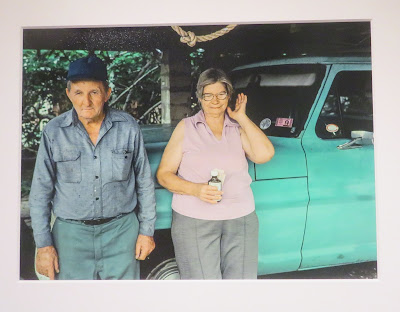
This color inkjet on paper photograph was also taken in 1981.  It shows "Sister Tommie Kaison, 108 years old, and Susanna Harteld, 110 years old, at family farm where they were born in the Florida panhandle, Two Egg, Jackson County.
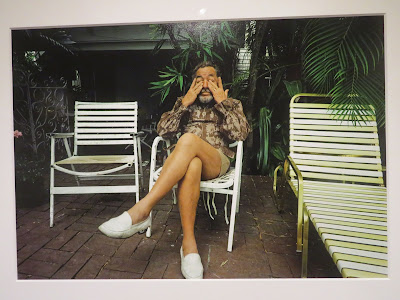

This photograph used the same medium or process as the previous two... Also from 1981, this is author and playwright "Tennessee Williams, Key West".

The photographer who created these inkjet on paper photos is Nathan Benn (b 1950).  Benn worked as a contract photographer for National Geographic from 1972 through 1991, with 300 of his photos being published by the magazine.  The film used by Benn was Kodachrome.  Photo buffs know that this color film was much appreciated for capturing rich colors and complex lighting.  In 1991, he put down his camera, becoming co-founder and President of Picture Network International, the earliest Internet digital asset management and online stock photo licensing platform.

In 1991, Benn became the co-founder and President of Picture Network International (PNI), the earliest Internet digital asset management and online stock photo licensing platform.  In 1998, Eastman Kodak purchased PNI...and later it was sold again, this time to Getty Images and Bill Gates.


This work is quite new.  Created in 2024, it is titled "Motown in Motion".  It was constructed using both natural and synthetic fabric, polyester and cotton thread, crystal glass beads plus metal and resin buttons.


This work is by the same artist as was "Motown in Motion".  In this instance, the work is titled "The Match at Paradise Park".  It was painted using acrylics and metal leaf on a panel.  

The artist who created both works, as well as the ladies in the beauty shop shown previously is Stephen Towns. (b 1980) Born in Lincolnville South Carolina, Towns was the youngest of 11 children.  He has a Bachelor of Fine Arts in Painting from the University of South Carolina.  

Towns' artistic works are on display in many museums.  Among them are the Nelson-Atkins Museum of Art in Kansas City Missouri, the Baltimore Museum of Art, the Smithsonian National Museum of African American History and Culture and, the National Portrait Gallery.

We took many other photos at the Rockwell Museum in Corning New York.  We definitely enjoyed our visit!  To learn more about this museum, just go to https://en.wikipedia.org/wiki/Rockwell_Museum, and the museum's website at https://rockwellmuseum.org/.

Just click on any of the photos to enlarge them...

Thanks for stopping by for a visit!

Take Care, Big Daddy Dave

Tuesday, January 21, 2025

Staying Home...

Time for a change of pace!  Leaving our October 2024 road trip just for a bit, this time its all about things, food and happenings around our home in East Tennessee...truly bits and pieces.


Let me introduce you to "Gopher", our tailless squirrel and frequent visitor.  He/or she has been around for about 4 years at this point... With a typical life span of around 6 years but with exceptions up to 12 years, Gopher may be around for a while.  Without a tail, we're a bit surprised that he/she has survived this long.  Grey squirrel's tail assist in balance when moving through the trees and they also provide warmth in cold weather.  In cold weather squirrels just wrap their tails around them like a blanket while in their nests.  Will Gopher survive a protracted Artic blast?

FYI...In Europe and in Western Canada the Eastern Grey Squirrel is considered to be an Invasive Alien Species as it is displacing native species of squirrels. 


Around New Years Day, our neighbor Jane baked this lovely and delicious Rum Cake for us...and for other neighbors as well.  I'm usually not a 'cake guy' and some flavor enhanced cakes are too over the top intense for me.  However, we devoured all of this cake.  It kept well in the refrigerator and we found that whipped cream went well with it.  Not healthy but very tasty!


We do have a tendency to buy items that catch our eye, especially antique or collectible goodies.  Frequently they just sit around and look nice...but in this case Laurie's new/old cast iron corn bread fry pan was put to good...and satisfying use.


Laurie decided to make a chicken recipe she saw on-line that grabbed her attention.  It involved chicken thighs, garlic cloves, soy sauce, butter and brown sugar...served over rice.  I didn't think that I'd like it but the caramelized sauce with the chicken and rice resulted in a fine meal...and I had leftovers too!


Time for breakfast!

My breakfast creations are not as adventuresome or imaginative as Big Dude's at https://bigdudesramblings.blogspot.com/.  However, neither of us like to waste leftovers.  In this case I fried up some left over beef pot roast and cheesy potatoes, siding them with over-easy eggs and a slice of toast.  Excellent!


Another recent breakfast 'winner' was my combination of leftover breaded and seasoned Tilapia filets topped with over-easy eggs... While I indulge in my 'healthy' breakfasts, my better half 'enjoys' yogurt with granola.  Ugh!


One more breakfast just to avoid leftover waste... This time it was Guinness flavored Mac 'n Cheese with fried segments of leftover Klement's (Wisconsin) hotdogs.  This was a truly satisfying breakfast although it almost demanded a nap long after consuming it. 

Now for a bit of Mother Nature...


Laurie's Christmas cactus in her plant room, both pink and red, are doing their thing and looking good.  But, if you look out the window, you might note that something weatherwise was going on...


Shortly after taking the photo in the plant room, Laurie took this picture of our front yard looking across to neighbors Roger and Jane's home.  What is that white stuff coming down from the heavens?!


After the snow 'storm' passed, I took this photo of our front yard looking across at Roger and Jane's home.  We were snowed in!  Those who live a bit north would consider this a minor snowfall or inconvenience.  In East Tennessee it is a big deal.  At our stage and age, I can't shovel snow and Laurie shouldn't.  I know that the usual sequence is that it melts the following day or, at most, a couple days later.  

However, kudos to the strapping 18 year old entrepreneur who showed up at Jane and Roger's house and cleared their driveway and sidewalk.  His next job was clearing our driveway and sidewalk.  He'd cleared 6 driveways the previous night and after these 2 jobs, he had 10 more booked.  Some of the driveways were much longer than ours... I'm estimating that his prompt recognition of opportunity had to bring in over $1,000!  Not too bad...


Of course, our local birds are a bit like the residents...just not used to truly cold and snowy weather.  Mr. Robin looks confused...but I'm sure he was waiting for food bits to drop from our feeders.  As for the bluebirds, they were patiently waiting for Laurie to replace the ice in their birdbath with some hot water from the house...


This view from Laurie's 'plant room' shows our 2.5 inches of snow on the grill and railings and looking at the trees and bushes that sill remain after the building spree we've experienced in the last 2 - 3 years.

Early weather forecasts for our area claimed that we would have a warmer than normal winter.  Through January 16th, every day this month has recorded lower than normal high temperatures and lower than normal low temperatures...and we have an "Artic Blast" headed our way.

Now for a bit of retail humor...  


Laurie found this storefront photo on the Internet.  Love the name!  It actually is a store located in Berkeley California... This is our favorite kind of store...and that sign rivals the one we saw in front of an antique store in Georgia a few years back.  That one read "We Sell Dead People's Stuff".

Just click on any of the photos to enlarge them...

Thanks for stopping by for a visit!

Take Care, Big Daddy Dave

Friday, January 17, 2025

Dinner...Overnight and Then What?

...continuing with our October 2024 road trip west through Tennessee and then continuing north to Pennsylvania and then back down through Virginia...

We overnighted at the Hampton Inn in Mansfield Pennsylvania for two nights.  End of the first day and it was time for dinner.


We decided on a local dining option on this occasion...and this is Papa V's Pizzeria and Restaurant at 12 North Main Street in Mansfield.  As you can see, the decor is the basic old time small town style.  Simple...but how was the food?


My entree came with a nice side salad with mixed greens, tomato, croutons and shredded mozzarella cheese...Italian dressing on the side.  I'm not supposed to eat many greens but I yielded to temptation in this case.


We are rarely able to resist Garlic Bread with Cheese...in this case accompanied with Homemade Marinara Sauce. ($7.50) There was plenty of it and, much to our liking, they weren't afraid of applying the garlic!  Very nice indeed...

Counting the Chicken Wings, there are 12 appetizers on the menu, many of them ones you might expect.  Ones that were a little different included the Breaded Fried Mushrooms, Mac 'n Cheese Bites and the Jalapeno Poppers.  Of special note was the truly unusual item...Pierogies - Cheesy potato dumplings with caramelized onions served with sour cream.


After all that Garlic Cheese Bread, Laurie decided to have a salad as her entree.  This was her Caesar Salad with Fried Chicken. ($11.00) She did enjoy it, with the chicken helping to satisfy her taste buds.  

There are 9 salads on the Menu at Papa V's.  These include an Antipasto Salad, the Fiery Chicken Salad and the New York Strip Steak Salad. (I was surprised that Laurie didn't order the Antipasto Salad) The most unusual salad on the menu was the Pittsburgh Steak Salad.  It consists of mixed greens, chopped steak, tomato, grilled onions, banana pepper, green pepper, sweet pepper, black olives, pickles, mushrooms, mozzarella cheese and...wait for it...beer battered French fries.  Rolaids needed for sure!


For my dinner, I ordered the Cajun Alfredo Pasta. ($21.00 side salad included) There were a generous number of shrimp with the pasta and the homemade Alfredo sauce was very tasty. 

As for the rest of the menu, there were 9 other pasta dishes offered.  Plus there are burgers, subs, cheesesteaks, sandwiches/wraps, paninis, pizzas, calzones, strombolis plus sides and desserts.  It was a much more extensive menu than we would have expected. 

Papa V's Pizzeria and Restaurant in Mansfield Pennsylvania is open daily for lunch and dinner.  Phone: 570-662-2651.  Their website is found at https://www.papavpizzeria.com/. 


While in Mansfield we also stopped for coffee and a pastry at Conspiracy Coffee, Cafe and Bakery at 11 West Wellsboro Street.  We had a couple of house brews, a scone, a biscotti and Laurie bought a bag of their coffee to take home.  Good coffee!  They are on Facebook at  https://www.facebook.com/ConspiracyCoffeeCo/.


A lack of thorough research and a lack of interesting shops led to the realization on our second day that we didn't have a plan... So, as I am wont to do, I picked up the road map and, after a quick look and a check of the Internet, we headed north from Mansfield on US Hwy 15...destination Corning New York! 


Many years ago, Laurie and I had visited Corning New York and we had toured the Corning Museum of Glass.  It was a great museum and I'm sure it's been enhanced since our last visit.  Website: https://home.cmog.org/.

But we had never visited The Rockwell Museum, an affiliate of the Smithsonian.  The museum, which is shown above, is housed in Corning's former City Hall.  It was built in 1893 in the Richardson Romanesque style, which combines both Gothic and Romanesque influences.  In 1893 the building was home to a fire station (until 1974), the city clerk, police department, city court and the jail.  It housed the city council chambers, public health department and dentist offices until 1972.  In addition the third floor included a public library and youth center.  The building was renovated and reopened as The Rockwell Museum in 1982.  

As you can see, at least one segment of the facade has been 'slightly' modified with the addition of that Bison sculpture.  In keeping with the museum's original benefactor's collections, it was created by artist Tom Gardner in 1999 and it's titled "Artemus the Bison".

Now onto some of the artwork presented at the Rockwell Museum...


This painting is by Newell Convers (N.C.) Wyeth, an American painter and illustrator. (1882 - 1945) He became one of America's best known illustrators, providing images for 112 books and creating more than 3,000 paintings.  His career took off in 1911 with the illustrations he created for Robert Lewis Stevenson's novel, "Treasure Island".  N.C. Wyeth was also the father of artist Andrew Wyeth and the grandfather of artist Jamie Wyeth.

This particular painting was completed in 1921 and rather than providing a title per se, Wyeth wrote the following: "If the woman in the wagon was scared to death at the sight of the prairie, I surely had cause to be afraid, but I was not.  I was uplifted".


Simply titled, "Landscape with Cows", this painting was completed in the late 1800s by Susan C. Waters. (1823 - 1900) Waters' early career in New York and Pennsylvania focused on portraits...the family 'photos' of the time.  Her husband was sickly and she became the primary breadwinner.  After moving to Bordentown New Jersey in 1866, and having earned the funds to allow variation in her work, she specialized in paintings of animals and an occasional still life.

A little history regarding The Rockwell Museum.  The 'foundational' works of the collection were gifted by Bob and Hertha Rockwell who operated a popular department store in Corning.  The Rockwell's amassed a significant collection of fine American art.  They honed their taste for fine art through study, travel and collecting...primarily in the American West.  Initially they displayed their collection in their department store.  They wanted to share their passion with the community and, with the assistance of executives from Corning Glass Works, the Rockwell's collection was transformed into a public museum.


This bronze sculpture was created in 1914 by Cyrus Edwin Dallin. (1861 - 1944) It is titled "On the Warpath".  Dallin was a sculptor best known for his depictions of Native Americans.  However, among his 260 works, he also completed the "Equestrian Statue of Paul Revere" in Boston and the "Angel Moroni" atop the Mormon Salt Lake Temple in Salt Lake City Utah.  Interestingly, Dallin had left the Mormon Church many years earlier but he still got the commission.  His most famous statues...or given their size...monuments, include "Appeal to the Great Spirit" in Boston and "A Signal of Peace" in Chicago.

As creative and prolific as Dallin was, he was also an Olympian.  In the 1904 Olympics staged in St. Louis Missouri, Dallin won a Bronze Metal in Archery.


This massive action packed painting measures 6.5 feet tall and 10.5 feet wide.  Titled "The Buffalo Hunt", it was painted by William Robinson Leigh. (1866 - 1955) Leigh was known for his paintings  of western scenes and he created illustrations for Scribner's and Collier's magazines among others.  The Santa Fe Railroad sent him west where he painted the Grand Canyon and Yellowstone Park.  When he died, his widow gave his New York studio to the Gilcrease Museum in Tulsa Oklahoma.  

The Gilcrease Museum is home to the world's largest, most comprehensive collection of art of the American West. (Another road trip destination!) Note: The Gilcrease Museum owns 18 of the 22 bronze sculptures that were created by Frederic Remington.

In a future posting, I'll feature more of the art objects on display at The Rockwell Museum in Corning New York.  In the meantime, here is the museum's website: https://rockwellmuseum.org/.  Just click on any of the photos to enlarge them...

Thanks for stopping by to follow along on our 2024 road trip!

Take Care, Big Daddy Dave

Tuesday, January 14, 2025

Wellsboro Pennsylvania

...continuing with our October road trip through parts of Tennessee, Kentucky, Ohio, West Virginia, Pennsylvania, New York and Virginia.  Our next stop was Wellsboro Pennsylvania.  It had been highly touted in the on-line 'travel-verse' as one of the best small towns to visit in the state. 


The Penn-Wells Hotel opened for business in 1870, although it was initially knows as the Cone House after the owner's name.  A.P. Cone actually built his hotel on the site of a previous hotel that had burned down in 1866.  Next it became the "Holiday Inn" as it was owned and operated by a fellow named B.B. Holiday.  Then it became the Parkhurst House and finally Coles House.  A fire in 1906 destroyed the 3rd and 4th floors.  

The hotel was reborn as the Penn-Wells in the mid-1920s as the area welcomed an increasing number of leisure travelers.  Elements of the structure from 1869 have been preserved and the old time elegance of the interior includes 1920s era finishings and decor.  Note the American flag in the second photo above.  It was created for a Corning Glass Works Christmas party in 1946 with the end of WWII.  It's made up with 1,438 glass Christmas ornaments.  To learn more about the Penn-Wells Hotel and it's sister Lodge, go to https://www.pennwells.com/.


This two-story red brick building in downtown was constructed in 1880.  It is part of the Wellsboro Historic District as list on the National Register of Historic Places.  The Historic District covers 360-acres and it includes 531 contributing buildings, 3 contributing sites and 4 contributing objects.  The properties include commercial structures, churches, residential areas, a park and 2 historic cemeteries.  As happens all to frequently, the paper work that was submitted to qualify the area for the National Register has never been input into the tracking NRHP system so detail is hard to come by...

Historically, in the early 1900s, Wellsboro was a shipping point and trade center for a large area.  It had fruit evaporators, flour and woolen mills, a milk-condensing plant, marble works, saw mills, a foundry, machine shops and manufacturing companies producing cut glass, chemicals, rugs, bolts, cigars, carriages and furniture.  In 1900, there were 2,945 residents and in 1910 there were 3,183.  Today the town is home to about 3,458 people.

Note: The biggest attraction in the area is the Grand Canyon of Pennsylvania.  Officially Pine Creek Gorge is a 47 mile long gorge carved into the Allegheny Plateau by Pine Creek.  It's deepest point is 1,440 feet from the rim and the rim to rim distance is about 4,000 feet.  To learn more, just go to http://en.wikipedia.org/wiki/Pine_Creek_Gorge.  We skipped it due to my Afib issues and the walking entailed...


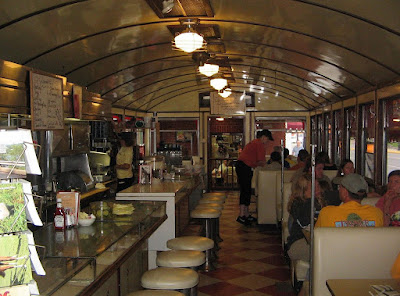
The Wellsboro Diner remains unchanged from the time it opened in April of 1939 at the town's busiest intersection.  This is a Sterling Diner (#388 - eighth one built in 1938 by J.D. Judkins Co. from Massachusetts.  It was originally named Schanacker's Diner.  I borrowed the interior photo from the Internet.  Located at 19 Main Street, the diner has a stainless steel exterior, a low-arched roof and pale green porcelain walls.  The owners changed the diner's name to Wellsboro Diner in the 1960s.  It wasn't time to eat yet, so we didn't sample their diner fare... The Diner is on Facebook at https://www.facebook.com/p/Wellsboro-Diner-100089417522142/.


I didn't find much information about this handsome United Methodist Church at 36 Main Street in Wellsboro.  The Gothic Revival style structure replaced an older Methodist Church in 1905 at the same location.  The previous building had been deemed unsafe for use in 1900.   The entrance to the church features a lintel stone from the Old Rectory in Epworth, Lincolnshire England...the original home of the Wesley family.


As in Ridgway Pennsylvania, Laurie was a bit disappointed with the number and quality of shopping opportunities in Wellsboro.  Still, she managed to find a couple of promising shops to peruse.  This Victorian style home at 15 Main Street offers two floors of antiques, collectables, gifts and home decor possibilities.  Learn more at https://www.facebook.com/p/Karens-Country-Store-100050564600457/.


When Wellsboro's Arcadia Theatre opened in December of 1921, it had one screen and it could seat 900 patrons.  The first film was of course a silent movie entitled "The Old Nest".  Having been built to show silent films, the theatre was equipped to provide the musical equipment needed...an organ, a piano and even an orchestra box.  In 1929, the Arcadia became one of the first theater in the northern states to start showing "talkies".

In 1987, the Wellsboro Hotel Company, owner of the Penn-Wells Hotel and Lodge, purchased the theatre.  With the success of television, the theatre's attendance and it's condition declined. However, in 1996, the theatre was completely renovated.  In March of 1997, it reopened as a state of the art 4 screen cinema...while preserving that classic old-time theatre feeling.  Special features now include "Dinner and a Movie" and live theatrical shows have been added and the theatre is prospering... Learn more at https://arcadiawellsboro.com/.


The Tioga County Courthouse, or at least the core building, was completed in 1835.  The architectural embellishments evident today came along much later.  For nearly a century, this courthouse was a trim but modest Federal-style 'block' built with dressed local sandstone.  By the 1920s local politicians decided that they wanted a more distinctive structure to represent the county.  Consequently, a Scranton Pennsylvania based architect replaced the two-over-two windows with nine-over nine windows.  He also added a rear wing, added a Federal-style entrance with the fan-light window and he erected the Corinthian portico with those impressive columns.  Further expansions have added to the original structure as the county's needs increased.


This red brick building at 114 Main Street is the former Tioga County Sheriff's residence.  It was built in 1860 at a cost of $10,000.  Later, until 1985, it served as the County Jail.  The structure is now the home of "Develop Tioga", "Wellsboro Chamber of Commerce", and "Growth Resources of Wellsboro".  Unfortunately I didn't capture a picture of the elm tree in at the front of the building.  It is one of the largest in existence and has been growing since sometime in the 1700s.


This is Wellsboro's "Green Free Library".  As you can see, it is not your typical small town (or large town) library!  The library was the former home of a wealthy lumber baron and banker.  It was built in 1855.  The home was remodeled by the owner's daughter in 1898 and it was named "Chester Place".  The woodwork is top notch.  Note the classic grandfather clock in the corner.  The former home also features a marble fireplace and a Tiffany window.

In 1910, citizens of Wellsboro organized a group to raise money to open a public library.  In 1911, Charles S. Green, a wealthy local lumberman bequeathed $50,000 for the incorporation of a "Green Free Library" in Wellsboro.  The owner and her heirs donated the home to the Green Free Library in 1916.  After some remodeling, the Green Free Library moved from its temporary location in a vacant storefront to "Chester Place", which opened in 1917.  Learn more at https://greenfreelibrary.org/.


The Jesse Robinson House or Manor at 141 Main Street in Wellsboro is a three-story Queen Anne style home that was built in 1888.  It is listed on the National Register of Historic Places.  This 5,342 square foot home, located on a half acre of land features stained glass windows and two prominent balconies.  In the past it has served as a hospital as well as home for several owners.  Currently it serves as a residence and dentist office.


This eye-catching Italianate home at 140 Main Street in Wellsboro was built ca 1850.  It's known as the "Lincoln Door House".  That red front door of the residence is purported to have been a gift from Abraham Lincoln to Dr. and Mrs. J.H. Shearer when they purchased the home in 1858.  Allegedly the door came from a building in Springfield Illinois.  It is well documented that the Shearers were close friends with Lincoln when they lived in Springfield.  While no one has been able to document the door's origins, it certainly may be a true story...


Laurie would have loved to browse through this shop at 6 East Avenue in Wellsboro!  She's always been interested in the possibilities of the supernatural.  Unfortunately, "Enchanted Hollow" was closed when we stopped by. (Probably fortunate for my wallet!) In any case, Enchanted Hollow sells, crystals, oils, incense or witch balls and they say that they have "your Faery, Witchy and Angel needs all covered".  You can check this store out at http://www.enchanted-hollow.com/.


As we rolled east out of Wellsboro toward Mansfield Pennsylvania, Laurie got lucky when we spotted The Farmer's Daughters Antiques and Gifts shop along US Hwy 6.  They offer lodge and cabin decor, antiques, re-purposed furniture, unique lighting and (unfortunately for me) candles...as well as a year-round Christmas room.  After helping the local economy at Farmer's Daughters, we headed down our final stretch of highway to our overnight stay in Mansfield.  For more about this shop, go to https://www.thefarmersdaughtersshop.com/.  

Just click on any of the photos to enlarge them...

Thanks for stopping by for a visit!

Take Care, Big Daddy Dave