Friday, October 18, 2013

On the Road – Calgary to Banff

If you’ve been following our trip to Alberta Canada via my blog, you may have begun to wonder if we were really going to ever get over to the main attraction, the Canadian Rockies!  The answer is yes…and this rather verbose blog tracks our drive from Calgary to Banff and the Rocky Mountains.


We don’t like super highways, expressways, freeways, or whatever you want to call them unless a) we’re in a hurry, or b) we’re using a freeway to reach a point that we’ve been to many times before…and we already have visited attractions along the way.  In this case, we opted not to take the Trans-Canadian Highway, but instead to follow Highway 1A which is a 2-lane highway once it clears the metropolitan area.  The drive was quite leisurely with minimal traffic and lots of countryside to enjoy…
Along the way we came across this historical church.  The McDougall Memorial United Church is located along Hwy 1A on the north bank of the Bow River, near the town of Morley. The church was constructed in 1875 and it is listed in Canada’s Register of Historic Places.  FYI…Morley is a ‘First Nations’ settlement within the Stoney Indian reserve in southern Alberta.

The Morleyville Mission was established in 1873 and it was relocated to its present site in 1875, when construction on several mission buildings, including the McDougall Memorial United (formerly Methodist) Church, began in earnest.  The mission was at the vanguard of Methodist evangelical efforts in southern Alberta, representing the first permanent Protestant mission in the region and serving the Native tribes in the area, particularly the Mountain Stoney peoples living along the eastern slope of the Rocky Mountains. It was also a pioneering settlement, featuring southern Alberta's first permanent homestead, its first herd of breeding cattle, and the first Protestant church…as well as one of the province's first trained teachers - Andrew Sibbald. (This latter fact is interesting to me as Sibbald was my maternal grandmother’s maiden name)
For more information regarding this historic site and for a link to Canada’s Register of Historic Places, just go to http://www.historicplaces.ca/en/rep-reg/place-lieu.aspx?id=8788. 

For this photo, all Laurie had to do was turn to the right after shooting the picture of the church…and snap.  Quite a vast and scenic vista with the foothills and the peaks of the Canadian Rockies rising in the distance!

Laurie took this photo as we moved along lightly traveled Hwy 1A toward the mountains.  Sometimes these windshield photos come out pretty well!
The Canadian Rockies have many high peaks and ranges, such as Mount Robson at 12,972 feet and Mount Columbia at 12,293 ft. The Canadian Rockies are composed of shale and limestone but they seem more ‘green’ than does much of the American Rockies.  A great deal of the Canadian range is protected by parks and a World Heritage Site.

As we approached the mountains, the forests appeared along the highway. 
The Canadian Rockies extend from the south to the north for about 900 miles.  They are about 93 miles wide and they occupy approximately 69,000 square miles…about the size of the entire state of Missouri.

We passed through a few smaller towns before we had to get back onto the Trans Canadian Highway as we neared Banff.  These towns included Kananaskis, Exshaw and Dead Man’s Flats.  We don’t recall which of those towns provided the view of the Rockies shown above…
There are many theories that attempt to explain the name for Dead Man Flats.  One story ties it to a murder that took place in 1904 at a nearby dairy farm.  One brother was accused of killing another, whose body had been dumped in the Bow River…but the jury acquitted him by reason of insanity.  I prefer the theory that states that two or three First Nations (Canadian Indian) people who were illegally trapping beaver noticed a warden approaching in the distance.  Since they didn’t have time to flee without being spotted, they smeared themselves with beaver blood and pretended to be dead.  The warden was fooled by their trick and he ran for help.  With the coast clear, the trappers took their beaver pelts and escaped.
Whatever the real reason, the fact is that the town was called ‘Pigeon Mountain Service Centre’ until 1985 when it changed its name to Dead Man's Flats to encourage tourism.

The last town we passed through before we reached Banff was Canmore. 
The Canmore Hotel is the second oldest continuously operated hotel in Alberta, and is one of the few landmarks remaining from Canmore’s mining history.  This was the choice meeting spot for railway workers and miners — even after the mine closed — and became the center of cultural and social gatherings in the town. 
The hotel was built by a French Nobleman, Count Eugene de Rambouville. For unknown reasons the Count had fallen into disgrace with his family and fled France, making his way to Canmore.  The Count lived in the town long enough to build the hotel, completing its construction in 1890.  It was one of four grand hotels in the area and it’s the sole survivor.  To learn more about this historic hotel, or perhaps to invest in its preservation and future operations, go to http://www.canmorehotel.com/index.html.   
The town of Canmore was officially named in 1884 by the Director of the Canadian Pacific Railway.  He named it after Malcolm III, a former King of Scotland…who was also named Canmore.  In its early days, Canmore was a coal mining town.  In 1886, Queen Victoria granted a coal mining charter to the town, and the No. 1 mine was opened in 1887.  The coal mining industry in Canmore boomed well into the 20th century, but by the 1970s the market for coal had diminished, and in 1979 the mines closed. 
For the curious who actually read all of my text, I’d never heard of Malcolm III, so here’s a link: http://en.wikipedia.org/wiki/Malcolm_III_of_Scotland.

And we finally arrived in Banff!  Little did we know that we’d arrived on a ‘holiday’ weekend.  We learned that the first Monday of August is a civic holiday in most Canadian provinces.  It is commonly referred to as the August Long Weekend… In Alberta it is officially called Heritage Day.  Only Quebec, Newfoundland and Nunavut do not celebrate this holiday. (For curious non-Canadians, go to http://en.wikipedia.org/wiki/Nunavut to learn about Nunavut).
In any case, although this photo really doesn’t show it, traffic over the weekend was wall to wall!  Apparently 'Calgarians' flocked to Banff to share the area’s beauty with all of us tourists… Much more on Banff to follow!
Just click on any of the photos to enlarge them…
Thanks for stopping by and checking out my long winded blog for the day!
Take Care, Big Daddy Dave

Wednesday, October 16, 2013

Japanese Grill – Lenoir City Tennessee

We’d been watching with some interest as a local restaurant was transformed into its 3rd or 4th iteration since we moved to East Tennessee.  So, when asked if we’d like to dine with a couple of friends to give this new eatery a try, we jumped at the chance!


This is the exterior of Tako Yaki in Lenoir City Tennessee.  Laurie and I had eaten in this building 2 or 3 times previously, when it served Italian cuisine and pizza and when it was a basic American grill type of operation. 
We are continually surprised at our impression that there are more restaurants serving sushi in the greater Knoxville area…than there are basic Chinese restaurants.  There even seems to be as many Japanese and Thai restaurants as there are Chinese dining spots.  There are now 3 Japanese restaurants in Lenoir City… 
 

This is a photo of the grill area inside the Tako Yaki Restaurant. The restaurant was not inexpensive to retrofit!  Walls came down and 3 or 4 of these grills were installed on one side of the restaurant.  On the other side of the dining area, seating is similar to most restaurants and the food is delivered to the customer.  The grill area is the ‘performance’ side of the operation!

The photo is a little dark but our waitress started us out with this salad and a chicken broth with rice soup.  Laurie liked both items but I thought that the soup was too bland.  Our friends liked the salad & soup as well.
OK…to be honest, I would normally never dine in the ‘entertainment side’ or grill area of a Japanese restaurant.  First of all, I came with the people I wanted to share the dining experience with…and I’m not looking to sit down with strangers.  Secondly, the menu choices are too limited.  Third, the ‘entertainment’ provided by the grill master doesn’t do much for me.  What I’m admitting is that I’m biased when it comes to this type of dining.
It didn’t help any when we were seated at a grill ‘table’ that wasn’t cleared of dirty dishes on the other side of the grill.  Plus, our friend had to grab forks for us. 
 

Here is our grill master at work…preparing the fried rice portion of the meal.  Fortunately, the people that joined us at the grill were OK and the grill master spent much of his time entertaining the young lady in the photo.
 

In this photo, the grill master has finished and served the fried rice and he’s started the mixed vegetables and the fried noodles.  My vegetables are under the bowl on the grill as I opted out of the mushrooms with my serving. 

Laurie and I really like sushi and sashimi!  We couldn’t properly dine at Tako Yaki without at least trying an appetizer from the sushi bar.  We ordered the Tuna Tataki…seared tuna with ponzu sauce. ($8.95) The presentation was very nice but I thought that the tuna slices were just a bit thin…lacking texture.  Laurie thought they were a bit thick & would of preferred them to be more of a sashimi thickness but she enjoyed the dish.  The ponzu sauce and veggies on the platter ‘made’ this dish!  Another problem was that this was our appetizer…and when we were well into our fried rice our waitress told us that the sushi chef was backed up but she hadn’t forgotten us.  We had our fried noodles and veggies before we got our appetizer…
FYI…Ponzu shōyu or ponzu jōyu is ponzu sauce with soy sauce (shōyu) added.  The mixed product is widely referred to as simply ponzu.  Ponzu is made by simmering mirin, rice vinegar, katsuobushi flakes, (from tuna), and seaweed, (kombu), over medium heat.  The liquid is cooled then strained to remove the katsuobushi flakes, and finally the juice of one or more of the following citrus fruits is added: yuzu, sudachi, daidai, kabosu, or lemon.  To learn what all these fruits are, you can go to http://en.wikipedia.org/wiki/Ponzu and click on each of them as shown in the text.

Other than flipping his grill tools around, one of our grill master’s tricks was creating a ‘volcano’ using those onion rings and some water from the squeeze bottle… I wasn’t particularly entertained, although I have to give him credit for trying.


In this photo, you can see that the grill master is working on the protein portion of our meal…chicken, shrimp and salmon. 
Single item grill entrees included vegetarian, scallops, calamari, salmon, sirloin steak, filet mignon, chicken and lobster.  Prices ranged from $11.95 for the vegetarian offering on up to $26.95 for the lobsters.

OK…the photo isn’t pretty.  This is Laurie’s Shrimp Teriyaki with the fried rice, fried noodles, vegetables and the shrimp. ($15.95)  The reason the plate is so messy is that first the grill master served the fried rice, then the fried noodles and the vegetables…and then came the protein/shrimp.  Much of the fried rice and the other sides had been eaten by the time we received our meat course… It’s another reason I’m not crazy about this style of dining.  The shrimp lacked flavor & were a bit on the small side.  Our friends agreed.

This is a photo of my Teriyaki Salmon. ($15.95) The filets were OK.  I really liked the veggies and the fried noodles.  The fried rice was extremely bland and it was only saved when the grill master offered some teriyaki sauce which he liberally applied.  The sauce also boosted the flavor of the noodles…
As I mentioned earlier, I am not a fan of this type of dining.  I do believe that my wife agrees with me to a point…it wasn’t worth the $52 and change we spent for dinner & she agrees with me on that point.  We are glad we tried it and that we were able to do so with friends.  I have read several commentaries that give Tako Yaki positive feedback…crediting both the food and the entertainment provided by the grill masters.  They must be doing something right as this is their second restaurant in East Tennessee! 
Tako Yaki is close to I-75 on US Highway 321 in Lenoir City Tennessee.  The formal address is 175 Kelsey Lane…but the restaurant faces Hwy 321.  Phone: 865-986-3332.  They are on Facebook at https://www.facebook.com/Takoyakicleveland.  Don’t listen to me… Try it for yourself and let me know what you think!
Just click on any of the photos to enlarge them…
Thanks for stopping by to see what Laurie and I have been up to!
Take Care, Big Daddy Dave


Monday, October 14, 2013

Gasoline Alley – Autos, Trucks and More! (#3)

This is the final blog about the Gasoline Alley automotive related collections at Calgary’s Heritage Park… We would highly recommend this experience to anyone who loves advertisment, trucks, automobiles and related ephemera and regards them as an art form.  This is a terrific collection and the items on display are pristine!


This unusual looking truck is a 1939 Federal Pick-Up, Model 8, ¾ Ton.  It’s a good example of the streamline style that was very popular in the late 1930s.  It's really a nice deep blue color but it didn't come out in this photo...
Although Federal was a relatively small producer, the company “was an all line manufacturer” offering a full range of trucks ranging from ½ - 7 ½ tons.  Their products included light duty pick-up trucks for general use, a range of delivery trucks, heavy haulers, plus school buses.  
As per the ‘Federal Trucks Photo Archive Paperback’ by Robert Gabrick, “Since 1910…Federal Trucks Have Been Known in Every Country—Sold on Every Continent.” One of the great ‘independents’ from Detroit, Federal produced a ‘high quality truck at a good price.’  From 1910 to 1959, Federal assembled over 160,000 trucks for all types of uses including delivery vans, buses, garbage trucks, and over the road heavy haulers.  In World War II Federal produced 11,338 military vehicles, earning the coveted Army-Navy ‘E Pennant’ four times for production excellence.  After the war Federal experienced the same difficulties experienced by other independents. Production of Federal trucks ended in 1959.”

This rare Canadian grain truck is a ¾ Ton 1927 Star.  This was one of the last Star trucks built. 
The chassis was built at the Durant Motors Company plant in Leaside, Ontario while the body was supplied by the Canada Carriage and Body Company of Brantford, Ontario.  Durant marketed its trucks under the Star emblem in North America and Rugby brand overseas.  This truck was soon consigned to light duty because it was not very powerful.
For more about William Durant and the Durant Motors Corporation you can go to http://en.wikipedia.org/wiki/Durant_Motors.  William Durant was the former CEO of GM. 

Lots of automotive related ephemera are evident in every nook and cranny of Gasoline Alley.  This is an early advertising Michelin Tire Man sitting astride an early tire pressure machine. 

FYI, the Michelin Tire Man is one of the world’s oldest trademarks.  It was first introduced in 1894!  His really name is Bibendum… The slogan ‘Nunc est bibendum’, (Now is the time to drink), is taken from Horace's Odes (book I, ode xxxvii, line 1). He is also referred to as Bib or Bibelobis.  For more on this topic, go to http://en.wikipedia.org/wiki/Bibendum. 

This handsome and powerful looking vehicle is a 1935 Diamond T Tow Truck, Model 211-AD Deluxe. 
During an era of utilitarian truck design, the President of Diamond T said that “A truck doesn’t need to be homely.”  Stylish design combined with sound engineering helped Diamond T secure a respectable market share during the lean years of the Dirty Thirties.  Exceptional quality was assured as Diamond Ts were assembled from components made by specialty manufacturers to the company’s exacting specifications. With forty years of faithful service, this Model 211-AD is a testament to the vehicle’s quality and owner pride.
To learn more about Diamond T and its trucks, you can go to http://en.wikipedia.org/wiki/Diamond_T.

This is a 1910 Fuel Tank Wagon.  It may seem a little strange to us in this day and age, but during the late 19th and early 20th century horse-drawn tank wagons were commonly used by oil companies to distribute their products to customers. With the aid of compartmentalized tanks they could haul and dispense both gasoline and kerosene. The rear box was used to carry axle grease and other products.  Although limited to a 15 mile distance, two-horse high-wheeled outfits like this could deliver fuels right to the customer over rough rural roads. 
I looked around the Internet and I discovered one of these wagons for sale.  Check it out at http://www.ebay.com/itm/HORSE-DRAWN-FUEL-WAGON-RESTORED-POLARINE-TANK-WAGON-/350887415529?pt=LH_DefaultDomain_0&hash=item51b2850ee9. You could pick it up for only $12,500!   
It’s a steal when you consider that Jackson-Barrett Auctions sold one of these wagons in 2012 for ‘only’ $36,300!  You can see this fuel tank wagon at http://www.barrett-jackson.com/application/onlinesubmission/lotdetails.aspx?ln=360&aid=465. 

This is a 1941 Chevrolet Tow Truck, Model TKH.  This 1 ½ ton tow truck is a good example of Chevrolet’s Art Deco line.  Introduced in 1941, their distinctive front end styling – two tiered grille, beaklike hood and streamlined headlights mounted on huge fenders – made them a hit with truck buyers.  

This early truck is a 1912 Benz Gagganau, Model GL-12, 5 Ton Fuel Tanker. 
Founded in 1894 as Bergmanns Industriewerke, Germany’s Benz – Gaggenau factory is the oldest operating automotive plant in the world.  In 1906 that factory produced the world’s first fire truck powered by an internal combustion engine.  By 1911 Benz’s three factories were producing passenger cars, commercial vehicles and engines for aircraft, industry and marine applications.  Built before heavy duty pneumatic tires were available, this chain driven 5 ton truck features cast iron wheels with solid rubber tires.  I imagine that the ride had to be a bit rough!
For a photo of the Gaggenau plant in its scenic setting, take a look at http://www.flickr.com/photos/daimlerag/6759490871/.

This beauty is a 1933 Model 210-FF Diamond T Brewery Truck.  Diamond Ts were called the “Cadillac of Trucks”.  As mentioned previously, Diamond Ts were noted for their quality construction, performance and overall good looks.  Showcased at the 1933 Chicago World’s Fair, their prestige was further enhanced by classy advertising and sales catalogues.  Diamond T trucks were frequently purchased as fleet vehicles for image conscious companies such as furniture manufacturers, movers and breweries.  

This classic ‘beater’ is a 1930 Nash 450 Single Six Sedan. 
At the beginning of the Great Depression this car rolled off the assembly line with shiny blue paint and bright nickel plating.  Its dents, repairs and rusty patina bear witness to the perseverance and ingenuity of a Saskatchewan family who weathered the Dirty Thirties. Rediscovered some fifty years later, “Scruffy” was mechanically restored.  It was later driven 2,000 miles down Route 66 from Chicago to Los Angeles, recreating the journey of many Dustbowl refugees.
To learn more about Nash Motor and to see lots of auto photos, you can go to http://en.wikipedia.org/wiki/Nash_Motors.  The company operated from 1917-1954.  In 1954, Nash bought the Hudson Motor Company and created the American Motors Corporation.  By 1957, under the leadership of George Romney, (a future governor of Michigan, future Presidential candidate and father of Mitt Romney), the Hudson and Nash name plates were phased out. 
 

This is a 1922 Gray-Dort Touring Car, Model 19-B.  Produced by Gray-Dort Motors Ltd. of Chatham, Ontario, this car was one of 26,000 automobiles produced during the company’s ten year of operation.  Initially the factory finished American Dort cars for the Canadian market.  With a gradual shift to 65% Canadian made parts, the Gray Dort is recognized as Canada’s first domestically built car.  By 1922, the dependable Gray Dort was the most popular vehicle on the prairies with over 5,000 registered.  Few examples have survived.

This early automobile is a 1909 McIntyre, Model M.  A true “Horseless Carriage,” this McIntyre Model M high wheel runabout is believed to be the only restored example of its type in existence.  The fine tradition of carriage building is evident in its handcrafted body, diamond tufted leather seats and rubber tired buggy wheels.  With 36” wheels and an air cooled four cylinder engine, McIntyre advertisements claimed, “High Wheel Motor Vehicles will go anywhere…no tire troubles, punctures and blowouts impossible with a McINTYRE.”
McIntyre Automobiles were built in Auburn Indiana from 1906 until only 1915 when the company went into bankruptcy.  For more information, go to http://en.wikipedia.org/wiki/McIntyre_Automobile. 

This is a photo of the main floor of Gasoline Alley.  As you can see, this is much more than a bunch of cars sitting around in a sterile environment. 
The primary benefactor of Gasoline Alley is a local businessman named Ron Carey.  He’s the President of J and L Supply, an oilfield supplier.  Mr. Carey is well-known for his commitment to preserving oil and gas memorabilia as well as antique vehicles.  If you visit Gasoline Alley, check out Ron Carey’s biography.  It is located in a wall mounted display halfway up the steps to the upper level at the north end of the building.
That’s it for our visit to Gasoline Alley at Calgary’s Heritage Park.  To view most of the vehicles on display in Gasoline Alley, you can go to http://www.heritagepark.ca/plan-your-visit/attractions-and-exhibits.html. Then filter by using the Type drop down menu…and then click on Gasoline Alley Museum.  In addition, for a video tour, just click on http://www.youtube.com/watch?v=KL2Z3Y_kUMk.
Click on any of the photos to enlarge them…
Thanks for stopping by and checking out this great exhibit at Calgary’s Heritage Park.  Only one more topic to write about from the park – Railroad History!
Take Care, Big Daddy Dave

Friday, October 11, 2013

Tooloulou’s for Breakfast – Banff Alberta

Continuing with our August trip to Alberta and the Canadian Rockies…

Our first morning in Banff…time to find something good for breakfast!  I’d done my research before going on this trip and I knew that I wanted to have breakfast at Coyotes.  They were the best rated breakfast spot in downtown Banff in “Trip Advisor” with 216 Excellent or Very Good reviews and ‘only’ 24 Poor or Terrible reviews.  Although the ‘bad’ to ‘good’ ratio was a little worse than 1 out of 10, (my normal standard), there was only 1 negative review year to date in 2013.

The only problem was that when we arrived, there was a line and a fairly long wait!  As we only had one full day in town and we weren’t big on waiting, we looked for an alternative.

Tooloulou’s is actually located right next door to Coyotes!  There was just a short wait…perfect for us…and we were seated.  I didn’t know it at the time but Trip Advisor’s feedback on Tooloulou’s was that they had a positive/negative rating ratio that was very similar to Coyotes…but with fewer reviews being reported.   

The interior of Tooloulou’s is cozy and warm…much like a diner atmosphere.  Our waitress was the young lady at the left of this photo.  No real complaints… She was efficient and hard-working…did her job well despite the restaurant being very busy…but she was a pretty reserved…nice but not much for smiling.

Laurie went with her standard breakfast fare…two eggs over easy, bacon, fried potatoes and toast with coffee. ($13.60) This was a very nice breakfast indeed, a great way to start out the day! 
Yes…we continued to be stunned at the prices in Canada…and not just in Banff either!  However, as prices were what they were throughout our trip, we stopped worrying about it.  The good news is that although we ate well, (badly from a health standpoint), we were so busy that we normally only ate 2 meals a day.
In addition to fried eggs and accompaniments, there were 13 omelets on the menu.  Some of them were quite interesting… The menu definitely has a Cajun twist to it.  Among the omelets were the Crab and Asparagus, ($12.95), a 3-egg omelet stuffed with crabmeat, grilled asparagus and cheddar jack cheeses, then topped with Hollandaise sauce, and; the ‘Crawdaddy’, ($14.95), a 3-egg omelet with crawfish tails, sautéed mushrooms and cheddar jack cheese.

For my breakfast I went with the Eggs Bayou…two poached eggs over spicy sausage on a toasted English sourdough muffin, topped with Hollandaise sauce. ($15.70 with coffee) My meal came with skillet potatoes or sliced tomatoes, and of course, I went with the potatoes.  Other than the chives…which I picked out of the Hollandaise sauce…it was a good breakfast! 
Tooloulou’s menu has an entire section devoted to eggs benedict.  It’s called the “Benny Bar”.  A couple of the more interesting ‘benny’ offerings were: Eggs Shannon, ($14.95), two poached eggs over Canadian back bacon on a buttermilk biscuit topped with Shrimp Crawfish étouffée, and; Smokey Salmon, ($13.95), two poached eggs over grilled onions and British Columbia smoked salmon on a toasted English sourdough muffin topped with Hollandaise, capers and green onions.

Skipping ahead to a late breakfast on the second morning prior to moving on to Lake Louise… We planned on going to Coyotes again, but this time when we arrived they’d already stopped serving breakfast.
So it was back to Tooloulou’s!  No eggs for us today… I ordered the Apple Cinnamon Waffle. ($10.95) This Belgian waffle was topped with hot apple preserves, cinnamon and whipped cream, then sprinkled with powdered sugar and served with syrup.  It satisfied all of my sweet teeth!
Other items on the menu included a variety of French toast offerings, a number of flapjacks/pancakes and a few crepes.  Plain French toast was $8.95.  You could also order 3 oz. of Canadian Maple Syrup for $2.25.  One of the most unusual French toast offerings was the Oreo Cookie Monster. ($10.95) This consisted of two slices French toast topped with crushed Oreo cookies, chocolate sauce and whipped cream sprinkled with powdered sugar and served with syrup.  

Laurie loves caramel!!  Consequently she ordered this attractive concoction…the Peach and Pecan Waffle. ($11.95) Her Belgian waffle was topped with peaches, crushed pecans, caramel and whipped cream, then sprinkled with powdered sugar and served with syrup.  Her taste buds were completely satisfied!
Our dining experiences could have been a little more exotic as there were some items on the menu that were a little ‘out there’ for our breakfast palate.  How about Breakfast Poutine, ($12.95), skillet potatoes topped with bacon, grilled onion, scrambled eggs, cheddar cheese curds and hollandaise sauce served with a buttermilk biscuit?  As another option, we could have gone ‘southern’ with Red Neck Grits…creamy grits with fricassee'd ham and eggs topped with red eye gravy served with a buttermilk biscuit. ($9.95)
Non-Canadians may not be familiar with ‘Poutine’.  To learn about this Canadian staple, you can go to http://en.wikipedia.org/wiki/Poutine.
The food at Tooloulou’s was quite good…with plenty of variety to challenge the taste buds!  Service was competent and just slow enough for us to enjoy our coffee.  We didn’t get the chance to try Tooloulou’s lunch menu…interesting because of the number of Cajun options offered.  Tooloulou’s is located at 204 Caribou Street in Banff Alberta Canada.  Phone: 403-762-2633.  You can check out their website at: http://www.tooloulous.ca/. 
Just click on any of the photos to enlarge them…
Thanks for stopping by for a visit!
Take Care, Big Daddy Dave

Wednesday, October 9, 2013

Gasoline Alley – Autos, Trucks and More! (#2)


We’re continuing with our tour of Calgary Alberta’s Heritage Park…this time with part 2 of our visit to Gasoline Alley…and its collection of cars, trucks and other related items from the early part of the 20th Century.


Hanging among the automotive related signs suspended from the ceiling and displayed on the walls, is this 1942 De Havilland Tiger Moth.  It is the only aircraft in the exhibit.
The Tiger Moth DH82C was one of the most widely used military training aircraft ever built.  Between 1931 and 1945, over 9,000 of the planes were manufactured in de Havilland factories in England, Canada, Australia, and New Zealand. Based on the then popular Gypsy Moth, the Tiger Moth featured staggered, swept-back wings which allowed the pilot to safely parachute from the front cockpit.  A principal trainer for Allied forces during the Second World War, over 1,700 Tiger Moths were built in Canada.  
After World War II many Tiger Moths were sold to civilians.  They used these versatile biplanes for racing, barnstorming, crop-dusting, film assignments, bush flying and freight hauling. With a choice of landing gear, including wheels, pontoons or skis, the Tiger Moth was readily adapted to the needs of Canadian Pilots.  For more about the De Havilland Company, go to http://en.wikipedia.org/wiki/De_Havilland 

This is one of my favorites in any auto collection.  It’s a 1931 Cord L-29.  This was the first American front-wheel drive automobile to win popular approval.  Front-wheel drive allowed the Cord L-29 to be lower to the ground than other cars of the time.  When coupled with a long hood, the Cord was one of the most rakish, visually striking cars on the market.  The L-29 line was phased out in 1932 during the depression.  The public could no longer afford the Cord’s $3,000 price tag… especially since a Ford Model A cost just a tenth as much!
To learn more about the history of Cord automobiles, you can click on this link: http://en.wikipedia.org/wiki/Cord_Automobile.

This is another favorite auto of ours… It’s a 1932 Auburn V12.  Auburn also built the Cord, with both cars being built in northern Indiana.  The elegance, speed and price tag of Auburns made them a popular choice for car lovers in the 1930s.  This V12 was the first 12-cyinder car to sell for under $1,000!  It was modestly priced for the time… As with the Cord, the Auburn brand of automobiles did not survive the economic hard times of the Depression.
There is a terrific museum located in Auburn Indiana that has a great number of Cords, Auburns and other classy and historic cars on display.   For more information about this museum, just go to: http://www.automobilemuseum.org/about/Pages/default.aspx.

Gasoline Alley has a plethora of signs and other automotive ephemera on display.  They’re on the exhibit floor, on the walls and they’re hanging from the rafters!  While many of the brands shown above are familiar to me, some are not.  North Star, XcL, Thunderbird Gas and Flying A aren’t part of my gas station/brand lexicon.  Neither is Frontier…I love that sign!  I also like the old Marathon Products sign… It may not be politically correct and we’re not smokers, but that Black Cat Cigarette sign is one I’d like to own!   

This pristine beauty is a 1926 White Shell Tanker.  As the use of cars and trucks spread across the continent, it created an unprecedented, (and continuing), demand for gasoline and motor oil.  This tanker is a rare example of a small or light fuel delivery truck.  It’s been fully restored with a new oak cab, vintage 500-gallon fuel tanks, and 12 vintage 5-gallon fuel cans.
White Motor Company began building cars in 1901 but ended car production after World War I and they exclusively began producing trucks.  The company soon sold 10 percent of all trucks made in the United States!  Although White produced all sizes of trucks from light delivery to semi, following World War II the decision was made to produce only large trucks.  For more about the White Motor Company, go to http://en.wikipedia.org/wiki/White_Motor_Company#Truck_manufacturing. 
As a side note, in 1909, president-elect William Howard Taft converted the White House stables into a garage and purchased four automobiles: two Pierce-Arrows, a Baker Electric, and a 1911 White.  This $4,000 car was one of the last steam cars produced.  It proved to be a favorite of the President who uses bursts of steam against "pesky" press photographers!

This is a 1918 ‘Coffin Nose’ International delivery truck…serving its original owners much like today’s pickup trucks do.  The arrival of gasoline powered trucks and tractors in the late 1910s marked a shift for farming in Alberta and elsewhere.  Instead of having to rely on horsepower and contractors with steam-powered threshers, many farmers began investing in their own machinery. Trucks like this one meant that farms needed fewer hours of labor to produce the same amount of food.  This was good news for Alberta and North America in total as the population was growing, as well as for farmers, who could now make much larger profits.
Any vehicle having a front end that is described as looking like a coffin, would ‘kill’ sales in today’s marketplace.  However, looking around the Internet, I found a few other old or classic vehicles that are described as having a ‘coffin nose’… Check out the photos at http://www.shorpy.com/node/15919#comment-158244, http://www.flickr.com/photos/bstrong/8427224734/ and http://www.flickr.com/photos/bstrong/8425190828/. I especially like the second photo…with the classic 1937 Cord Speedster!

Wouldn’t it be fun to drive this 1919 Oldsmobile 3/4 Ton Truck!?  What a beautiful looking and historic truck.  It’s ‘only’ 95 years old! 
Legend has it that Ransom Eli Olds of Michigan started inventing automobiles because he couldn’t stand the smell of horses.  His first automobiles were built in 1901.  He was determined to sell his new trucks and he must have been convincing.  Trucks like this one soon became very popular among both delivery services and farmers.  Despite this fact, many others were reluctant to make the big change from horse-and-buggy.  In Alberta, motorized vehicles and horses continued to work alongside each other into the 1950s…

This is a 1956 Plymouth Sport Suburban Station Wagon… It was the 50’s version of today’s SUV’s.  The station wagon was the family car of choice in the 1950’s!  They offered spaciousness and comfort with lots of room for everyone.  Many were ‘high-end’ with lots of options such as fins, lots of chrome and plenty of bright colors…
Plymouth built Suburban station wagons from 1949 until 1978.  If you’d like to buy one, there are 3 for sale on the Internet.  There is a 1956 model, with only 18,504 actual miles on the odometer, that’s being offered for sale for only $18,900.  Other models are from 1958 and 1970… For more information and photos, you can go to http://www.hemmings.com/hmn/stories/2008/11/01/hmn_feature6.html23,500.

The Plymouth Sport Suburban is displayed with this classic little 1959 Champion Holiday Trailer.  Trailers like this one provided beds, kitchens and modern conveniences like refrigerators. They became an icon of the motoring era as they represented freedom, independence and the thrill of the open road!
Motorists had used their cars to go “auto-camping” starting in the early days of the automobile.  The first holiday trailers or mobile homes were homemade wooden structures attached to the chassis of a car.  As roads were improved in the 1920s, holiday trailers or campers became common.  As we all know, they’ve become larger and more luxurious than ever in recent years…

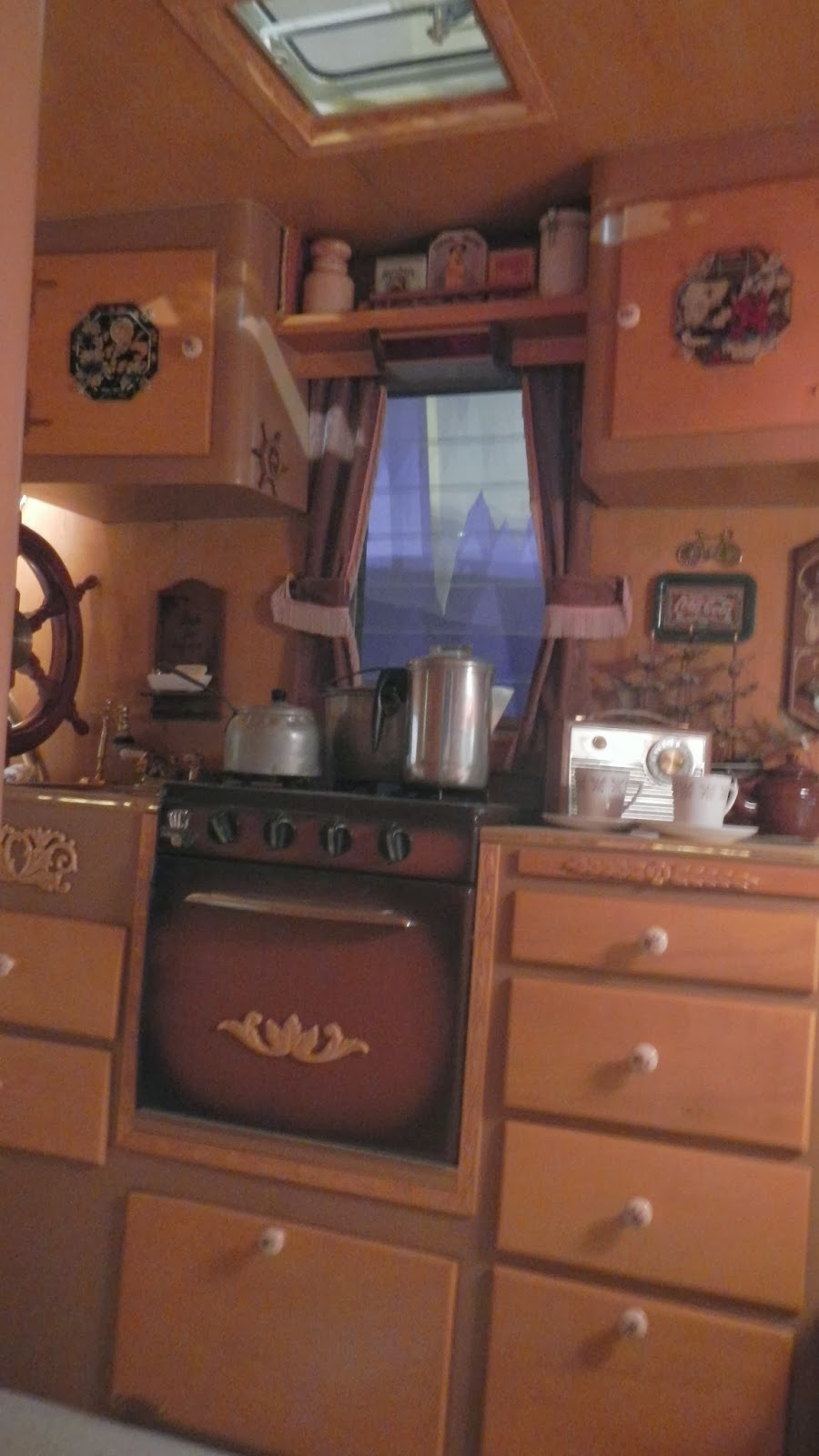
We thought that the kitchen of the Champion Holiday Trailer was a hoot…but it was kind of nifty too!  It has that vintage 50’s look, that’s for sure!

Here’s another view of the interior of the Holiday Trailer.  It looks like the family was interrupted in the middle of a card game… Note the kerosene lamp in the corner and that big picture window! 
Both the Plymouth Station Wagon and the Champion Holiday Trailer were appropriately displayed adjacent to the indoor playground and staffed activity space provided for young children whose parents are visiting Gasoline Alley.

Here’s one last vehicle for this chapter of our visit to Gasoline Alley.  This is a 1937 Terraplane Pickup Truck Model 78. 
Produced between 1932 and 1938 by the Hudson Motor Car Company of Detroit, the economical Terraplane combined Hudson quality and performance with eye-catching style.  Famed aviator Amelia Earhart christened the first Terraplane!  The company claimed that “driving a Terraplane was like flying on land.”  Similar to Terraplane passenger cars, this truck features a waterfall grill, torpedo headlights and pontoon fenders.  The drop frame design produced a low center of gravity ensuring good stability and low profile.
For more on Terraplane vehicles as well as some very nice photos showing some of these great looking cars, go to http://en.wikipedia.org/wiki/Terraplane.
Just click on any of the photos to enlarge them…
Thanks for stopping by for chapter 2 of our visit to Gasoline Alley at Calgary Alberta Canada’s Heritage Park!
Take Care, Big Daddy Dave