Friday, March 22, 2019

Norman Rockwell Museum – Stockbridge Massachusetts

...continuing with the 18th day of our trip and exploration of the northeastern United States.

We started out the day with a major attraction!


This is the Norman Rockwell museum just outside of Stockbridge Massachusetts.  Not only is the museum attractive, but so are the grounds upon which it is situated.  Loved the flowers!

If you are over the age of 50, you absolutely should know who Norman Rockwell was.  I’m sure that our grandsons never heard of him…

Rockwell (1894 – 1978) was an American author, painter and illustrator.  His art work enjoyed broad appeal in the USA because they represented a reflection of American culture.  Norman Rockwell was best known for his cover illustrations for the magazine, The Saturday Evening Post that he completed over 5 decades.  They showed everyday life in the USA. 

What follows is a small selection of some of Rockwell’s works on display at the museum…


This original of a cover illustration for the August 30, 1947 edition of The Saturday Evening Post is entitled “Going and Coming”.  Like many of Rockwell’s works, this is a narrative painting in that it’s seasonal and topical…with a bit of humor thrown in.


This painting is titled “Marriage License” and it was used as the cover for The Saturday Evening Post’s June 11, 1955 issue.  The light on the bride’s dress indicates their bright future together.  Rockwell used models for his paintings.  In this case, the town clerk used as the model had just lost his wife…and the painting shows his state of mind.   


This is one of my favorites, a bad habit of the human species that has been greatly exacerbated by smart phones and social media.  Before technology overwhelmed us, gossip was mostly a local affair…not any longer!  In any case, this painting from 1948 is titled “The Gossips”.  It was the cover illustration for The Saturday Evening Post’s issue on March 6, 1948. 

Reportedly, the Post’s editor questioned whether Rockwell’s characters could possibly be real.  The second grouping of Rockwell’s models for the painting was rather convincing… After the photos, Rockwell’s next rendering of these characters was in charcoal and graphite on paper.  It was also on display at the museum. 


This is one of Rockwell’s best known illustrations.  “The Runaway” is an illustration of what we would refer to these days as community policing.  This was the cover for the Post on September 20, 1958.  All the attention is focused on the boy and his situation… 


This painting is unlike any other works I’d seen by Rockwell.  Entitled “Strictly a Sharpshooter”, it was completed as an illustration for a short story by D.D. Beauchamp in the June 1941 issue of American Magazine.  In the painting, the gold digging girlfriend of the young boxer has goaded him into fighting a seasoned veteran of the sport.  When the inexperienced young man loses, she yells out her rejection of him!


Norman Rockwell was 84 when he died.  At the time, his vision was failing but he was still painting.  This was his last painting, unfinished when he died.  It’s called “John Sergeant and Chief Konkapot”.  The painting commemorated a significant event in Stockbridge’s history… This meeting resulted in a ‘grant’ of land to the Mohican Nation.


Another earlier Rockwell painting followed the same theme…races coming together.  This earlier painting is titled “New Kids in the Neighborhood” and it was an illustration for an article written by Jack Star for Look Magazine’s May 16, 1967 issue entitled “Negro in the Suburbs”.  The article was about the integration of Chicago’s Park Forest community.  It appears the children are getting acquainted and will probably be playing together very soon…  


This painting is titled “Veterans of Two Wars”.  It was the cover illustration for The Red Cross Magazine in June of 1918.  A World War I soldier who is about to ship out to the war in Europe stands between 2 veterans from the Civil War, one from the Confederate Army and the other from the Union Army… The apparent theme is unity and support for our veterans.

This would be a great place to mention 4 of Norman Rockwell’s most famous paintings.  In January of 1941, President Roosevelt had given a speech about his vision for a postwar world based on 4 basic human freedoms.  They were: freedom of speech; freedom of religion; freedom from want, and; freedom from fear. 

Rockwell had been producing illustrations that supported the war effort but he decided to do more, illustrating Roosevelt’s 4 freedoms.  The government rejected the effort at first but The Saturday Evening Post published Rockwell’s 4 paintings and they were immensely popular!  

In 1943, the Post and the US Department of the Treasury launched a joint campaign to sell war bonds and stamps.  The Four Freedoms and other related works went on tour.  Traveling to 16 cities, the exhibition was visited by over a million people who purchased $133,000,000 in war bonds and stamps…

To learn more about the speech, Rockwell’s contribution, and to view the paintings, go to https://www.nrm.org/2012/10/collections-four-freedoms/.  I would be surprised if you weren’t familiar with one or two of them…


This work is entitled “Home for Christmas” and it was published in McCall’s Magazine in December 1967.  Rockwell’s home and studio were just to the right of that white old Victorian Hotel.  He had another studio in town for a while as well.  It was over the market in the painting.  Note the light in the window.


This illustration was for an advertisement for ATO, Inc. the maker of American LaFrance Fire Engines.  It was completed in 1971. And it’s titled “The New American LaFrance is Here” (Firehouse).  All the people in the painting add interest to the theme.  The firehouse is in Stockbridge but the old LaFrance fire engine was substituted for the actual fire truck that was built by Ford.


This is another of Norman Rockwell’s better known paintings.  It’s simply titled “The Catch”.  It was the cover illustration for Country Gentleman Magazine’s issue on May 3, 1919.  Can you see what made the boy in the middle of the picture so unhappy?  This is the second photo of a pair of paintings.  In the first painting, the boys are headed off to the fishing hole.
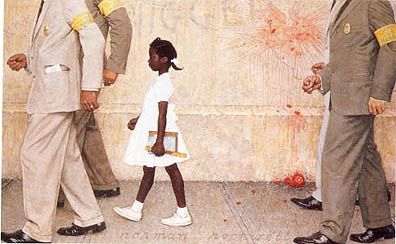


This may be Rockwell’s most famous and, at the time, controversial painting.  This work is titled “The Problem We All Live With”.  This was Rockwell’s first assignment for Look Magazine.  A 6 year old African-American girl is being escorted by 4 U.S. Marshals to her first day at an all-white school in New Orleans.  The actual integration of New Orleans schools occurred 6 years after the Brown vs. Board of Education ruling.

While working for The Saturday Evening Post, Rockwell had been forced to paint out an African-American in an illustration.  The Post’s rule was that African-American’s could only be shown in service industry jobs… Rockwell seemed to relish the newfound ability to correct the editorial prejudices in his previous work.


I’ll end our examples of Norman Rockwell’s paintings with “A Good Scout”.  This painting/illustration was done as an illustration for the Boy Scouts of America’s 1935 calendar and for the cover of the February 1935 issue of Boy’s Life Magazine.

Actually, Rockwell had a very long relationship with the Boy Scouts.  He illustrated the Boy Scout Handbook in 1912 and was on the staff of the scout’s Boy’s Life Magazine until 1917.  His loyalty to the Boy Scouts was unwavering.  He produced illustrations for the group’s annual calendar from 1925 – 1976.


The Rockwell Museum isn’t all about Norman Rockwell.  Other exhibits with a variety of artists regularly rotate through some of the galleries.  I’ve included 4 varied examples of other artist’s works that were on exhibit during our visit…

This painting is titled “Solitude”.  It was completed in 1911 by Maxwell Parish (American 1870 – 1966)


Lemuel Wilmarth (American 1835 – 1918) painted this sentimental work entitled “The Sailor’s Return” in 1884. 


Carle Van Loo (French 1705 – 1765) completed this work in 1737.  Its title is “A Pasha Having His Mistresses’ Portrait Painted”. 


American artist, N.C. Wyeth (1882 – 1945) painted the western themed “The Bear Hunter” in 1909.   


Our first thought was that this handsome big house on the grounds near the museum had been Norman Rockwell’s home and that there would be a tour.  We were mistaken.  This is the Linwood House.  It was built as a ‘summer cottage’ by a prominent (and apparently successful) New York attorney.  This was among the first of the elegant ‘Berkshire Cottages’ built in the area. It is not open to the public and it serves as the administrative offices for the Rockwell Museum…


Norman Rockwell lived and worked in Stockbridge Massachusetts for the last 25 years of his life.  He called this studio, his “best studio yet.”  This building was originally located in the backyard of his home on South Street in town.  Toward the end of his life, in 1976, Rockwell left the studio and its contents to the Norman Rockwell Museum.  In 1986, the building was cut in half and moved to the museum’s grounds. 

All of the artist supplies, furniture and decorative items in the studio are original as given to the museum directly by Norman Rockwell. 

We really enjoyed our visit to the Norman Rockwell Museum!  It’s very well done, the docents are very knowledgeable and Rockwell’s art is ‘comfort food’ for the mind.  It was late August when we visited the museum.  We both agree that this was the busiest tourist attraction that we visited anywhere during our trip!

To learn more about Norman Rockwell and his prolific artistic endeavors, you can go to https://en.wikipedia.org/wiki/Norman_Rockwell

The Norman Rockwell Museum is located at 9 Glendale Road (MA Hwy. 183) in Stockbridge Massachusetts.  They are open 7 days a week.  Admission is $20 for adults, $18 for seniors and $17 for veterans.  Phone: 413-298-4700.  Website: https://www.nrm.org/.

That’s about it for this post… Just click on any of the photos to enlarge them.

Thanks for stopping by for a tour!

Take Care, Big Daddy Dave

Wednesday, March 20, 2019

Northampton Massachusetts and Dinner

…continuing with our exploration of parts of the northeastern United States.

At the end of our 17th day on the road, we checked in to our Hampton Inn in Hadley Massachusetts and then went out looking for a place to eat.  We checked out one place that didn’t appeal to us and another, an Italian restaurant that did appeal to us…but it was booked solid!  I had an image of Northampton as a beat up old industrial town…but we’d run out of options so we decided to cross the Connecticut River bridge and see what the town had to offer.


Once again, I was reminded to never ‘assume’ anything!  Northampton was a surprise to both of us.  Northampton is an academic, artistic, music and countercultural center.  This cleverly decorated railroad bridge and walkway set the tone for me.  This town of about 28,500 residents is roughly 15 miles north of Springfield Massachusetts and while it did suffer somewhat with the decline of manufacturing in the area, that endeavor was never the key to Northampton’s existence.  


Downtown Northampton is alive and well, with hotels, restaurants and shops…

Conservatives beware!  Northampton is reputed to be the most politically liberal medium sized city in the United States.  Numerous alternative health and intellectual organizations are located here.  The city has a high proportion of citizens who identify as gay and lesbian and it’s a popular destination for the LGBT community.  I sure didn't see any MAGA hats! 

The area has always seemed to be ahead of its time.  Congregational preacher, theologian and philosopher Jonathan Edwards sparked the 1734 Christian Revival in Northampton.  This led to the Great Awakening under his leadership.  By way of contrast vs. Northampton’s current political leanings, Edwards is considered one of the founders of what we call today evangelical Christianity. 

To learn more about Jonathan Edwards go to https://en.wikipedia.org/wiki/Jonathan_Edwards_(theologian), and to learn about the Great Awakening go to https://en.wikipedia.org/wiki/Great_Awakening.

In any case, we were just looking for good place to eat in a casual atmosphere…


After looking around a bit and checking out street-side menus, we decided to have dinner at Fitzwilly’s Restaurant and the Toasted Owl Bar.  They must be doing something right here since this dining venue has been in business here since 1974…45 years as of 2019. 


The Toasted Owl Bar is massive, attractive and impressive.  It was busy when we arrived and much busier when we finished our dinners and departed. 


This was one of the dining areas.  It was warm and cozy despite the high ceilings.  Note the old brick wall on the left.  I wonder what occupied this space in the early 1900s…


Then we looked up and noted the brick arches from another era and yet another area for diners. 

FYI... The first permanent settlement of the area took place in 1654.  The town itself was incorporated in 1775.  The town and surrounding area played a key part in American history.  

In August of 1786, Daniel Shays and a large group of Revolutionary War veterans stopped the civil court from 'sitting' in Northampton.  Shays’ Rebellion led to an attack on the nearby Springfield armory and it involved thousands of ex-soldiers.  It also drew retired General George Washington back into public life, leading to his 2 terms as our first President. 

To learn about Shays’ Rebellion and its many ramifications on American history, go to https://en.wikipedia.org/wiki/Shays%27_Rebellion.


For an appetizer, we ordered Fitzwilly’s Gorgonzola and Garlic Bread. ($10.95) This lovely loaf of garlic bread was served with melted gorgonzola and alloutte cheese.  It was excellent…and very filling too!


Laurie chose the Fish and Chips for her entrée. ($16.95) Fresh haddock fillets were dipped in beer batter and flash fried, then served with French fries and some nice coleslaw.  Laurie enjoyed her meal but I did ‘have to’ help her finish off one of those fish fillets and a few fries…


For my dinner, I chose the Bacon, Shrimp and Asparagus Pasta.  I can’t tell you what it cost as it doesn’t seem to be on the current menu.  It’s a pity too as I really enjoyed it.  I love shrimp, asparagus and pasta…plus everyone knows that everything is better with bacon!

We made a good choice for our evening meal!  Fitzwilly’s Restaurant and the Toasted Owl Bar is located at 23 Main Street in Northampton Massachusetts.  Phone: 413-584-8666.  This restaurant’s website is at: https://www.fitzwillys.com/.


After diner it was dusk and we walked around for a little while to work off some of our ‘lite’ meal.  I had to take a photo of this closed old time train car diner just across from Fitzwilly’s.  It dates back to the 1930s and for 24 years, it was called “Kathy’s Diner”.  Before that is was the “Red Lion Diner” and the “Miss Northampton Diner”.    It had been vacant since June of 2013.  Hopefully someone will restore it and open it for business once again!


This beautiful old hotel is the Hotel Northampton.  Built in 1927, it is a member of the Historic Hotels of America.  It features 106 guestrooms and suites.  Lewis Wiggins constructed the hotel and part of his goal was to achieve museum status for the hotels furnishings.  Many of those antiques still grace the hallways, restaurants and lobby.
 
Wiggins actually disassembled and moved a 141 year old tavern to incorporate into his hotel.  It was actually a tavern that one of his ancestors had built.  He reassembled what is now a 200 year old tavern in the hotel.  This hotel and tavern have housed and fed many celebrities and famous people.  They include the Dalai Lama, Dwight Eisenhower, Nicole Kidman, David Bowie, John F. Kennedy, Franklin and Eleanor Roosevelt, Richard Nixon, Calvin Coolidge, Bob Dylan, Jenny Lind, Stephen King, Wynton Marsalis and Leonard Nimoy.

For more information about this hotel, its rates and dining opportunities, go to http://www.hotelnorthampton.com/.


As we departed the area the next morning, we passed this amazing and attention getting structure.  This is the Northampton City Hall.  It was built in 1850.  Its designer conceived of it as a novelty, combining the Gothic, Tudor and Norman styles…complete with arrow slits in the towers. 

Sadly, in a 1923 restoration of this building, the historic second floor auditorium was lost.  Back in the day it seated 1,000 people, playing host to Jenny Lind, P.T. Barnum, Horace Greeley, William Lloyd Garrison, Oliver Wendell Holmes, Ralph Waldo Emerson, Sojourner Truth and Frederick Douglass. 

One more footnote about Northampton.  It is the home of Smith College.  Graduates of this independent women’s college include Sylvia Plath, Barbara Bush, Nancy Regan, Gloria Steinem and Julia Child.

That’s all for now.  Just click on any of the photos to enlarge them…

Thanks for stopping by for a visit!

Take Care, Big Daddy Dave

Monday, March 18, 2019

Sights along the Way…plus a Surprise!


Following the Hancock Shaker Village near Pittsfield Massachusetts, we wandered along a number of local roads and 2 state highways, headed in the general direction of Old Deerfield…

I started out by checking out a local railroad museum…


This is the ‘new’ old Lenox Massachusetts Railway Depot at 10 Willow Creek Road.  The original Lenox Depot was built in 1850 by the Stockbridge and Pittsfield Railroad.  It was leased by the Housatonic Railroad and subsequently by the New York, New Haven and Hartford Railroad.  But it burned down in 1902.  The current depot was completed in 1903.
 
The station was abandoned by the railroad in the 1950s and then found use as a repair shop, carpentry shop and as a warehouse.  In 1986, the building was donated to the Berkshire Scenic Railway Museum.  Years of hard work and significant funds have restored it to its appearance back in 1903. 

Today the Lenox Depot is home to the Railway Museum’s offices, ticket office, museum and the museum store. 

The Berkshire Scenic Railway Museum also operates the 1893 Depot in Stockbridge Massachusetts as well as a replica Block Station, the latter being used by railroads in the early days to control safe train movements.


The Berkshire Scenic Railway Museum owns quite a bit of rolling stock.  The top photo shows Locomotive 562 which was built by the American Locomotive Company in 1950 as well as BRMX 67, that little black and orange diesel-electric locomotive.  Locomotive 9128 in the second photo was built by General Motor’s Electro-motive division in 1957.  In total, BSRM owns 8 locomotives, a couple of self-powered diesel coaches, several passenger coaches for the operation’s scenic trains and several other miscellaneous pieces of equipment.

In addition to the Lenox Depot with its railyard, and the Stockbridge Depot, the Berkshire Scenic Railway Museum also operates scenic rail tours out of North Adams Massachusetts.  To learn more about this organization, the museum, their collection of rolling stock and the opportunity for a rail tour, go to https://www.berkshiretrains.org/.


Next we wandered east along MA Hwy. 9.  When we passed through Dalton, I stopped to take this photo of the Dalton Town Hall Building and Free Library.  This Romanesque style structure was completed in 1893 and has been occupied by both local government and the library since it opened.

Dalton was settled in 1755 and it was officially incorporated in 1784.  By 1829, Dalton had 3 paper mills, a gristmill and 5 sawmills.  Paper making became the town’s largest industry.  In 1801, Zenas Crane started a paper making business and in 1844, Crane’s developed its distinctive bank note paper.  More than 170 years later, Crane and Company is the largest employer in Dalton and the company is still making all of the paper that the USA uses for its currency.   The company supplies other countries with their currency paper as well…


Laurie loves the stone walls you see when you drive the back roads and byways in New England.  This photo was kicked up a notch with that nice old barn behind the wall…


This building at 457 Main Street in Ashfield Massachusetts was acquired by the Ashfield Historical Society in 1964.  It was built in 1830 and the ground floor was used by various merchants until 1900.  The upstairs had been used as a meeting place for secret societies that had flourished in the mid-1800s.  To learn more about Ashfield’s Historical Society and this museum, just go to http://ashfieldhistorical.org/.

Ashfield was first settled in 1743 and it was incorporated in 1765.  The population of the town today is about 1,700.  Of note is the fact that famous movie director Cecil B. DeMille was born here while his parents were on vacation.  His most famous movies, at least for those of us who are still alive, were The Greatest Show on Earth and The Ten Commandments. 


This is the Field Memorial Library at 1 Elm Street in Conway Massachusetts.  With its domed rotunda, Italian marble, original woodwork, a spiral staircase and cast-iron shelving, this is an over-the-top example of late nineteenth-century architecture.  It was built in 1901, by Marshall Field, founder and owner of Marshall Field and Company, as a memorial to his parents.
 
When Marshall Field completed this structure in 1901, he was one of the 10 wealthiest men in the USA.  He’d been born on a subsistence farm in Conway in 1834, but he wanted to be a merchant, not a farmer.  Still, he felt that whatever success he had in life, it owed it to his parents.


We finally drifted into Old Deerfield Massachusetts and Historic Deerfield.  These old trees and the wide street combined, provide a sense of what this place feels like…

As per an article I read, this tree-lined avenue appears much the same as it did in the late 1700s when the Reverend William Bentley visited and wrote: “The Street is one measured mile, running north and south.”  He went on to note that “There is a gate at each end of the street and about 60 houses in better style, than in any of the towns I saw”.  Today, 25 of those homes still stand and Historic Deerfield has moved others to this site.


The Street is not all museum… I don’t think that this house is part of the official historical attraction in Historic Deerfield, but it is a very appealing home and it ‘fits the part’ in this old town.

Historic Deerfield, located in the village of Old Deerfield, is a multi-building museum that is dedicated to the heritage and preservation of Deerfield Massachusetts as well as the history of the Connecticut River Valley.

Eleven house museums are included in Historic Deerfield.  In addition there is a modern museum and a visitor’s center.  Most of the homes are viewed on guided tours.  We didn’t have enough time to take a tour so we just drove through and took pictures.  In addition we’d visited a lot of historic homes already on this trip…  With more time Historic Deerfield would have been a great place to visit.


This is Historic Deerfield’s Dwight House.  It was built ca. 1754 in Springfield Massachusetts.  When it was threatened with demolition in 1950, it was dismantled and reassembled here.  It is one of 4 houses along the Street that weren’t here originally.  It now serves as a museum of the historic trades.   

Historic Deerfield has over 28,000 artifacts.  They include furniture, ceramics, textiles, clothing, embroidery, paintings, maps and prints, silver and metal ware, glass, powder horns, folk art, books, manuscripts, documents and much more…


Frary House was built ca. 1750.  It has been interpreted to depict the 1890s home of Miss C. Alice Baker, who restored the home in 1892.  Miss Baker was a teacher, collector and antiquarian.  The focus of the home is to interpret the village’s arts and crafts movement. 

In the late 1800s and early 1900s, education, tourism and the sale of arts and crafts helped sustain the village and its residents.  Tourism was big business in the increasingly industrialized USA, with people seeking a break from their hectic lives…not much different than today’s tourists.


This is a relatively ‘new’ building in Historic Deerfield.  The building housing the Wilson Printing Office was built in 1816.  Other than the fact that old time printing techniques are on display and sometimes demonstrated here, I wasn’t able to find out anything about this home. 

A little history about Deerfield.  It was first settled in 1673.  As a frontier settlement, it was regularly attacked by Native Americans.  It was abandoned after the 1675 attack at Bloody Brook at South Deerfield.  That was followed by a retaliatory attack on the Native Americans in which 200 of them were killed, many being women and children.  Deerfield was resettled in 1682 but faced several more raids in the 1690s, culminating in a devastating raid in February of 1704.  Fifty citizens were killed and 112 were marched off to captivity in Canada.  It was a bloody era…that’s for sure.

If we’re in the area again, we will definitely spend a day touring this multi-faceted museum.  Historic Deerfield is located at 84B Old Main Street in Old Deerfield.  Phone: 413-774-5581.  Website: https://www.historic-deerfield.org/.


This was our surprise!  As we sped along US Hwy. 5/MA Hwy. 10 just south of Old Deerfield, we did a U-turn when we spotted the sign announcing Magic Wings – Butterfly Conservatory and Gardens.  This was something new and unexpected!


Magic Wings features an 8,000 sq. ft. indoor butterfly conservatory.  Its home to almost 4,000 exotic and domestic butterflies.  As you can see, it’s an indoor tropical wonderland.  As per Magic Wings, they are focused on butterfly related education, recreation, entertainment and related gardening needs. 

I’ll be perfectly honest.  I don’t know much of anything about butterflies other than we both like them and plant perennials that attract them along with our friends, the bees.  So, I will spare the commentary and just show you a number of butterfly/moths photos.  FYI, those little devils are hard to photograph unless they’re feeding…  


This was just a small sample of the butterflies living at Magic Wings.  We forgot about time and just focused on the magic…and our attempts in photography.


There were quail wandering around on the ground in the butterfly jungle and we said hi to the parrot.  There were also some koi in the jungle pond and tortoises and a number of interesting displays in the room off the conservatory.

Magic Wings – Butterfly Conservatory and Gardens is located at 218 Greenfield Road (US 5/MA 10) in South Deerfield.  It has been open since 2000.  They are open 7 days a week.  For more information and some great photos, you can go to http://www.magicwings.com/. 


What!!  A tobacco barn in Massachusetts!?  We took about a dozen photos in an effort to capture the beauty of the scene… Too bad there aren’t some beneficial uses for tobacco!

Connecticut shade tobacco is tobacco grown under shade in the Connecticut River Valley in the states of Connecticut, Massachusetts and southern Vermont.  It is primarily used for binder and wrapper for premium cigars.
   
Next stop, Northampton Massachusetts and Dinner!

Just click on any of the photos to enlarge them…

Thanks for stopping by for a visit!  Big Daddy Dave