Tuesday, July 4, 2023

Headed West on Backroads from Owensboro KY

As this post to my blog site is being published on July 4th, it’s important that we remember why we celebrate this Holiday and date… It’s not just a long weekend full of family fun and a day off work.  It was on July 4th, 1776, that the Second Continental Congress established the United States of America!

While the Fourth of July is perhaps the most important milestone in America’s history, we’re also wishing that all Americans have a safe and happy July 4th holiday!

…continuing on our recent road trip via back roads to St. Louis Missouri.

I remember a family road trip back around 1952 when my stepfather drove us from Jackson Michigan up to Sidney Mines Nova Scotia Canada…and then back again via Connecticut.  It was all 2 lane roads, long before today’s super limited access highways.  Since everyone was on these narrow roads, a slow truck, farm equipment or just a slow driver, really extended your ‘road time’. 

These days, with rare exception, we just sail along the back roads, only dealing with local traffic and small towns to slow us down.  But there are exceptions!  As we headed west from Owensboro Kentucky, for about 30 minutes, we were trapped behind 2 large trucks/dual segment carriers hauling huge I-beams toward a project somewhere…probably a bridge being rebuilt.  A lead vehicle was way out in front ensuring that oncoming vehicles were pulled off the road.   

I didn’t have any particular items listed in Sebree Kentucky for us to take a look at.  But we stopped to take photos when we spotted Bell’s Drug’s, an old time drug store that still has fountain service.  I couldn’t determine when the building was constructed but my guess would be sometime ca 1900.  Note the “Drugs” built into the face of the building.

In any case, Bell’s Drug Store is an icon of sorts in Sebee.  It still has that old time charm and you can still buy a cherry soft drink made to order.  Customers today sit in the same red leather chairs and at the same tables with black Formica tops where parents and grandparents sat before them.  The Bell family bought the drug store in 1946.  Previously, it had been the Melton and Mosby Drug Store.  The Bell family still operates the store.  To learn more, go to Contact | Bell's Drug Store (wordpress.com).

This is a fairly recent photo downtown Sebree Kentucky that I borrowed from the Internet.  Bell’s Drug Store is just right of the center of the picture.  Sebree was founded in 1868 just before the arrival of the Louisville and Nashville Railroad in the fall.  It was founded by William Scott and Colonel E.G. Sebree and it was named after Sebree for his assistance in bringing the railroad to the area.

The railroad, now long gone, ran right through the middle of town.  At one time Sebree was home to about 40 businesses, hotels, shops and stores.  Its first church was erected in 1870.  The town was also home to Sebree Springs, a summer resort and park.  Telephone service arrived in 1895 and several tobacco factories were also built.  The historic Sebree Deposit Bank, ca 1890, is still in operation.  It’s at the far left of the photo.

This old bank which was built in 1903, is right across the street from Bell’s Drug Store.  I couldn’t learn anything about the structure but at least it has been repurposed, now serving as the law office of Tommy Joe Fridy.

Sebree’s population has held steady in recent years.  It now numbers 1,533 residents.

What…!  Yet another short delay in our trek across western Kentucky toward the Ohio River and Illinois.  Not a great photo, but this time we spent several miles trailing behind 2 crop spraying tractors.  They were too wide to pass and oncoming vehicles had to squeeze by or pull over to let the tractors pass.  Roadway courtesy prevailed though.  When they came to a place with their lead vehicle and both tractors could safely pull over, they did and we headed on down the road.

FYI, curiosity got the better of me and I started wondering what one of these tractors might cost.  I found a used one on line, a 2010 model, for only $130,000.  The new ones I found ranged from $228,900 to $269,500.  The size of the chemical tank is an important factor in cost…
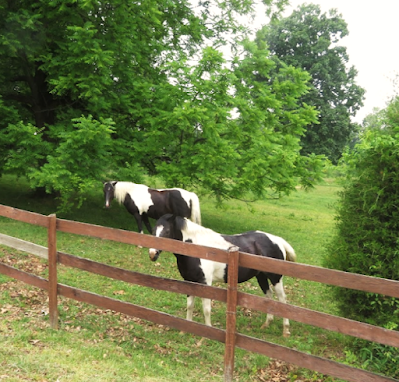
We had to stop and take a photo of these two beautiful black and white American paint horses.  We both love horses…

The American Paint Horse combines both the conformational characteristics of a western stock horse with the pinto spotting pattern of white and dark coat colors.  They were developed from a base of spotted horses with both Quarter Horse and Thoroughbred bloodlines.  The American Paint Horse Association’s breed registry is one of the largest in North America.


One of my railroad depot resource documents noted that there might still be an old Louisville and Nashville Railway Depot located in the tiny town of Pride Kentucky.  The ‘town’ consists of 4 blocks along KY Hwy 141.  As you can see, the depot still stands and it has been well maintained.  My source indicated that it had been used by a local business for some time.  The depot looks great, especially considering how rural this area is and that fact that more than 70 years have passed since that the railroad abandoned the Morganfield Branch line.

Fohs Hall is located in Marion Kentucky, the county seat of Crittenden County.  The town has a population of about 2,900.  Fohs Hall was built in 1926 to serve as a community center for the town and an auxiliary building for the high school which was located right across the street.  It was a donation of Ferdinand Julius Fohs, a notable petroleum geologist who grew up in the town.  The building included a music room, lounge, study hall, a small library, classrooms and an auditorium.

Ferdinand Fohs has been credited with helping discover the Mexia oil field in 1920.  That Texas oil field has yielded over 110,000,000 barrels of oil to date and it’s still in production, although at a much reduced pace.

Notes:

  • Crittenden County was generally pro-Confederate during the American Civil War.  Fighting here was minimal despite both armies passing through it repeatedly.  The county courthouse was burned by Confederate Brigadier General Hylan Lyon during his raid across western Kentucky in 1864.  Lyon’s men, all Kentuckians, burned a total of 7 courthouses.  This was because the Union Army was using them for barracks.  Locals were allowed to move the records before the fires were set.
  • One product that has been manufactured in Crittenden County caught our attention.  Now we know where the blue crystal glass used by Ball Company’s canning jars came from.  In the early 1900s, people thought that darker glass helped prevent food from spoiling as quickly.  Other colors used included yellow, amber, olive and a number of shades of green.

God Bless America!

Happy July 4th


 Just click on any of the photos to enlarge them… Thanks for stopping by for a visit!

Take Care, Big Daddy Dave
Friday, June 30, 2023

Owensboro Kentucky – Architecture and History

After our rather unsatisfying and disappointing BBQ dinner, we wandered around the center of Owensboro to take photos and explore.

This is the former Carnegie Free Public Library.  This Beaux-Arts structure was built in 1909.  In 1903, the Owensboro Business Men’s Association had solicited at $30,000 donation from Andrew Carnegie for a library building.  For a time, Carnegie was the richest man in the world.  In any case, city budgeted funds were added to public contributions to buy the lot and plan for construction of the building.

In 1968 the library was moved to a larger building and this structure became the home of Owensboro’s “Area Museum” in 1968.  In 1977 that museum moved to another facility and the former library building became the home of the Museum of Fine Art. 

I took a virtual tour of the Art Museum and it appears to be quite a collection of an eclectic and quality grouping of art forms.  One display includes 16 large stained glass church windows from the late 1800s.  To learn more, go to Owensboro Museum of Fine Art – Owensboro, Kentucky (omfa.us).

Another building of note in Owensboro is the three-story Federal Building and U.S. Post Office.  The structure is the finest example of Beaux-Arts architecture in the city.  It also is the more architecturally significant civic building.

Notes:

·       Owensboro has been the home of many sports stars and celebrities.  The Hayden family provided 3 racing professionals and the Green Family did the same for NASCAR.  As regards the latter organization, both Michael and Darrell Waltrip are from Owensboro.  The best known celebrities from town were Tom Ewell, Florence Henderson and Johnny Depp.

·       As of the most recent census data, the Owensboro metropolitan area has about 117,000 residents. 

·       FYI, Owensboro is the home of the Bluegrass Hall of Fame and Museum.  You can learn all about it at Home - Bluegrass Music Hall of Fame & Museum (bluegrasshall.org).

I couldn’t find any historical reference to this building or buildings in downtown Owensboro.  However I’d be really surprised if this handsome and eye-catching structure wasn’t part of one of the city’s commercial districts that are listed in the National Register of Historic Places.  Unfortunately, the data bank at the National Register is incomplete for the great majority of the historic structures in the city.  The Register includes 34 listings for Owensboro included 4 Historic Districts, each containing a number of buildings or historic places.

Currently, the row of store fronts in this old building has 3 businesses in place.  Riverwalk Razor Barber Shop; Hooded Crow Tatoo Shop and; Vintage Stripes Barber Academy.  I’m guessing that they are all related…

Note:

·       Unfortunately, the history of Owensboro was severely blemished in August of 1936.  That’s when the downtown area became the site of the last public hanging in the USA.  A 26 year old African American man was convicted and sentenced for the rape and murder of a 70 year old woman.  Only 37 days lapsed between the crime and the execution.  A carnival atmosphere was in place on the day the accused man, Rainey Bethea, was hung.  There were food vendors, as well as a large crowd including children and reporters.  Worse yet, before Bethea was dead, the crowd began to tear at his clothes and even his body for souvenirs.  Following this sad and embarrassing fiasco, the Kentucky General Assembly quickly abolished public executions.

We both loved the look of this narrow three-story Romanesque Revival building.  The Breidenbach building, completed in 1890, remains one of the best examples of this style of architecture in Owensboro’s downtown commercial area.  The structure was part of what was then called “Court Row” and it was constructed by Edward H. Breidenbach, the Light and Water Superintendent for the city for over 50 years.  Breidenbach was also a distiller, city commissioner and an extensive land owner.  In recent times, the building served as a law office but now it is the headquarters for MediaWorks Advertising, a company that has been in business since 1996

This is the old Odd Fellows Building.  This eclectic Beaux Arts and Italian Renaissance three-story structure was built in 1895 but unfortunately, part of the street level portion has been poorly altered.   The Odd Fellows chapter had 125 members in 1895 when the building was completed.  The Odd Fellows Lodge was on the third floor, while the rest of the building was commercial, the second floor serving as office space and the first floor as retail space.

The Lodge was organized in 1856 and it owned half of the “Court Row” block at the time they built this structure.  I noted that this 22,255 sq. ft. building was sold at auction in May of 2022.  It cost $610,000.  Currently, the building is the home to a restaurant, Colby’s Fine Foods and Spirits.  If you’re interested, you can learn more about this restaurant at http://www.colbysfinefoodandspirits.com/.

I couldn’t find out anything about this juxtaposition of what I’m sure is at part of an historical structure and a modern glass addition.  It was an interesting and eye-catching concept which preserved the front of an impressive old building while serving the needs of the Truest Bank Corporation.  A similar and more dramatic mix of old and new was created a number of years ago in Paris France with the expansion of the Louvre. 

N0tes:

·       The first European who settled at Owensboro was frontiersman William “Bill” Smeathers in 1797.  A restless soul, he moved around quite a bit, ending up in Texas.  He fought in The War of 1812 and in the Texas Revolution.  In 1909, when living in Kentucky, using the name “Bill Smothers”, he was tried for the murder of a man who allegedly raped his sister.  He was acquitted but advised to leave the area for a while.  For more on Bill Smeathers, go to https://en.wikipedia.org/wiki/William_Smeathers.   

·       The settlement that was to become Owensboro was originally known as “Yellow Banks” after the color of the land beside the Ohio River.  In 1817, the town was renamed “Owensborough”, after Colonel Abraham Owen.  Owen served as a colonel and as aide-de-camp to William Henry Harrison at the Battle of Tippecanoe, where he was killed in 1811.

·       Owensboro was incorporated in 1817 and during the 1800s it developed as a market for tobacco and a center for distilling bourbon whiskey.  By 1900, the city could count 12 active distilleries and 25 tobacco stemmeries.  FYI, a stemmery is a building where tobacco leaves are stripped for the production of tobacco products.

The Beaux Arts style Callas Sweet Shop was built in 1921.  The National Register of Historic Places termed it ‘elegant’ and described it: “The buff color terra cotta and tile decorative elements, such as brackets, shields, and cornices, create a simple, classical appearance”.

Listed in the National Register in 1986, the building was deemed significant as “having the only surviving example of complete terracotta tile fronts in downtown Owensboro.  The original owner was a European immigrant who started out shining shoes.  His first shop was called Progress Candy.  He built this shop next door to the Empress Theater.  When Callas’ health failed he rented it to a local who added sandwiches to the menu.  For many years, a visit to the Callas Sweet Shop was an Owensboro tradition…

More recently, for several years this building served as “Bill’s Restaurant”.  Today, it is once again a restaurant.  Now it is called “Sassafras”.  See Sassafras (sassafrasowensboro.com).  

This is the old Trinity Episcopal Church in the 400 block of West 5th Street in Owensboro.  Listed on the National Register since 1972, this building was built way back in 1875.  In 2 years it will be 150 years old… The structure has the attractive straightforward lines of typical village Gothic Chapels that are found across the English countryside.  It is the oldest brick church building in town…

The church was first organized in the Masonic Lodge with services being held over Dr. McGill’s Drug Store.  A bit later, church members bought a carpenter’s shop and worshipped there until this building was completed.  Trinity Episcopal Church would seat 600 people and many people thought that it was too large for the city.

Owensboro acquired the Old Trinity Centre/Church in 1972 and it was offered to the Theater Workshop of Owensboro in 1973.  For many years, theater productions were staged here but in the 1990s, play productions were moved to the new RiverPark Center.  In 1999, a major renovation of Trinity Centre was completed and productions are once again being staged in its intimate auditorium.  You can learn more about the Theater Workshop of Owensboro at Theatre Workshop of Owensboro | The Longest Running Show in Town.

This big blue Queen Anne style home caught our eye.  The James J. Sweeney House was built in 1893.  The home ranks among the finest examples of late nineteenth century domestic architecture in Owensboro.  James Sweeney was a prominent local attorney who was a partner in the law firm with his father and a brother.  The home served as a residence for over 70 years.  The five bedroom and five bath home has 8,580 sq. ft. of space. 

In the 1970s the Sweeney home was converted into a restaurant.  But in 1980, it was sold to owners who rehabilitated it for use as a private residence once more.  The current on-line estimated value for this property is $658,100.

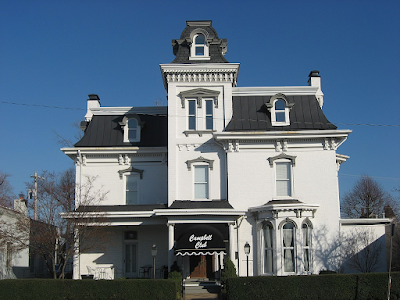
I borrowed this old photo from the internet as this old home was being rehabilitated/updated when we stopped by.  Scaffolding doesn’t make for a great photo.  This home, referred to as the Gillim House, was built ca. 1880 by John Woolfolk, a local business entrepreneur.  A few years later, he sold it to C.D. Jackson, a relative of President Andrew Jackson and a major local landholder.  When Jackson died, his heirs sold it to a wealthy distiller who, a few years later sold it to J.D. Powers, an attorney and state legislator.  Finally, it was purchased by Dr. W.F. Gillim who owned it for 31 years…hence its known as the Gillim House.

The home became a boarding house for the upper class in the 1930s.  In 1959, it was converted to a private members only dining club, hence the photo showing it as the Campbell Club.  Once again, it has changed hands.  Small world… Bill Hughes, the former chef and general manager of the Campbell Club and the former owner/operator of Bill’s Restaurant in the Callas Sweet Shop location has moved on.  The Gillim House will now be known as the Cupola Club and that same Bill Hughes is the proprietor.  I’d provide the contact information but this is a members’ only dining opportunity...

Just click on any of the photos to enlarge them…

Thanks for stopping by for a visit!

Take Care, Big Daddy Dave 

Tuesday, June 27, 2023

The Last Few Miles to Owensboro plus Dinner

As we neared our overnight stop in Owensboro Kentucky, I still had a few items on my list of historic places that I wanted to check out…

The first spot dates back to the 1930s when Americans were truly beginning to expand their exploration of the USA despite the ongoing Great Depression.


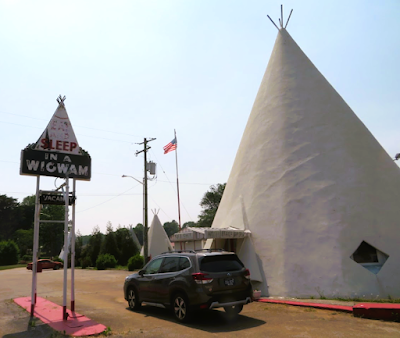
This is Wigwam Village #2 in Cave City Kentucky.  It was built in 1937 to offer travelers a fun/different sleeping experience during their visits to nearby Mammoth Cave National Park.  Initially, Wigwam Village #2 featured a gas station as well as a lunch counter…both long gone since the 1970s. 

These Wigwam Motels aka “Wigwam Villages” was a motel chain with 7 locations that were built between 1933 and 1949.  Originally, there were 2 locations in Kentucky with one each in Alabama, Florida, Arizona, Louisiana and California.  Of these locations only 3 have survived.  In addition to this one, the other 2 are in Holbrook Arizona (#6) and near San Bernardino California. (#7)

Wigwam Village No. 2 has 15-wigwam units for travelers.  The concrete structures/rooms were built in the form of tipis, mistakenly referred to as wigwams.  Each wigwam has all the modern conveniences one would expect including private bathrooms, air conditioning, coffee pots, free Wi-Fi and cable television.  Located on 4 grassy, tree-lined acres, the property includes 2 large fire pits where guests can gather in the evening, plus a ‘retro’ playground, cooking grills and a covered lighted picnic pavilion with tables.

There are 2 styles of wigwams or tipis for guests to choose from.  A single sleeps 2 and a double sleeps 4.  The wigwams feature the original hickory bed frames, caned chairs, night stands and vanities that were created 84 years ago in Indiana.  In addition, the bathroom’s red and white graphic tile is also original.

At the moment, part of Wigwam Village No. 2 is undergoing extensive renovation to bring all aspects of the facility back to its 1930s original appearance.  Ongoing patronage helps pay for the restoration effort.  The Village is listed on the National Register of Historic Places.  To learn more about the rates and to see photos of the interior of these tipis, you can go to Wigwam Village No. 2 – Authentic Americana Since 1937 (historicwigwamvillage.com).

The old Brownsville Deposit Bank was not on my list of places to check out…but it looked old and historic to me so Laurie took this photo for me.  The bank itself was apparently founded in 1899 and it ceased doing business in 2006.  Note the exterior deposit slot. 

The building appears to have been renamed as the Washington Meredith Memorial Building at some point in time.  It was named after Washington A. “Watt” Meredith. (1862 – 1931) He was a member of the Masonic Lodge and served as a Master of the Brownsville Lodge.  As a matter of fact, the Lodge is now designated as Washington Meredith Lodge #355.

The Meredith family seems to have been prominent in the town and the surrounding area for many, many years.  A “Meredith” is currently serving as the Mayor.  The Brownsville City Hall may also share this space.  Laurie found a history for the Meredith that really is very interesting.  Check it out at https://www.wikitree.com/wiki/Meredith-2143.

Our next photo opportunity in Brownsville Kentucky was the Reed-Dossey House.  This unusually large vernacular late Victorian style home is well preserved both on the outside and the inside.  It was listed on the National Register of Historic Places, it was built ca. 1890.  It was built by or for entrepreneur J.P. Reed who was reputed to be connected with the steamboat traffic on the Green River.  The home was purchased by the Dossey family ca. 1910 and the family occupied the property, sometimes as a boarding house, until the 1980s.  This impressive home sits on a shelf of a ridge overlooking the town.

Once again, curiosity got the best of me.  Steamboat traffic on the Green River?  The river itself is 384 miles long rising from Lincoln County in south central Kentucky.  It eventually empties into the Ohio River near Henderson Kentucky.  I learned that way back in 1842, the river and its tributary, the Barren River, were canalized with a series of locks and dams creating a navigable channel all the way to the city of Bowling Green.  In 1901, two additional locks and dams were opened on the Green River, allowing river traffic to Brownsville and Mammoth Cave.  All of the dams and locks either eventually failed or have been removed...

Our next stop was in Fordsville Kentucky, population 446.  The former Louisville, Henderson and St. Louis Railroad Depot was built in 1916.  This concrete-block, tile-roofed building has architectural elements most closely related to the Prairie School style.  The first railroad feeder line was the Owensboro, Falls of Rough and Green River Railroad which reached the town in 1889. 

This depot replaced the first one which had been built in 1890.  Like most depots in the south in those days, the current depot had 2 waiting rooms, one for whites and one for blacks.  The ticket office was in the middle between the waiting rooms.  There were actually 2 rail lines serving Fordsville, the other being the Madisonville, Hartford and Eastern Railroad.  It was completed in 1910.

As we moved further north along KY Hwy 54 toward our destination for the day, we ‘had to stop’ to take a photo of a critter that one doesn’t see too often in the eastern USA except in zoos.  There were at least 3 buffalo, aka bison in this field along the road. 

It is estimated that there are between 400,000 to 500,000 bison on ranches and farms across North America while only about 31,000 are considered to be wild…although about half of that number are fenced in/contained.  In the late 1700s, there were an estimated 60,000,000 bison roaming across North America…included the eastern portion of what is now the USA.  Due to slaughter for food, blankets and robes, as well as a means of subduing Native American tribes, by 1889, only 541 bison remained.

On to food!  We had researched and discussed where we wanted to have our dinner in Owensboro.  On a couple of work related trips (A Montgomery Ward’s ill-fated “Electric Avenue Store”), I had eaten at the Moonlight Bar-b-q Inn.  I liked it so much that Laurie and I have also eaten there on 2 or 3 other occasions.  Website: Moonlite Bar-B-Q Inn - Kentucky BBQ Restaurant.  

When we checked TripAdvisor, Moonlite Bar-b-q Inn was still listed as number 1, but Old Hickory Bar-B-Que had a higher rating.  They only had about half of the reviews that Moonlite had.  We decided that it was time for a change and the reviews were very positive, so we chose to eat dinner at Old Hickory…


The inside of the restaurant was straight-forward and fairly basic, just what one would expect from a relatively ‘upscale’ BBQ restaurant. 

To quote from the restaurant’s website, “Old Hickory Bar-B-Que is a locally owned and family-operated restaurant that has been proudly serving families in Owensboro, KY since 1918.  Our bar-b-que is legendary and has been featured in many magazines and TV shows.”  1918 is when Charles “Pappy” Foreman began barbequing mutton.  The operation was given the Old Hickory Bar-B-Que name in 1954.

This is the menu at Old Hickory Bar-B-Que for purchases by the pound for take-out.  The big difference between this menu and most other barbeque restaurants across the USA is the inclusion of BBQ mutton options.

We perused the dining room menu for our options.  There are sections for plates, sandwiches, soups/salads/sides as well as for desserts and drinks.  Fortunately, our waitress gave us some valuable guidance when it came to ordering…  

We decided that we’d go for ‘plates’ instead of sandwiches.  I was looking at the Mutton Plate ($16.45) and Laurie was torn between the Brisket Plate ($15.89), or the Pork Ribs Plate ($16.25).  Then our waitress stepped in and suggested that we should order and share the Combination Plate…which comes with our choice of 3 different meats and 2 sides. ($17.49) She said that it would be plenty of food for both of us.

So…we ordered the mutton, pork ribs and brisket with French fries and beans for dinner…and, as promised there was plenty to eat for both of us.  The problem was we didn’t like most of what we were served.  Ranked from best to worst, the sliced mutton was best, the brisket was second and the ribs were the worst.  The brisket was kind of chopped up and lacked flavor and the ribs looked and tasted like they’d been overdone or cooked a day earlier.  The baked beans were mediocre at best.  Even the watery bbq sauces were almost flavorless.  The whole meal was a disappointment!

Many thanks to our waitress!  She kept us from wasting another $15.00 or so!  Of course, BBQ is a personal thing and Old Hickory Bar-B-Que is well rated, so maybe it was just us…or the pit master had a bad day.  If you’re in the Owensboro area, check it out for yourself and let me know what you think.  Website: BBQ Restaurant | Old Hickory Bar-B-Que | Owensboro, KY.

Just click on any of the photos to enlarge them…

Thanks for stopping by for a visit!

Take Care, Big Daddy Dave

Friday, June 23, 2023

On the Road Again – Backroads to St. Louis Missouri (#3)

 …continuing on our journey following our lunch at the Esto Country Store and Café.  I diverted a little from my intended route, skipping past the town of Russell Springs Kentucky.  I’d designed our route to allow for shorter drive times if needed…

With my route change, the next town we came to was Edmonton Kentucky, the county seat of Adair County.  Adair County was formed in December of 1801.  Columbia was chosen as the county seat in 1802 and the first courthouse was completed in 1806.  This is the fourth courthouse to be built in the town square.  It was completed in 1885 and it’s still in use today.

This is one of the best preserved major late 19th century Kentucky courthouses.  It is a late Victorian variation of earlier Kentucky courthouse designs.  Located on the central city block and approached by major streets from all sides, it is fittingly capped with that 4-sided clock tower.  Architecturally, it is difficult to describe.  Elements of High Victorian Gothic, Medieval, New Grecian, Romanesque and perhaps Second-Empire influences are evident.  The architect, William Henry Hudson, was so proud of his work that his portrait is carved in a capital at the top of a column on the porch.

The county, population ca. 19,000, was named in honor of John Adair, a veteran of both the Revolutionary War and the Northwest Indian War.  Later, he commanded Kentucky troops in the Battle of New Orleans at the end of the War of 1812.  Adair was the eighth Governor of Kentucky.

Notes:

·       Adair County has some of the few surviving American chestnut trees to be found anywhere in the United States.

·       Adair County is one of the handful of completely ‘dry’ counties in Kentucky…no alcohol sold anywhere.


As we circled the courthouse and the town square, Laurie spotted a store that appealed to her.  This structure is part of the Columbia Commercial District, a cluster of 29 buildings that has been listed on the National Register of Historic Places.  This particular building was constructed ca. 1895 and it is considered one of the most highly styled and intact buildings in the District.

Nanwood Market is a home décor store that has been in business in downtown Columbia for quite a few years now.  The building was renovated and it is full of items that really appeal to Laurie.  The home décor items in the store have been carefully curated and there even is a coffee bar for shopper’s enjoyment.  Laurie did make a modest purchase.  To learn more or to shop on line, go to https://www.nanwoodmarket.com/.

Notes:

         ·         For the first 100 years of Adair County’s existence, transportation was the biggest problem for residence and commerce.  As late as 1910, travelers would have to take a stagecoach to Campbellsville to reach the railroad.

         ·         On April 29, 1872, a gang of 5 men, believed to included Frank and Jesse James from Missouri, robbed the Bank of Columbia.  They got away with $600, killing the bank’s cashier in the process.

Moving along the road, the next town we came to was Edmonton Kentucky.  The first building of interest that I spotted was the old Metcalfe County Jail.  This historic jail was built ca. 1861 using 2 feet thick blocks of limestone.  This early Romanesque Revival-style structure has 3 rooms on the first floor.  One 14’ x 18’ room, referred to as the ‘dormitory’, contains 6 bunks and 4 other beds. 

Early in the history of the jail, the jailer lived in the 2 rooms upstairs in the jail.  Heating relied on stoves and 2 flues.  A pile of coal on the east side of the front door provided the fuel for the stoves and water came from a pump located on the west side of the door.  Prisoners were held here until the early 1980s when the state ordered that it had to be shut down

Then I spotted the old Metcalfe County Courthouse.  This small 2-story Italianate brick structure was completed in 1869.  It is described as “one of the oldest courthouses still standing in south central Kentucky’.  It actually serves as the unofficial symbol/logo for the county.  Note the bell positioned over the entrance.  Ahead of the times, two fire proof vaults were installed, one for the County Clerk and the other for the Court Clerk.

This old courthouse served Metcalfe County (population ca. 10,400) for over 148 years, was finally replaced with a new courthouse in 2017.  In 2022, the Metcalfe County Historical Society opened the Courthouse Museum in this old 154 year old building.  To learn more about the museum and to view some photos of the varied exhibits, just go to Metcalfe County Historical Society | Edmonton KY | Facebook.

Note: An earlier courthouse was burned down by Confederate guerrilla forces during the Civil War.  It is suspected that some members of this force burned it down to destroy all records pertaining to their previous criminal activity and convictions.

Before turning north toward Owensboro, our overnight destination, we came to the city of Glasgow.  The first structure that caught my eye was The Plaza Theater at 117 East Main Street.  This 2-story tan brick building was completed in 1934.  Like many theaters of the era, it was constructed in the Spanish Revival style.  The original marque and ‘Plaza Theater’ sign remain in place.  There is even a free-standing, octagonal Art Deco ticket booth.

In 1935, this theater began offering stage shows in addition to the movies.  Country music luminaries such as Minnie Pearl, Loretta Lynn, the Carter Family, Flatt and Scruggs, Porter Wagoner and Dolly Parton performed here.  Other big names included Dinah Shore, Roy Rogers and Gene Autry.

The city of Glasgow purchased the theater in 2001 and it has been totally and beautifully restored.  Today the theater has 1,020 seats and it features live performances by national, regional and local artists, plus touring groups and theatre productions.  To learn more and to see what the interior of the theater looks like today, go to Plaza Theatre | Glasgow KY | Facebook.

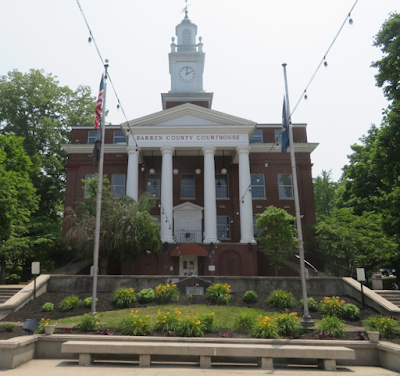
Wrong again!  This is the Barren County Courthouse in Glasgow Kentucky.  It looks old from a distance…but it isn’t!  This is the sixth Barren County Courthouse and it was completed in 1965.  The fifth courthouse was considered unsafe and it was torn town.  The cost for this handsome new structure was $470,000…over $4,500,000 in 2023 dollars.

Officially recognized as a town in 1809, Glasgow had operated as a residential and commercial community since Barren County was formed 10 years earlier.  Settlers chose to establish the town on the site of a spring, commonly called “The Big Spring”, which is still located adjacent to the downtown square.

The old First National Bank at 143 West Main Street, was built ca. 1869...or in 1876.  Different sources give different dates.  In any case, it is a fair representation of the late nineteenth century buildings on the square in Glasgow.  It still retains its original Victorian Italianate features…with pressed tin, corbels, a bracketed cornice and molded hoods.  The building didn’t start out as a bank but it became the First National Bank in 1892.  If you look closely, you can see the bank’s name up at the middle peak in the front.

The best news for this ornate survivor is that it is occupied as it approaches its sesquicentennial…its 150th anniversary!  The Fine Arts Bistro features a coffee shop and a full service restaurant that serves breakfast and lunch.  A little earlier in its ‘non-banking life’, this old building served as a photo studio.  To learn more about the Fine Arts Bistro and to see its menu, just go to https://www.facebook.com/fineartsbistro/.  It has a 4.5 out of 5.0 rating on TripAdvisor.


In the early days of generally unregulated banking in the USA, banks could print and offer their own currency.  This $20 bill was issued by the First National Bank of Glasgow.


I really like the look of the Emmanuel Morris building on Glasgow’s town square.  It is the most significant nineteenth century commercial building in town…and the most intact.  It was built as a dry goods store ca. 1875 and it retains its original rare iron front and posts.

This handsome decorative Romanesque building looks great on the outside but apparently it needs major repairs somewhere.  At the moment, it’s for sale.  It has 6,900 square feet of space with 2 store fronts available.  The asking price is only $109,000 and it’s been on the market since early February.  To learn more about this real estate opportunity, just go to 100 S Public Square, Glasgow, KY 42141 - Special Purpose Property for Sale - 100 S Public Square (crexi.com).

Note: Barren County, like most of south-central Kentucky, was settled by Scottish and Irish immigrants.  That heritage is evident given the name of the county seat.  Named after Glasgow Scotland, the town stages an annual festival, the Glasgow Highland Games.  To learn more re: this celebration, go to https://en.wikipedia.org/wiki/Glasgow_Highland_Games.

Actually, downtown Glasgow Kentucky features a 20 building historic commercial district, listed in the National Register of Historic Places.  They are centered on Courthouse Square.  This particular building…currently unoccupied…was the Third National Bank Building and it was built in 1903.  This Victorian Italianate style structure, with its second-story turret above the entrance, was most recently home to a children’s clothing store.

Notes:

·       Barren County was named for the “Barrens”, the meadowlands that cover the northern third of the county…barrens even though the soil is fertile.

·        Seventy percent of the original settlers in the county came from Virginia and 80% of them were English, Scottish, Welsh or Irish.

·       With Barren County having been formed before Christmas in 1798 and with no fires wiping out the county’s records, the County Clerk has marriage records from 1799 and land records from 1798. 

That’s about it for this edition about our road trip from East Tennessee to St. Louis Missouri.  Just click on any of the photos to enlarge them.

Thanks for stopping by for a visit!

Take Care, Big Daddy Dave