Friday, September 20, 2013

First and Last Meals in Alberta!

Like everything else, when I plan a trip for us, I check out possible restaurants in the areas we’re visiting.  I look for a variety of dining experiences…diners on up to upscale restaurants and everything in between. 

I like to use Trip Advisor for my research…and I look for restaurants where the ratio of Excellent/Very Good reviews to Poor/Terrible is no worse than 10 positive to 1 negative. (www.tripadvisor.com) Of course I also read a few reviews to learn what negative issues were encountered and when.  If service was a problem in 2012 but it’s been all upbeat in 2013, the problem was probably fixed.

This is Earl’s Restaurant on McLeod Trail SE in Calgary Alberta Canada…one of several locations in that city.  As it turned out, this Earl’s location wasn’t well rated and according to Trip Advisor’s latest reviews, it still has service problems.  However, it was close to our hotel and we were tired…se we gave it a try.
Earl’s has roughly 64 restaurants in Alberta, British Columbia, Saskatchewan, Manitoba, Ontario and the Yukon in Canada, plus Washington and Colorado in the USA.  It’s all about casual but comfortable dining.

This isn’t a great photo…but Earl’s does provide a nice atmosphere for socializing and dining.  The restaurant was quite busy.  Given the number of negative reviews I’d seen on line for this location we were a little apprehensive.
We received a friendly greeting at the front door and we were promptly seated… So far, so good!

This was our order of garlic bread. ($4.25) I'd eaten one piece but it was still overpriced…even for Canada…and it was just ok.

We started out with Earl’s Clam Chowder. ($7.00) It was made with cream, baby clams, bacon and some garden vegetables.  While it wasn’t the best chowder we’ve ever had, it was very good and we both liked it!
Our waitress was Karly… She was very helpful, personable and attentive. Both Laurie and I noted that almost everyone working in this restaurant was attractive, whether they were male or female.
 

I have to admit that I took this blurry photo all by myself… This was my entrée.  It is the Cajun Blackened Chicken. ($21.00) The chicken was seasoned with Earl’s blackening spices and garlic butter.  This entrée is normally served with warm potato salad and coleslaw, but I’m not a potato salad fan so I asked our waitress if I could substitute with garlic mashed potatoes.  As you can see, it was no problem.
Yes, I know!  $21.00 for a chicken dinner is a bit steep!  We had to wrap our minds around the higher prices for just about everything Canada.  My meal was good if not great…about what I expected.
Laurie ordered a personal pizza for her entree… There will be more about that later in this blog.  This was the first of two Earl’s that we visited while exploring Alberta…

Yes…this is another Earl’s Restaurant.  This one is also located in Calgary…this time near the airport.  Yes…we ate dinner at Earl’s on our first day in Alberta and on our last day as well! 
This Earl’s location met my 10:1 Trip Advisor criteria with 39 Excellent or Very Good reviews vs. only 4 Terrible or Poor. 

Patio dining was an option but we generally prefer sitting indoors away from flies, heat and any nearby traffic.  It was a bit early but the patio was already busy when we arrived…

For our second trip to an Earl’s dining establishment…our last day on this trip…we each had a beer and a Caesar Salad to start out. ($6.75 for the beer and a starter salad for $6.50) The Caesar salad was very nice…quite satisfactory indeed.  It consisted of romaine lettuce, fresh grated Grana Padano parmesan, brioche croutons and Earl’s signature Caesar dressing.

This is WHY WE RETURNED TO EARL’S FOR OUR SECOND TIME!  Laurie had ordered this pizza for her entrée in the first Earl’s we’d eaten at.  It was so good that we wanted to come back and experience this fabulous pizza creation again before heading home to East Tennessee.
This is Earl’s Italia Pizza. ($15.00…and we each ordered one!) This pizza is described as a hand tossed thin crust pizza with “Virginia ham, salami and chorizo, provolone cheese, parmesan, fresh basil and San Marzano tomato sauce.  The ingredients were top notch, the tomato sauce was just right, the spices were perfect and the crust was thin, crispy and it held up when picked up.
Laurie thinks that this is the BEST PIZZA she’s ever had and while I’m not willing to go that far, I will say that it easily ranks among the Top 5 pizzas that I’ve ever eaten.  Given my age and waistline, that equals a lot of pizzas!

This young lady was another major factor in the enjoyment of our last dining experience in Alberta.  Her name is Alex.  She played basketball for the University of Calgary.  She had to be one of the most popular team members among the other players.  Alex has a terrific personality!  Friendly, efficient and smart…she will go far in life…
Earl’s Restaurants worked out well for us.  The wait staff was helpful and efficient, the food ranged from OK to Excellent and the restaurant’s themselves were clean and well kept.  Should you find yourself in Canada…especially western Canada…or in Colorado or Washington states, check them out for yourself.  Be sure and try the Pizza!  Website: http://www.earls.ca/.
Just click on any of the photos in order to enlarge them...
Thanks for stopping by for a visit...and another restaurant review!
Take Care, Big Daddy Dave

Wednesday, September 18, 2013

Heritage Park – Calgary Alberta, Canada (#2)

Continuing with our tour of Calgary Alberta’s Heritage Park Historic Village, this is Part 2 of 4 in total.  In addition, there will be multiple blogs about the automobile/transportation museum which is located right at the entrance to the park.  There was so much to see and do at this major historical tourist attraction!


This is a partial view of the 1880s Pre-railway Settlement at the park.  The Canadian Mountie Post is to the left and Drew’s Saloon is to the right.  Note the gentlemen in period dress sitting outside the tavern. 
Henry "Boston" Drew was a well-educated ex-U.S. army officer who first came to Canada in 1884 on a cattle drive from Idaho.  He decided to settle in Alberta, and built a saloon, called the Drew Reserve, on his property at Spitzee Crossing in 1886. (This is now the town of High River)
The saloon wasn’t licensed at first but that didn't deter patrons from stopping by for a drink.  In 1891, Drew added four second-story guest rooms to his saloon, turning it into an inn for weary travelers who needed a drink and some rest.  Drew later changed the name of his stopping-house to the High River Hotel.  It passed through several hands over the next 100 years before the Town of High River gave the building to the Heritage Park as a gift in 1977.

This is the former Berry Creek North West Mounted Police Barracks or, as they call it ‘encampment’.  It was built in 1905 about 90 miles east of Calgary.  There was a serious problem with horse rustling…and many thought that some of the thefts had been the work of Montana’s Hole-in-the-Wall gang.
Heavily armed bands of outlaws used to sweep up from the coulees of the Missouri River to make periodic raids upon lonely Alberta ranches.  Then they would drive the stolen livestock back across the border. The Mounted Police of the Berry Creek detachment made regular patrols of the surrounding countryside to prevent these thefts.  In just a few years, horse and cattle rustling in the region was greatly reduced and the Berry Creek detachment was disbanded in 1915.

Laurie and I like the animals as much as anything… In addition to trolley and steam train rides, free horse drawn wagon tours are available to visitors in the park. 

Laurie and I really liked the fact that all of the work vehicles we saw in the park…as well as their park employees…were in character.  There were trucks and wagons in use that had been built new but which looked old.  It really helped to keep you focused on the time periods that the park strives to project.

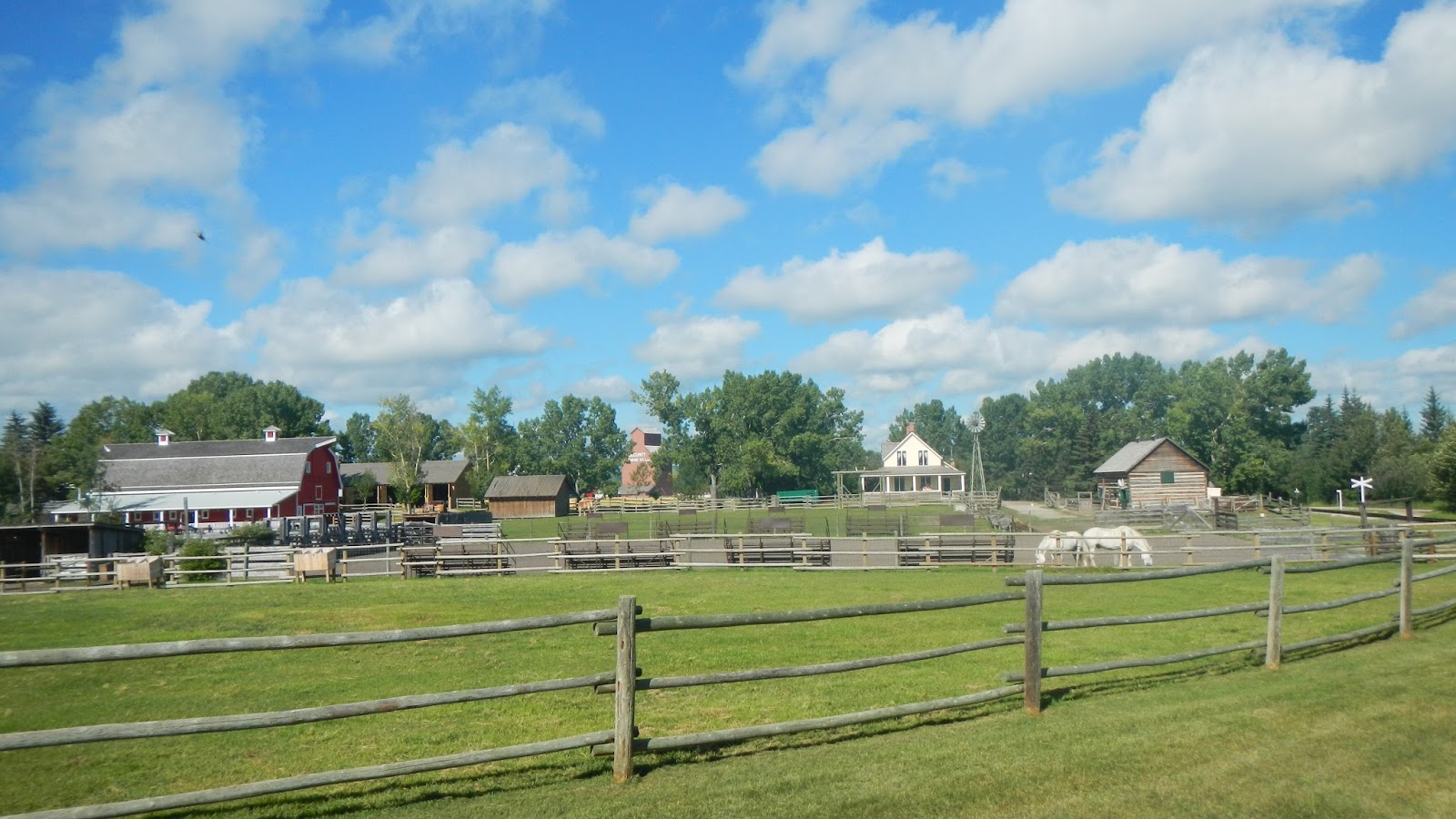
This bucolic scene shows a late 1800s, early 1900s ranch/agricultural scene in central Alberta.  It looks so natural that you might think that Laurie had photographed it along the road during our travels…

This is the Burnside Ranch House.  It was built in 1904 by Ewan Donald MacKay.  He established his ranch or mixed use farm in 1887.  ‘Ranches’ in this part of Alberta tended to be relatively small family operated ventures that planted grain and raised livestock.  Among his other operations, MacKay raised and sold registered Clydesdale horses. 
This house, which was located near Cochrane Alberta, was known for its lively parties during the early part of the 20th century.  When naming his ranch, Mackay resorted to his Scottish roots.  ‘Burnside’ in Gallic means ‘beside the creek.’  Subsequent owners donated the home to Heritage Park in 1964.

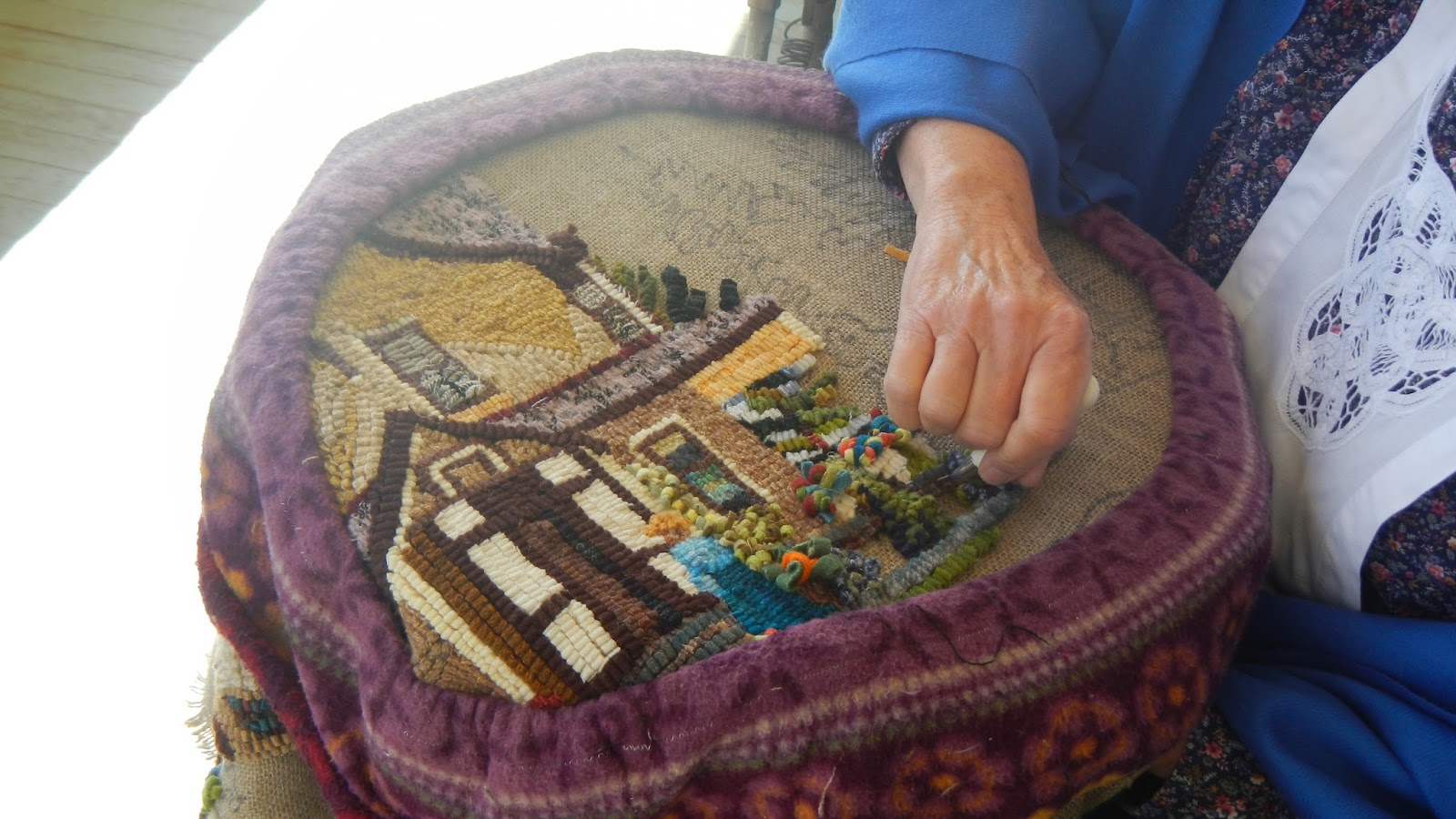
A lady acting as a living history character was on the porch of the Burnside ranch house hooking a chair cover.  Throughout the park, employees either played a part in the life of whatever time period they were representing, or they served as docents explaining the exhibits.
Hooked rugs represent a fond memory for me as both my grandmother and my mother both hooked classic rugs at one point in their lives.  We have 2 very nice hooked rugs from my grandmother that are at least 70 years old and one from my mother that is between 62 and 65 years old.

This docent or re-enactor was hard at work in the kitchen of the Burnside house…baking bread and rolls.

This is a ‘Soddy’ or sod shack.    It’s estimated that between 1900 and 1910, over one million sod houses were in use on the Prairies of North America.  Upon their arrival on the Prairies, many settlers discovered that there weren’t enough large trees in the area for them to build a log cabin.
They turned to the only building material abundant on the prairie, sod. Heritage Park drew on the expertise of many people in erecting its own sod shack in 1971.  An elderly carpenter who had grown up in a sod house in Saskatchewan was instrumental in this reconstruction.  His memories of the many finer points of building with sod, such as attaching factory cotton to the walls using small saplings, helped build the most authentic sod house possible.  I can't imagine living with dirt floors and a roof that gets soggy and drips whenever a hard rain takes place!

This is just one of the many working draft horses on display and/or in use at Heritage Park.  Did I mention that my editor/wife loves horses!  This is a Belgian Draft Horse.

This barn was built in 1927 for the P. Burns and Company Bow Valley Ranch in Calgary.  Its owner, Patrick Burns, was one of the celebrated ‘Big Four’ who first invested in American Guy Weadick's Calgary Stampede in 1912.  Over the years, Burns bought thousands of acres of rangeland throughout Western Canada.  P. Burns Ranches Ltd. of Calgary donated the barn to Heritage Park in 1977.  The Burns' Barn currently serves as the home for the Talisman Heritage Education Centre and it’s also used for the Park's summer camps and educational programs.  It truly is a gorgeous barn!
If you aren’t aware of it, the Calgary Stampede is an annual rodeo, exhibition and festival held every July in Calgary.  The ten-day event, which bills itself as "The Greatest Outdoor Show on Earth", attracts one million + visitors each year.  Activities include one of the world's largest rodeos, a parade, a midway, stage shows, concerts, agricultural competitions, chuckwagon racing and First Nations/Native North American exhibitions.  For more information on The Stampede, go to http://en.wikipedia.org/wiki/Calgary_Stampede.

Here are a couple more of Laurie’s friends…  The one on the right did like the attention…but the one on the left…not so much!

Yes indeed!  What would an historical park be without some representation of riverboat transportation…so critical in those early days.  This is the S.S. Moyie.  In those areas of British Columbia and Alberta that could not easily be reached by road or rail, steamships served as the primary form of transportation.  They could move large quantities of freight and/or passengers.  With their shallow draft and paddles that could function in a few inches of water, paddle wheelers could travel in shallow rivers and access settlements that didn’t have docks.  
The original S.S. Moyie, built in 1898, was intended to ferry miners to the Klondike gold rush.  Instead, the Canadian Pacific Railway put her to use on Kootenay Lake to ferry passengers from its rail terminal at Kootenay Landing to Nelson, B.C.   She was named Moyie after a prosperous mining community in the region.  That town got its name from the French word for wet, mouillé.
The S.S. Moyie was North America's oldest sternwheeler that was still in service when she was retired in 1957.  The original ship is still on display in Kaslo, British Columbia, Canada.  Check her out at http://klhs.bc.ca/.  In 1965, Heritage Park commissioned the building of a half-size replica of the S.S. Moyie, which uses a diesel engine.

The cruise was not one of the high points of our visit to Heritage Park Historical Village.  But…it was a welcome break for our feet following about a third of our stroll through the Park!  The S.S. Moyie cruises the shores of the ‘smallish’ Glenmore Reservoir.  At one point, the ship turns around to head back to its dock and, as it turns, there is a good view of downtown Calgary. 

This postcard gives you a better view of the city of Calgary.  With a population of roughly 1,250,000, Calgary is the largest city in Alberta.  As you can see, a river passes through the city.   Widespread flooding throughout southern Alberta, including on the Calgary’s Bow and Elbow rivers, forced the evacuation of over 75,000 city residents on June 21, 2013.  The floods were barely mentioned on US News broadcasts.  Large areas of the city, including downtown, were left without power.  The Calgary Stampede was to open on July 5 and their show grounds and stadium were underwater.  Adopting the phrase, “Come hell or high water”, the city, the organizers and volunteers made it happen!  The 2013 stampede did go on as planned. 
To learn more about Calgary Alberta, you can go to http://www.visitcalgary.com/ or http://en.wikipedia.org/wiki/Calgary.
 Just click on any of the photos to enlarge them…
Thanks for stopping by to take a look at Part 2 of our blogs about Calgary’s terrific Heritage Park!
Take Care, Big Daddy Dave

Monday, September 16, 2013

Nice Lunch – Houston Intercontinental!

Anyone who’s ever flown much has experienced the many ‘food as fuel only’ restaurants and fast food operations that serve many and probably most of our domestic airports.  On our trip to Calgary Alberta and the Canadian Rockies, we flew from Knoxville to Houston, and then after a lengthy layover, it was on to Calgary…

Our flight was fairly early leaving Knoxville so we had breakfast at Ruby Tuesday's in McGee Tyson Airport.  It was OK…fuel for the trip and a morning wake up.  When we finally arrived at Houston’s Intercontinental, officially the George, (H. W.), Bush Intercontinental, it was time for lunch. 
 

We checked our options on one of the big airport services directories and maps…and we decided to skip the cutesy diner that would normally draw me in and instead, we opted for Cat Cora’s Kitchen.  I had no clue who Cat Cora was but Laurie knew about her and it sounded like an upscale luncheon opportunity. 
For the uninitiated, myself included, Catherine Ann "Cat" Cora is an American professional chef best known for her featured role as an "Iron Chef" on the Food Network television show Iron Chef America and as co-host of Around the World in 80 Plates on Bravo.  FYI…I don’t watch cooking shows, I watch eating shows!
 

This is an interior photo of Cat Cora’s Kitchen in the airport.  For an airport restaurant, it’s a pleasant and friendly atmosphere.  We were promptly greeted and our server was very pleasant and informative. 
As per Houston’s George Bush Intercontinental Airport’s website, Cat Cora's Kitchen in Terminal 'E' provides "healthy, fresh choices including a variety of cocktails, tapas and unique entrees like flank steak tacos, lobster mac and cheese, chimichurri chicken sandwich and burgers with special toppings."  This restaurant is open from breakfast through dinner, 7 days a week. 

FYI…This is a photo of Cat Cora ‘borrowed’ from Wikipedia.  She was born in Mississippi but her father was from Greece and both her father and grandfather were in the restaurant business.  For more on Cat Cora and her rise to fame and fortune, you can go to http://en.wikipedia.org/wiki/Cat_Cora.
 

A couple of days ago, I sent an email to Cat Cora’s 'Q and A' email address on her website.  I was looking for an emailed copy of the Houston menu as it isn’t posted on-line.  I haven’t had a response yet, so I’ll just have to describe our lunches from memory using our photos.
I had this terrific cheeseburger…top quality ground beef cooked perfectly to medium rare and served on an excellent grilled bun.  The burger was accompanied by an equally excellent spicy fresh tomato soup! ($15.00) 
 

Laurie went for the chicken sandwich on a grilled French roll with what we believe was chimichurri sauce.  This very nice/very flavorful sandwich was topped with fresh tomato and cucumber slices and a little red onion.  Did I mention that the spicy tomato soup was excellent?! ($14.00)
While lunch at Cat Cora’s Kitchen wasn’t inexpensive, it was worth the money just for the upscale luncheon opportunity…in an airport!  Thankfully, more and more of our larger airports have added restaurants that really do make traveling a bit nicer.  Any of you that flew in the 50’s, 60’s and even into the early 70’s will remember that most of the larger airports used to have at least one fancy upscale restaurant.  I don’t miss the fancy part…but I do welcome back a bit of quality dining!
In addition to Houston, Cat Cora now has dining facilities at both the Salt Lake City and the San Francisco’s International Airports.  The website only shows a menu for San Francisco and it’s much different than the one in Houston.  She also has restaurants at Disneyworld and in Costa Mesa California.  For more information, go to http://www.catcora.com/.
Just click on any of the photos to enlarge them…
Thanks for stopping by for a visit!
Take Care, Big Daddy Dave

Friday, September 13, 2013

Heritage Park – Calgary Alberta, Canada (#1)

This is the first of a series of blogs about our summer trip to Alberta Canada. We flew into Calgary and stayed there for a couple of nights.  Then we moved on to Banff, Lake Louise, Jasper and Edmonton before returning to Calgary for our flight home…

When I planned this trip, I researched each area that we were planning to visit, looking for attractions and sights that we would find interesting and beautiful.  The one that really drew my attention in Calgary was the Heritage Park Historical Village in Calgary… It seemed to have a lot of things to see that we both like…

Heritage Park Historical Village is located on 127 acres of parkland on the banks of the Glenmore Reservoir, along the Calgary’s southwestern edge.  As Canada's largest living history museum by number of exhibits, it is one of the city's most visited tourist attractions.  The park is referred to as a living history museum because it features 4 distinct ‘villages’ or areas reflecting different time periods in Western Canadian history.  These time periods are circa 1864, 1880, 1910 and a town from the 1930s to 1950s. 
Many of the buildings in the park are historical and were transported to the park to be placed on display.  Others are re-creations of actual buildings. Most of the structures are furnished and decorated with genuine artifacts.  Park employees dress in historic costume, and antique automobiles and horse-drawn vehicles service the site.  A steam locomotive and trolley’s provide transportation and an old time experience for park visitors…

We arrived early on a Friday morning in early August.  The crowds were starting to stream in already… We’re not big on crowds but as it turned out, this park is so spread out and there is so much to see that crowds or long lines were never an issue. 

This is a scaled down recreation of a Hudson's Bay Company Fur Trading Fort or post.  This fort was built by Heritage Park in 1965 to illustrate the important role played by the Hudson's Bay Company.  At one time, the company had established posts from Alaska, British Columbia and Oregon to the eastern part of Canada in Labrador.  Hudson Bay Company was key in the economic, social and resource development of Canada.
Heritage Park originally designed this structure as a replica of the second fur trading fort built in Rocky Mountain House, Alberta, in 1835.  The forts were each staffed by approximately 30 laborers, interpreters, clerks, apprentice clerks and traders.  They were managed by one chief trader or chief factor.  This particular fort was used as a backdrop for a film celebrating the Hudson’s Bay Company's tricentennial. (Hudson Bay Company, now a giant retailer known as ‘The Bay’, recently purchased Saks Fifth Avenue in the USA)
For more on the history of the Hudson Bay Company, just click on the following: http://en.wikipedia.org/wiki/Hudson's_Bay_Company.  Did you know that this company is the longest continually operating commercial venture in North America!

The interior of the fort contains several buildings with period furnishings or replicas thereof.  It was clear that the focus was on trading and activities related to trading.  There were people in period costumes and there was a small garden plot.  As with everything else at Heritage Park, the displays and buildings were pristine and clean…and the staff was all friendly and helpful. 

European demand for furs brought trading companies to Canada as early as 1670.  The Hudson Bay Company was a British partnership…and it was the first trading company to enter the market and the last to cease the fur trading business.  Posts were spread from coast-to-coast.  They were staffed by poorly paid young men from Eastern Canada and Great Britain. 
The whole business focused on the exchange of furs for manufactured goods.  The furs came from trappers and Indians alike.  As explained to us by the young man in the trading post, beaver skins were the standard… Everything else was measured against the value of beaver skins.  While the HBC traded in almost all pelts, it might take 3 wolf pelts to equal one beaver skin.  In the mid-1800s, it might have taken 12 - 14 beaver pelts to buy a rifle.

We loved the stonework on these fireplaces.  As usual for Canadian Historic Parks, everything is well done, clean and well thought out… 
The Heritage Park in Calgary is the 3rd Canadian Living Park that we’ve visited.  The other two were the Barkerville Historic Town in north central British Columbia, (http://www.barkerville.ca/), and Fortress Louisbourg in Nova Scotia. (http://www.pc.gc.ca/eng/lhn-nhs/ns/louisbourg/index.aspx) Be sure and visit them both!  We’ve been to Fortress Louisbourg twice!


There were several windows in the fort and nearby cabins that were covered with tanned hides as shown above. (For some reason, I couldn't turn this photo right side up...) These 'hide windows' keep out the elements and let in a little light too.  Since glass was unavailable for the most part, this was an alternative…

This collection of tipis is a representative Aboriginal/Plains Indian encampment.  Appropriately enough, it’s placed next to the Hudson's Bay Company Fort.  Historically, the encampment represents a gathering place for diverse groups of people including First Nations, Métis (mixed blood aboriginals), explorers, settlers and traders, as well as others who travelled through Western Canada.
Heritage Park's native encampment was re-created within the historical context of neighboring exhibits, such as the Fort, Livingston House, Our Lady of Peace Mission and the North West Mounted Police Berry Creek detachment, in order to allow visitors to see how these different cultures would have interacted. (We didn’t try to take photos of every building or display…)

The 3 canvas tipis that are on display are furnished with artifacts that represent the lifestyle of the Plains First Nations during the last half of the 19th century.  This encampment represents a special place for Aboriginal people, their home, their way of life and their economy.  Native interpreters were on hand to demonstrate traditional activities, tools and other artifacts and share stories from their culture.

Three aboriginal tribe members…all ladies…were present when we visited.  As shown above, they demonstrated the process of erecting a tipi.  The largest numbers of Indians or aboriginal people living in Alberta are from Blackfoot, Cree and Metis groups.
For more information on these 3 native/aboriginal groups, you can click on any of the following: http://en.wikipedia.org/wiki/Blackfoot_Confederacy;  http://en.wikipedia.org/wiki/Cree;     http://en.wikipedia.org/wiki/M%C3%A9tis_people_(Canada).    

This upscale 2-story log ‘cabin’ is the ‘Livingston House’.  Samuel Henry Harkwood (Sam) Livingston was born in Ireland in 1831.  He immigrated to America at the age of 16.  Following an unsuccessful venture in the Californian gold rush of 1849, he moved to Canada.  He spent 20 years moving around western Canada as a prospector, trapper, trader, freight hauler and buffalo hunter.
In 1865, he married the Metis daughter of a fur trade officer.  He claimed a homestead in the area in 1876 and this home was built shortly thereafter…

This photo shows one corner inside the Livingston House.  It was a very impressive structure for its day!  Laurie and I love these old stoves.  Many of them were so ornate that they are works of art.  We also noted that many of them were manufactured in Chicago…
Sam and his wife Jane raised 14 children!  Sam died in 1897 shortly after the birth of the 14th child.  He was 66 years old… Sam farmed in Alberta when farming was a dirty word.  It was all about cattle ranching in those days.  He persevered and became known for impressive yields of grain, huge vegetables and excellent beef.  He also became a champion of settler’s rights and a key promoter of agriculture in southern Alberta.

One last photo… We like animals and this very laid back mule offered to pose for Laurie’s camera.  Many more animal photos will follow from the Heritage Park!
This is the first of a series of blogs that stemmed from our day at Calgary’s Heritage Park Historic Village.  There was so much to see and do!  As an additional plus…there is also a terrific auto/transportation museum right at the entrance to the park. 
That’s it for now… Just click on any photo to enlarge it.
Thanks for touring the Heritage Park with us!
Take Care, Big Daddy Dave


Wednesday, September 11, 2013

Boathouse Grill at Put-in-Bay Ohio

During our visit to South Bass Island/Put-in-Bay Ohio, the family did have to grab a bite to eat… Our first choice was off limits to anyone under the age of 21 so our grandsons couldn’t eat there.  So we searched until we found an acceptable alternative…


The Boathouse Grill was big and busy but they had lots of indoor and outdoor seating available.  We hadn’t researched this restaurant but we took a chance as we needed to eat soon.  Otherwise, we weren’t going to make it to our ferry to the mainland at its scheduled departure time…
As I mentioned in my previous blog, golf cart parking is a premium.  David and Amy jammed their golf cart into the curb right next to the telephone pole as shown above.  I drove around for a bit before I could find another spot…

We opted for patio dining… This allowed us to watch the entertainment walking by on the main drag.  There were lots of tourists like us, drunken day trippers, some true characters, crazies, studs and bikinis…

This carousel is directly across the street from where we sat at the Boathouse Grill.  This is Kimberly’s Carousel…a 1917 Herschel model and one of the very few truly old carousels or merry-go-rounds in operation in the country.

We started out with a bunch of appetizers… This was the Creamy Crab Asiago Dip with Pita Chips. ($9.95) It was pretty darn good, especially after I added a bit of Tabasco to my chips!

Did I mention that David II and I seem to fall into a sort of a father / son eating challenge whenever we get together?  We ordered more appetizers…this time the Combo Platter. ($13.95) This included onion rings, jalapeno poppers, cheese sticks and pickle spears with a red sauce for dipping.  A second order of cheese sticks rounded out the appetizers… Emmett Lee loves cheese sticks!  Everything was good if not great…

Emmett kept his dinner simple with a cheeseburger and applesauce…

Laurie is a lobster fanatic!  She couldn’t resist the Lake Erie Seafood Roll. ($14.95) Why it’s called a Lake Erie Seafood Roll is a bit of a question mark… It didn’t contain walleye or perch, but rather shrimp and lobster.  She couldn’t identify much lobster in the sandwich but she said that it was OK.

Then there was my dinner entrée… Have you ever heard about having too much of a good thing?  This was the perfect example of that saying!  This is the “Brig Lawrence” aka “The Barge”. ($14.95) This bun-less 10 oz. burger was grilled, coated with beer batter and deep fried.  Then it was topped with deep fried bacon, chili, cheese, diced tomato and roasted garlic sour cream.  Yikes!  This was not a good idea…but at least I can now say that I’ve had battered and deep fried bacon as well as a hamburger.  About all I could taste was the fried batter…

This was the “Brig Caledonia” aka “The Whaler”. It comes either as a single 10 oz. burger or a double… ($11.95 or $17.95) This was a single patty with cheddar cheese, bacon, onion straws, lettuce and tomato, smothered in BBQ sauce.

David III ordered what I should have had… This is the basic 10 oz. burger with American cheese.  It’s called the “Brig Niagara” aka the “Lyman”. ($9.95) We liked the fact that they toast the buns at the Boathouse Grill.
In case you’re wondering about the names given to most of the burger creations… they’re named after the ships and boats that comprised Admiral Perry’s fleet at the Battle of Put-in-Bay during the War of 1812.

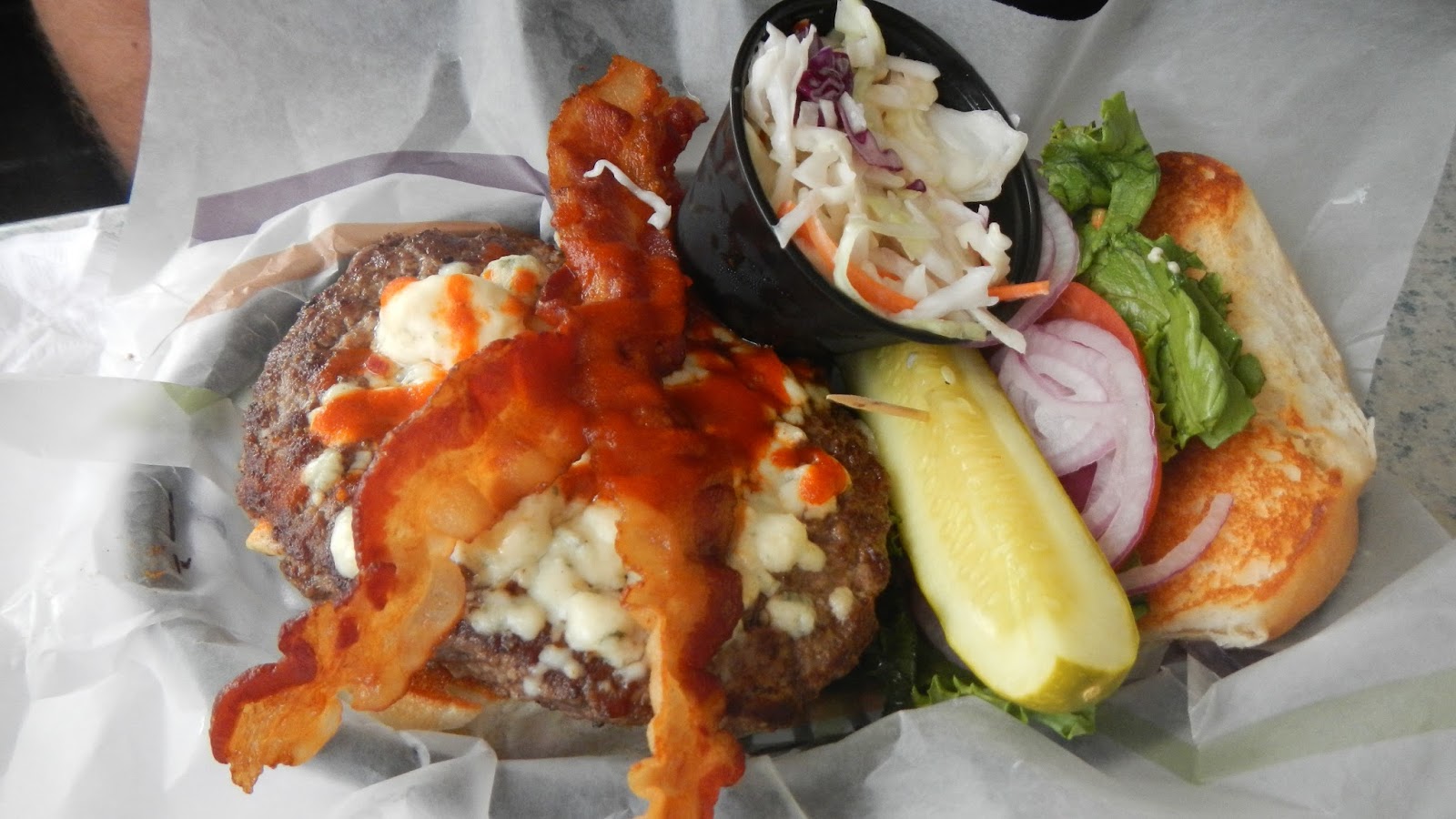
This is a special burger that was recently added to the menu.  It’s the “Bicentennial Burger”. ($12.95) FYI…the Battle of Put-in-Bay was fought 200 years ago this year.  This burger is topped with blue cheese crumbles, bacon and siracha sauce.
The Boathouse Grill offers more than just Burgers.  Other dining options include dinner salads, wraps, a number of sandwiches including walleye and perch plus a number of dinner baskets. Service was good and the food was OK if not great.  It filled our needs.  The restaurant is located on Delaware Avenue in Put-in-Bay on South Bass Island in Ohio.  Phone: 419-285-5665.  The website for Boathouse Grill is http://www.theboathousebarandgrill.com/index.html.
Just click on any of the photos to enlarge them…
Thanks for stopping by for a meal with us on South Bass Island!
Take Care, Big Daddy Dave