Friday, November 10, 2023

DeSoto National Wildlife Refuge and Museum

During our family visits to Omaha, we’ve continued to explore the state of Nebraska as well as the Omaha metropolitan area itself.  The De Soto National Wildlife Refuge and its museum was one more attraction on our Omaha area’s ‘to visit list’.  So the family headed a little north of Omaha and then across the Missouri River into Iowa.


The large building that is so nicely blended into the trees is the Refuge Office and Museum for the DeSoto National Wildlife Museum.  Parts of this 8,365 acre wildlife refuge lie in both Iowa and Nebraska but the largest portion, including this structure, is located in Iowa.  The refuge is centered on DeSoto Lake, an oxbow lake that was once a bend in the Missouri River.

This refuge includes bottomland forests, tall grass prairie and wetland habitats that mimic the natural Missouri River floodplain.  One of, if not the primary purpose, for the DeSoto National Wildlife Refuge’s existence is that it serves as a critical flyway stopover for migrating birds that pass through here each spring and fall. 

This handsome sculpture of an eagle near the entrance to the Refuge office and museum was created by Richard Hart in 2003.  It was paid for by visitors to the Refuge as well through donations.

Exhibits related to the wildlife found at the DeSoto National Wildlife Refuge are found near the entrance to the Refuge’s office.  There are a number of taxidermy examples that provide visitors with close-up looks at various species.  The combination of habitats in the refuge is utilized by more than 100 species of birds… Of course, we visited in mid-summer so other than a few water birds and local feathered residents, birdwatching was minimalized.  The Refuge is also home to rabbits, mink, muskrat, beaver, otters, white-tailed deer, bobcat, coyotes and many other mammals.
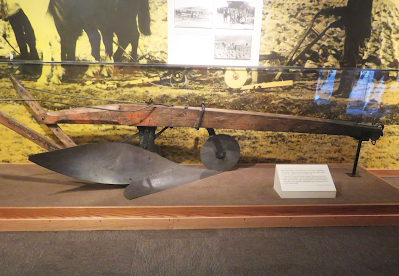
As we moved past the taxidermy birds and other animals, we noted this steel plow.  Once upon a time, the USA’s tallgrass prairie land covered about 170,000,000 acres or 40% of the country.  Somewhere from 1 to 4% remain. 

The soil in the tallgrass prairie was rich in nutrients and steel plows enabled European American settlers to break up the rich sod and plant crops.  The layers were so deep that it required a special ‘breaking plow’ to plow a furrow the first time.  Those plows were attached to a cart that was pulled by a yoke of 4 – 6 oxen.

Next, we came to the part of the museum that isn’t related to wildlife…but rather man’s movement to the western USA in the 1800s.   The ship model is of the ‘Bertrand’, a stern-wheel steamboat.  It was built in Wheeling West Virginia in 1864.  The ship was 161 feet long and had a beam/width of 32 feet.  She was a shallow draft vessel, probably requiring than about 3 feet of water to navigate. 

The Bertrand was one of many vessels involved in the regional river trading system that existed from the mid to late 1800s.  Beginning in 1859, steamboats had been traveling up the Missouri River as far as Fort Benton in the Montana Territory, which is only about 40 miles from Great Falls.  When gold was found at the Alder Gulch claim in 1863, many wishful prospectors headed to the area from around the country.  This migration created one of our most previously prosperous frontier towns, Virginia City Montana.  A year after the discovery, 35,000 people lived within 10 miles of the original claim.

On April 1, 1865, the Bertrand’s short career was ended when she struck a snag and sank on her way up the Missouri River toward Fort Benton Montana.  She sank in 10 minutes in about 12 feet of water and no one lost their lives but almost the entire cargo was lost.  This happened just 25 miles north of Omaha.  The equivalent loss in today’s dollars was ca. $1,900,000.

Using historical documents and a flux gate magnetometer, 2 modern treasure hunters located the wreck of the Bertrand in early 1968.  As the wreck was found on Federal property, the treasure hunters relinquished all of the recovered artifacts to the U.S. Fish and Wildlife Service for permanent preservation.  More than 500,000 artifacts were recovered during the excavation.

The items shown in the photo above are “carboys”, lead containers used to transport mercury.  The treasure hunters had hoped to find the rumored 500 of these containers on the wreck, but only 9 were ever found.  The mercury in 500 of these containers would have been very valuable. 

FYI – When mercury and gold meet, they settle and combine to form an amalgam.  Then the gold is extracted by vaporizing the mercury…a highly toxic procedure but common in the gold rush days.


This photo shows a variety of items on exhibit in the Bertrand portion of the museum.  On the shelves behind the bottles are wash tubs, lard tins, and champagne.  The bottles contain a variety of food items.  The vessel’s cargo included 216 pints of honey plus strawberries, pepper sauce, bourbon, brandy, vegetables, peaches, etc. 

Early ‘canned goods’ were stored in sealed glass containers.  Sanitary air-tight cans weren’t introduced until 1904.  Samples of canned food from the Bertrand, including brandied peaches, oysters, plum tomatoes, honey and mixed vegetables were tested in 1974.  Appearance, smell and the vitamin content has deteriorated, but the food was determined to still be safe to eat.  No thank you!
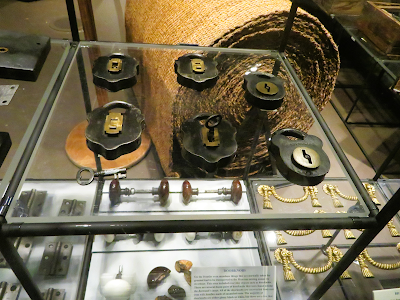
What follows is a series of photos showing a fraction of the cargo that has been recovered from the Bertrand and preserved.  In the photo above, there are doorknobs, brass drawer pulls, padlocks and hinges…with that big roll of hemp in the background.

This is a solid wood box full of axe heads.  Interesting irony…the crate is labeled with the warning, “Must be kept Dry”.  Other key items for the miners included blasting powder, pickaxes and bunches of shovels.  I believe that the same disclaimer probably applied to similar boxes...that contained soap.

As the sign on this display states, cowbells would have been valuable in the Montana Territory, especially during the gold rush.  It was a chance to get rich without mining!  Dairy cows were really valued by the mining camps for their milk, cream and butter. 


It boggles my mind that textiles survived in their containers under the mud and water for over 100 years before they were ‘recovered’.  Here we have a selection of hats and socks…along with surviving fabric and a tie.  Over 3,000 textile and items of clothing were recovered.  They included gloves, trousers and 137 men’s coats in a number of different styles.

Did you notice the ice skates and wooden buckets in the first photo above?
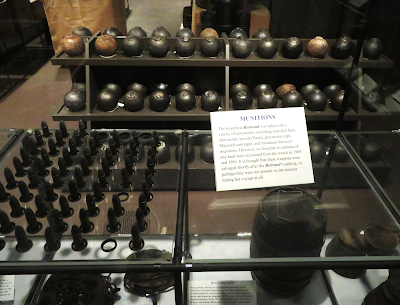
Being the ‘wild west’ in 1865, and right after the Civil War, the Bertrand was also fully loaded with munitions although no firearms or cannons were recovered in 1968 – 1969.  It is thought that either there weren’t any on the vessel when it went down or that they were salvaged immediately after the ship was wrecked.  In any case, the recovered munitions include lead shot bars, shot molds, powder flasks, percussion caps and even mountain howitzer shells.

Just in case you were wondering…all of the goods on the Bertrand were fully insured. 


Although the ‘star’ of our visit was the contents of the Bertrand, the purpose of the refuge is its wildlife.  While we didn’t seen many water birds, there were plenty of songbirds and we did spots lots of turtles.  I noted that related species at the DeSoto National Wildlife Refuge include: smooth soft shelled; spiny soft shelled; painted; Blanding’s; ornate box, and; snapping turtles.

To learn more about the DeSoto National Wildlife Refuge and its museum, go to DeSoto National Wildlife Refuge | U.S. Fish & Wildlife Service (fws.gov).  Admission: $3.00 per vehicle or via a National Park Pass!  It’s quite a deal given how much most attractions cost in this day and age…

To learn about an even earlier steamboat wreck on the Missouri River (1856), the story of its discovery in 1988 and the preservation of associated items, you can just journey to Kansas City and visit the museum for the steamboat Arabia.  See A Historic Kansas City Attraction | The Arabia Steamboat Museum (1856.com).

Just click on any of the photos to enlarge them…

Thanks for stopping by for a visit!

Take Care, Big Daddy Dave

Tuesday, November 7, 2023

Another Year Older!

We usually visit the family in Omaha around the Memorial Day holiday but this year, we decided to make the trip around my birthday in July.  At my stage and age, birthdays can be as ‘memorable’ as the birthdays we celebrate with children who are 5 or younger.

Part of the celebration involved our exploration of Harold Warp’s Pioneer Village in Minden Nebraska.  Then of course, as is our practice when the family gets together, there are more dining experiences.  With my birthday in mind, the primary food focus was on places of interest or food that I really enjoy. 


For breakfast, the family took us to Vidlak’s Brookside Cafe…a large ‘diner style’ operation that is only open for breakfast/brunch/lunch until 1:45 PM daily.  We’d eaten at Vidlak’s before and our breakfasts had been very satisfying.  Breakfast is my favorite meal to eat out.


I’m not going to describe everyone’s meal… Suffice it to say, our group had eggs, scrambled plain or with vegetables, or poached with bĂ©arnaise sauce.  Hash brown potatoes were popular as was sausage and bacon.  Toast, an English muffin and a bagel rounded out the entrees.  The plate of biscuits and sausage gravy was shared.

Everyone was content with their food…with the hash brown potatoes being consistently crispy as we like them.  The only ‘downer’ was the sausage gravy.  It lacked any real sausage flavor or 'kick', but the biscuits were fine.


This was my breakfast…2 over-easy eggs with a nice order of hash brown potatoes and a country-fried steak smothered in the sausage gravy.  I added a ‘kick’ to the sausage gravy with a sprinkling of Tabasco sauce.  I also had rye toast…not pictured. 

The menu at Vidlak’s is oversized for sure.  It features 8 pan omelets, 8 types of pancakes plus potato pancakes, French toast, a breakfast burrito, 6 ‘scrambles’, 6 breakfast casseroles, 2 breakfast sandwiches, 4 different eggs benedict options and 9 ‘old fashioned’ favorites.  And then again there are the lunch/brunch/early dinner offerings.

Vidlak’s Brookside CafĂ© is located at 15668 West Center Road in Omaha Nebraska.  Phone: 402-330-0914.  Website: Vidlak's Cafe in Omaha, Nebraska (vidlaksbrooksidecafe.com).

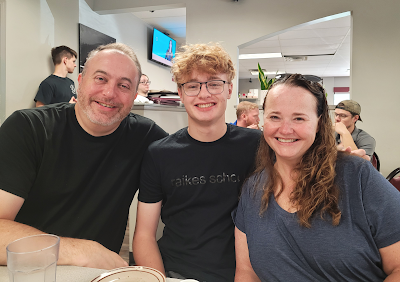
Either Laurie or I took this photo of our happy crew before we had breakfast.  From the left, David II, Emmett (our youngest grandson) and Amy.  David III was off somewhere else…

Another activity during our visit was a trip to the movie theater.  Pictured above are David III, Amy, Emmett and David II.  The movie was the latest/7th of the ‘Mission Impossible’ series starring Tom Cruise.  This one was titled “Mission Impossible – Dead Reckoning Part One”.  The follow on…Part Two…won’t be released until 2025. 

I am notoriously difficult to buy presents for and David II works hard to figure out something new and different as a present or presents that he can give to his old dad.  I do have most of what I want or can use…at least most of what I want that doesn’t involve hundreds or thousands of dollars.

In one of my blog posts I’d mention that we’d visited the lair of author James Oliver Curwood on one of our trips…this time it was to Michigan.  I’d also commented that I’d have to buy a couple of Curwood’s books.  Well, as you can see by the pile in my lap, I now have a plethora of Curwood’s books. They should keep me busy for quite a while!  

My age is a secret…or it was until my lovely wife took this photo of yours truly with my birthday pie.  FYI, it was a banana cream pie, an all-time favorite of mine!  Luckily for y’all, I didn’t record the family’s rendition of “Happy Birthday”!

Just click on any of the photos to enlarge them…

Thanks for stopping by as we continue to wander through our life together, documenting it was we go.

Take Care, Big Daddy Dave

Friday, November 3, 2023

Dinner Out in Omaha Nebraska

Back in July, Laurie and I drove to Omaha Nebraska via the backroads of Missouri.  The goal was share my birthday with the family and to spend some time with our son, David II, our daughter-in-law Amy, and our two grandsons, David III and Emmett Lee.

Yes, I do know that it's almost November and I'm still writing about happenings in July...

…so, after our exploration of Harold Warp’s Pioneer Village in Minden Nebraska, Laurie, David II, Amy and myself went out for something to eat.  The ‘boys’, in their early 20s, had other plans for the evening.  Plenty of time for the grandson’s later as you will see…


This is the Pitch Restaurant in the western part of Omaha Nebraska.  There are 2 Omaha locations as well as 2 more in Scottsdale Arizona.  Both the exterior façade and the interior dĂ©cor lend themselves to the currently over-popular “Industrial chic” style.  Note the open grill area where one could see the food being prepared if one was so inclined.

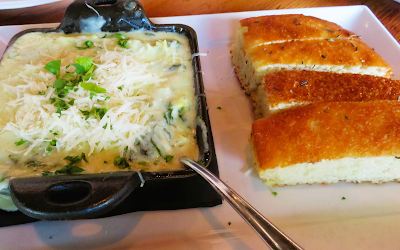
We started out with the Pitch version of Artichoke Dip…artichokes with a Romano and Parmesan cheese dip…served with the house focaccia bread. ($15.00) It was excellent.

I’m not sure who ordered a bowl of the Soup of the Day, but it was top notch as proven by the fact that it was half gone before I thought to take a picture. ($5 cup/$7 bowl)

As I recall, Amy ordered the Crab Cake Salad. ($22.00) In addition to a couple of nice looking crab cakes, it included spinach, red cabbage, cherry tomato, farro, avocado dressing and a ‘Pitch sauce’ drizzle.

This order of Crispy Calamari with zucchini strips and pepperoncini and arrabbiata sauce was very nice…a change up in preparation and seasoning as compared to the ‘usual’ fried calamari. ($18.00)

Since I can’t find this entrĂ©e/item on the current on-line Pitch menu, I’ll have to assume that it was a special when we were there.  It looks like a chicken sausage with spinach and cavatelli noodles with a garlic butter sauce and parmesan cheese…and it looks great!

We ended up with a nice basket of French fries on the table too. ($7.00)  I don’t know how it got ordered or by who.  I tested a couple of them and they were good…but I had my own carbs to deal with. 

Since this was my ‘birthday week’, I went all out for my entrĂ©e!  This was my Gold Canyon Angus Beef Short Rib Dinner. ($35.00) The short ribs were boneless and slow braised and they were accompanied with creamy polenta, braised carrot and sweet potatoes all with veal jus.  This dish is normally accompanied with Brussel sprouts…but since I can’t eat them, the kitchen substituted the sweet potatoes.  This was an excellent dinner!

The Pitch location in west Omaha is located at 17808 Burke Street.  Phone: 402-289-4096.  Service was good and the food was better!  Website: Food — Pitch (pitchpizzeria.com).

Just click on any of the photos to enlarge them…

Thanks for stopping by for a visit!

Take Care, Big Daddy Dave

Tuesday, October 31, 2023

A Blast from the Past (Final): Harold Warp’s Pioneer Village

…and finally, my last post about our tour/exploration of Harold Warp’s Pioneer Village in Minden Nebraska.  I’ll end this series of posts with the very late lunch/early dinner we had on the way back to Omaha.

There were a few items and collections that I’d missed or skipped over before…and I’ll mention other exhibits and collections that we just didn’t take photos of.

This is a 1934 Harley-Davidson Model VLD.  With the onset of the Great Depression, sales of motorcycles were hard to come by.  In an effort to cut costs and increase sales, Harley eliminated chrome trim, substituting black paint.  This model had its shift lever mounted on the gas tank.  A total of 4,527 Model VLD’s were built, selling for $310 each.  A 1934 H/D VLD sold this year through Hemming’s Auctions for $21,000.

We didn’t tour the second floor of the building where motorcycles, bicycles and more are on display but I’ve seen photos of both…and the floor is jam-packed with goodies.

This beautiful red 1905 Buick Model C is the oldest Buick in existence!  It is equipped with a 2-cylinder motor that produces 22 HP.  Its frame is made of wood and it was built in Jackson Michigan (my hometown).  The price tag for the Model C back in the day was $1,200. (About $42,000 in today’s dollars)


This is an illustration showing the huge Buick manufacturing plant in Jackson Michigan that I borrowed from the Internet.  Buick built automobiles in Jackson from 1905 until 1912 when it focused all its operations in Flint Michigan.  Jackson was the home of 25 different car manufacturers from 1901 until 1954.  Buick is the only brand name to have survived over the years.  As a youngster, I knew that some auto manufacturing was happening in Jackson, but most of it was related to parts and accessories.

…but, once again, I digress...

Back to the exhibits at Pioneer Village.  This is a 1914 2-passenger Saxon.  It cost $395, the equivalent to $11,696 in 2022, and it was billed as “A Good Low Priced Car”.  This particular version includes a couple of options…electric lights and an electric starter.  A total of 7,000 of these cars were built in the first year of production. 

In 1914, a Saxon roadster was driven 135 miles a day for 30 days straight.  Total miles covered was 4,050 and it averaged 30 miles per gallon.  It was among the first cars that ‘christened’ the then new transcontinental Lincoln Highway…primarily US Hwy 30 today.

The Saxon Motor Car Company was located in Detroit Michigan and it was in operation from 1914 to 1922 when it over expanded and got into serious financial difficulties.  In 1917, Saxon built 28,000 cars, making it the seventh largest car maker in the USA.

This is a 1909 E-M-F 30.  Note the lap robe on the seat for warmth...  This 2-seat coupe was built in Walkerville Ontario although the company had plants in the USA as well.  The E-M-F Company produced cars from 1909 to 1912.  The name E-M-F came from the initials of the 3 founders of the company.  The E was for Barney Everitt, an auto-body maker.  The M was for William Metzger, who had been with Cadillac.  Finally, the F was for Walter Flanders, who had worked for Henry Ford as his production manager.  The company was folded into the Studebaker Company which shortly afterwards, stopped using the EMF brand name.

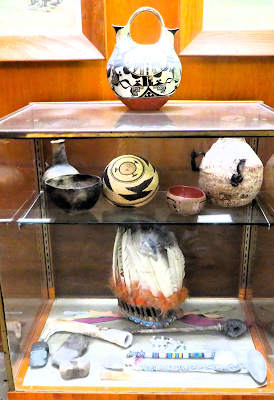
Exhibits at Pioneer Village pertaining to Native American culture are limited as the focus of the museum is the growth and progress of the country from 1830 into the early 1960s.  Much of the 'progress' and innovations noted came at the expense of Native Americans.  Nevertheless, I did note this showcase of Native American artifacts in the main building at Pioneer Village.  Included are pottery items, tools, beads, a ceremonial headdress and what appears to be 2 ceremonial tomahawks.  That item at the front of the case is a hide scraper.
The Algonquian people created the tomahawk.  The word Tomahawk is derived from Powhatan ‘tamahaac’.  Originally, Native Americans would use sharpened stones secured to wooden handles using strips of rawhide.  The tomahawk quickly spread from the Algonquian culture to the tribes of the South and Great Plains.


As I’ve emphasized several times, there is little that Harold Warp and his Pioneer Village didn’t collect that is representative of European American life, growth and expansion beginning in 1830. 

The “Cigar Store Indian” in the first photo once stood in front of a Chicago Cigar factory.  It was wheeled out to the sidewalk every day from 1875 until 1902.  It was found in a Chicago basement 50 years later.  These ubiquitous carved wooded sculptures actually became popular with the demise of ship’s figureheads.  American tobacconists started buying the figureheads…especially American Indians…to advertise their shops.  At one time, there were over 75,000 “Cigar Store Indian” sculptures across the USA.  They lost their popularity in the early 1900s.

The cast metal Native American (unfortunately covered by signs) was cast in the true likeness of an Indian chief in Wisconsin.  A lumber executive made friends with the chief and had the cast made ca. 1850 to keep peace with the tribe.  The goal of course was to cut as much timber from the tribe’s hunting grounds as possible.  The figure is wearing a capote.  A capote is a wool blanket fashioned into a sort of coat to provide a means of dealing with harsh winters and they served as winter outerwear for First Nations.

This is the last automobile, I promise!  It’s a 1915 Moon touring car with a “double cowl Delaumay-Belleville” body design.  This style, it was claimed, “is usually associated with higher priced European models”.  It even had Spanish leather upholstery!  Three models were available ranging in price from $1,395 to $1,750 for the 6-66 combination touring and club roaster.

The Moon Motor Car Company, founded in St. Louis Missouri in 1905, had a venerable reputation among the discriminating auto buying public.  One early model…a true luxury car…sold for $3,000 or about $94,500 in todays dollars.  The company came to be known for fully assembled, easily affordable cars using high-quality parts.  They were expensive to build with the intensive hands-on attention to detail.  The company built both cars and trucks, almost 60,000 vehicles in total.  The company went out of business in 1930.  It is said that Moon autos were exported to 47 different countries.

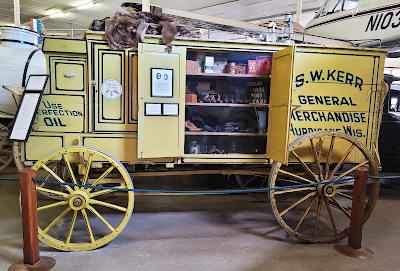
This Peddler’s Wagon was recovered from a shed in Wisconsin where it had been stored for about 70 years.  Two mature trees had to be cut down to remove it after all those years.  Peddler’s wagons were very common between 1840 and about 1880 as they sold, bought and traded products with settlers across the mid-west and plains states. 

S.W. Kerr’s daughter learned that Harold Warp had recovered the wagon and that it would be on display at Pioneer Village.  She was very happy to learn that her dad’s wagon had found a home and would be there for all to see.  Her family was from Hurricane Wisconsin…named after a local mine.  Back around 1900 the town had a cheese factory, sawmill, blacksmith, grist mill, post office and the S.W. Kerr General Store.

Mr. Kerr would use a 3 horse hitch on the wagon and he’d roam the countryside selling and trading.  He’d sell or trade groceries, kerosene, dry goods, clothing/shoes, hardware and more.  He’d obtain eggs, animal hides, wild rabbits, crates of chickens and other farm products in exchange for the offerings on the wagon.

Note: Laurie ran across this video on Facebook of a horse powered threshing machine at a 'threshers' gathering from earlier this year.  Very interesting to see just how it was done before engines were used... Check it out at: https://www.facebook.com/reel/324172843619987.  You'll need to copy and paste this in your search bar.

OK…The last building we explored was the Hobby House.  It is the only building where Mr. Warp didn’t try to display collectibles in chronological order.  As I’ve stated many times, Harold Warp collected just about everything.

How about the ‘button collection’!  There are wooden alphabet letters hanging on the wall with each letter covered with 200 to 300 buttons.  There also is a miniature rocking chair, wheelbarrow, wind mill, water well, a star and a covered wagon…all made with wood and covered with bunches of buttons.  My favorite was the ‘button dress’.

So what other Pioneer Village items didn’t I feature?  How about outboard motors, dolls, tools, patches, snowmobiles, several more aircraft, parking meters, gas pumps, seeding and planting farm equipment and one of my favorites, a very large collection of horseshoes.

Any other weird and wonderful exhibits?  Well, yes there are!  The Hobby House has this huge collection of pens as well as salt shakers, ashtrays, pencils, liquor decanters, mechanical banks, nightcaps and spittoons. 

Other items that we didn’t feature in our tour include Currier and Ives prints, the William Henry Jackson paintings, the carousel animals, radio and TV vacuum tubes, fishing trophy mounts and fishing equipment, porcelain figures, famous American figurines…and more!

The Television Show, “American Pickers” visited Pioneer Village and bought a few surplus items earlier this year…and it was featured on one of their shows.  The Pioneer Village is now operated as a 501(c)(3) Foundation and is able to receive tax-deductible donations.  The goal is to restore and improve Pioneer Village.  State grants have helped and surplus/duplicate items have been auctioned off to raise money so the Village can move forward.  Other auctions are planned and hopefully, they will provide needed funds.

To view a short but interesting video that provides an overview of the Village’s collections, just go to https://www.bing.com/videos/riverview/relatedvideo?q=Pioneer+Village+-+art+collection&mid=E0D55AEDE0D7C8CDA408E0D55AEDE0D7C8CDA408&FORM=VIRE.  It provides a nice overview of the Village’s plethora of objects on display…

My family and I highly recommend a visit to Harold Warp’s Pioneer Village.  If you are a collector, a car buff, a farmer, into history or just like to tour museums, you will enjoy your visit.  Admission is amazingly low at $15.00 per person…especially given their huge and impressive historical collection of Americana.  Website: Home - Pioneer Village - Minden, NE.

…moving on down the road toward Omaha, we decided to stop for a late lunch in Hastings Nebraska.

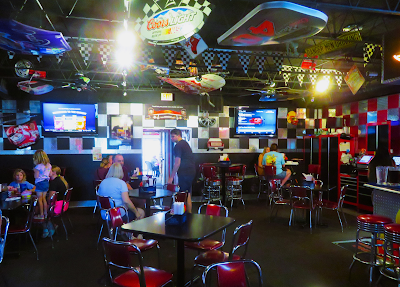
This is Kitty’s Roadhouse Bar and Grill on US Hwy 6 in Hastings.  A grill or restaurant has been located on this spot since 1958.  In 1958 it was named “Kitty’s” and when the new owners took over in 1972, they decided to stay with the familiar name…and they just added “Roadhouse” to it.


The bar and dining area is over the top colorful and eye-catching.  The racing theme dominates.  I thought that the gas pump draft beer feature was something different, or at least I’d never seen it anywhere else. 

Kitty’s Roadhouse offers sandwiches, broasted chicken, pizzas, salads and steaks.  A couple of appetizers caught my attention.  They were “Shrimp Jammers”, 7 jumbo shrimp stuffed with Monterrey Jack cheese and served with Sweet Thai Chili. ($12.99), and; the “Junk Yard Combo Platter” (Full order $17.99/Half order $12.99).  The combo platter included deep fried mushrooms, cauliflower, corn fritters, onion rings, mini tacos and French fries.

However, since it was too early for a dinner with appetizers, salads, steaks and/or chicken, we all decided to have cheeseburgers with fries.  At Kitty’s, you design your own burger combo.  In keeping with the racing/auto theme, burgers are listed as an F-150, F-250 and F-350…with 1 through 3 beef patties. 

In this case, it was double 1/3 lb. burger patties (F-250) on a grilled bun with pickles and onion. ($9.99) Add tomato and lettuce ($.49), cheese ($.69) and French fries ($3.99) and this burger platter cost $15.16.  The burgers and fries were both above average and we were ready to hit the road back to Omaha with full stomachs… To see more about Kitty’s Roadhouse in Hastings Nebraska, just go to Kitty's Roadhouse|Hastings,NE|Wood-Fired Pizza| Broaster Chicken (kittysroadhouse.net).

Just click on any of the photos to enlarge them…

Thanks for stopping by for a visit!  Happy Halloween

Take Care, Big Daddy Dave